

Adverse possession attorney: Secure Your 2025 Claim
Understanding Your Rights When Property Boundaries Blur
An adverse possession attorney steers complex disputes when someone occupies land they don’t legally own for an extended period. This area of law, often called “squatter’s rights,” can result in a court transferring ownership from the titleholder to the occupier. An attorney can help claimants prove their case or assist landowners in defending their title against such claims.
An adverse possession attorney can help with:
- For claimants: Proving all legal requirements (e.g., 10+ years of open, hostile, continuous, exclusive possession) have been met.
- For landowners: Defending a property title against claims of long-term use.
- Evidence gathering: Collecting surveys, photos, tax records, and witness testimony.
- Court representation: Filing quiet title actions and navigating state-specific laws.
- Preventive advice: Taking steps to stop adverse possession claims before they mature.
Legal requirements vary significantly by state. For example, California requires five years of possession plus payment of property taxes, while Georgia requires 20 years (or seven with written evidence of ownership). These cases are highly fact-specific, and the burden of proof is on the claimant. Landowners who ignore encroachments risk losing portions of their property.
I’m Peter Cullotta, a trial lawyer with over 35 years of experience. While my practice focuses on personal injury, I have handled property disputes and understand how crucial an adverse possession attorney is when property rights are at stake. My experience with complex evidence rules and Illinois statutes is essential for these technical cases.
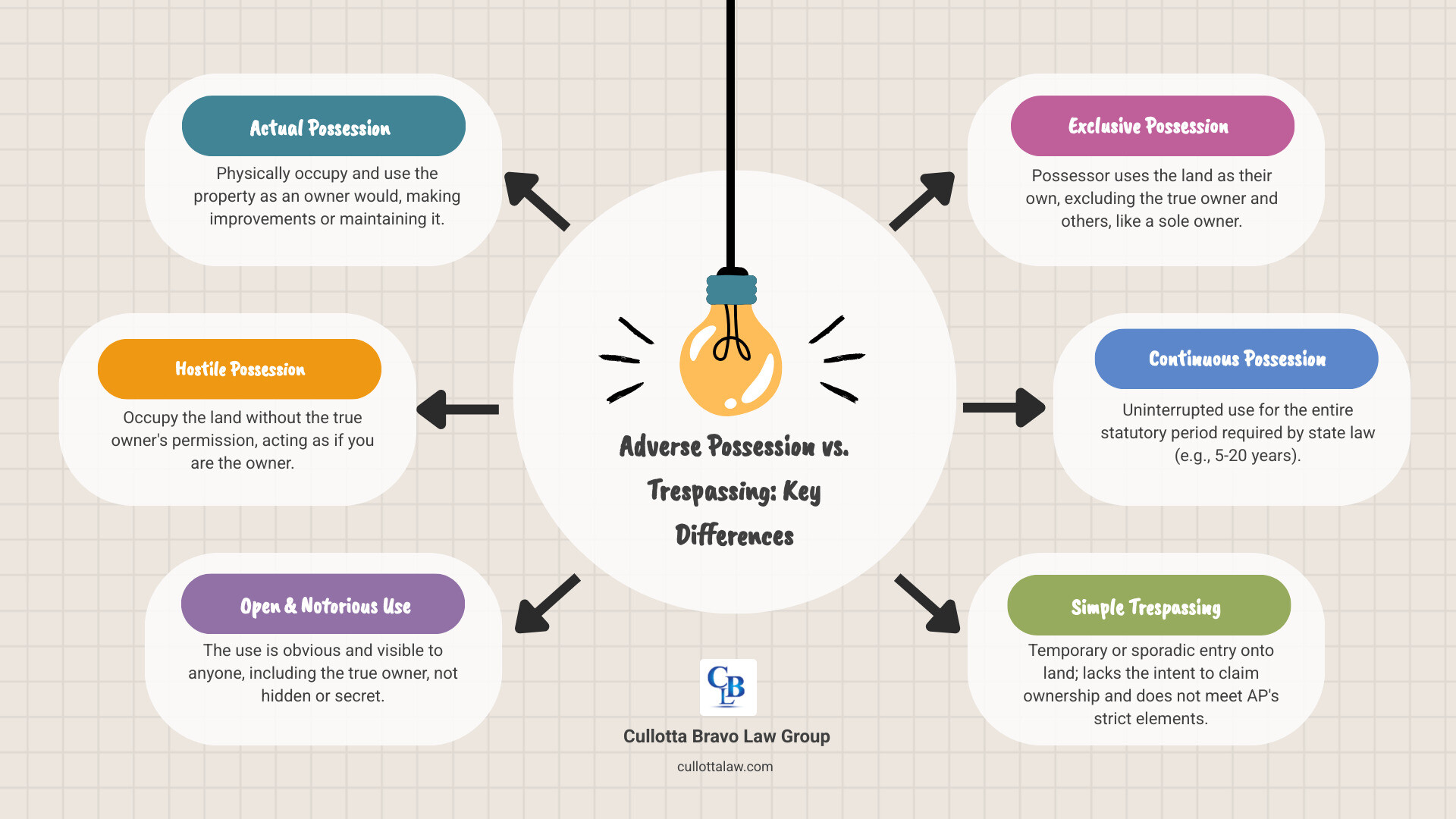
Understanding Adverse Possession: More Than Just “Squatter’s Rights”
Adverse possession is a property law doctrine that allows someone to gain legal ownership of land they don’t hold title to, but only under very specific and strict circumstances. It’s not about rewarding trespassers; it’s rooted in the principle that land should be used productively. If an owner neglects their property for years while someone else openly uses and maintains it, the law may eventually recognize the user’s claim. This is fundamentally different from trespassing or a landlord-tenant relationship, as adverse possession must occur without the owner’s permission.
Most disputes arise from boundary issues, not dramatic land grabs. A fence built a few feet over a property line, a driveway that encroaches on an adjacent lot, or a garden planted on a neighbor’s land are common scenarios. These situations often start innocently but can escalate into serious legal battles, especially when a property is sold.
What are the Core Elements of a Valid Claim?
Courts are skeptical of adverse possession claims, and the burden of proof falls entirely on the claimant. You must prove every one of the following five elements for the entire statutory period required by your state. Failure to prove even one element will cause the claim to fail.
- Actual possession: You must physically use the land as a typical owner would, such as by building structures, farming, or making improvements. The use must be tangible and peaceful.
- Hostile possession: This is a legal term meaning your possession is without the owner’s permission and conflicts with their ownership rights. If you have permission, your claim is invalid.
- Open and notorious use: Your possession must be visible and obvious, not hidden. A reasonably diligent owner should be able to notice your use of their land.
- Exclusive possession: You must possess the land to the exclusion of others, including the true owner. You are treating it as your private property, not sharing it.
- Continuous possession: You must possess the land without interruption for the entire statutory period (typically 10-20 years, depending on the state). Significant gaps can reset the clock.
Building a case that satisfies these strict requirements is challenging. An adverse possession attorney can help gather the necessary evidence to build a persuasive case or defend against a claim that fails to meet these standards.
Common Examples of Adverse Possession Disputes
Real-world adverse possession disputes often involve:
- Fence encroachments: A fence is mistakenly built on a neighbor’s property and remains for decades, with the enclosed land being maintained by the non-owner.
- Driveway disputes: A driveway is paved or used in a way that crosses onto an adjacent lot for the statutory period.
- Gardens and landscaping: A garden or landscaped area is maintained on what is later finded to be a neighbor’s property.
- Misplaced structures: A shed, garage, or home addition is built partially over a boundary line.
- Access paths: A path across a neighbor’s property is used and maintained for years to access another property, potentially leading to a claim.
- Unused vacant lots: A neighbor begins using an adjacent empty lot for parking, storage, or gardening, and the true owner never objects.
State Laws and Statutory Periods: A Complex Web
Adverse possession is not a uniform legal doctrine; each state has its own rules, timelines, and requirements. While the five core elements—actual, hostile, open, exclusive, and continuous possession—are consistent, the specific details that determine a claim’s success vary dramatically by location.
Some states add extra problems. California and Nevada, for example, require claimants to prove they paid property taxes on the disputed land. Other states recognize “color of title,” where a claimant has a flawed document (like an incorrect deed) that led them to believe they owned the property. In states like New York and Washington, having color of title can shorten the required possession time.
Here in Illinois, we focus on the specific requirements that apply to properties in Aurora, Chicago, Naperville, Joliet, and throughout the state. Understanding the nuances of Illinois law is critical to your case.
How Time Requirements Vary by State
The statutory period for possession ranges widely across the country:
- California: Five years, plus payment of all property taxes.
- Georgia: Twenty years, but reduced to seven if the claimant has written evidence of ownership.
- New York: Ten years of possession.
- Washington: Ten years, but can be reduced to seven with color of title and good faith reliance, as detailed in Washington state adverse possession law.
These variations underscore why hiring an attorney familiar with your state’s laws is essential.
The Role of an Adverse possession attorney in Proving Your Case
Whether claiming land or defending your title, an experienced attorney is vital. The burden of proof is high and requires extensive evidence.
An adverse possession attorney acts as an investigator and strategist, gathering evidence like:
- Current and historical property surveys
- Aerial photographs spanning decades
- Witness testimony from neighbors and former owners
- Tax records, old deeds, and other official documents
In Illinois, navigating procedural rules like the Dead Man’s Act, which can restrict testimony about conversations with a deceased person, is a technical challenge that requires an experienced trial lawyer.
After building a case, an attorney typically files a quiet title action—a lawsuit asking the court to declare the claimant the official owner. For landowners, the strategy shifts to disproving the claimant’s evidence, for example, by showing the use was permissive or not continuous. Given the complexity and high stakes, professional legal guidance is indispensable.
How to Protect Your Property from an Adverse Possession Claim
As a landowner in Illinois, you can take proactive steps to protect yourself from adverse possession claims. These claims develop over years, giving you opportunities to stop them before they become a legal problem. Vigilance is your best defense.
Proactive Steps for Landowners

To prevent disputes, be an engaged property owner:
- Know your boundaries: Get an up-to-date property survey to eliminate ambiguity about property lines.
- Monitor your property: Regularly walk your property lines, especially on vacant land, looking for new fences, structures, or signs of use.
- Challenge unauthorized use immediately: Time works against you. Send a written notice, preferably from an adverse possession attorney, telling the person to stop using your property. This interrupts the “hostile” and “continuous” elements of a claim.
- Grant permission in writing: If you don’t mind a neighbor’s minor use of your land, give them formal written permission. This destroys the “hostile” requirement, as the use is no longer without your consent.
- Post “No Trespassing” signs: Signs clarify that your land is private and use is not permitted, contributing to your defense.
- Carry title insurance: This insurance can cover legal defense costs and losses from possessory claims that existed when you bought the property.
The Importance of an Adverse possession attorney for Landowners
If you suspect an adverse possession claim is developing or has been filed, contact an adverse possession attorney immediately. Defending a claim involves systematically challenging the claimant’s evidence on all five required elements.
An attorney can help you:
- Prove permissive use: Evidence that you gave permission, even verbally, can defeat a claim.
- Interrupt the continuous period: A formal legal notice or other action to reassert your ownership can restart the statutory clock.
- Negotiate a settlement: Sometimes, selling the disputed land or creating a formal easement is more cost-effective than litigation.
Our goal is to protect your title. Whether defending against a claim or getting help with your real estate dispute before it escalates, we work to ensure your property rights are upheld.
The Crucial Role of Your Adverse Possession Attorney in Court
When adverse possession disputes go to court, the stakes are high. These cases involve complex evidence rules, detailed statutes, and often emotional conflicts between neighbors. Representing yourself is a significant risk. An adverse possession attorney who knows Illinois law is essential for navigating the litigation process.
Our firm’s experience in Illinois courts means we understand the procedural rules governing evidence and witness testimony. Critically, we know how to handle statutes like the Dead Man’s Act (735 ILCS 5/8-201), a rule that can make or break a case by preventing testimony about interactions with a deceased person. This is a common landmine in property disputes.
For the Claimant: Building a Winning Case
Asserting an adverse possession claim is an uphill battle, as courts are naturally skeptical. You must provide rock-solid evidence covering the entire statutory period.

An attorney helps by:
- Gathering historical evidence: This includes a painstaking review of deeds, surveys, aerial photos, tax records, and maintenance receipts.
- Proving intent: We help demonstrate through your actions that you treated the land as your own, excluding the titleholder.
- Satisfying all five legal elements: We build a bulletproof case to prove actual, hostile, open, exclusive, and continuous possession.
- Navigating procedural rules: We manage every aspect of the case in Illinois courts, from filing the complaint to trial. The Dead Man’s Act, for instance, can bar your testimony about an agreement with a deceased prior owner, making third-party evidence critical—a factor we are well-equipped to handle.
For the Landowner: Defending Your Title
If someone is trying to take your property, an adverse possession attorney will fight to protect your rights. Our first line of defense is to challenge the claimant’s case.
Key defensive strategies include:
- Challenging the evidence: We scrutinize their proof for inconsistencies, gaps in the timeline, or periods where their use was not continuous or exclusive.
- Proving permissive use: This is a powerful defense. Any evidence that you gave the claimant permission, even informally, destroys the “hostile” element of their claim.
- Interrupting the continuous period: We can show that you took action to assert your ownership (like sending a formal notice), which resets the clock on their claim.
- Using the Dead Man’s Act: This statute can work in your favor by blocking a claimant from testifying about alleged conversations with a deceased prior owner of your property, significantly weakening their case.
We work to defeat the claim and file our own actions to ensure your title is cleared and your property is restored to your exclusive use.
Frequently Asked Questions about Adverse Possession
We frequently encounter the same questions from clients about adverse possession. Here are answers to the most common ones.
Can you claim adverse possession against government property?
No. In Illinois, you generally cannot claim adverse possession against government-owned land. This includes property owned by federal, state, county, or municipal governments. Public land is held in trust for all citizens, and courts consistently uphold the government’s immunity from these claims. Exceptions are exceedingly rare and difficult to prove.
What is the difference between adverse possession and a prescriptive easement?
This is a critical distinction. Both involve long-term, unauthorized use of another’s property, but the outcomes are different.
- Adverse Possession = Ownership. A successful claim transfers the legal title of the land to you. You become the new owner.
- Prescriptive Easement = Use. A successful claim grants you a specific, limited right to use the land for a particular purpose (e.g., a right of way to cross a property), but the original owner retains title.
With adverse possession, you are trying to take ownership. With a prescriptive easement, you are only trying to secure a right of use.
How much does an adverse possession case cost?
The cost of an adverse possession case varies widely depending on its complexity, the amount of evidence required, and whether it goes to trial. It is not an inexpensive process. Key expenses typically include:
- Legal Fees: Most adverse possession attorneys charge hourly rates for the extensive work involved, which can include document review, witness interviews, and court appearances. Fees can range from thousands to tens of thousands of dollars.
- Court and Administrative Costs: These include filing fees and costs for serving legal documents.
- Expert Witness Expenses: Most cases require a professional surveyor. You may also need other experts, whose fees for preparation and testimony can be substantial.
Because of the potential expense, we always discuss costs and strategy with our clients upfront. Sometimes, a negotiated settlement is more financially prudent than prolonged litigation.
Secure Your Property Rights with Expert Legal Guidance

Property rights are a fundamental protection. Whether you are defending your title or believe you have earned rights to land through long-term use, the stakes are incredibly high. Adverse possession cases demand meticulous attention to detail, and missing a single legal element can cause a claim to fail.
At Cullotta Bravo Law Group, we bring over 35 years of litigation experience to these complex disputes. While our primary focus is personal injury, our extensive courtroom experience with evidence rules, witness testimony, and challenging Illinois statutes like the Dead Man’s Act is directly applicable to the demands of adverse possession cases. We know how to build a compelling case and steer the procedural complexities that can determine the outcome.
If you are facing a boundary dispute in Aurora, an encroachment in Naperville, a title defense in Chicago, or have a potential claim in Joliet, we can help. The statutory clock is always ticking, so don’t delay in protecting your rights.
Contact us today for a confidential consultation to review your case and discuss your legal options. Get help with your real estate dispute and let us put our experience to work for you.