

Aurora Workers Compensation: 3 Vital Steps
Why Understanding Aurora Workers Compensation Matters After a Workplace Injury
Aurora workers compensation is a no-fault insurance system in Illinois designed to protect employees who suffer work-related injuries or illnesses. If you’ve been hurt on the job in Aurora, knowing your rights and the immediate steps to take is critical.
Quick Action Guide for Work Injuries in Aurora:
- Report the injury to your supervisor immediately (written notice within 45 days).
- Seek medical treatment and tell the doctor it’s work-related.
- File your claim with the Illinois Workers’ Compensation Commission (within 3 years).
- Benefits available: 100% medical coverage, wage replacement (TTD/PPD), vocational rehab, and death benefits.
- You cannot be fired for filing a workers’ compensation claim.
In Illinois, nearly all employers must carry workers’ compensation insurance. This system provides medical care and lost wage benefits without requiring you to prove your employer was at fault. However, insurance companies often try to minimize payouts by denying claims over missed deadlines or disputes about the injury’s origin. My name is Peter Cullotta, founding partner at Cullotta Bravo Law Group. For over 35 years, I’ve helped injured workers in the Chicagoland area steer aurora workers compensation claims and secure the benefits they deserve against insurance company tactics.
First Steps After a Workplace Injury in Aurora
When you get hurt at work in Aurora, your actions in the first minutes and hours can significantly impact your aurora workers compensation claim. The Illinois workers’ compensation system has specific rules you must follow from the start.
What to Do Immediately After Getting Hurt
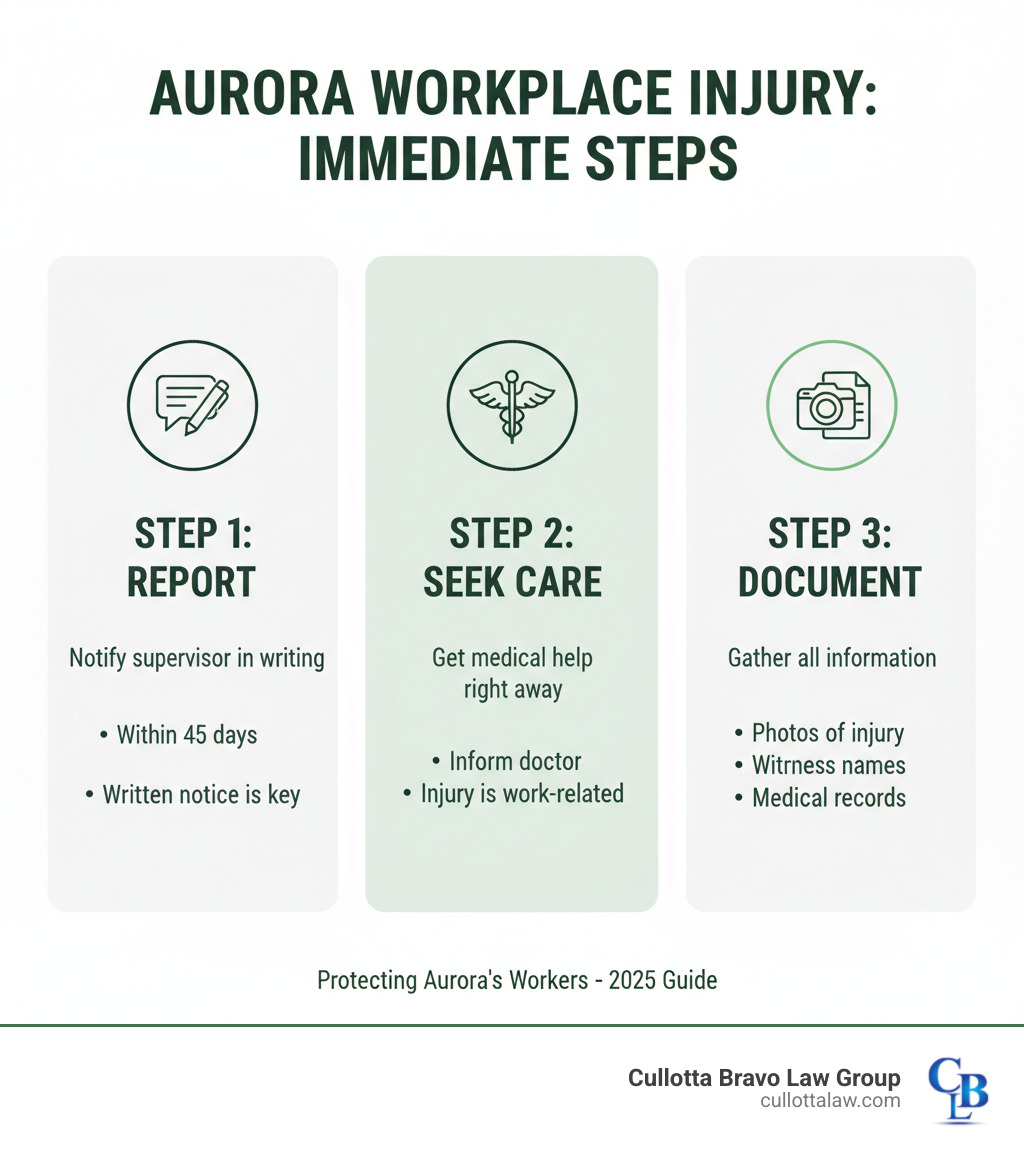
First, report the injury to your supervisor as soon as possible, even if it seems minor. While a verbal report is a good start, it’s not enough. You must provide written notice within 45 days to your employer. Keep a copy for your records. Missing this deadline gives the insurance company an easy reason to deny your claim.
Next, get medical care immediately. Your health is the priority. When you see a doctor, be sure to state that your injury happened at work. This creates the necessary link for your workers’ compensation claim. Follow all medical advice and attend all appointments. If your injury involved a vehicle while working, you may have both a workers’ comp and a personal injury claim. Our guide on Workers’ Compensation on the Job Vehicle Accidents explains this further.
Documentation is where many claims succeed or fail. Take photos of your injuries and the accident scene. Get names and contact information for any witnesses. Keep all medical records, bills, and correspondence with your employer or their insurer. It’s also wise to keep a journal detailing your daily pain levels and how the injury affects your life.
Common Workplace Injuries and Occupational Diseases

Workplace injuries can be sudden or develop over time. Both types can qualify for aurora workers compensation. Common injuries include:
- Musculoskeletal Injuries: Back, neck, shoulder, and knee injuries are common, especially in jobs requiring heavy lifting. A torn rotator cuff is a frequent and serious example. These and other Workers’ Compensation Orthopedic Injuries can require extensive recovery. Learn more in our article on Workers’ Compensation Torn Rotator Cuff Injuries.
- Repetitive Stress Injuries: Conditions like carpal tunnel syndrome and tendonitis develop from performing the same motions repeatedly. Insurers often dispute these claims, making good documentation essential.
- Slips, Trips, and Falls: These can happen in any work environment and lead to serious injuries like fractures, sprains, and concussions.
- Construction Accidents: Construction sites pose unique dangers, including falls, falling objects, and machinery accidents. We have extensive experience with Illinois Construction Accidents.
- Exposure to Toxins: Working with hazardous materials can lead to occupational diseases like respiratory conditions or cancer, which may not appear for years.
- Machinery and Vehicle Accidents: Operating heavy equipment can cause devastating injuries. Accidents in a motor vehicle while on the job are also covered by workers’ compensation.
No matter how your injury occurred, you deserve benefits. Don’t let an insurance company tell you otherwise.
Navigating the Aurora Workers Compensation Claims Process
After reporting your injury and seeking medical care, you must formally file your claim. Understanding the process, your eligibility, and the Illinois Workers’ Compensation Commission’s role is key.
Illinois’s aurora workers compensation system is no-fault, meaning you can receive benefits even if you were partially at fault, as long as the injury wasn’t intentional. You only need to prove you were injured while doing your job. Once you report an injury, your employer’s insurer will review the claim and either approve or deny it. You have three years from the date of the accident to file a formal claim with the Illinois Workers’ Compensation Commission, but it is always best to act quickly. Our guide on Filing for Workers’ Comp in Aurora, IL provides a detailed walkthrough.
Eligibility for Aurora Workers Compensation
To be eligible for benefits, you must meet specific requirements:
- You must be an employee. Nearly all Illinois employers must cover full-time, part-time, and seasonal workers. Independent contractors are typically not covered. However, some employers misclassify employees to avoid paying for insurance. If you believe you’ve been misclassified, you may still have options. Learn more in our article on Workers’ Compensation for Misclassified Workers.
- Your injury must have arisen out of and in the course of your employment. This means the injury happened while you were performing job-related duties.
- You must meet deadlines. You have 45 days to notify your employer and three years to file a formal claim with the IWCC. Missing these deadlines can jeopardize your case.
The Role of the Illinois Workers’ Compensation Commission (IWCC)
The Illinois Workers’ Compensation Commission (IWCC) is the state agency that oversees the workers’ compensation system, acting as a neutral administrator to ensure rules are followed.
When a claim is filed, the IWCC is the central hub. If your claim is denied or benefits are disputed, the IWCC provides a formal process for resolving disputes through mediation, arbitration, or a hearing before an arbitrator. Many claims are resolved through settlements, but any settlement must be approved by the IWCC to ensure it is fair.
If a case goes to a hearing, the arbitrator issues a decision based on the evidence. This decision can be appealed. The IWCC’s procedures are complex, and insurance companies have experienced lawyers. Having an attorney on your side levels the playing field. For more on legal protections, see Ask an Attorney: What Legal Protections Are Available for Work Injuries in Chicago?. We can guide you through every step of the IWCC process.
Understanding Your Entitled Benefits in Illinois
After a workplace injury, the Illinois workers’ compensation system provides several types of benefits to help you recover financially and physically. These are your legal rights as an injured worker.

Medical and Disability Benefits
Aurora workers compensation covers your medical care and helps replace lost wages.
- 100% Medical Coverage: Your employer’s insurance must pay for all necessary and reasonable medical care related to your work injury. This includes doctor visits, surgery, physical therapy, prescriptions, and even mileage reimbursement for medical appointments. While your employer may suggest doctors, you generally have the right to choose your own provider within certain guidelines.
- Wage Replacement (Disability Benefits): These weekly payments replace a portion of your lost income.
- Temporary Total Disability (TTD): If your doctor says you cannot work at all, you receive two-thirds of your average weekly wage until you can return to work or reach maximum medical improvement.
- Temporary Partial Disability (TPD): If you return to work in a limited capacity and earn less, TPD pays two-thirds of the wage difference.
- Permanent Partial Disability (PPD): If you have a permanent impairment after recovery, you receive compensation based on the body part injured and the level of impairment, according to state schedules.
- Permanent Total Disability (PTD): In severe cases where you cannot return to any gainful employment, you may receive weekly payments for life. Proving these cases requires strong evidence. Learn more about Permanent Total Disability.
- Vocational Rehabilitation: If you cannot return to your old job, you may qualify for job training or placement services.
- Death Benefits: If a work injury is fatal, surviving dependents can receive benefits for funeral expenses and ongoing financial support.
Third-Party Claims vs. Workers’ Compensation
While workers’ compensation is often your only recourse against your employer (the “exclusive remedy rule”), it may not be your only option for compensation.
If someone other than your employer or a co-worker caused your injury, you may have a separate third-party personal injury lawsuit in addition to your workers’ comp claim. Examples include:
- An injury caused by a defective piece of equipment (a product liability claim against the manufacturer).
- A car accident caused by another driver while you were working.
- An injury on a construction site caused by another contractor’s negligence.
A third-party claim is important because it allows you to seek damages not covered by workers’ comp, such as pain and suffering. At Cullotta Bravo Law Group, we investigate every case for potential third-party claims to ensure you receive full compensation from all responsible parties.
Common Challenges: Denials and Complex Claims
Dealing with a work injury is stressful, and a claim denial from an insurance company can make it worse. Insurers are businesses focused on their bottom line, which often means minimizing payouts. They may question your injury, delay benefits, or pressure you into a low settlement. Understanding their tactics is the first step in protecting your rights.
Common Reasons for Denying an Aurora Workers Compensation Claim
Insurance companies use a variety of reasons to deny aurora workers compensation claims. Be prepared for these common arguments:
- Missed Deadlines: Failing to report your injury within 45 days or file your claim within three years.
- Injury Not Work-Related: Arguing the injury happened outside the “course and scope” of your employment.
- Pre-existing Conditions: Blaming your symptoms on a prior injury or condition, even if the work accident aggravated it.
- Insufficient Medical Evidence: Claiming your medical records don’t clearly link the injury to your work.
- Employee Misconduct: Alleging you were violating safety rules or engaging in horseplay when the injury occurred.
- Commute-Related Injury: Injuries during a typical commute are generally not covered.
- Misclassification: Claiming you are an independent contractor, not an employee, and therefore ineligible. This can often be challenged, as detailed in our guide on Workers’ Compensation for Misclassified Workers.
A denial is not the final word. You have the right to appeal. For specific advice, see our guide on Partial Disability Claims in Illinois: How to Improve Your Chance of Success.
The Benefits of Hiring a Workers’ Compensation Lawyer
While the workers’ comp system is supposed to be simple, it rarely is. An experienced aurora workers compensation lawyer can be invaluable.
Insurance companies have teams of lawyers; you should have one too. An attorney helps by:
- Navigating Complexity: We ensure all paperwork is filed correctly and on time, avoiding technical errors that could jeopardize your claim.
- Maximizing Your Benefits: We calculate the full value of your claim, including future medical needs and lost earning capacity, to prevent you from accepting a lowball offer.
- Handling Appeals: If your claim is denied, we gather evidence and represent you at the IWCC to fight for the benefits you deserve.
- Negotiating Fair Settlements: We review all settlement offers to ensure they are fair and protect your future interests. We can provide clarity on complex issues, like employer liability during a crime at work. Learn more here: Is Your Employer Liable If You’re Injured During a Crime at Work?.
- Protecting You from Pressure: We act as your shield, handling all communication with insurers and employers.
- Investigating Third-Party Claims: We look for other responsible parties to maximize your total compensation.
Hiring a lawyer provides peace of mind, allowing you to focus on your recovery. At Cullotta Bravo Law Group, we have over 35 years of experience fighting for injured workers. Visit our Workers’ Compensation page to see how we can help.
Frequently Asked Questions about Workers’ Comp in Aurora
When facing a workplace injury, you’re bound to have questions and concerns. Here are straightforward answers to some of the most common ones we hear.
Can my employer fire me for filing a workers’ compensation claim?
No. It is illegal for your employer to fire you in retaliation for filing a workers’ compensation claim. This is known as retaliatory discharge. While Illinois is an “at-will” employment state, the law makes a specific exception to protect injured workers exercising their rights.
Proving retaliation can be difficult, as an employer may offer a different reason for the termination. If the timing is suspicious, you may have a separate wrongful termination lawsuit in addition to your workers’ comp case.
Crucially, your workers’ compensation benefits continue even if you are terminated. Your right to medical care and wage replacement is tied to your injury, not your employment status. If you believe you were fired for filing a claim, contact us immediately to understand your rights.
Do I have to pay for a workers’ compensation lawyer?
The short answer is no, not upfront. We work on a contingency fee basis, which means you only pay us if we win your case.
There are no upfront costs or hourly fees. Our payment is a percentage of the compensation we recover for you, as set by Illinois law and approved by the IWCC. If we don’t win, you owe us nothing. We also offer free consultations to review your case and explain your options without any obligation. This system allows you to get experienced legal help without any financial risk.
What is a workers’ compensation settlement?
A settlement is an agreement with your employer’s insurance company to resolve your claim for a lump-sum payment. In exchange, you close your case and give up your right to future benefits for that injury.
In Illinois, settlements are typically finalized with a Lump-Sum Settlement Contract (LSSC). This agreement must be approved by the Illinois Workers’ Compensation Commission (IWCC) to ensure it is fair.
The most critical thing to understand is that a settlement is final. If your injury worsens later, you cannot ask for more money. That’s why it is essential to have an experienced attorney review any offer. We ensure a settlement adequately covers your past and future medical needs and fairly compensates you for any permanent disability. Our goal is to secure fair compensation that protects your future, not just a quick payout that benefits the insurer.
Conclusion
A workplace injury in Aurora can be overwhelming, but you don’t have to face it alone. The aurora workers compensation system exists to protect you, and you have the right to its benefits.

This guide has covered the essential steps: reporting your injury, seeking medical care, understanding your benefits, and recognizing the challenges posed by insurance companies. The system is complex, and insurers have legal teams dedicated to minimizing their costs. Having an advocate in your corner can make all the difference.
At Cullotta Bravo Law Group, we have spent over 35 years fighting for injured workers in Aurora and across Illinois. We know how to stand up to insurance companies and are not afraid to take a case to a hearing to get our clients the fair compensation they deserve.
We work on a contingency basis, so you pay nothing unless we win your case. Your initial consultation is always free. Time is critical after an injury, so don’t delay in protecting your rights. Learn more about filing for workers’ comp in Aurora, IL or contact us today. Let us handle the legal fight while you focus on your recovery.