

Car accident legal rights: 5 Smart Steps to Maximize
Your Legal Rights After a Car Accident: What You Need to Know Right Now
Car accident legal rights protect your ability to recover compensation when someone else’s negligence causes you harm. After a crash, you have the right to seek damages for medical bills, lost wages, property damage, and pain and suffering—regardless of whether you were a driver or passenger.
Your core legal rights after a car accident include:
- The right to file a claim against the at-fault driver’s insurance company
- The right to compensation for medical expenses, lost income, and pain and suffering
- The right to legal representation at no upfront cost through contingency fee arrangements
- The right to refuse recorded statements to the other driver’s insurance adjuster
- The right to sue if insurance offers inadequate compensation or denies your claim
- Protection under Illinois law to recover damages even if you’re partially at fault (as long as you’re 50% or less responsible)
Car accidents are terrifying. In the aftermath, you face injuries, damaged property, and mounting bills. The legal system can feel overwhelming, and many victims don’t realize they have powerful legal protections against insurance company tactics designed to minimize payouts.
The reality is stark: thousands are injured or killed in Illinois crashes each year. Whether you’re a driver, passenger, or pedestrian, understanding your rights is the first step toward fair compensation.
I’m Peter Cullotta, founding partner at Cullotta Bravo Law Group. With over 35 years of experience, I’ve secured millions for injured individuals in Chicagoland by combining aggressive advocacy with compassionate guidance, ensuring every client gets the justice they deserve.
Car accident legal rights terms made easy:
Immediate Steps to Protect Your Rights After a Crash
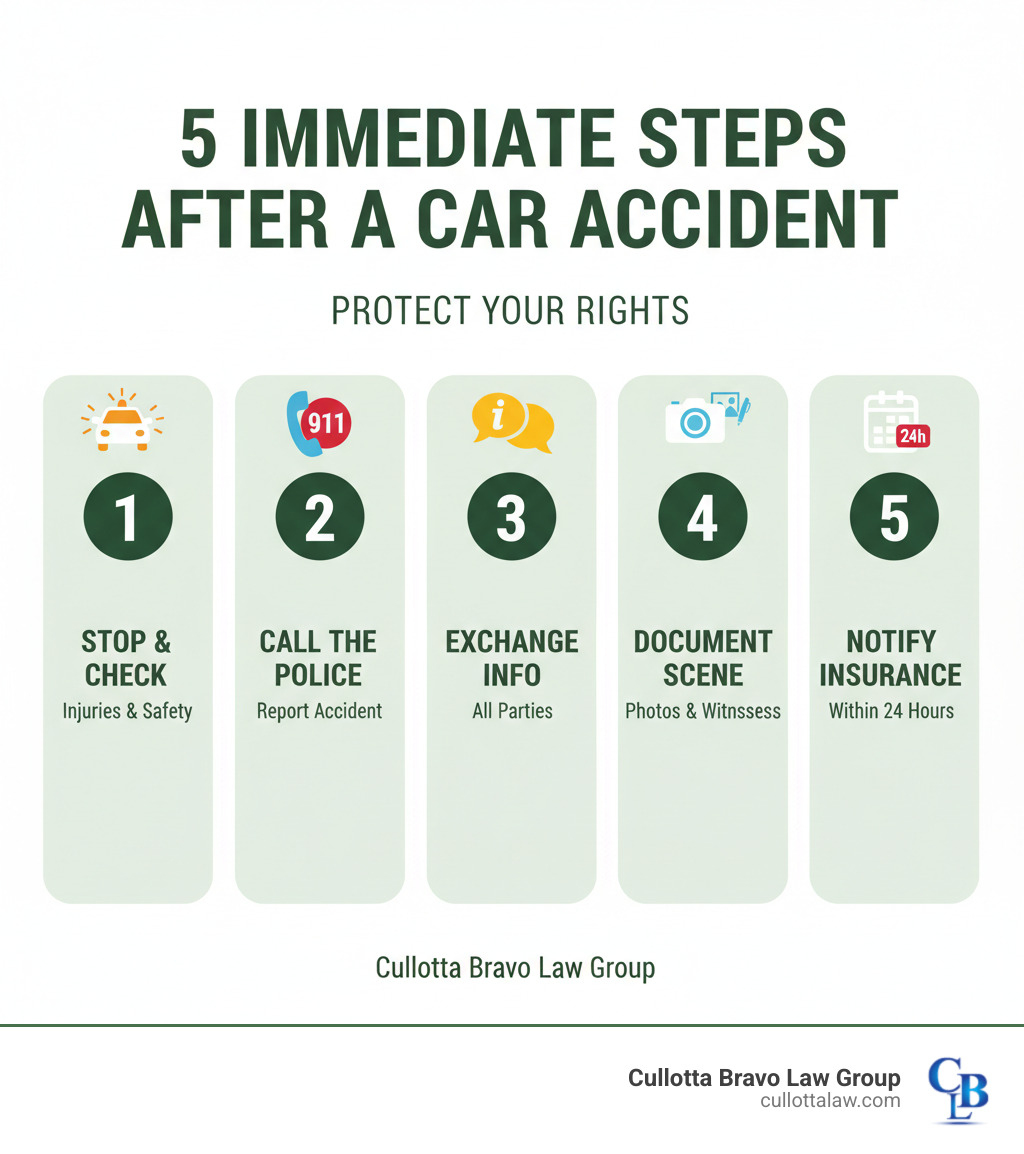
The moments after a car accident are disorienting, but the actions you take can make or break your legal rights. This is your game plan for protecting your car accident legal rights if the unthinkable happens.

Key steps to preserve your car accident legal rights
Stop immediately. This is the law. Leaving an accident scene, especially one with injuries, can lead to serious criminal trouble. Pull over safely and turn on your hazards.
Check for injuries. Call 911 if anyone is hurt, even if they say they’re fine. Shock can mask serious injuries that paramedics should evaluate.
Get the police involved. An official police report is crucial for insurance claims. In Illinois, you’re legally required to report any accident that causes injury, death, or property damage over $1,500. Modern car repairs easily exceed this amount.
Exchange information. Get the other driver’s name, phone number, license number, license plate, and insurance information. Do not apologize or admit fault. Insurance adjusters will use admissions against you.
Talk to any witnesses. Get contact information from any witnesses. Their independent account can be crucial if there’s a dispute about fault.
Document everything. Use your smartphone to take photos and videos of vehicle damage, the entire scene (road conditions, signs, skid marks), and any visible injuries. This visual evidence is powerful.
Notify your insurance company. Notify your insurer within 24 hours, as required by your policy. Stick to the facts and don’t speculate about fault.
See a doctor. Get medical attention as soon as possible, even if you feel okay. Adrenaline can mask pain, and injuries like whiplash or concussions may have delayed symptoms. An immediate medical record links your injuries to the crash.
What to do if you are an injured passenger
As a passenger, you are almost never at fault for a collision, which puts you in a strong legal position. Your car accident legal rights allow you to seek compensation from multiple sources. You can file a claim against the at-fault driver’s insurance, even if that’s the driver of the car you were in. It may feel awkward to file against a friend or family member, but you are claiming against their insurance policy, not them personally. This is what insurance is for.
You may also have coverage through your own policy’s Medical Payments, Personal Injury Protection, or Uninsured/Underinsured Motorist provisions. Check with your insurer to see what’s available.
Most importantly, get medical care immediately. Gaps in treatment give insurance companies an excuse to argue your injuries aren’t serious or related to the accident. Documenting your injuries from day one is critical to protecting your health and your legal rights.
Understanding Liability and Your Car Accident Legal Rights
Every car accident claim hinges on one question: who is legally responsible? Illinois is a fault-based state, meaning the party who caused the crash is responsible for the victim’s losses. Understanding liability is key to protecting your car accident legal rights.
Liability is based on negligence. To prove another driver was negligent, we must show they had a duty to drive safely, they breached that duty (e.g., by speeding or texting), this breach caused the crash, and you suffered actual damages (medical bills, lost wages, etc.) as a result. Proving liability requires evidence like police reports, witness statements, and photos. An experienced attorney is invaluable in collecting and analyzing this evidence.
Who is liable for your injuries?
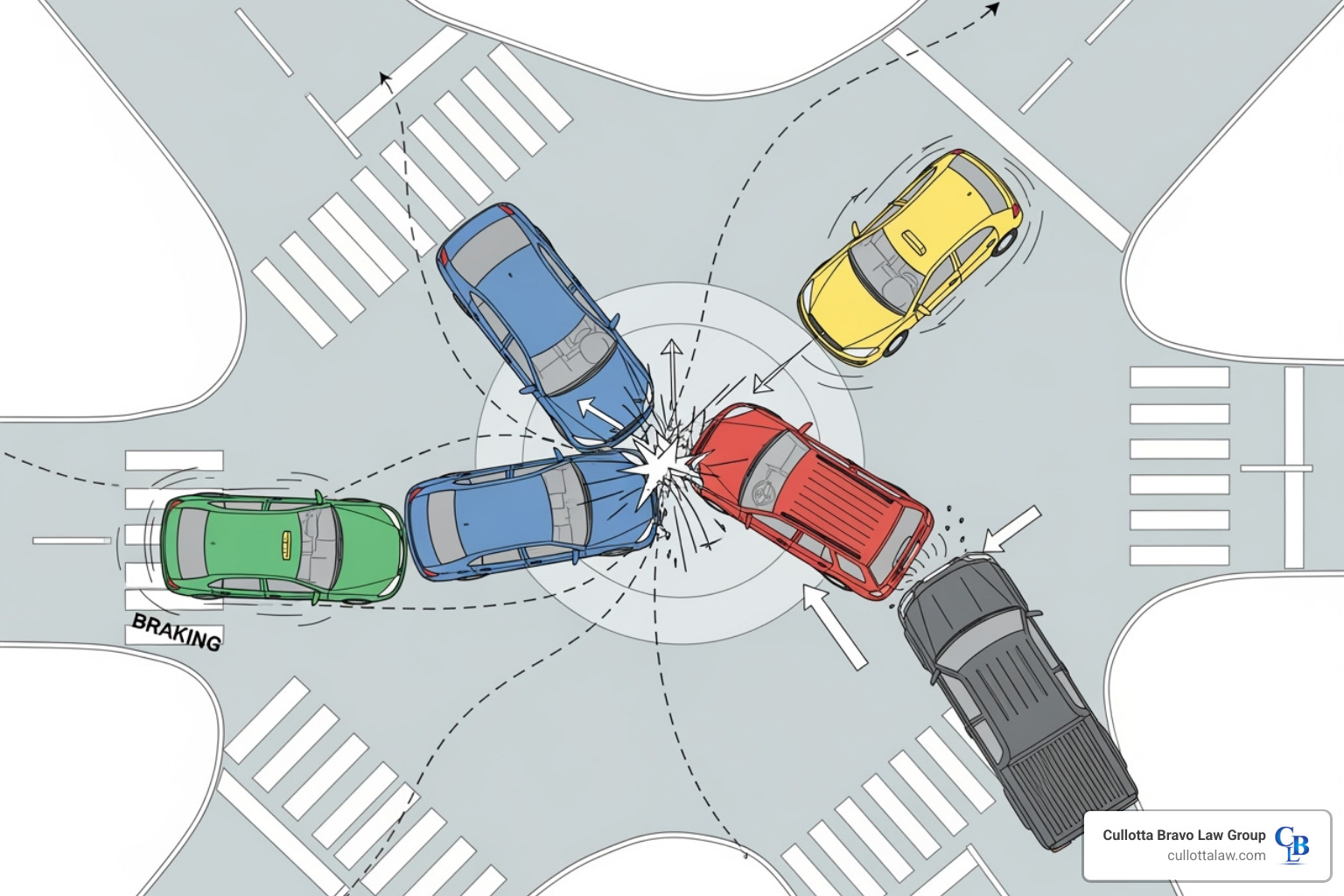
Liability can be complex. While the at-fault driver is the obvious party, others may also be responsible. Identifying all liable parties is crucial for maximizing your compensation.
- The at-fault driver: Their negligence makes their insurance company liable for your damages.
- The vehicle owner: If the owner negligently entrusted their car to an unsafe driver (e.g., someone unlicensed or intoxicated), they may also be liable.
- Their employer: If the driver was working at the time of the crash (e.g., a delivery or truck driver), their employer can be held vicariously liable.
- Government entities: Poor road design, missing signs, or bad road maintenance can make a government agency liable. These claims have strict, short deadlines.
- Vehicle manufacturers: A defective part like faulty brakes or airbags can lead to a product liability claim against the manufacturer.
- Multiple parties: In multi-vehicle pileups, several parties may share fault, requiring a thorough investigation.
How Illinois’s Comparative Fault Rule Affects Your Claim
Even if you were partially at fault, you might still be entitled to compensation. Understanding Illinois’s “modified comparative negligence” rule is a vital part of your car accident legal rights.
Illinois’s modified comparative negligence rule means that if you are 50% or less at fault, you can still recover damages. Your total compensation is simply reduced by your percentage of fault. For example, if you have $100,000 in damages and are 20% at fault, you can recover $80,000.
However, if you are 51% or more at fault, you are barred from recovering any damages. This makes accurate fault determination critical. This rule is why a thorough investigation is so important. Insurers will try to shift blame to you to reduce their payout. An experienced attorney can counter these tactics and establish fault accurately, which can be the difference between fair compensation and nothing.
Securing Compensation: What Damages Can You Recover?
After a car accident, you face both financial and personal losses. Your car accident legal rights entitle you to seek compensation for a broad range of damages, from medical bills to pain and suffering. Understanding what you can recover is essential for receiving fair compensation.

The law recognizes two main types of damages:
- Economic damages cover your tangible financial losses. This includes all past and future medical expenses, lost wages, diminished earning capacity, and property damage to your vehicle and personal items.
- Non-economic damages compensate for intangible losses that deeply affect your life. This includes pain and suffering, emotional distress, and loss of enjoyment of life. In severe cases, a spouse may claim loss of consortium.
Punitive damages are rare and awarded only to punish extremely reckless behavior, like that of a repeat drunk driver. They are meant to deter others, not just compensate the victim.
Calculating the Value of Your Claim
Calculating your claim’s true value is complex. It goes beyond current bills to include future losses, which your car accident legal rights entitle you to. We document all medical expenses and, for serious injuries, consult experts to project the costs of future care. We also calculate all lost income, including diminished future earning capacity if your injuries impact your career.
Pain and suffering is subjective, and insurers often make low offers. An experienced attorney can calculate a fair value, sometimes using a multiplier method where economic damages are multiplied by a factor (e.g., 1.5 to 5) based on injury severity. For permanent injuries, we use expert testimony to demonstrate the full impact on your life to insurers and juries.
What if the at-fault driver is uninsured or underinsured?
It’s frustrating when the at-fault driver has little or no insurance, but your car accident legal rights still provide options.
Uninsured Motorist (UM) coverage is your safety net. This part of your own policy covers your damages up to your policy limits if the at-fault driver has no insurance.
Underinsured Motorist (UIM) coverage applies when the at-fault driver’s insurance isn’t enough to cover your damages. Your UIM policy can cover the difference, up to your own policy’s limits.
In Illinois, UM/UIM coverage is optional but highly recommended. We can help you steer your own policy to maximize these benefits. Without UM coverage, you can sue the driver personally, but collecting a judgment can be difficult if they lack assets. This is why carrying your own UM/UIM coverage is so critical for your protection.
Navigating the Claims Process: From Insurance to Lawsuits
The path to compensation involves dealing with insurance companies, which are businesses focused on minimizing payouts. Their adjusters are trained to protect company profits, not you. Understanding the claims process and your car accident legal rights is essential.
The process for filing an insurance claim
The process begins when you notify your own insurer. Stick to the basic facts of the accident. You will also file a third-party claim against the at-fault driver’s insurance. Their adjuster will investigate to determine what the company will pay.
The insurer will request documentation like police reports, medical bills, and proof of lost wages. We help our clients compile a strong, organized case file. While the adjuster investigates, never give a recorded statement or sign medical releases without consulting an attorney. These are tactics used to devalue or deny your claim.
Once you reach maximum medical improvement, we prepare a comprehensive demand package detailing all your damages and send it to the insurer with a demand for fair compensation. The insurer will likely respond with a lowball offer. This is a negotiation tactic, counting on you to be desperate or intimidated. An experienced attorney knows how to counter this and fight for what you truly deserve.
When to file a lawsuit and understanding the statute of limitations
Most claims settle out of court, but sometimes a lawsuit is necessary to protect your car accident legal rights and get fair compensation. A lawsuit may be needed for:
- An unsatisfactory settlement offer that doesn’t cover your damages.
- An outright claim denial, which a lawsuit allows you to challenge in court.
- Complex liability involving multiple parties, which often requires formal litigation to resolve.
- Severe or catastrophic injuries, where a lawsuit may be the only way to secure adequate compensation for long-term needs.
The most critical deadline is the statute of limitations. In Illinois, you generally have two years from the accident date to file a personal injury lawsuit. If you miss this deadline, you lose your right to sue permanently, regardless of your injuries.
Exceptions exist. For minors, the clock may not start until they turn 18. Claims against government entities have much shorter deadlines (sometimes one year). Wrongful death claims have a two-year limit from the date of death. These deadlines are absolute. Contacting an attorney promptly is crucial to ensure all deadlines are met, protecting your right to compensation while you heal.
Frequently Asked Questions about Car Accident Rights
Here are answers to common questions about car accident legal rights in Illinois.
As a passenger, can I file a claim against the driver of the car I was in, even if I know them?
Yes, and you shouldn’t feel guilty. As a passenger, you are almost never at fault and have the right to seek compensation. You are filing a claim against their auto insurance policy, not suing them personally. This is exactly why they pay for insurance—to cover damages in an accident. You are not taking money from their pocket; you are accessing the coverage they paid for. A true friend or family member will understand that you need to take care of your health and finances.
What are my rights if I was partially at fault for the accident in Illinois?
Under Illinois’s modified comparative negligence rule, you can still recover damages as long as you are 50% or less at fault. Your compensation is simply reduced by your percentage of fault. For example, if you are 25% at fault for an accident with $50,000 in damages, you can still recover $37,500. However, if you are 51% or more at fault, you cannot recover anything. Because insurers will try to inflate your share of the blame to pay less, an accurate investigation is critical to protecting your car accident legal rights.
Do I have to talk to the other driver’s insurance company?
No. You are not obligated to provide a recorded statement to the other driver’s insurance company. We strongly advise against it without consulting an attorney. The adjuster’s goal is to protect their company’s bottom line, and they are trained to get you to say things that can devalue your claim. Innocent comments like “I’m feeling okay” or a simple apology can be twisted and used against you. Let an attorney handle all communications with the insurance company. This allows you to focus on healing while we protect your rights from their tactics.
How an Attorney Champions Your Rights and Maximizes Your Claim
After an accident, you’re healing from injuries and facing mounting bills. The last thing you need is to battle a skilled insurance adjuster whose job is to minimize your claim. They count on you being too overwhelmed to fight back. Having an experienced attorney to protect your car accident legal rights is critical. It can be the difference between a lowball offer and a settlement that truly compensates you for your losses.
At Cullotta Bravo Law Group, we level the playing field. We work on a contingency fee basis, meaning you pay nothing upfront and we only get paid if we win your case. This allows you to access top legal representation without financial stress, so you can focus on healing while we fight for you.

An attorney’s role in upholding your car accident legal rights
Our role is comprehensive, starting the moment you hire us:
- Investigate the accident thoroughly by gathering all evidence, from police reports to black box data, and working with reconstruction experts.
- Identify all liable parties, including employers or government entities, to maximize sources of compensation.
- Calculate your total damages, including future medical costs and lost earning capacity, often with help from medical and vocational experts.
- Handle all communication with insurers, protecting you from their tactics and managing all negotiations.
- File all legal paperwork correctly and on time, protecting your claim from being dismissed on a technicality.
- Represent you in court if a fair settlement cannot be reached. Our trial experience gives us leverage during negotiations.
Why You Shouldn’t Go It Alone
Handling a claim alone is a serious disadvantage. You risk accepting an unfair settlement that doesn’t cover future medical care, lost earning potential, or pain and suffering. You also risk missing the statute of limitations, which would permanently bar your claim. The power imbalance is immense: it’s you against a multi-billion dollar corporation with teams of professionals dedicated to paying you as little as possible.
At Cullotta Bravo Law Group, we have secured millions for clients throughout Aurora, Chicago, Naperville, Joliet, and across Chicagoland. We combine aggressive representation with compassionate guidance. We know the insurance companies’ tactics and are not intimidated by their resources. We fight to get you the justice you deserve.
Your priority should be recovery. Let us handle the legal battle. Get help from an experienced Aurora car accident lawyer who will fight to protect your rights and maximize your compensation so you can focus on rebuilding your life.