

The Workers’ Comp Rejection: What to Do When Your Claim is Denied
Understanding Your Rights When Facing a Denied Workers Comp Claim
Denied workers comp claims affect thousands of Illinois workers annually, leaving them to struggle with medical bills and lost wages. If your claim was rejected, you’re not alone—and more importantly, you’re not out of options.
Quick Answer: What to Do When Your Workers’ Comp Claim is Denied
- Don’t panic – Review the denial letter to understand the reason.
- Gather evidence – Collect all medical records, witness statements, and accident reports.
- File an appeal – Submit an Application for Adjustment of Claim with the Illinois Workers’ Compensation Commission.
- Meet deadlines – You typically have up to 3 years from the injury date to file, but act quickly.
- Consider legal help – An attorney can significantly improve your chances of success.
The statistics offer hope: 67% of denied workers’ compensation claims are eventually converted to paid claims. This means most denials can be successfully challenged with the right approach.
Getting injured at work is stressful enough. When a claim is denied, you face mounting medical bills and uncertainty. The good news is that a denial is rarely the end of the story.
I’m Peter Cullotta, and with over 35 years of practice, I’ve helped countless clients appeal denied workers comp claims and secure the benefits they need. My experience shows that most denials can be overcome with proper preparation and aggressive advocacy.
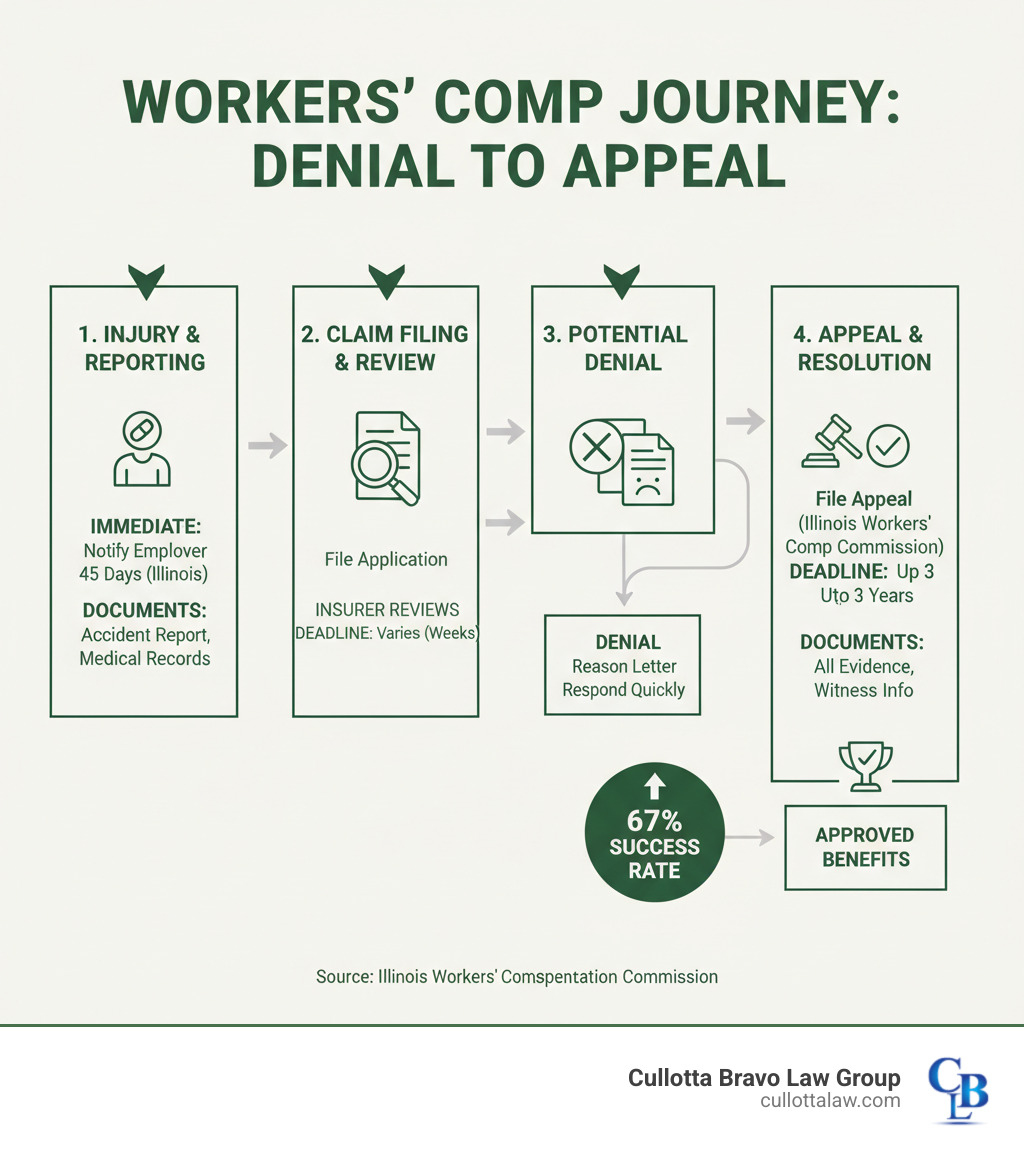
Understanding Why You Received a Denied Workers Comp Notice
Getting a denied workers comp letter doesn’t mean your story is over. Understanding why your claim was rejected is the first step toward building a winning appeal. Insurance companies deny claims for many reasons, and most can be successfully challenged.

Administrative and Procedural Errors
Many denials have nothing to do with your injury’s legitimacy but are due to paperwork problems or missed deadlines. These are often fixable.
- Missing deadlines is a major issue. In Illinois, you have 45 days to report your injury to your employer (in writing is best). You then typically have three years from your accident date to file a formal claim with the Illinois Workers’ Compensation Commission.
- Paperwork mistakes, like typos or incomplete information, can cause a denial.
- Lack of medical evidence or waiting too long to see a doctor can lead to rejection. Your medical records must clearly connect your injury to your work.
- Seeing the wrong doctor (one not on the employer’s approved list) can give the insurer an excuse to deny coverage.
For more on proper procedures, see our guide on Filing for Workers’ Comp in Aurora, IL.
Disputes Over the Injury Itself
Sometimes, the insurer questions whether your injury happened at work or is as serious as you claim.
- The “not work-related” argument is common. They may claim your injury occurred during a break or commute. The key is whether it happened “in the course and scope of your employment.”
- Pre-existing conditions are often blamed. However, if your work accident aggravated an old injury, you are still entitled to benefits. This is common with injuries like a Workers’ Compensation Torn Rotator Cuff.
- Your employer might dispute your claim to avoid rising insurance premiums.
- Inconsistent stories between your incident report and what you told a doctor can damage your case.
- Certain injuries like repetitive stress injuries, mental health conditions, and back injuries face higher scrutiny.
Issues Related to Employee Conduct
While workers’ comp is a “no-fault” system, your actions can disqualify you from benefits.
- Being under the influence of drugs or alcohol is a primary reason for denial.
- Willfully violating safety rules or engaging in horseplay and fighting can jeopardize your claim.
- Getting hurt while running a personal errand during work hours is typically not covered.
- Worker misclassification is a growing issue where employers wrongly label employees as independent contractors to deny benefits. Our guide on Workers’ Compensation for Misclassified Workers covers this.
Denied vs. Controverted Claims
A denied claim is an outright refusal to pay. A controverted claim means the insurer is formally disputing your claim and plans to fight it. According to the New York Workers’ Compensation Board, about 10% of claims are controverted. Nationally, major carriers like Liberty, Sedgwick, and The Hartford deny roughly 7% of all claims annually. The motive is financial, but many of these denials can be successfully appealed.
Your Immediate Action Plan After a Denial
A denial isn’t the end; it’s a detour. A large percentage of denied workers comp claims can be successfully appealed with swift, strategic action.

Don’t Panic: Understand the Consequences and Your Rights
That denial letter can be devastating, but take a deep breath. This isn’t over.
Review the denial letter carefully. The insurance company must state exactly why they denied your claim, and that reason is what we will attack in your appeal. Knowing their strategy allows us to build a stronger case to counter their arguments.
The potential consequences of a denial are serious: mounting medical bills, lost wages, and immense stress. But the insurance company doesn’t want you to know that you have a legal right to appeal. In Illinois, a denial letter is just the beginning of the fight. Don’t let them intimidate you. For more guidance, see our guide on Denied Workers’ Comp Claims: What to Do.
Steps for a Denied Workers Comp Claim: Gather Your Evidence
Building your appeal is like solving a puzzle. Each piece of evidence helps complete the picture of what happened.
- Collect all medical records, including ER visits, follow-up appointments, test results, and every bill. These records must clearly state that your injury is work-related.
- Doctor’s notes and opinions carry immense weight. Their professional opinion on the cause and limitations of your injury can make or break your appeal.
- Witness contact information provides independent verification of your accident.
- Accident reports filed with your employer should be reviewed for accuracy.
- Photos of the injury or accident scene can be powerful evidence.
- Keep all correspondence with your employer and your pay stubs, which are needed to calculate your disability benefits.
Formally Request a Hearing
Once your evidence is assembled, it’s time to formally challenge the denial through Illinois’s official system.
The Illinois Workers’ Compensation Commission (IWCC) is the state agency that resolves these disputes. It has the power to overturn the insurer’s denial.
Filing an Application for Adjustment of Claim is how you demand a hearing. This document officially declares that you are fighting the denial. It must be filled out completely and accurately.
Deadlines cannot be overstated. You generally have up to three years from your injury date to file, but waiting long after a denial can weaken your case. Acting swiftly preserves your legal rights and keeps pressure on the insurance company.
Navigating the Illinois Workers’ Comp Appeals Process
Appealing a denied workers comp claim in Illinois involves a series of steps through the Illinois Workers’ Compensation Commission (IWCC). Understanding each stage will help you move forward with confidence.

The Application for Adjustment of Claim and Initial Proceedings
Filing your Application for Adjustment of Claim officially starts the fight. The IWCC will assign an Arbitrator—an administrative law judge specializing in workers’ comp—to your case.
The process begins with status calls and pre-trial conferences, where both sides update the Arbitrator and discuss potential settlement. Throughout this process, your medical documentation is your most important asset.
The insurance company will likely send you for an Independent Medical Examination (IME). Be aware that IME doctors hired to independently examine injured workers are chosen and paid by the insurer. Their reports often minimize injuries, so it’s crucial to have strong medical evidence from your own doctors to counter their findings.
The Arbitration Hearing: Presenting Your Case
If a settlement isn’t reached, your case proceeds to an arbitration hearing. This is a formal proceeding at the IWCC where you tell your story under oath.
During the hearing, you will present all your evidence: medical records, witness statements, and accident reports. You will testify about your accident and its impact, and you will face cross-examination from the employer’s attorney. The key is to be honest and consistent.
The Arbitrator acts as both judge and jury, weighing all evidence to decide if your injury is compensable. The main goal is proving your injury is work-related—that it arose out of and in the course of your employment, fulfilling the purpose of the Illinois workers’ compensation statute.
Appealing a Denied Workers Comp Decision to the Commission and Courts
If the Arbitrator’s decision is unfavorable, the fight isn’t over. Illinois provides multiple levels of appeal.
- Review by the Commission: Either side can appeal by filing a Petition for Review with the full IWCC within 30 days of the decision. This deadline is strict. A panel of Commissioners will review the case record and legal arguments.
- Circuit Court: If you’re still unsatisfied, you can take your case to the Circuit Court for judicial review. The court will examine whether the Commission made any legal errors.
- Appellate Court: In rare cases involving significant legal issues, a case can be appealed to the Appellate Court and, in extremely limited circumstances, the Illinois Supreme Court.
This multi-layered process is complex and makes experienced legal representation essential, especially in cases involving severe injuries that could lead to Permanent Total Disability.
When to Hire a Workers’ Compensation Attorney
Facing a denied workers comp claim is overwhelming. While you can represent yourself, the system is complex, and insurance companies rely on that complexity to defeat legitimate claims. After 35+ years of fighting for injured workers, I know that an experienced attorney dramatically improves your chances of success.
The Role of an Attorney in a Denied Claim
When your claim is denied, it becomes a legal battle. You need someone who knows how to win. An attorney is critical for:
- Navigating complex laws: We know the intricate statutes, deadlines, and procedural rules that can make or break your case.
- Gathering critical evidence: We know how to obtain the right medical records, take depositions from witnesses, and secure expert opinions to counter the insurer’s arguments.
- Negotiating with insurance companies: Adjusters are trained to pay as little as possible. We handle all communications so you can’t accidentally hurt your claim and they know they can’t intimidate you.
- Representing you at hearings: We have the courtroom experience to present evidence effectively, cross-examine witnesses, and make compelling legal arguments before the IWCC.
- Maximizing your benefits: We fight to ensure you receive every dollar you’re entitled to, including future medical care and permanent disability benefits. For more on your protections, see our guide on What Legal Protections Are Available for Work Injuries in Chicago?.
Signs You Need Legal Help Immediately
Some situations are clear red flags that you need an attorney now. Call for help if:
- Your claim has been denied. This is the biggest red flag. The insurer is ready to fight, and you need an expert on your side.
- Your employer is disputing the claim or has become adversarial.
- The insurance adjuster is unresponsive or making unreasonable demands.
- Your injury requires surgery or long-term care, indicating a high-value, complex case.
- You have a pre-existing condition that the insurer is blaming for your injury.
- Your employer retaliates against you (harassment, demotion, termination) for filing a claim.
Insurance companies have lawyers working to minimize your payout. Shouldn’t you have someone working to maximize it?
Frequently Asked Questions about Denied Workers’ Comp Claims
When you’re dealing with a denied workers comp claim, it’s natural to have questions. Here are answers to the most common concerns I’ve heard over my 35+ years of practice.
How long do I have to appeal a denied workers’ comp claim in Illinois?
Time is critical. To start an appeal, you must file an Application for Adjustment of Claim with the Illinois Workers’ Compensation Commission (IWCC). The deadline is generally three years from the date of your injury or two years from your last benefit payment, whichever is later.
However, if an Arbitrator rules against you, you have only 30 days from receiving that decision to file a Petition for Review with the full Commission. This 30-day window is non-negotiable. Missing a deadline can end your case.
What are my chances of winning an appeal?
Your odds are better than you might think. A 2018 study found that 67% of denied workers’ compensation claims are eventually converted to paid claims. This means two out of three denials can be overturned.
Success depends on the strength of your medical evidence, credible witness testimony, and the quality of your legal representation. When an experienced attorney gets involved, insurance companies know they are facing a real fight and often become more reasonable.
Can I be fired for filing a workers’ comp appeal?
No. It is illegal for your employer to fire you in Illinois for filing a workers’ compensation appeal. This is called retaliatory discharge.
State law prohibits employers from retaliating against, harassing, or terminating you for exercising your right to seek benefits. This protection exists so workers aren’t afraid to pursue the benefits they deserve. If your employer does retaliate, you may have a separate legal claim for damages, including lost wages and emotional distress. The law is on your side.
Don’t Accept a Denial—Fight for the Benefits You Deserve
Receiving a denied workers comp letter can feel devastating, but I want you to remember: that denial letter is not your final answer.
The insurance company’s denial is often just an opening move. They are testing to see if you will walk away, which many injured workers do. But the statistics prove that fighting back works: 67% of denied claims eventually get converted to paid claims. Those are workers just like you who refused to give up.
Your right to appeal is your lifeline. The process exists because lawmakers knew insurers would deny legitimate claims. However, time is not your friend. The sooner you act, the stronger your position. Evidence stays fresh, and you preserve all your legal rights.
The insurance company has a team of professionals working against you. Going up against them alone is a battle you shouldn’t have to fight.
At Cullotta Bravo Law Group, we have over three decades of experience fighting and winning against these companies. We know their tactics and how to beat them. Our history of multi-million dollar settlements shows our commitment to securing the future our clients deserve. We serve injured workers throughout Aurora, Chicago, Naperville, Joliet, and all of Illinois.
Don’t let a denial letter be the end of your story. Your injury happened at work, and you deserve compensation. For aggressive representation from a team with a history of success, contact an experienced personal injury lawyer in Naperville to protect your rights. We’re ready to turn your denial into the victory you deserve.