

Don’t Get Swamped: Why You Need a Boating Accident Attorney
Why Boating Accidents Require Specialized Legal Help
A boat accident attorney is a specialized lawyer who handles injury claims involving watercraft incidents on lakes, rivers, and coastal waters. These attorneys understand both maritime law and state boating regulations to help victims recover compensation for medical bills, lost wages, and pain and suffering after collisions, capsizing, or other boating-related injuries.
When you need a boat accident attorney:
- Serious injuries – Drowning, traumatic brain injuries, spinal cord damage, or hypothermia
- Disputed fault – When the other party denies responsibility or blames you
- Commercial vessels – Accidents involving rental boats, tour operators, or cruise ships
- Insurance resistance – When insurers offer lowball settlements or deny valid claims
- Complex liability – Multiple parties, defective equipment, or unclear negligence
- Fatal accidents – Wrongful death claims for family members
Boating is a popular pastime throughout Illinois, but it comes with real risks. Research shows that around 200 people die in boating accidents across Canada each year, and in Illinois alone, 2023 saw 70 accidents resulting in 12 fatalities and 37 injuries. The most troubling statistic? Eight of those 12 fatalities involved victims who weren’t wearing life jackets.
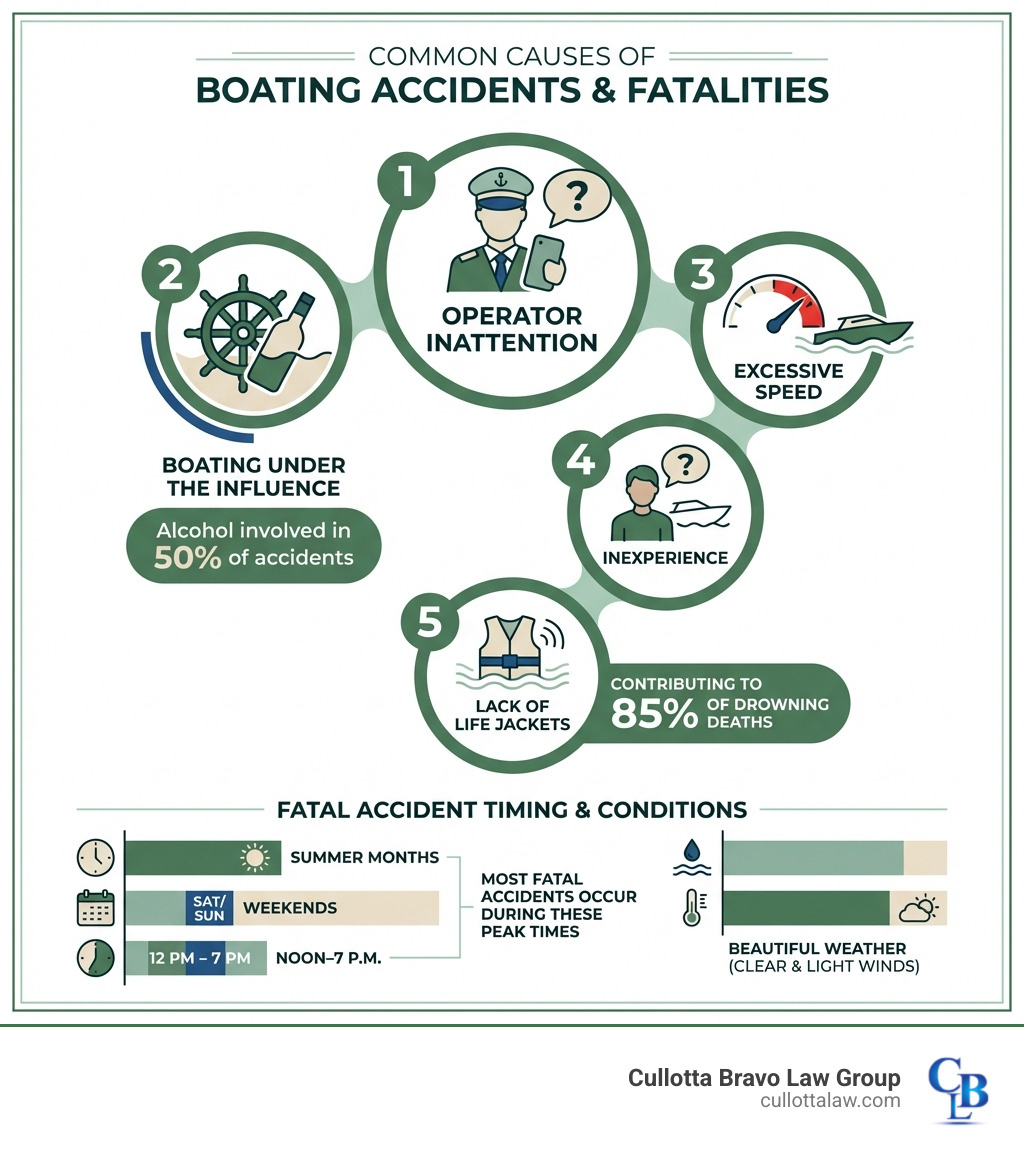
Most accidents happen during beautiful weather—clear conditions, light winds, summer weekends—when the water seems safest. But operator inattention remains the number one cause of vessel collisions, and alcohol is involved in at least 50 percent of all boating accidents in some regions.
Unlike car accidents, boating incidents involve unique legal challenges. Maritime law, federal regulations, and state-specific statutes all come into play. Proof of negligence can be harder to establish on open water where there are no traffic cameras or skid marks. Insurance companies know this complexity and often use it to minimize payouts to injured victims.
I’m Peter Cullotta, and with over 35 years of trial experience in personal injury cases throughout the Chicagoland area, I’ve helped countless injured individuals navigate complex liability claims and secure fair compensation. As a boat accident attorney, I understand how maritime regulations intersect with Illinois law to protect victims’ rights.
Boat accident attorney terms to know:
Understanding the Common Causes and Injuries of Boating Accidents
When we head out to the Fox River or Lake Michigan, the last thing on our minds is a catastrophe. However, the Illinois Department of Natural Resources (IDNR) Boating Statistics tell a cautionary tale. In 2023, Illinois saw a spike in accidents, proving that even experienced boaters can find themselves in harm’s way.
The Human Element: Why Accidents Happen
Most people assume that storms or mechanical failures cause most accidents. In reality, it is human behavior that poses the greatest risk.
- Operator Inattention: This is the number one reason vessel collisions occur. It only takes a second of looking at a phone or chatting with a passenger to miss an oncoming jet ski or a submerged hazard.
- Boating Under the Influence (BUI): There is a persistent, dangerous myth that alcohol and boating go together. Alcohol impairs judgment, balance, and reaction time. In many jurisdictions, alcohol is involved in at least 50 percent of all boating accidents.
- Excessive Speed: Just like on the road, speed kills on the water. Operating too fast for the conditions—especially in crowded areas or near docks—prevents operators from reacting to sudden obstacles.
- Inexperienced Operators: Many people rent boats without formal training. These operators often lack an understanding of the “rules of the road” for waterways, leading to dangerous maneuvers.

Common Boating Injuries
Boating accidents often result in injuries that are more complex than those found in car crashes because of the added element of water.
- Drowning and Near-Drowning: This is the leading cause of death in boating accidents. Alarmingly, nearly 85 percent of drowning victims were not wearing a life jacket. Even strong swimmers can be incapacitated by the shock of falling overboard.
- Traumatic Brain Injuries (TBI): High-speed collisions or falling within the vessel can lead to severe head trauma.
- Spinal Cord Trauma: The “jarring” motion of hitting a large wake at high speed or a collision can cause permanent back and neck injuries.
- Hypothermia: Even in summer, Illinois waters can be cold enough to cause hypothermia if a victim is submerged for an extended period.
- Carbon Monoxide Poisoning: Poorly ventilated engines can cause odorless, colorless gas to build up in the back of the boat, which can be fatal.
- Lacerations from Propellers: These are among the most gruesome injuries, often occurring when someone falls overboard near the engine or when an operator fails to turn off the engine while swimmers are nearby.
Immediate Steps to Take After a Watercraft Incident
If you are involved in a collision, your adrenaline will be pumping, but your actions in the next few minutes are critical for both safety and your future legal claim. Knowing what to do when involved in a boat accident can save lives and protect your rights.
1. Render Aid and Ensure Safety
Your first priority is to check for injuries. If someone is missing or seriously hurt, radio for emergency help or call 911 immediately. Under the law, you are required to render assistance to others involved as long as it does not endanger your own vessel or passengers.
2. Exchange Information
Just like a car accident, you must exchange details. You need to provide your name, address, and vessel identification to the other party. If the boat is a rental, get the rental company’s information as well.
3. Reporting Requirements
Illinois and federal laws have strict deadlines for reporting accidents:
- 48-Hour Fatal Report: If an accident results in a death or a person disappearing, it must be reported within 48 hours.
- Injury/Property Report: If an injury requires medical treatment beyond first aid, or if there is property damage exceeding $2,000, a report is usually required within several days (often 5 to 30 days depending on the specific state statute).
4. Collect Evidence
While at the scene, if it is safe to do so:
- Take photos and videos of the damage to all vessels.
- Capture the weather conditions and any nearby landmarks.
- Get contact information from any witnesses on other boats or the shore.
- Seek a medical evaluation immediately, even if you feel “fine.” Internal injuries or concussions may not show symptoms right away.
Proving Negligence with a Boat Accident Attorney
Proving who is at fault in a boating accident is significantly more difficult than in a car accident. There are no lanes, few signs, and the “road” is constantly moving. This is where a boat accident attorney becomes essential.
The Four Elements of Negligence
To win a settlement, we must prove four key things:
- Duty of Care: The operator had a legal obligation to operate the vessel safely.
- Breach of Duty: The operator failed that duty (e.g., they were speeding or drunk).
- Causation: That specific failure directly caused the accident.
- Damages: You suffered actual losses (medical bills, pain, etc.) as a result.
Maritime Law vs. State Law
Depending on where the accident occurred, different laws may apply. If you were on a “navigable waterway” (like the Great Lakes or major rivers used for commerce), federal maritime law might take precedence.
- The Jones Act: Protects maritime workers and seamen injured on the job.
- Longshore and Harbor Workers’ Compensation Act: Provides protection for land-based maritime employees.
- Presumption of Negligence: In some maritime cases, if a moving vessel hits a stationary object, there is a legal presumption that the moving vessel was at fault.
We understand these nuances. The role of a boat accident attorney is to investigate these complexities so you don’t have to.
| Feature | Car Accident Liability | Boating Accident Liability |
|---|---|---|
| Evidence | Skid marks, traffic cams | GPS data, witness testimony |
| Rules | Clear traffic laws | Navigation “Rules of the Road” |
| Jurisdiction | State law | State and/or Federal Maritime Law |
| Safety Gear | Seatbelts (Mandatory) | Life Jackets (Required on board) |
| Licensing | Driver’s License required | Boater Education Card (Age-dependent) |
Navigating Boating Laws and Compensation Claims
In Illinois, boating is regulated to ensure everyone’s safety. However, many people treat boats like toys rather than motorized vehicles.
Licensing and BUI Laws
While Texas and other states have their own specific codes, Illinois has strict Boating Under the Influence (BUI) Laws. Operating a boat while impaired is a criminal offense with penalties similar to a DUI. Furthermore, many operators are required to carry a Boater Education Card, proving they understand the rules of the waterways.
What Compensation Can You Recover?
If you’ve been injured, you may be entitled to various types of damages:
- Economic Damages: These are measurable costs like medical bills (past and future), lost wages, and the cost of boat repairs.
- Non-Economic Damages: These cover “invisible” injuries like pain and suffering, emotional distress, and loss of enjoyment of life.
- Punitive Damages: In rare cases where an operator was extremely reckless (like extreme intoxication), the court may award punitive damages to punish the offender.
There is a statute of limitations in Illinois. Generally, you have a two-year filing period from the date of the accident to bring a personal injury claim. If you miss this window, you lose your right to sue. You can find more info on boat accidents and how these timelines apply to your specific situation on our website.
When Should You Hire a Boat Accident Attorney?
You should consult a boat accident attorney if:
- Fault is disputed: The other boater claims you caused the wake that tipped them.
- Serious injuries occurred: High-value claims are always fought harder by insurance companies.
- Rental boat waivers are involved: Don’t assume a signed waiver means you can’t sue; many are legally unenforceable if there was gross negligence.
- Commercial vessels: If a tour boat or barge was involved, you are up against corporate legal teams.
For more details, check out our boating accident legal services page.
How to Choose the Right Boat Accident Attorney for Your Case
Not all personal injury lawyers are equipped for maritime cases. When choosing representation, look for:
- Maritime Expertise: Do they understand the specific federal laws governing the water?
- Trial Experience: Are they willing to go to court, or do they just want a quick insurance settlement?
- Contingency Fee Structure: You shouldn’t pay a dime unless we win your case.
- Local Illinois Knowledge: Familiarity with local waterways like the Chain O’ Lakes or Lake Michigan is a major advantage.
Frequently Asked Questions about Boating Accidents
What is the statute of limitations for a boating accident in Illinois?
In Illinois, the standard limit is two years for personal injury claims. However, the “discovery rule” might apply if an injury wasn’t immediately apparent. For minors, the clock typically doesn’t start until they turn 18. Regardless, you should act quickly to preserve evidence.
Do I have to report a boat accident if there are no injuries?
Yes, if the property damage exceeds a certain threshold. While federal law sets this at $2,000, Illinois state rules may vary. It is always safer to file a report to ensure you have a paper trail for insurance purposes.
Can I still recover compensation if I wasn’t wearing a life jacket?
Yes, but it may affect your total payout. Illinois follows “comparative negligence” rules. If a jury decides that your lack of a life jacket contributed to the severity of your injuries, they might reduce your compensation by your percentage of fault. However, the negligent operator is still responsible for causing the accident itself.
Conclusion
At Cullotta Bravo Law Group, we have seen how a beautiful day on the water can turn into a nightmare. Whether you are in Aurora, Chicago, Naperville, or Joliet, our team is dedicated to providing aggressive legal representation for those injured on Illinois waterways.
With over 35 years of experience and a history of multi-million dollar settlements, we treat every client with the dignity and respect they deserve. We don’t back down from big insurance companies, and we don’t settle for less than you are owed.
If you or a loved one has been injured, don’t navigate these murky legal waters alone. Contact a boating accident lawyer today for a free, no-obligation consultation. Let us do the heavy lifting so you can focus on your recovery.