

Why Experienced Personal Injury Representation Can Make or Break Your Case
Experienced personal injury representation is often the difference between receiving fair compensation and being left with overwhelming financial burdens after an accident. When you’re facing medical bills, lost wages, and emotional distress, the legal system can feel impossible to steer alone.
An experienced lawyer brings years of practice, a proven track record, trial experience, and deep knowledge of insurance company tactics. Research shows that accident victims who hire a personal injury lawyer receive 3.5 times more money than those who don’t. This guide will help you understand why hiring the right legal partner is almost always the best decision.
I’m Peter Cullotta, founding partner at Cullotta Bravo Law Group, with over 35 years of trial experience serving injured individuals throughout the Chicagoland area. My experienced personal injury practice has helped clients recover millions, and I understand the challenges you’re facing right now.
Why an Experienced Personal Injury Firm is Your Greatest Asset
When you’re dealing with an accident’s aftermath, you shouldn’t have to become a legal expert overnight. An experienced personal injury firm is your most powerful ally. Personal injury law is complex, with intricate rules and deadlines. We’ve spent decades learning this legal maze so you don’t have to.
We identify all responsible parties and steer the system effectively. Insurance adjusters are trained to minimize payouts. Their job is to protect their company’s bottom line, not your future. We level the playing field. When an insurance company sees our team on your side, they know we mean business and aren’t afraid to go to court for fair compensation.

A study from the Insurance Research Council found that accident victims who hire a personal injury lawyer receive 3.5 times more money than those who try to handle their claims alone. That’s a life-changing difference.
The Statistical Advantage of an Experienced Personal Injury Lawyer
Numbers don’t lie. That 3.5x more compensation means a potential $10,000 settlement on your own could become $35,000 with a lawyer. Furthermore, you’re more likely to get any money at all. Data shows 85% of attorney-represented cases get a payout, compared to only 55% for those who go it alone. This higher settlement likelihood comes from our ability to build strong cases and negotiate effectively.
Battling Insurance Companies on Your Behalf
Insurance adjusters use specific adjuster tactics to save their company money. A common move is the lowball settlement offer, made quickly while you’re vulnerable. They also use recorded statements to find anything they can use against you. We handle all these conversations for you. Our aggressive representation signals that their usual playbook won’t work. With over 35 years of experience, we’ve seen every trick and know how to counter them.
The Importance of a Proven Track Record
Experience isn’t just about years in practice; it’s about results. Our trial experience is crucial because it forces insurance companies to negotiate fairly, knowing we’re willing to go to court. Our settlement history includes multi-million dollar recoveries because we know how to value cases and fight for every dollar. Our firm also has the resource allocation to build comprehensive cases with expert witnesses and thorough investigation, which individuals can’t fund on their own. When you choose Cullotta Bravo Law Group, you get a team with a reputation that insurance companies respect.
The Anatomy of a Personal Injury Claim: What You Need to Know
If you’ve been hurt in an accident, you might wonder if you have a case. A successful personal injury claim requires specific legal elements. An experienced personal injury lawyer knows how to identify these elements and build a compelling case. The challenge isn’t just having a valid claim, but proving it.
The Four Pillars of a Successful Claim
Every personal injury case rests on four essential pillars:
- Duty of Care: Someone had a legal responsibility to act reasonably to avoid harming others (e.g., a driver following traffic laws).
- Breach of Duty: That person failed to meet their duty, acting negligently (e.g., texting while driving).
- Causation: We must prove a direct link between the breach of duty and your injuries. Proving proximate cause is essential for your claim, meaning the injury was a foreseeable result of their actions.
- Damages: You must have suffered actual, documentable harm, such as medical bills, lost wages, or pain and suffering.
When all four pillars stand together, you have the foundation for a strong claim.
Common Types of Personal Injury Cases
Personal injury law covers a wide range of incidents. We handle cases involving:
- Car, motorcycle, and truck accidents: These are the most common cases, with truck accidents often causing catastrophic injuries.
- Slip and fall accidents: Property owners are responsible for maintaining safe conditions.
- Medical malpractice: Occurs when healthcare providers are negligent.
- Dog bites: Understanding Illinois’s Animal Control Act is key, as it holds owners strictly liable.
- Nursing home abuse: We seek justice for vulnerable elderly residents who suffer neglect or abuse.
- Wrongful death: Helps families get compensation when negligence is fatal.
- Workers’ compensation and defective products cases also fall under this umbrella.
Each case type has unique challenges, which is why an experienced personal injury firm is vital.
Signs You Have a Valid Case
You likely have a valid claim if:
- Your injury was caused by someone else’s negligence.
- You’ve incurred medical bills for treatment.
- You’ve lost wages or income due to your injuries.
- You’re experiencing significant pain and suffering, both physical and emotional.
- You’re dealing with emotional distress like anxiety, depression, or PTSD.
If these apply to you, contact an experienced personal injury lawyer to preserve evidence and protect your rights.
Your Roadmap to Resolution: From Accident to Settlement
The moments after an accident are chaotic. You’re in pain, confused, and worried about the future. While every case is unique, the journey from accident to resolution follows a predictable roadmap. Understanding this process can bring clarity during a challenging time.
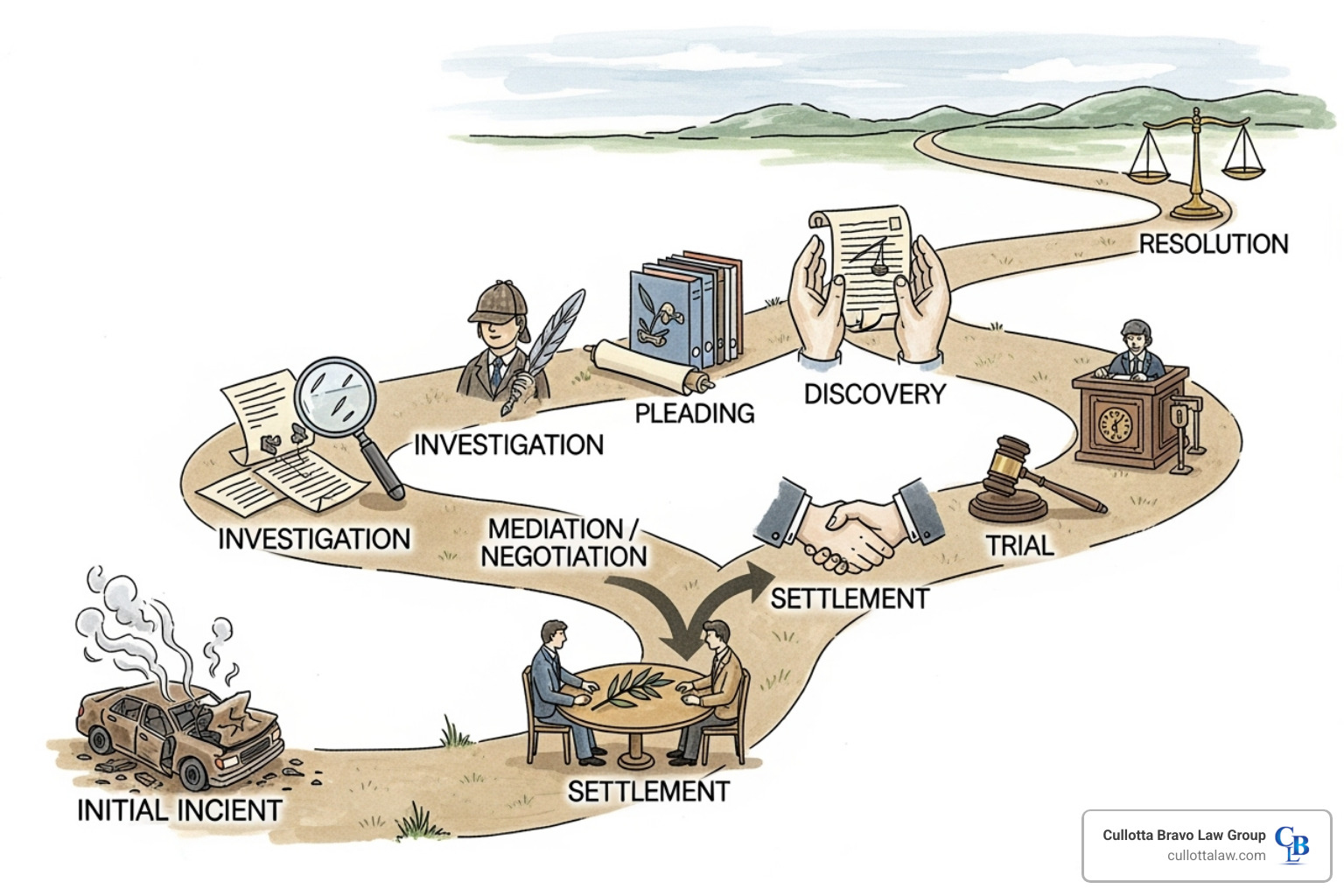
This section is your guide through the legal landscape, from the first critical steps to the day you receive compensation.
Immediate Steps to Take After an Injury
What you do right after an accident is crucial for your health and your case.
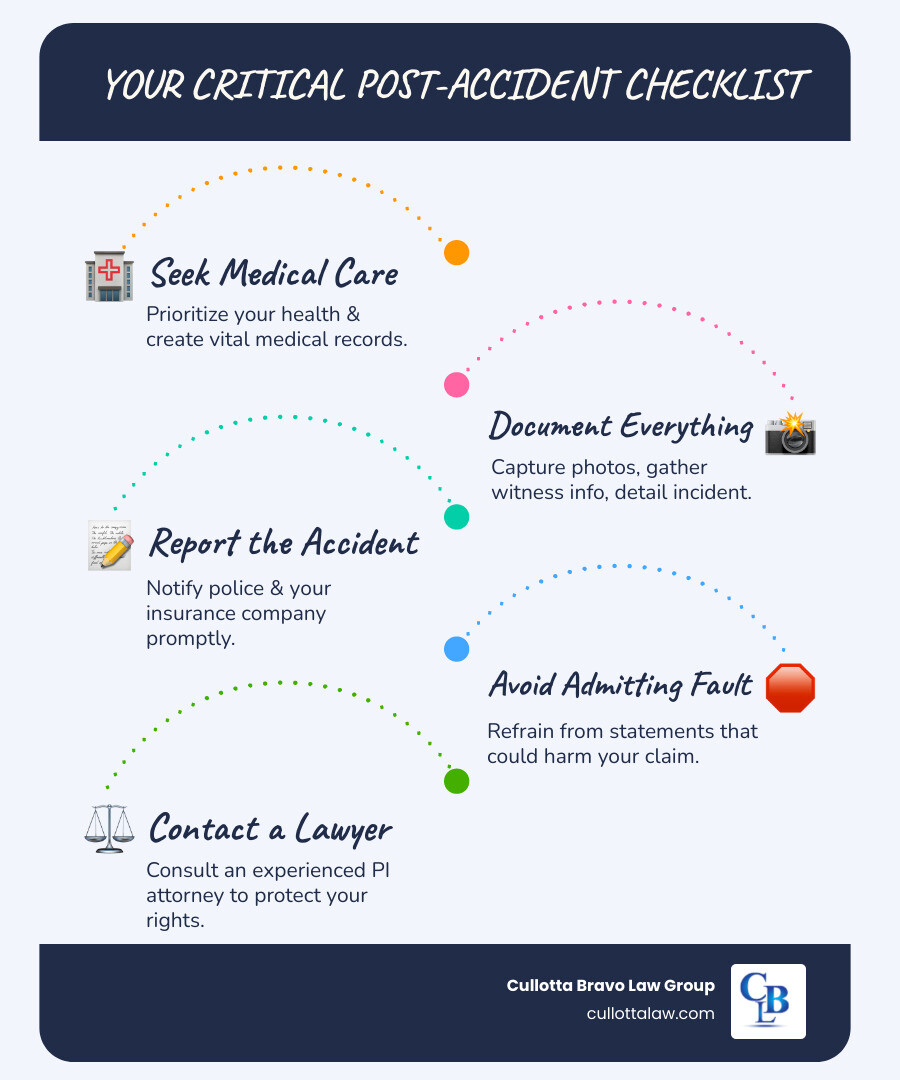
- Get medical help immediately. This creates a medical record linking your injuries to the accident.
- Document everything. Take photos of the scene, your injuries, and property damage.
- Talk to witnesses. Get their names and phone numbers.
- Ensure there’s an official report. Call the police for car accidents or report it to an authority for other incidents.
- Call your insurance company, but be careful. Stick to basic facts and don’t give a recorded statement without talking to a lawyer.
- Don’t apologize or admit blame.
- Contact a lawyer as soon as possible. In Illinois, you have two years to file, but waiting hurts your case. Our consultations are free.
The Role of Evidence in Building Your Case
Evidence is the foundation of your case. Key pieces include:
- Medical records: These form the backbone, proving your injuries and treatment.
- Police reports: Provide an official, unbiased account of the incident.
- Witness testimony: Independent voices can confirm your version of events.
- Expert witnesses: Specialists like accident reconstructionists can explain complex details.
- Your personal injury journal: A real-time record of your pain, limitations, and emotional struggles.
- Photos and videos: Visual evidence is incredibly persuasive.
- Employment records: These prove your lost wages and lost earning capacity.
As your experienced personal injury lawyers, we handle all evidence gathering while you focus on healing.
Navigating the Legal Timeline and Resolution Methods
Personal injury cases take time, typically settling between six months and three years. The timeline depends on injury severity, legal complexity, and whether liability is disputed. The process generally follows these steps:
- Investigation: We gather evidence, interview witnesses, and calculate damages.
- Demand Letter: Once your medical treatment is stable, we send a comprehensive demand to the insurance company.
- Negotiation: We go back and forth with the insurer to reach a fair settlement.
- Mediation: If negotiations stall, a neutral mediator can help facilitate a resolution.
- Filing a Lawsuit: This step increases pressure and shows we’re serious. Most cases still settle before trial.
- Trial: If necessary, we are prepared to fight for you in court.
We keep you informed every step of the way.
Explaining Damages and Attorney Fees
After an accident, you’re likely wondering, “What compensation can I get?” and “How much does a lawyer cost?” We believe in transparency. Your compensation depends on your unique circumstances, including the severity of your injuries and your financial losses.

How Compensation is Calculated: Economic vs. Non-Economic Damages
Damages are calculated to cover everything the accident has cost you. They fall into two main categories:
- Economic damages are quantifiable financial losses. These include medical expenses (past and future), lost wages, loss of earning capacity, and out-of-pocket expenses.
- Non-economic damages are for subjective losses that are harder to calculate but just as real. This includes pain and suffering, emotional distress (anxiety, depression, PTSD), and loss of enjoyment of life.
| Type of Damages | Description | Examples |
|---|---|---|
| Economic (Pecuniary/Special) | These are quantifiable financial losses that come with a clear monetary value or receipt. They are often easier to calculate. | – Medical Bills: Past and future expenses for doctor visits, hospital stays, surgeries, medications, rehabilitation, physical therapy, and assistive devices. – Lost Wages: Income lost due to time off work, including salary, bonuses, and commissions. – Loss of Earning Capacity: Future income you’re unable to earn due to permanent injury or disability. – Property Damage: Cost to repair or replace damaged property (e.g., vehicle, personal items). – Out-of-Pocket Expenses: Transportation to medical appointments, home modifications, domestic help. |
| Non-Economic (Non-Pecuniary/General) | These are subjective, non-monetary losses that are harder to quantify but are very real. They don’t come with a receipt. | – Pain and Suffering: Physical pain and discomfort, both past and future. – Emotional Distress: Anxiety, depression, fear, PTSD, humiliation, and other psychological impacts. – Loss of Enjoyment of Life: Inability to participate in hobbies, recreational activities, or daily functions you once enjoyed. – Loss of Consortium: Impact on marital relationship due to injury. – Disfigurement: Scarring or physical alterations. |
| Punitive (Aggravated) | These are rarely awarded and are not intended to compensate the victim but to punish the defendant for particularly egregious, reckless, or malicious conduct and to deter similar behavior in the future. | – Cases involving drunk driving, intentional harm, or extreme negligence. |
Illinois does not cap non-economic damages in most personal injury cases, allowing our experienced personal injury lawyers to fight for the full value of your losses. Punitive damages are rare and are meant to punish the defendant for extremely reckless behavior, like drunk driving.
Understanding the Contingency Fee Agreement
You shouldn’t have to worry about paying a lawyer upfront. We work on a contingency fee basis, which means you don’t pay us unless we win your case. There are no hourly bills or upfront retainers. Our fee is a pre-agreed percentage of your settlement or award. This aligns our interests with yours—the better you do, the better we do. We also typically cover case costs like filing fees and expert witness fees, which are repaid from the settlement only if we win.
What is the Statute of Limitations for an Experienced Personal Injury Claim?
Every state has a legal deadline for filing a lawsuit, called a statute of limitations. In Illinois, you generally have two years from the date of your injury to file a personal injury lawsuit. Miss this deadline, and you lose your right to compensation forever. There are exceptions, such as for wrongful death claims under the Illinois Wrongful Death Act or claims involving minors. Waiting hurts your case because evidence disappears and witnesses’ memories fade. Contacting an experienced personal injury lawyer quickly is the best way to protect your rights.
Frequently Asked Questions about Personal Injury Claims
It’s normal to have many questions about your personal injury claim. Here are answers to some of the most common ones we hear from clients.
How long does a personal injury case take to resolve?
There’s no simple answer. A straightforward case might resolve in six months, while a complex one can take three years or more. The timeline depends on the severity of your injuries, whether liability is disputed, how reasonable the insurance company is, and the court’s schedule. Our experienced personal injury team prioritizes getting you the best possible outcome, not the fastest one.
What if I was partially at fault for the accident?
This doesn’t automatically disqualify your case. Illinois uses a “modified comparative negligence” rule. This means you can still recover compensation as long as you are 50% or less at fault. Your final award is simply reduced by your percentage of fault. For example, if you are found 10% at fault for a $100,000 claim, you would receive $90,000. If you are 51% or more at fault, you cannot recover anything. Insurance companies will try to shift blame to you to reduce their payout, which is why having an experienced personal injury lawyer is critical.
What common challenges will I face during my claim?
The journey can be challenging, but we’re here to handle the heavy lifting. Common problems include:
- Insurance company tactics: They use strategies like lowball offers, requests for recorded statements, and delays to minimize what they pay.
- Delayed diagnosis issues: Some serious injuries (like concussions or whiplash) don’t appear immediately. Insurers may argue these injuries aren’t related to the accident.
- Financial pressure: Mounting medical bills and lost income can create stress, tempting you to accept a low settlement. Our contingency fee model helps relieve this pressure.
- The emotional toll: Dealing with pain, appointments, and the legal process is overwhelming. Having a legal team allows you to focus on healing.
- Proving non-economic damages: Putting a dollar value on pain and suffering requires compelling evidence, which we are skilled at gathering and presenting.
We have steerd these challenges thousands of times and know how to protect our clients.
Conclusion: Taking the First Step Towards Justice
After an accident, the path forward can feel overwhelming, but you don’t have to face this alone. Experienced personal injury representation is often the key to securing fair compensation. The data is clear: people with experienced lawyers receive 3.5 times more compensation than those who represent themselves.
The value of experience is immense. With over 35 years of experience, Cullotta Bravo Law Group knows how to counter insurance company tactics and build cases that demand respect. We understand the importance of evidence and have the resources to gather everything needed to prove your claim, from medical records to expert testimony.
Understanding and acting on your rights is the foundation of justice. You have the right to compensation for your medical bills, lost wages, and pain and suffering. Securing fair compensation requires aggressive representation and a willingness to fight for what you deserve.
The clock is ticking. In Illinois, you have two years to file a claim, but waiting can harm your case as evidence disappears. The sooner you act, the stronger your position.
For aggressive representation backed by decades of experience, consider a consultation with Cullotta Bravo Law Group. We serve injured individuals throughout Aurora, Chicago, Naperville, and Joliet. We work on a contingency fee basis, which means no win, no fee. You have nothing to lose by calling us.
Contact our Naperville personal injury lawyers for a free, no-obligation consultation today.
Your journey to justice starts with a single phone call.