

How to find and buy vacant land for sale near you
What You Need to Know Before Buying Land for Sale
Finding land for sale that fits your goals — whether farming, building, investing, or recreation — is more achievable than most people think. But the process involves more than just picking a plot on a map.
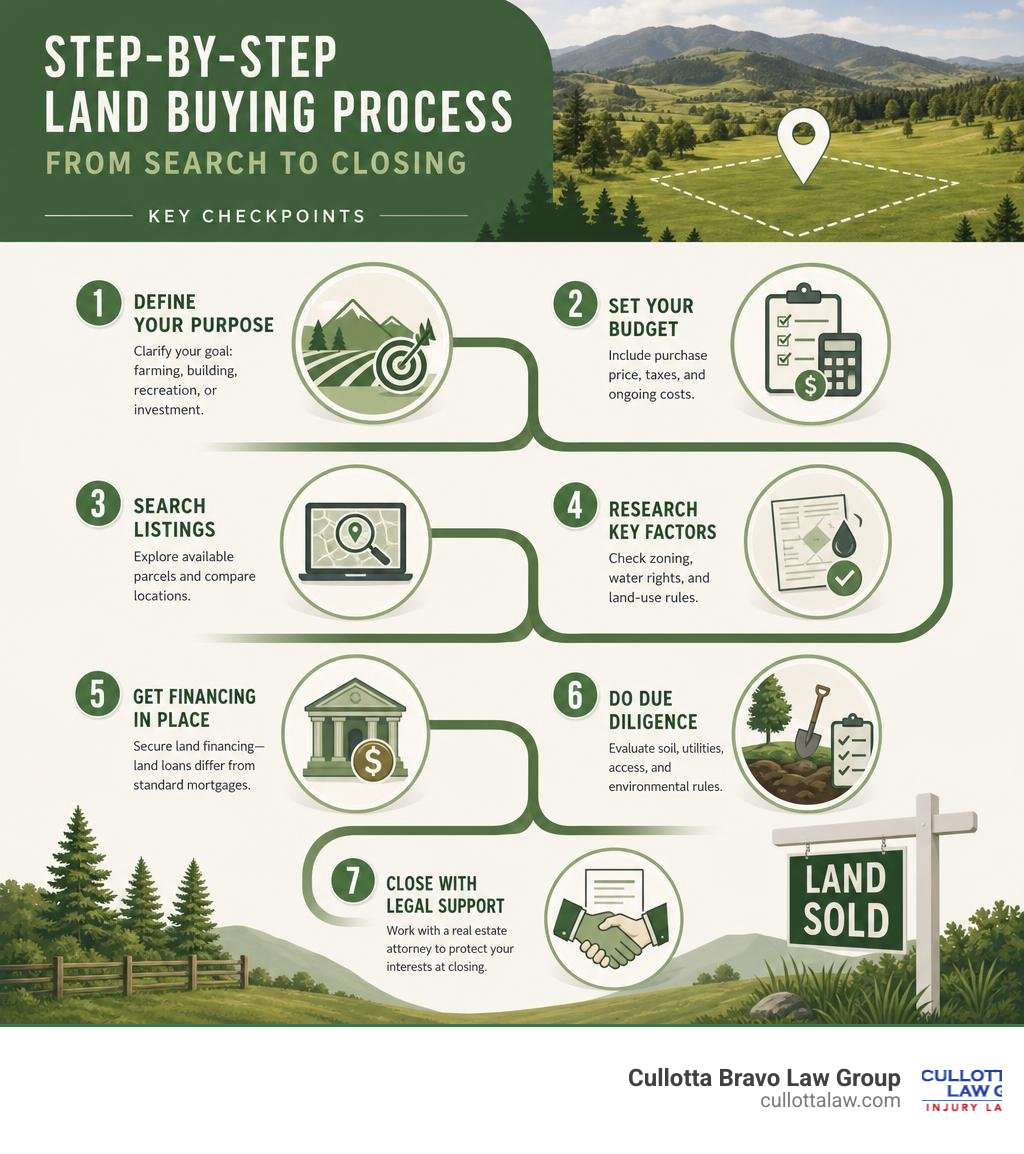
Here’s a quick overview of how to buy vacant land:
- Define your purpose — farming, homebuilding, recreation, or investment
- Set your budget — including purchase price, taxes, and ongoing costs
- Search listings — platforms like Zillow, LandWatch, and Redfin show thousands of active parcels
- Research zoning and water rights — before making any offer
- Get financing in place — land loans differ from standard mortgages
- Do due diligence — soil quality, utilities, access roads, and environmental rules
- Close with legal support — a real estate attorney protects your interests at closing
California alone has nearly 24,000 active land listings, and states like Texas, Michigan, and Wisconsin offer strong options at a wide range of price points. Whether you want a 35-acre mountain parcel in Colorado for $110,000 or a 34,000-acre organic farming operation in South Dakota, the market in July 2026 has something for nearly every buyer.
The challenge isn’t finding land — it’s knowing what to look for before you sign anything.
I’m Peter Cullotta, founding partner at Cullotta Bravo Law Group, with over 35 years of experience helping clients navigate complex legal transactions, including real estate matters surrounding land for sale. In this guide, I’ll walk you through every step so you can buy with confidence and avoid costly mistakes.
Understanding the Types of Land for Sale and Their Uses
Before you start browsing listings for land for sale, you must understand that raw earth is not a blank canvas you can paint any way you like. Every parcel of land comes with its own history, natural limitations, and legal boundaries. Identifying the right type of land for your specific goals is the first step toward a successful purchase.

Whether you are looking to build a private estate, start a commercial farming operation, or hold acreage as a long-term investment, the land’s classification will dictate your zoning rules, development costs, and utility requirements. Let’s break down the primary types of land available on the market and how they are typically used.
Agricultural and Farmland Opportunities
Agricultural land is one of the most resilient real estate investments available. It offers steady value appreciation alongside the potential for annual income through crop cultivation, livestock operations, or agricultural leases. When evaluating farmland, soil productivity and historical crop yields are your most critical metrics.
For buyers looking at institutional-scale farming, the market offers incredible opportunities. A prime example is the massive dryland farming operation at Listing #19357 – 34000 Acres In Stanley County, SD | LandHub. This property features 34,000 contiguous acres, including approximately 31,345 FSA cropland acres. What makes this South Dakota property highly valuable is its status as USDA-certified organic cropland. Organic certification allows owners to tap into premium grain markets, and the property’s infrastructure—including nearly 1 million bushels of on-farm grain storage across two headquarters—reduces reliance on third-party storage.
Whether you are looking at a massive organic operation or a small family farm, you must evaluate the soil quality, historical crop rotation, and regional climate patterns to ensure your agricultural venture is sustainable and profitable.
Ranches, Timberland, and Recreational Land for Sale
If your goals are geared more toward lifestyle, conservation, or timber harvesting, ranches and recreational properties are highly attractive. Ranches provide vast open spaces for livestock grazing, equestrian activities, or simply preserving a slice of natural wilderness.
Timberland, on the other hand, represents a unique, slow-growing investment class that can yield substantial long-term returns. For instance, the 105 Acres On Mccosh Mill Rd, LaGrange, GA 30240 | MLS #10773972 includes approximately 73 acres of planted Loblolly pine stands of varying ages. This Georgia property demonstrates how timberland can double as an active investment and a personal recreational playground. While the pine trees mature for future harvest, the land serves as an excellent site for hunting, camping, ATV riding, and hiking.
Recreational land is often prized for its natural features, such as dense woodlands, rolling hills, and proximity to water bodies. Many buyers look for parcels that support local wildlife populations, such as deer and turkey, making them ideal for private hunting preserves or off-grid weekend cabins.
Key Factors to Consider Before Buying Rural or Agricultural Land
Buying raw land is inherently more complex than purchasing a traditional home. When you buy a house, the structural shell and utilities are already there; when you buy land for sale, you must perform extensive due diligence to ensure the property can actually support your vision.
Without careful research, you could end up with a beautiful piece of property that is legally or physically impossible to build on.

Water Rights, Utilities, and Infrastructure
One of the most common mistakes land buyers make is assuming they can easily access water and electricity. In rural real estate, water is gold. You must determine whether the property has deeded water rights, access to a municipal water line, or if you will need to drill a well. Drilling a well can be highly unpredictable; you might hit clean water at 100 feet, or you might dig 500 feet and find nothing but dry rock.
Infrastructure costs can quickly spiral out of control. For example, look at 0 Camelot Dr, Newberry Springs, CA 92365 | MLS #CV25062825 | Compass. This 28.88-acre parcel, the former site of the Trillion Trees Farm, is highly attractive to agricultural buyers because it is fully fenced and already features its own private well. Having a well and fencing already in place saves the buyer tens of thousands of dollars in upfront development costs.
In addition to water, you must evaluate:
- Electricity Access: Are power lines at the property boundary, or will you have to pay the utility company thousands of dollars per pole to run electricity to your building site?
- Sewer and Septic: Most rural parcels lack municipal sewer access, meaning you must install a septic system. This requires a “perc test” to ensure the soil can absorb liquid waste.
- Access Roads: Is the property accessible via a publicly maintained road, or does it rely on an easement across a neighbor’s land? If the road is private, who is responsible for grading and snow removal?
Zoning, Environmental Regulations, and HOA Fees
Zoning laws dictate exactly what you can and cannot do with your property. A parcel zoned strictly for agricultural use might prohibit you from building a residential home, or it may limit you to a single dwelling. Conversely, residential zoning might prevent you from keeping livestock or running a home-based business.
You must also watch out for environmental regulations and local property rules. For instance, lot 127 County Road 312.1, Trinidad, CO 81082 | MLS #239862 is a 35.05-acre parcel of high-country land zoned for agricultural use. It offers a true blank canvas for an off-grid retreat or hunting camp, featuring incredibly low annual property taxes of just $11.84 and absolutely no HOA fees.
In contrast, other vacant parcels may be subject to strict Homeowners Association (HOA) covenants that dictate minimum square footage for homes, paint colors, and even where you can park your RV. Always check for:
- Zoning Classifications: Verify with the county planning department that your intended use aligns with local zoning.
- Environmental Protections: Check for wetlands, endangered species habitats, or flood zones that could severely restrict your building footprint.
- Easements: Ensure there are no utility or access easements that allow others to cross your land.
Regional Market Trends and Land Values
The value of land for sale varies dramatically depending on geography, soil quality, proximity to major metropolitan areas, and local demand. Understanding these regional dynamics is essential to finding the best value for your investment.
| State | Typical Parcel Highlighted | Key Land Features & Infrastructure | Primary Use Case |
|---|---|---|---|
| Illinois | Chicagoland & Rural Lots | Municipal utilities, flat terrain, fertile soils | Residential & Farming |
| Wisconsin | 37.25-Acre Dallas Parcel | Tilled fields, open pasture, wooded areas | Agriculture & Recreation |
| Michigan | 95.6-Acre Fenton Estate | Splitable acreage, existing barn, active lease | Income & Development |
| Colorado | 35.05-Acre Trinidad Lot | Mountain topography, off-grid, low taxes | Recreation & Hunting |
| California | 28.88-Acre Newberry Springs | Fully fenced, private well, desert agriculture | Farming & Ranching |
| South Dakota | 34,000-Acre Stanley County | Certified organic, 1M-bushel grain storage | Commercial Agriculture |
California and Texas Land Markets
California and Texas represent two of the most active yet vastly different land markets in the United States.
California’s market is defined by its extreme geographic and price diversity. While coastal areas and wine country command premium prices, regions like the Central Valley, the Sierra foothills, and the high desert offer more affordable agricultural and recreational options. For example, Riverside County, CA, currently features 2,465 land listings with a median listing price of $630,000, reflecting strong demand from buyers looking to build custom homes or establish small ranches.
Texas, on the other hand, is famous for its massive working ranches and rural acreage. The Texas land market relies heavily on specialized brokerage services, with top firms previewing hundreds of ranches a year and facilitating billions in sales. Many of the most desirable properties in the Texas Hill Country and West Texas are sold through off-market, private transactions, making local connections and expert representation crucial for buyers.
Midwestern and Southern Land for Sale
For buyers looking for highly productive agricultural soil or versatile recreational properties, the Midwest and South offer exceptional value.
In Wisconsin, land often combines active farming potential with natural beauty. The 37.25-acres Shale Ave N, Dallas, WI 54733 | MLS #1601434 is listed at $298,000 and features a beautiful blend of tilled fields, wooded acreage, and open pasture. This property is zoned agricultural and offers flexible division options, allowing buyers to purchase partial acreage or the full tract depending on their budget.
In Michigan, versatile parcels provide opportunities for immediate income and future development. The 7114 Mabley Hill Road, Fenton, MI 48430 | MLS #26031741 is a 95.6-acre agricultural property listed at $1,200,000. It includes mature woods, open meadows, two existing houses, and a barn. The property is fully splitable, offering incredible flexibility for future subdivision, and features an active agricultural lease that provides immediate income.
Closer to home, the Illinois land market is robust and highly localized. Across the state, there are currently thousands of active listings, as shown on the Illinois Land & Lots For Sale – 7751 Listings | Zillow page. For buyers looking to stay near major economic hubs, the collar counties around Chicago offer prime development opportunities:
- Chicago: Discover urban lots and infill development sites on Chicago IL Land & Lots For Sale – 669 Listings \| Zillow.
- Aurora: Explore residential and commercial lots on Aurora IL Land & Lots For Sale – 20 Listings – Zillow.
- Naperville: Find premium suburban land parcels on Naperville, IL Land for Sale – 183 Properties – LandSearch.
- Joliet: Browse growing residential and industrial lots on Joliet IL Land & Lots For Sale – 40 Listings \| Zillow.
These local Illinois markets provide a perfect balance of accessibility, strong property values, and long-term appreciation potential.
Financing Options and Ongoing Costs of Land Ownership
One of the most surprising hurdles for first-time land buyers is securing financing. Banks view raw land as a speculative investment, making land loans significantly harder to obtain than traditional home mortgages.

Navigating Land Financing
Because there is no physical house to serve as immediate collateral, lenders typically require:
- Higher Down Payments: While you can buy a home with 3% to 20% down, land loans often require 30% to 50% down.
- Higher Interest Rates: Expect interest rates on land loans to be several percentage points higher than standard mortgage rates.
- Shorter Repayment Terms: Land loans are rarely structured as 30-year fixed loans; they are often 10- to 15-year terms or structured as balloon loans.
To secure financing, many buyers turn to specialized agricultural lenders, local credit unions, or negotiate seller financing, where the seller acts as the bank and allows the buyer to make monthly payments directly to them.
Ongoing Costs and Tax Implications
The costs of land ownership do not stop after the closing. You must budget for ongoing maintenance, insurance, and property taxes.
Fortunately, many states offer agricultural tax exemptions (often called “ag assessments”) that can dramatically lower your annual property tax bill. If your land is actively used for farming, livestock grazing, or managed timber harvesting, the county may assess your property taxes based on the land’s agricultural productivity rather than its market value. This can reduce your annual tax burden from thousands of dollars to just a nominal fee.
Frequently Asked Questions About Buying Land
What are the most important things to check before buying land?
Before purchasing any parcel of land for sale, you must verify its zoning laws to ensure your intended use is legally permitted. Next, confirm access to water (via municipal lines or a private well) and perform a soil perc test if you need to install a septic system. Finally, check for any deed restrictions, easements, or environmental regulations that could limit your ability to build.
How does financing vacant land differ from a traditional mortgage?
Vacant land loans require much larger down payments (typically 30% to 50%) and carry higher interest rates because lenders view raw land as a higher-risk investment. The repayment periods are also shorter, often ranging from 10 to 15 years, compared to the standard 30-year residential mortgage.
Are there tax advantages to owning agricultural or timber land?
Yes. Most counties offer substantial property tax reductions through agricultural or timber conservation programs. If your land qualifies, it will be taxed based on its productive value rather than its developmental market value, which can save you thousands of dollars annually.
Conclusion
Buying vacant land is an incredible opportunity to build a custom estate, establish a profitable agricultural operation, or secure a legacy asset for your family. However, because land transactions lack the standardized guardrails of traditional residential home purchases, they require rigorous due diligence, thorough contract review, and a deep understanding of local property laws.
At Cullotta Bravo Law Group, we understand that real estate transactions are major milestones that require careful legal oversight. While our firm is widely recognized for our aggressive representation in personal injury, workers’ compensation, and nursing home abuse cases across Aurora, Chicago, Naperville, and Joliet, our experienced legal team is also fully equipped to guide you through the complexities of property transactions and legal due diligence. We treat every client with the dignity they deserve, ensuring your contract is legally sound and your financial interests are protected from the moment you make an offer to the day you close.
If you are ready to take the next step toward purchasing land in Illinois, contact us today to schedule a consultation, or visit our Cullotta Bravo Law Group Real Estate Services page to learn how we can help you secure your piece of land with complete peace of mind.