
How to Navigate the Semi Trailer Blind Zone Like a Pro
Why Semi Blind Spot Awareness Could Save Your Life
Semi blind spot awareness is one of the most overlooked road safety skills — and one of the most critical.
Here’s what you need to know right now:
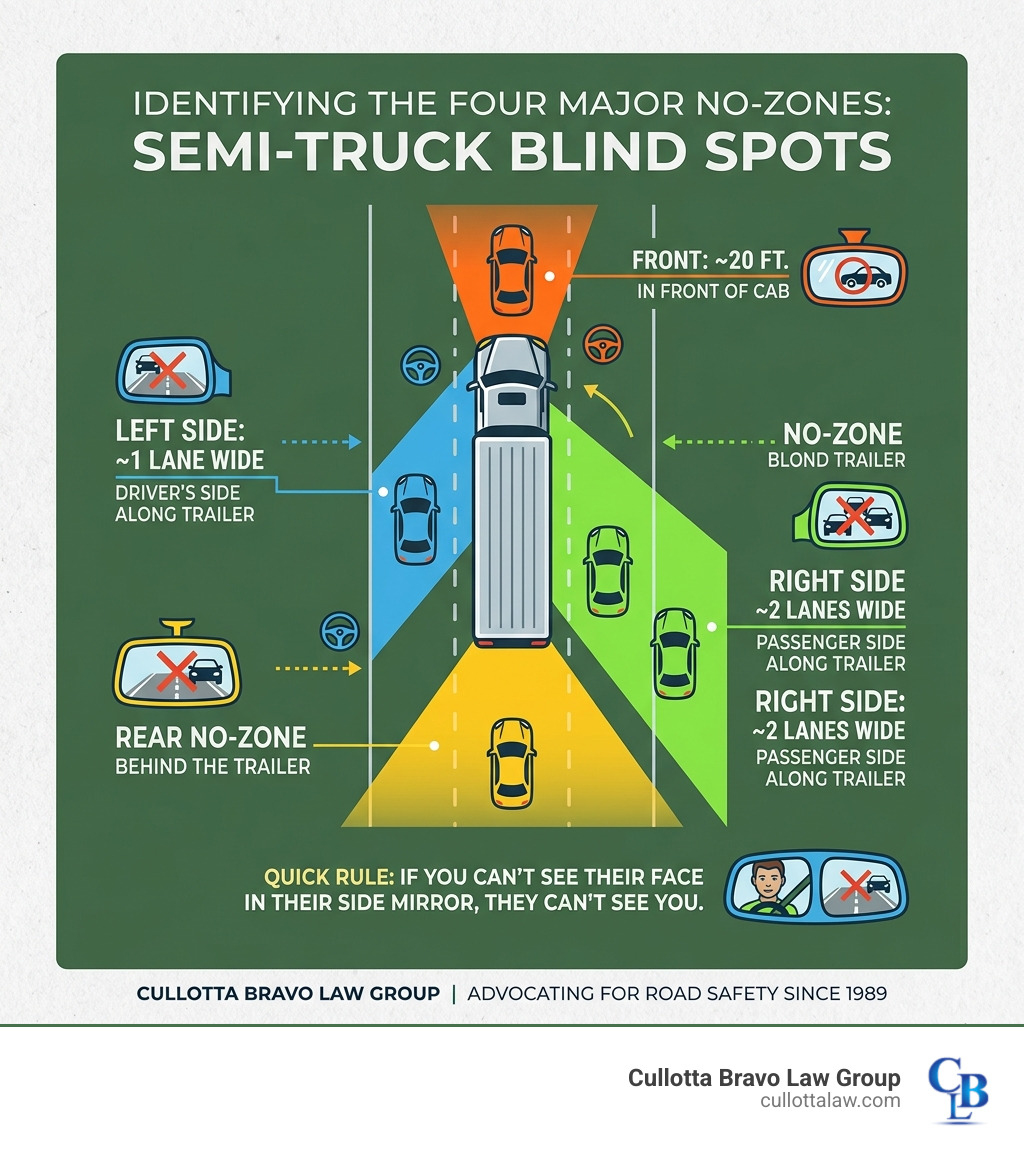
The four major blind spots on a semi-truck (No-Zones):
| No-Zone | Location | Size |
|---|---|---|
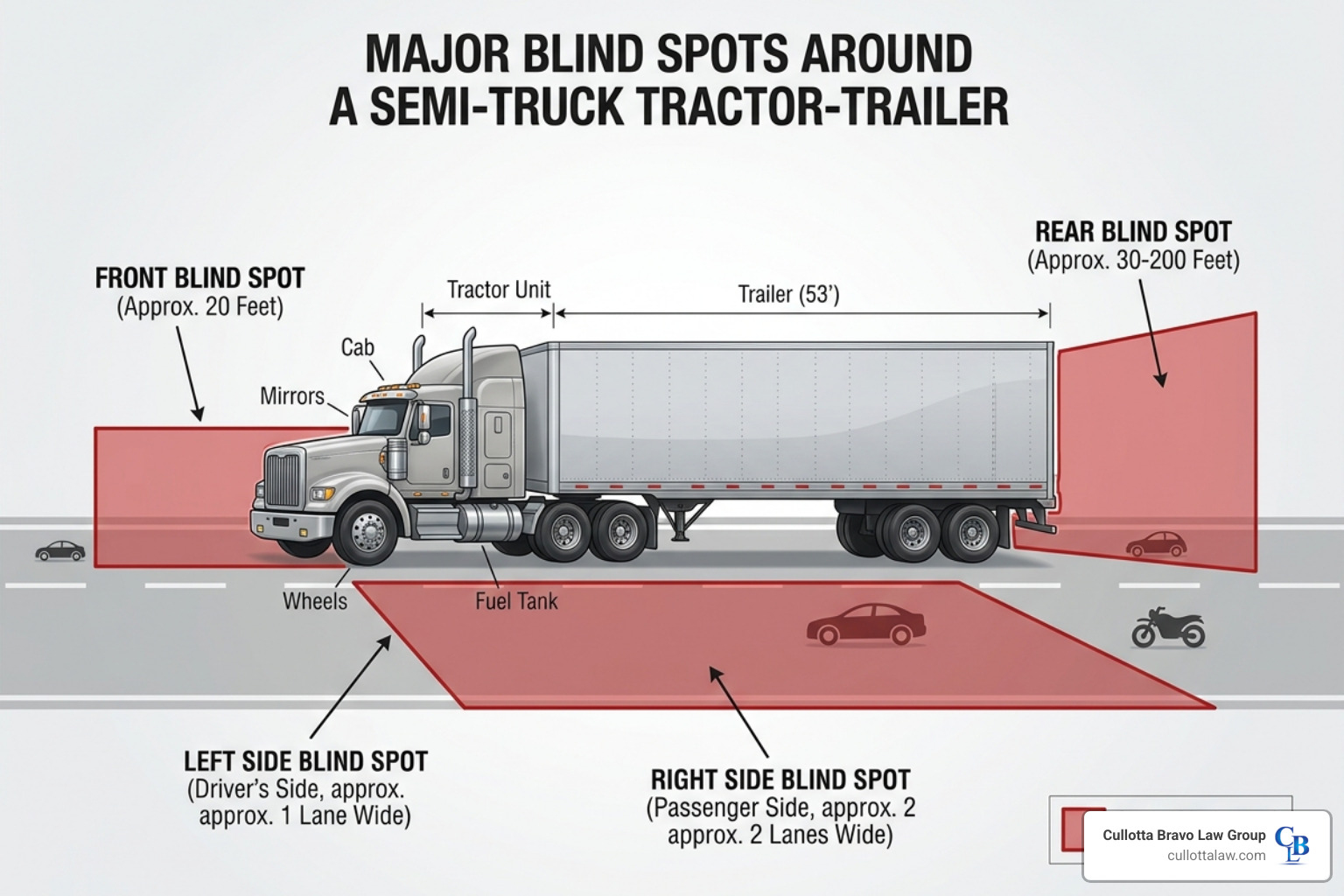
| Front | Directly ahead of the cab | ~20 feet |
| Rear | Behind the trailer | 30–200 feet |
| Left side | Driver’s side along the trailer | ~1 lane wide |
| Right side | Passenger side along the trailer | ~2 lanes wide |
Quick rule: If you can’t see the truck driver’s face in their side mirror, they can’t see you. Move out of that zone.
These blind spots aren’t small. A fully loaded semi can stretch up to 80 feet long, and its right-side blind spot can swallow two full lanes of traffic. Yet fewer than 5% of American adults can correctly identify all four of them.
That gap in awareness has real consequences. Over 400,000 accidents per year are linked to truck blind spots in the U.S., and roughly 300 people are killed annually in crashes directly tied to No-Zone collisions. In 2023 alone, more than 5,400 people died in large truck crashes — and the occupants of other vehicles made up the vast majority of those fatalities.
This guide walks you through exactly how to recognize, avoid, and respond to dangerous truck blind spot situations — whether you’re a daily commuter, a cyclist, or someone who just survived a collision you didn’t see coming.
I’m Peter Cullotta, founding partner of Cullotta Bravo Law Group, and with over 35 years representing injured individuals across the Chicagoland area, semi blind spot awareness is a topic I’ve seen matter enormously — not just on the road, but in the courtroom. If you or someone you love has already been hurt in a truck blind spot accident, this guide will also help you understand your rights.
Identifying the Four Major No-Zones
When we talk about “No-Zones,” we aren’t just using a catchy trucker term. We are talking about areas where a 4,000-pound car effectively becomes invisible to an 80,000-pound machine. Understanding these major blind spots is the first step toward professional-level road safety.
The Front No-Zone
It might seem counterintuitive that a driver sitting so high up can’t see what’s right in front of them. However, the height of the cab and the length of the hood create a significant shadow. This zone extends about 20 feet forward. If you cut into this space, the driver may not even know you are there until the moment of impact. This is particularly dangerous because the front end of a truck is the most common impact point in fatal collisions.
The Rear No-Zone
Unlike your sedan, a semi-truck has no rearview mirror looking through a back window. They rely entirely on side mirrors. The rear blind spot can stretch up to 200 feet behind the trailer. If you are tailgating a truck, you are essentially driving in a tunnel where the truck driver has zero visibility of your presence.
The Left-Side Blind Spot
While the driver sits on the left, their visibility isn’t perfect on that side either. The left-side blind spot typically extends from the cab back to about the middle of the trailer. It usually covers about one lane width.
The Right-Side Blind Spot
This is the “big one.” Because the driver is seated furthest from this side, the angle created by the mirrors is much wider and less effective. We often tell our neighbors in Aurora and Joliet to treat the right side of a truck as a “no-go” zone whenever possible.
You might wonder, why do trucks still have big blind spots despite huge advances in vehicle safety technology? The reality is that the sheer physical design—the trailer length, the cab height, and the lack of a center line of sight—creates physical limitations that even the best mirrors can’t fully overcome.
Why the Right Side is the Most Dangerous
The right-side blind spot is the undisputed heavyweight champion of danger. It is the largest of the four No-Zones, often spanning two full lanes in width and stretching the entire length of the trailer.
The danger here is often realized during the “squeeze play.” When a truck needs to make a right turn, it must often swing wide to the left to clear the curb. To an unaware driver, it looks like the truck is moving into the left lane, leaving an open “invitation” to pass on the right. If you take that invitation, you enter a truck’s blind spot just as the driver begins their hard right turn. Because of mirror limitations, the driver cannot see you “squeezed” between their trailer and the curb until it is too late.
Statistics Highlighting the Need for Semi Blind Spot Awareness
If you think “it won’t happen to me,” the data suggests we all need to be more vigilant. According to the National Highway Traffic Safety Administration (NHTSA), blind spot issues are a leading factor in truck-on-car collisions.
- 400,000 Accidents: Annually, nearly half a million accidents are linked to truck blind spots in the U.S.
- 25% Attribution: Roughly one out of every four truck accidents is directly attributed to a blind spot incident.
- Fatal Impact Points: Front-end impacts account for a staggering 64% of fatal car-on-truck crashes.
- Public Unawareness: A 2024 industry survey found that less than 5% of adults could identify all truck blind spots correctly.
In Illinois, where our highways like I-55 and I-80 are major arteries for interstate commerce, these stats hit close to home. We see the aftermath of these “inadequate surveillance” errors far too often.
How to Practice Semi Blind Spot Awareness on the Road
Navigating around these giants requires a mix of common sense and specific techniques. The gold standard is the “See the Face” rule. If you are driving alongside or behind a truck, look at their side-view mirrors. If you cannot see the driver’s face reflecting in that mirror, they cannot see you. It’s a simple, binary rule for mutual visibility.
Practicing semi blind spot awareness also means adjusting your following distance. We recommend at least a four-second gap between you and the truck. This gives you time to react if they brake suddenly and ensures you aren’t lingering in that 200-foot rear No-Zone. You can find more detailed tips in our guide on how-to-safely-pass-a-truck-on-the-highway/.
Safe Passing and Lane-Change Etiquette
Passing a semi-truck isn’t like passing a sedan. It requires a plan.
- Pass on the Left: Always pass on the driver’s side where the blind spot is smaller.
- Be Decisive: Don’t “linger” next to the trailer. If you’re going to pass, do it steadily and safely.
- The Rearview Check: Do not merge back in front of the truck until you can see the entire front of the truck (both headlights) in your rearview mirror. This ensures you aren’t cutting into their 20-foot front No-Zone.
- Signal Early: Give the driver plenty of notice. Professional drivers often use a lean and look technique, shifting their body in the seat to get a better angle on their mirrors, but they need time to do this.
Never “cut in” immediately after passing. Trucks weigh 20 to 30 times more than your car and take up to 40% longer to stop. If you cut in and slam your brakes, the truck simply cannot stop in time. For more on highway maneuvers, check our advice on how-do-you-safely-pass-trucks-on-the-freeway/.
Semi Blind Spot Awareness for Vulnerable Road Users
If you are a bicyclist or pedestrian in a city like Chicago or Naperville, semi blind spot awareness is even more vital. Large trucks have a massive turning radius—often up to 55 feet.
At intersections, never stop your bike or stand on the curb directly to the right of a truck. If that truck turns right, the trailer will “track” closer to the curb than the cab did, creating a deadly “squeeze.” We have seen tragic results of what-happens-when-trucks-hit-bicyclists/, and almost all of them involve a lack of visibility during a turn.
How Truck Drivers and Technology Mitigate Risks
While passenger drivers must be careful, the burden of safety also rests on the professionals behind the wheel. Truck drivers undergo rigorous CDL training to manage a truck’s blind spots.
| Feature | How It Helps | Limitation |
|---|---|---|
| Convex Mirrors | Provides a wider angle of view | Distorts distance; objects look smaller |
| Mirror Checks | Frequent scans (every 5-8 seconds) | Human error and fatigue |
| Radar Sensors | Detects objects in adjacent lanes | Can be blocked by mud, ice, or trailers |
| Camera Systems | Provides a direct feed of the rear/sides | Can be distracting; requires screen monitoring |
Despite this training, the Large Truck Crash Causation Study found that “inadequate surveillance” (the driver simply not seeing the other vehicle) was a factor in 14% of all large-truck crashes.
The Role of Modern Safety Technology
Fortunately, technology is catching up. Many modern fleets are now equipped with advanced driver assistance systems (ADAS).
Systems like HONDA’s Blind Spot Information System (BSI) and Active Blind Spot Assist use millimeter-wave radar sensors in the rear bumpers. These sensors detect vehicles entering the No-Zone and alert the driver with a light on the mirror or an audible beep if they turn on their signal.
Other technologies include:
- Automatic Emergency Braking (AEB): Can mitigate front No-Zone collisions.
- Side-Object Detection: Specifically targets the dangerous right-side blind spot.
- 360-Degree Cameras: Eliminates the “No-Zone” by giving the driver a bird’s-eye view.
However, News investigations suggest that while this tech exists, federal regulations often lag behind, meaning not every truck on the road has these life-saving tools.
Common Accidents and Legal Consequences
When semi blind spot awareness fails, the results are rarely “minor.” Because of the mass involved, these accidents often result in catastrophic injuries.
Common accident types include:
- Sideswipes: The most frequent blind-spot accident, occurring during lane changes.
- Underride Crashes: When a car hits the rear or side of a trailer and slides underneath it. This is often fatal.
- Jackknife Incidents: A loss of traction that causes the trailer to swing out like a folding knife, often striking cars in the side No-Zones.
- Lane-Change Strikes: Where a truck moves into an occupied lane because the driver didn’t “lean and look.”
The impact of blind spot errors goes beyond physical pain. There are complex legal questions of liability. Was the truck driver negligent? Did the trucking company fail to install available safety tech? You can read more about the variety of these incidents in our article on 18-wheels-and-a-dozen-types-of-accidents/.
Steps to Take After a Blind Spot Collision
If you find yourself in the aftermath of a collision in Illinois, you need to act quickly to protect your health and your legal rights.
- Seek Medical Attention: Even if you feel “fine,” the adrenaline of a truck crash can mask severe internal injuries or TBI.
- Call the Police: An official report is essential.
- Preserve Evidence: Take photos of the vehicle positions, the mirrors of the truck, and any road debris.
- Request ELD Data: Modern trucks use Electronic Logging Devices. This data can prove if a driver was fatigued or speeding.
- Identify Witnesses: Get names and numbers.
Illinois law follows a “comparative negligence” system. This means that even if you were partially in a blind spot, you may still be able to recover damages if the truck driver failed their professional duty of care. For more specifics on local laws, see our breakdown of tractor-trailer-crashes-in-illinois/ and resources from the Illinois Department of Transportation (IDOT).
Frequently Asked Questions about Semi Blind Spot Awareness
How can I tell if I am in a truck’s blind spot?
The easiest way is the “See the Face” rule. If you can’t see the driver in their side mirror, you are invisible to them. Also, if you are within 20 feet of the front bumper or 30 feet of the rear, you are definitely in a No-Zone.
Are truck drivers always at fault for blind spot accidents?
Not necessarily, but they are held to a higher “professional” standard. If a driver fails to perform adequate surveillance or ignores their blind spot sensors, they are likely at fault. However, if a car cuts off a truck abruptly, the car driver may share liability. The Federal Motor Carrier Safety Administration (FMCSA) sets strict standards that we use to investigate these cases.
What is the “No-Zone” exactly?
It is the area around a commercial vehicle where the driver’s visibility is zero or severely limited. This includes 20 feet in front, up to 200 feet in the rear, one lane to the left, and two lanes to the right. Understanding the safety risks of large trucks starts with respecting these zones.
Conclusion
Road safety is a shared responsibility. While truck drivers are professionals who must manage their vehicles with extreme care, passenger drivers can protect themselves by practicing consistent semi blind spot awareness.
By staying out of the No-Zones, passing decisively on the left, and always ensuring mutual visibility, you can navigate the highways of Illinois like a pro.
If you or a loved one has been involved in a collision with a semi-truck, don’t navigate the legal aftermath alone. At Cullotta Bravo Law Group, we provide aggressive legal representation to victims of truck accidents in Aurora, Chicago, and throughout Illinois. We treat our clients with the dignity they deserve while fighting for the multi-million dollar settlements our history is built on.
Contact a dedicated Illinois truck accident attorney today for a free consultation. Let us help you move from the “blind spot” of the legal system into the light of justice.