
Legal Help for Hungry Plaintiffs: Why You Need a Restaurant Negligence Lawyer
When a Night Out Ends in an Emergency Room: What Restaurant Injury Victims Need to Know
A restaurant injury lawyer can help you recover compensation if you were hurt due to a restaurant’s negligence — whether from a slip and fall, food poisoning, a burn, or an assault on the premises.
Here’s what you need to know right away:
- You may have a valid claim if the restaurant failed to maintain safe conditions
- Compensation can include medical bills, lost wages, pain and suffering, and more
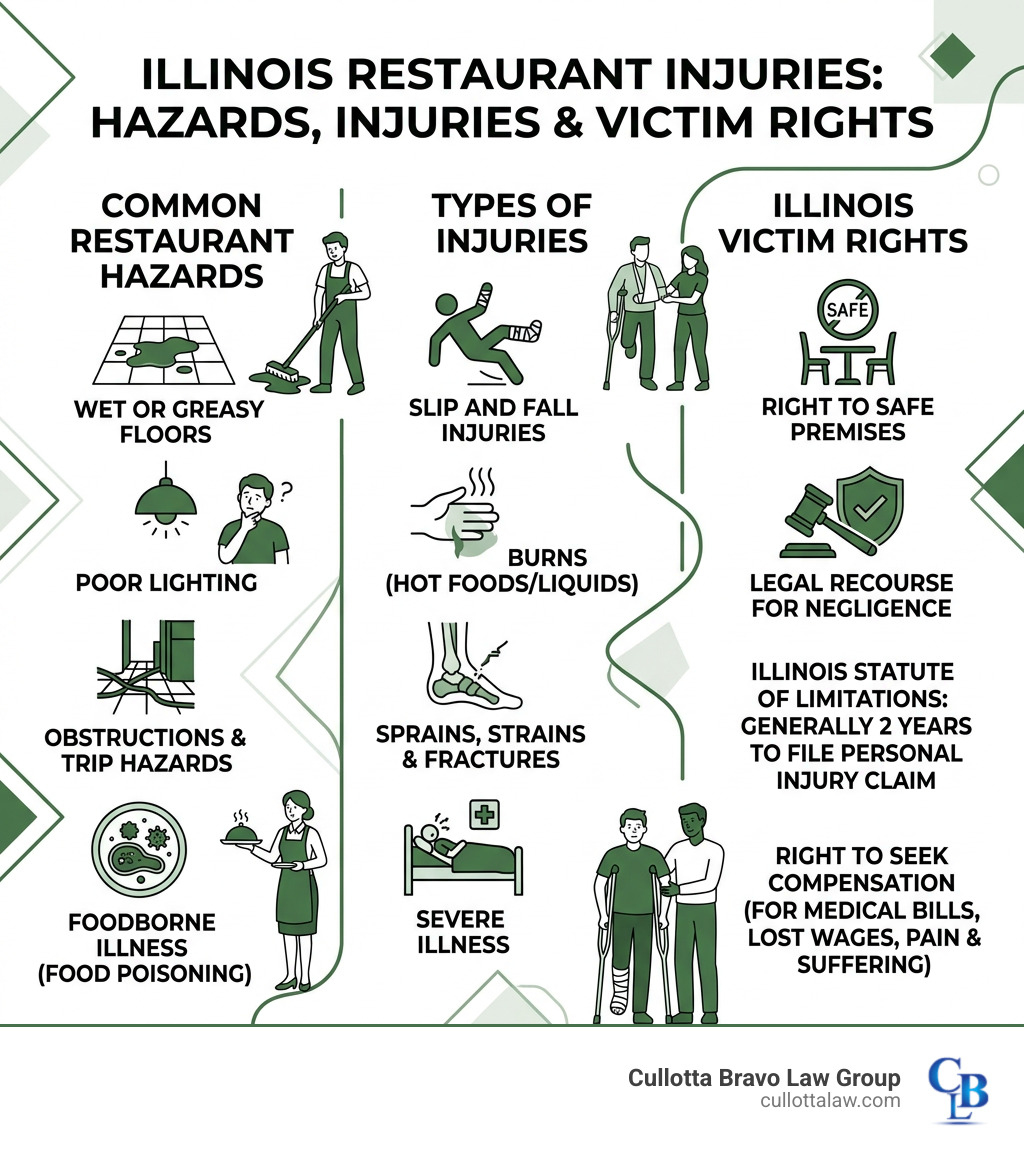
- In Illinois, you generally have two years to file a personal injury claim
- You can still recover damages even if you were partially at fault, as long as you were less than 51% responsible
- A restaurant injury lawyer will gather evidence, negotiate with insurers, and fight for maximum compensation on your behalf
Restaurants are busy, environments. Spills happen constantly. Floors get greasy. Lighting goes unrepaired. And when owners cut corners on safety, real people get hurt — sometimes seriously.
According to the National Floor Safety Institute, slip and fall accidents account for over one million emergency room visits every year. Restaurants are among the most common settings where these accidents occur, yet owners and their insurance companies routinely push back on legitimate claims.
If you are dealing with mounting medical bills, missed work, and real pain after a restaurant accident, you deserve to know your rights — and your options.
I’m Peter Cullotta, founding partner at Cullotta Bravo Law Group, with over 35 years of experience representing injured individuals throughout the Chicagoland area, including clients hurt in restaurant negligence cases. As a seasoned restaurant injury lawyer, I’ve seen how hard insurance companies fight to minimize payouts — and how much difference the right legal representation makes.
Common Hazards and Injuries in the Foodservice Industry
When we walk into a restaurant in Aurora or Naperville, we are usually thinking about the menu, not the maintenance of the floor. However, the foodservice industry is fraught with hidden dangers. Statistics from the National Floor Safety Institute reveal a sobering reality: slips and falls are a leading cause of emergency room visits, and the restaurant environment is a primary culprit.
In fact, research suggests that the average restaurant experiences between three and nine slip and fall accidents every year. While some might think of these as “clumsy” moments, the data tells a different story. Over 50% of these incidents are directly attributed to wet or dangerous floors. Whether it’s a spilled soda in the dining area or grease tracked from the kitchen into the hallway, these hazards are often the result of poor management or inadequate cleaning protocols.
Beyond slips, there are significant workplace risks. While California statistics often highlight over 346,000 nonfatal workplace injuries in a single year, the risks in Illinois are just as prevalent. From the server who suffers second-degree burns from a malfunctioning heat lamp to the guest who contracts a severe case of Salmonella due to improper food storage, the dangers are diverse.
Common Causes of Restaurant Accidents
In our decades of experience as a restaurant injury lawyer team, we have identified several recurring themes in restaurant negligence. These aren’t just “accidents”; they are preventable failures.
- Spilled Drinks and Tracked Grease: High-volume service means drinks fall and ice cubes melt. If a restaurant doesn’t have a policy for immediate cleanup or the placement of wet floor signs, they are inviting disaster.
- Torn Carpeting and Uneven Flooring: A small rip in a carpet or a loose floor tile can easily snag a heel or trip an unsuspecting patron.
- Overcrowded Tables: In an effort to maximize profit, some establishments cram too many tables into a small space. This creates cluttered walkways that make it difficult for both guests and servers to navigate safely.
- Defective Furniture: A chair with a loose leg or a booth with sharp protruding springs can cause sudden, painful injuries.
- Inadequate Security: This is a major concern in bars and late-night eateries. Poor lighting in parking lots or a lack of security personnel can lead to assaults or robberies that the property owner could have prevented.
Severe Injuries Sustained by Patrons
The consequences of these hazards are rarely minor. We often see clients who have had their lives turned upside down by a single moment of negligence.
- Spinal Cord Injuries and Herniated Discs: A hard fall on a tile floor can cause permanent damage to the back and neck.
- Hip Fractures: Especially common among older patrons, a hip fracture can lead to a long-term loss of mobility.
- Second-Degree Burns: Spilled hot coffee or sizzling plates can cause deep tissue damage requiring skin grafts.
- Lacerations: Broken glassware or sharp metal edges on fixtures can cause deep cuts that lead to permanent scarring.
- Traumatic Brain Injuries (TBI): Striking one’s head on a hard floor or a counter can result in concussions or long-term cognitive impairment.
- Internal Organ Damage: Severe falls or blunt force trauma can cause internal bleeding that isn’t always immediately apparent.
Proving Liability with a Restaurant Injury Lawyer
Proving that a restaurant is responsible for your injury is more complex than simply showing that you fell. Under Illinois premises liability law, we must establish that the restaurant owner or manager owed you a duty of care and that they breached that duty.

To win a case, your restaurant injury lawyer must prove one of two things regarding the hazard:
- Actual Knowledge: The restaurant staff knew the hazard existed (e.g., a server saw a spilled drink) but did nothing about it.
- Constructive Knowledge: The hazard existed for such a long period that the restaurant should have known about it through reasonable inspection.
For more detailed insights, you can explore our More info about slip and fall services page. Proving “constructive knowledge” often involves looking at surveillance footage or maintenance logs to see how long a spill sat on the floor before the accident occurred.
Why You Need a Restaurant Injury Lawyer for Your Case
You might think that because the negligence seems obvious, the insurance company will simply pay out. Unfortunately, that is rarely the case. Insurance adjusters are trained to minimize the company’s financial exposure. They may claim you were distracted, that your shoes were inappropriate, or that the spill had only just happened.
When you hire us, we take the burden off your shoulders by:
- Conducting a Deep Investigation: We secure surveillance footage before it is recorded over and interview witnesses while their memories are fresh.
- Securing Expert Testimony: We work with floor safety experts and medical professionals to prove exactly how the accident happened and the extent of your injuries.
- Handling Insurance Negotiations: We know the “lowball” tactics insurers use. We don’t accept settlements that don’t cover the full scope of your damages.
- Developing a Litigation Strategy: If the insurance company refuses to be fair, we are prepared to take your case to court. With over 35 years of experience, we aren’t afraid of a fight.
Immediate Steps to Take After Being Injured
What you do in the minutes following an accident can make or break your legal claim. If you are injured in a restaurant, follow these steps:
- Seek Medical Care Immediately: Even if you think you’re fine, adrenaline can mask serious injuries like internal bruising or concussions. Documentation from a doctor is the most critical piece of evidence.
- Notify Management: Ensure the manager on duty knows exactly what happened. Ask them to fill out an incident report and request a copy for your records.
- Take Photos and Video: Capture the hazard that caused your injury (the spill, the torn carpet, the dark parking lot) as well as the surrounding area.
- Collect Witness Contacts: If other diners saw what happened, get their names and phone numbers. Their unbiased accounts are gold in a legal case.
- Preserve Physical Evidence: Keep the shoes and clothing you were wearing. Do not wash them, as they may contain traces of grease or liquid from the floor.
- Avoid Making Statements to Insurance: The restaurant’s insurance company may call you for a “recorded statement.” Politely decline and tell them to speak to your restaurant injury lawyer.
Customer Claims vs. Employee Workers’ Compensation
It is important to distinguish between a customer being injured and a restaurant employee being injured.
- Customer Claims (Premises Liability): These are fault-based. You must prove the restaurant was negligent to recover damages.
- Employee Claims (Workers’ Compensation): Illinois operates on a “no-fault” workers’ compensation system. If you are an employee injured on the job, you generally do not need to prove your employer was negligent. You are entitled to medical benefits and a portion of your lost wages regardless of who caused the accident.
However, there are “third-party claims.” For example, if a restaurant employee is burned by a defective stove, they might have a workers’ comp claim against their employer and a personal injury claim against the stove manufacturer.
Navigating Compensation and Comparative Fault
The goal of a personal injury claim is to make you “whole” again. While no amount of money can undo the pain of a broken hip or a scarred face, financial compensation can alleviate the stress of unpaid bills.
For more information on the types of claims we handle, visit our personal injury claims page.
How a Restaurant Injury Lawyer Evaluates Your Damages
When we sit down to calculate the value of your case, we look at several factors:
| Economic Damages (Tangible) | Non-Economic Damages (Intangible) |
|---|---|
| Past and future medical expenses | Pain and suffering |
| Lost wages and loss of earning capacity | Emotional distress |
| Costs of rehabilitation and physical therapy | Loss of quality of life |
| Out-of-pocket costs (medications, crutches) | Permanent disfigurement or scarring |
We look at the permanence of the injury. A sprained ankle that heals in two weeks is valued differently than a traumatic brain injury that prevents you from ever returning to your career. We also consider the psychological trauma; many victims of violent assaults in restaurant parking lots suffer from PTSD and require long-term counseling.
Understanding Modified Comparative Negligence
Illinois follows a modified comparative negligence rule. This is a fancy way of saying that the court will look at whether you contributed to your own accident.
For example, if you were walking through a restaurant while texting and slipped on a wet floor, a jury might find that the restaurant was 80% at fault for the spill, but you were 20% at fault for not watching where you were going. If your total damages were $100,000, you would receive $80,000.
The “51% Rule”: In Illinois, if you are found to be more than 50% responsible for your own injury (e.g., you were 51% at fault), you are barred from recovering any compensation. This is why having an aggressive restaurant injury lawyer is vital—we fight to ensure the blame stays where it belongs: on the negligent property owner.
Frequently Asked Questions about Restaurant Negligence
What is the statute of limitations for filing a restaurant injury claim?
In the state of Illinois, the statute of limitations for most personal injury claims is two years from the date of the accident. If you miss this deadline, you lose your legal right to sue. While two years might seem like a long time, evidence disappears quickly. Surveillance tapes are erased, and witnesses move away. It is always best to contact a restaurant injury lawyer as soon as possible to preserve your rights.
Can I recover damages if I am partially at fault for the accident?
Yes! As mentioned above, as long as your level of fault is 50% or less, you can still recover damages. The insurance company will try very hard to push your percentage of fault above that 51% threshold to avoid paying you anything. We are experts at countering these defenses and proving the restaurant’s liability.
Why should I hire a lawyer instead of handling the insurance company myself?
Insurance companies are multi-billion dollar entities for a reason: they are very good at keeping their money. When you handle a claim yourself, you are at a massive disadvantage. They may offer you a settlement that covers your current medical bills but ignores the fact that you need surgery next year.
A restaurant injury lawyer from Cullotta Bravo Law Group provides:
- Aggressive Representation: We don’t back down from big insurance companies.
- Experience: We’ve seen every trick in the book over the last 35 years.
- No Upfront Costs: We work on a contingency fee basis, meaning you don’t pay us a dime unless we win your case.
Conclusion
A meal out should be a time of relaxation and enjoyment, not the start of a multi-year medical and financial struggle. If you or a loved one has been injured due to the negligence of a restaurant owner, you don’t have to face the recovery process alone.
At Cullotta Bravo Law Group, we treat our clients with the dignity and respect they deserve. With locations in Aurora, Chicago, Naperville, and Joliet, we are conveniently located to serve the entire Illinois community. Our history of multi-million dollar settlements speaks for itself, but our true pride lies in the lives we’ve helped put back together.
Don’t let a restaurant’s mistake dictate your future. Contact a restaurant injury lawyer today for a free, no-obligation consultation. Let us put our 35 years of experience to work for you.