

Local Legal Eagles: Top Boating Accident Attorneys Near You
Why Finding the Right Boating Accident Attorney Near Me Matters
After a serious watercraft incident, a boating accident attorney near me is your most critical ally. Time is of the essence—you need local legal expertise that understands Illinois maritime law, can quickly visit accident scenes, and steer both state and federal regulations.
Here’s what to look for when searching for a boating accident attorney near you:
- Experience with maritime law – Boating accidents fall under complex federal admiralty standards, not just standard personal injury law
- Local knowledge – An attorney familiar with Illinois waterways, Coast Guard procedures, and local courts
- Proven track record – Multi-million dollar settlements and verdicts in boating injury cases
- No upfront costs – Contingency fee agreements mean you pay nothing unless you win
- Trial readiness – The willingness to take your case to court if insurance companies won’t settle fairly
While boating on Lake Michigan or Illinois’ rivers should be relaxing, operator inattention, boating under the influence (BUI), and equipment failures cause devastating accidents annually. Unlike car accidents, these incidents involve unique legal challenges, from determining jurisdiction to proving negligence under maritime standards.
The injuries are often severe. Drowning, traumatic brain injuries, spinal cord damage, and propeller lacerations require extensive medical treatment while insurance companies work to minimize their payout.
You need someone fighting for you.
I’m Peter Cullotta, and for over 35 years, I’ve represented injured individuals in complex personal injury cases throughout Chicagoland. I understand the challenges victims face when searching for a boating accident attorney near me who can steer both Illinois state law and federal maritime regulations. My firm combines compassionate care with aggressive representation to secure the maximum compensation you deserve.
Common boating accident attorney near me vocab:
Understanding the Landscape of a Boating Accident Claim
Navigating personal injury law after a boating accident can be daunting. It’s important to understand what constitutes a boating accident, its common causes and injuries, and the legal grounds for a claim.
What Constitutes a Boating Accident?
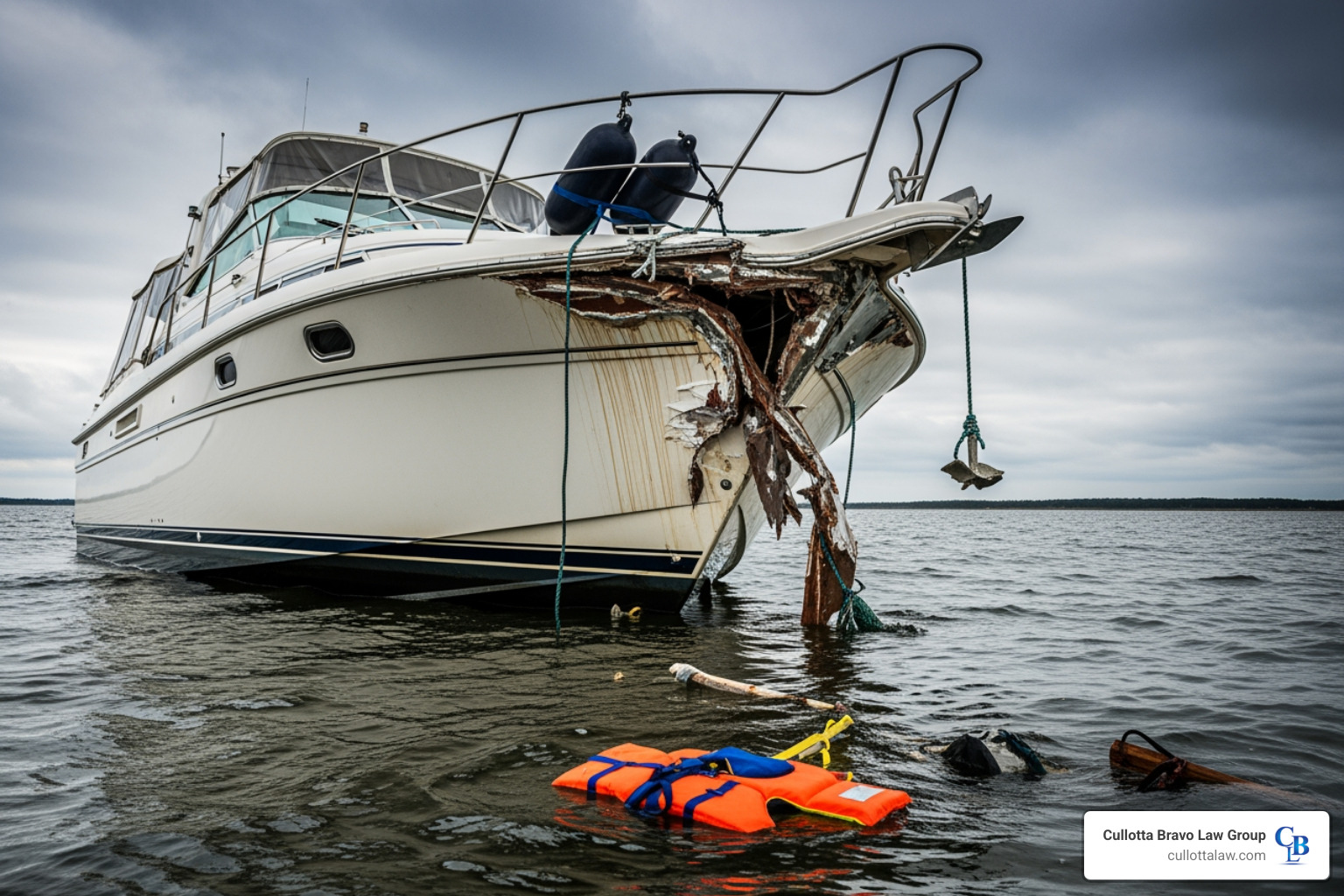
A boating accident includes a broad range of incidents on any navigable waterway that result in injury, death, or property damage. Generally, a boating accident can involve:
- Collisions with other vessels due to inattention, excessive speed, or failure to follow navigation rules.
- Collisions with fixed objects like docks, buoys, or submerged rocks.
- Capsizing or flooding from rough weather, improper loading, or mechanical failure.
- Falls overboard, leading to drowning, hypothermia, or impact injuries.
- Propeller-related incidents causing severe lacerations or death to swimmers or those who fall overboard.
- Water-skier accidents involving towed individuals from collisions or equipment malfunction.
- Striking underwater objects, leading to sudden stops and ejections.
- Wake damage where large wakes from excessive speed swamp smaller boats or damage shoreline property.
If any of these incidents occur due to another’s negligence, you may have a valid claim.
Common Causes and Devastating Injuries
The risks of boating are real, and many accidents stem from preventable human error and negligence.
Common causes of boating accidents include:
- Operator inattention: Distracted boating is a leading cause of accidents.
- Operator inexperience: Many boat operators lack extensive training.
- Boating under the influence (BUI): Operating a watercraft while impaired is illegal and dramatically increases accident risk.
- Excessive speed, especially in congested areas or rough conditions.
- Reckless operation, such as weaving through traffic or dangerous maneuvers.
- Equipment failure in engines, steering, or safety gear.
- Failure to follow safety regulations like “rules of the road” or using navigation lights.
- Poor weather conditions like storms, high winds, or heavy fog.
- Overcrowded waterways, increasing collision risk during peak seasons.
The injuries sustained in boating accidents are often severe and life-altering:
- Traumatic Brain Injuries (TBI) from impacts or falls, potentially causing long-term impairment.
- Spinal Cord Injuries from violent impacts, often leading to paralysis.
- Drowning or near-drowning incidents causing fatalities or severe brain damage.
- Lacerations from propellers or sharp debris.
- Hypothermia from prolonged exposure to cold water.
- Broken Bones from impacts or falls.
- Amputations, particularly from propeller strikes.
- Internal Organ Damage from blunt force trauma.
- Emotional Trauma/PTSD, which can be as debilitating as physical injuries.
Understanding these risks is the first step toward protecting yourself. For more detailed guidance, read our guide on Understanding the Legalities: What to Do When Involved in a Boat Accident.
Establishing the Legal Grounds for Your Case
To establish legal grounds for your Illinois boating accident claim, you must prove negligence. While negligence is the cornerstone of personal injury law, boating cases often involve the added complexity of maritime law.
To prove negligence, we must demonstrate four key elements:
- Duty of Care: The responsible party owed you a duty to operate their vessel safely.
- Breach of Duty: The party failed to uphold that duty (e.g., by speeding or boating under the influence).
- Causation: The breach of duty directly caused your injuries.
- Damages: You suffered actual harm or losses as a result.
Accidents on public waterways like Lake Michigan often fall under federal admiralty jurisdiction. This involves different legal standards than a car accident, and your attorney must be admitted to practice in federal court.
For example, the Illinois law on reckless operation of a watercraft defines behaviors that constitute a breach of duty. Our team is well-versed in both state and federal regulations, ensuring every angle of your case is thoroughly investigated.
Critical Steps to Take Immediately After a Boating Accident
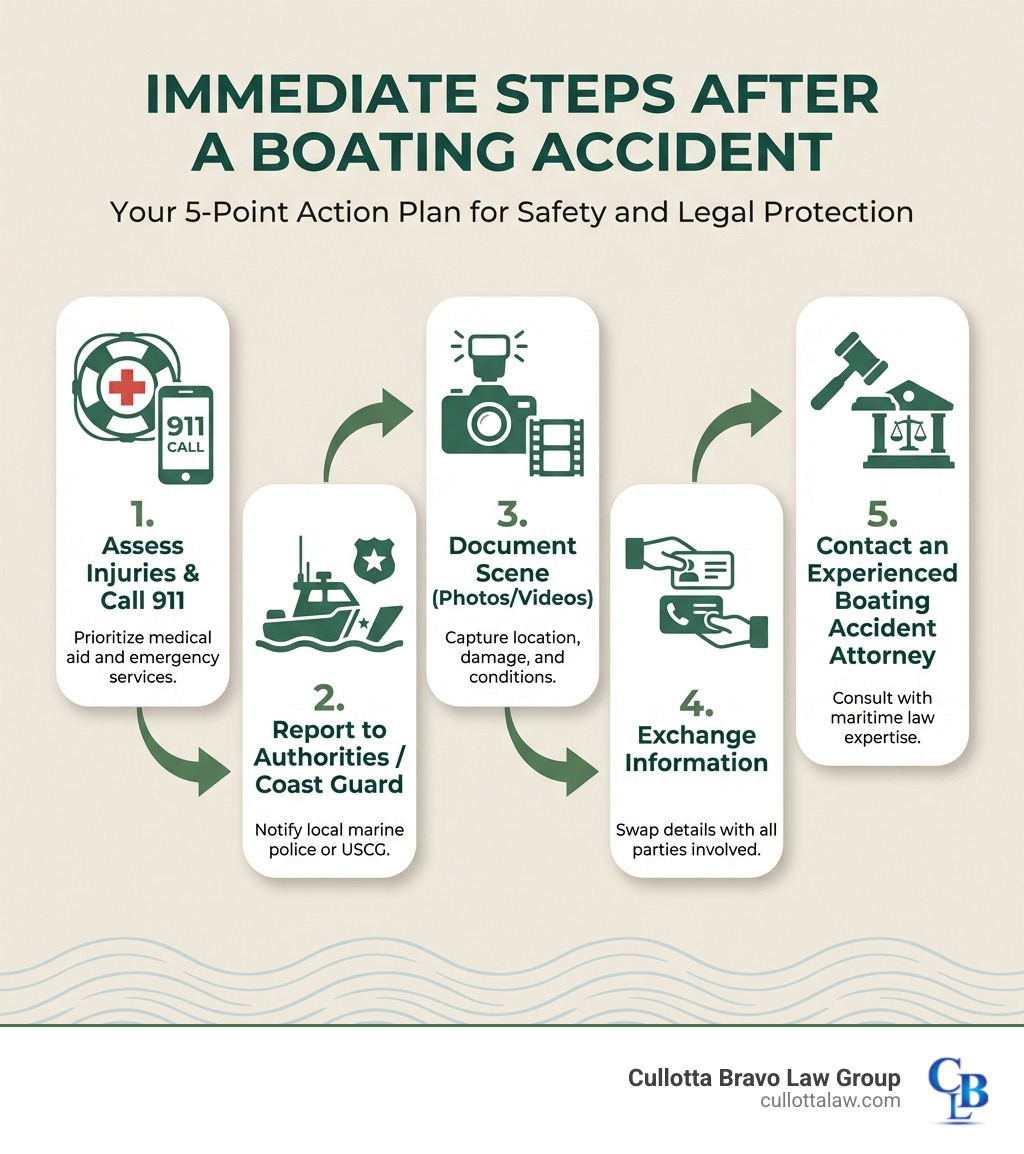
The steps you take after a boating accident can significantly impact your health and any future legal claim. Taking these critical steps protects your rights during a chaotic time.
Prioritize Safety and Document Everything
Your immediate actions are crucial.
- Check for injuries and call 911: Assess everyone for injuries and call for emergency help, even if they seem minor. Serious conditions like internal bleeding can have delayed symptoms.
- Report the accident to the Coast Guard or local authorities: Federal law requires reporting certain boating accidents involving death, serious injury, or significant property damage to the U.S. Coast Guard or Illinois Department of Natural Resources (IDNR). An official report is vital.
- Document the scene with photos and videos: If safe, photograph and video everything: vessel positions, damage, injuries, weather and water conditions, and any debris or hazards.
- Exchange information with other parties: Get names, contact information, boat registration numbers, and insurance details from all other operators and owners.
- Get contact details from witnesses: Independent witnesses provide invaluable, unbiased accounts. Ask for their names and phone numbers.
The Importance of Official Reports and Medical Records
Official reports and medical records are the backbone of a successful claim.
- Why a police or Coast Guard report is vital: An official report provides an objective, third-party account of the incident, including initial findings on fault and contributing factors. Insurance companies almost always require this report.
- Creating a medical record of all injuries: Seek medical attention immediately, even if you feel fine, to identify hidden injuries and create a formal record. Follow all medical advice. This documentation links your injuries to the accident and substantiates your claim.
- How documentation strengthens your claim: This documentation helps prove negligence and calculate your full damages, making it harder for insurance companies to dispute your claim.
- Preserving evidence: Preserve any damaged equipment, torn life vests, or clothing worn during the accident. These items can provide crucial physical evidence.
For more comprehensive information on what to do after an incident, please see our page on Boat Accidents.
Why You Need a Boating Accident Attorney Near Me
The aftermath of a boating accident is a whirlwind of pain, distress, and administrative headaches. While you’re trying to heal, you face insurance adjusters and the daunting task of proving fault. This is why a dedicated boating accident attorney near me is essential.

The Essential Role of a specialized boating accident attorney near me
A specialized attorney becomes your advocate, investigator, and guide through the challenging legal landscape.
- Conducting a thorough investigation: We launch our own investigation, gathering all evidence (photos, witness statements, maintenance logs), consulting with accident reconstruction experts, and reviewing all relevant regulations.
- Identifying all liable parties: Liability can be complex. We investigate the operator, owner, rental company, manufacturer, or even government entities to identify all responsible parties.
- Handling all communication with insurance companies: Adjusters are trained to minimize payouts. We handle all communication to protect your rights and prevent you from jeopardizing your case.
- Calculating the full value of your claim: Your injuries are more than just medical bills. We calculate all damages, including future medical needs, lost income, and pain and suffering, to fight for maximum compensation.
- Navigating complex maritime law: Boating accidents on navigable waters often fall under federal admiralty law, which has different rules than state personal injury law. Our attorneys are skilled in these nuances.
Our role is to alleviate your burden so you can focus on recovery while we aggressively pursue justice. To learn more, read about The Role of a Boat Accident Attorney: Advocating for Your Rights After an Incident.
What Compensation Can You Recover?
You deserve full compensation for all the ways the accident has impacted your life. Damages typically fall into two categories:
Economic Damages: These are quantifiable financial losses.
- Medical expenses (current and future): This covers ER visits, hospital stays, surgery, physical therapy, and any necessary long-term care.
- Lost wages and earning capacity: Compensation for wages you’ve already lost and future income you won’t be able to earn.
- Property damage: Covers the cost to repair or replace your boat or other damaged personal property.
- Out-of-pocket expenses: Costs like transportation to medical appointments or necessary home modifications.
Non-Economic Damages: These are subjective losses that compensate you for the impact on your quality of life.
- Pain and suffering: Compensation for the physical pain and discomfort from your injuries.
- Emotional distress: Includes anxiety, depression, PTSD, and other psychological impacts of the accident.
- Loss of enjoyment of life: If injuries prevent you from participating in hobbies or daily activities you once enjoyed.
In tragic cases, we can pursue Wrongful Death Claims for surviving family members to cover funeral expenses, lost financial support, and loss of companionship.
In rare instances of extreme recklessness, punitive damages may be awarded to punish the at-fault party.
How to Find and Select the Best Local Attorney for Your Case
Choosing the right legal representation is a critical decision after a boating accident, as it can significantly influence your claim’s outcome. You need a boating accident attorney near me who is experienced, trustworthy, and dedicated.
A Step-by-Step Guide to Finding a qualified boating accident attorney near me
Finding the right legal “captain” involves some homework. Here’s our recommended approach:
- Seeking referrals from trusted sources: Ask friends, family, or colleagues for personal injury attorney recommendations.
- Researching online reviews and case results: Look for attorneys with strong positive reviews and a history of handling boating accident cases in Illinois.
- Verifying credentials with the state bar association: Confirm any attorney you consider is licensed and in good standing with the Illinois State Bar Association.
- Scheduling free consultations with multiple attorneys: Use this opportunity to discuss your case, assess their experience, and find a legal team you trust.
Key Questions to Ask During Your Consultation
Come to your free consultations prepared with questions to help you make an informed decision. Here are some we recommend asking any prospective boating accident attorney near me:
- What is your experience with boating accident cases in Illinois? (Look for specific examples and knowledge of maritime law).
- What is your track record of success in cases similar to mine? (Ask about settlements and verdicts).
- How does your contingency fee structure work? (Understand the percentage and any potential expenses).
- Who will be my primary point of contact, and how often can I expect updates? (Clear communication is essential).
- Are you prepared to take my case to trial if necessary? (An attorney willing to go to court often secures better settlement offers).
At Cullotta Bravo Law Group, we welcome these questions. We believe in transparency and building trust with our clients from day one.
Frequently Asked Questions about Boating Accident Claims
Navigating the legal aftermath of a boating accident raises many questions. Here are answers to common inquiries we receive from those seeking a boating accident attorney near me in Illinois.
What is the statute of limitations for filing a boating accident claim in Illinois?
Illinois generally has a two-year statute of limitations for personal injury claims, including those from boating accidents. You must file a lawsuit within two years from the accident date, or you could lose your right to seek compensation forever.
However, special circumstances and exceptions can alter this timeframe:
- If the injured party is a minor, the period may not begin until they turn 18.
- If the at-fault party is a government entity, the notice period can be much shorter.
- In some federal maritime cases, different rules may apply.
Acting quickly is critical. Delaying can cause evidence to be lost and witness memories to fade, making a case harder to build. Contacting a boating accident attorney near me as soon as possible protects your rights and allows us to start an investigation while evidence is fresh.
For more detailed information, you can review More information on Illinois civil procedure.
How much does it cost to hire a boating accident lawyer?
We understand the financial burden after an accident, which is why we work on a contingency fee agreement.
What this means for you:
- No upfront fees or out-of-pocket costs: We cover the costs of investigation, expert witnesses, and court filings.
- You only pay if your case is won: Our fee is contingent upon us securing a settlement or winning a verdict for you. If we don’t win, you owe us nothing.
- The fee is a percentage of the recovery: Our fee is a pre-agreed percentage of the compensation we recover, which is clearly outlined in our agreement.
This arrangement allows everyone, regardless of their financial situation, to access high-quality legal representation.
Will my boating accident case go to trial?
It’s a common concern, but the vast majority of personal injury cases, including boating accidents, settle before trial. Over 95% of cases in Illinois resolve without going to court.
Here’s why:
- The role of negotiation with insurance companies: Our primary goal is to secure a fair settlement through negotiation, presenting a strong case backed by evidence and expert opinions.
- Why your attorney must be prepared for litigation: While most cases settle, trial readiness is crucial. Insurance companies offer fairer settlements when they know your attorney is prepared to go to court. This pressures them to negotiate seriously.
- The final decision to settle or go to court is yours: We will always advise you on the best course of action, but the ultimate decision rests with you. We are here to fiercely advocate for your best interests, whatever you decide.
Our team has decades of experience at the negotiation table and in the courtroom, ensuring we are prepared for any path your case may take.
Conclusion: Taking the Next Step Towards Justice and Recovery
A boating accident can leave you with devastating injuries and an uncertain future. You don’t have to face this alone. Taking swift action to secure expert legal counsel is the first step toward protecting your future and getting the justice you deserve.
At Cullotta Bravo Law Group, we bring over 35 years of experience, specializing in aggressive representation while treating every client with dignity and compassion. Our history of multi-million dollar settlements shows our commitment to fighting for maximum compensation. When you choose us as your boating accident attorney near me in Aurora, Chicago, Naperville, or Joliet, you get a team that understands Illinois maritime law and is dedicated to your recovery.
Don’t let legal complexities overwhelm you. While you focus on healing, we will investigate your case, identify liable parties, handle insurance communications, and calculate all your damages.
Contact a legal expert today to ensure your rights are protected. We offer free consultations, working on a contingency fee basis so you pay nothing unless we win. Let us be your steadfast advocates on the journey to recovery and justice.
Get a Free Consultation with an Experienced Boating Accident Lawyer