

The High Stakes of Motorcycle Accidents
A motorcycle accident injury claim is a complex legal process. When you’re facing severe injuries, mounting medical bills, and a resistant insurance company, understanding the path ahead is crucial to protecting your rights and securing the financial recovery you deserve.
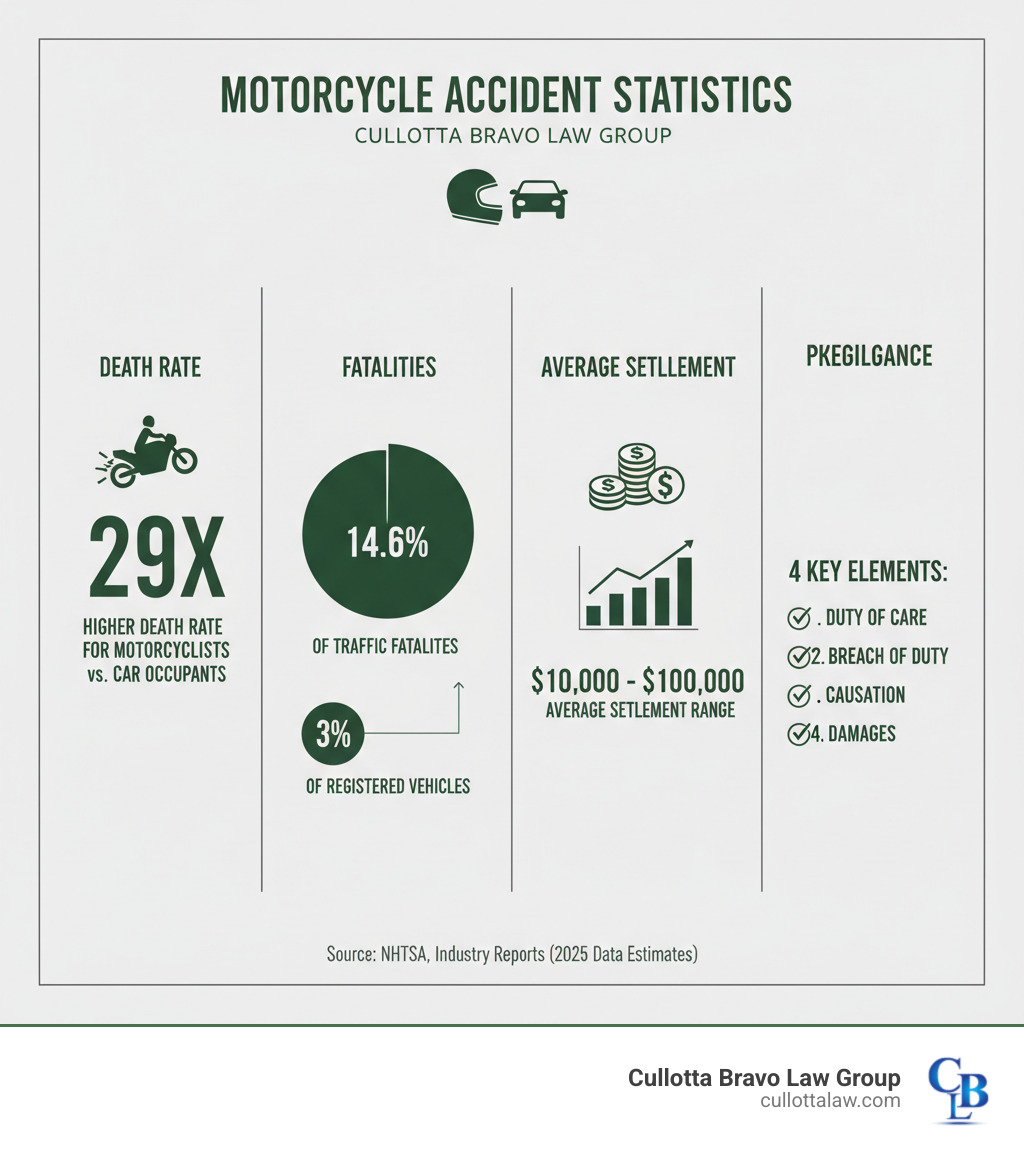
Key steps include documenting the scene, proving the other driver’s negligence, calculating all damages, navigating Illinois’ specific laws, and meeting the strict two-year filing deadline. The statistics paint a sobering picture: motorcyclists are 29 times more likely to be killed in a crash than car occupants and accounted for 14.6% of traffic fatalities in 2022, despite being only 3% of registered vehicles. This vulnerability leads to catastrophic injuries and devastating financial consequences.
Insurance companies often exploit the unfair bias against riders to reduce settlements. As Peter Cullotta, founding partner at Cullotta Bravo Law Group with over 35 years of trial experience, I’ve seen this tactic used repeatedly. My experience handling these cases throughout the Chicagoland area has shown that success requires legal expertise and the ability to combat the stereotypes motorcyclists face.
First Steps After a Crash: Protecting Your Health and Legal Rights
The moments after a motorcycle accident are confusing and frightening, but your actions can make or break your motorcycle accident injury claim.
Your health comes first. Adrenaline can mask serious injuries, so call 911 immediately to get police and paramedics on the scene. This creates an official police report, a crucial piece of evidence. Always get medical attention, even if you feel “okay.” Insurance companies will argue that a delay in treatment means you weren’t seriously hurt. Don’t give them that ammunition.
If you are physically able, document everything with your smartphone.
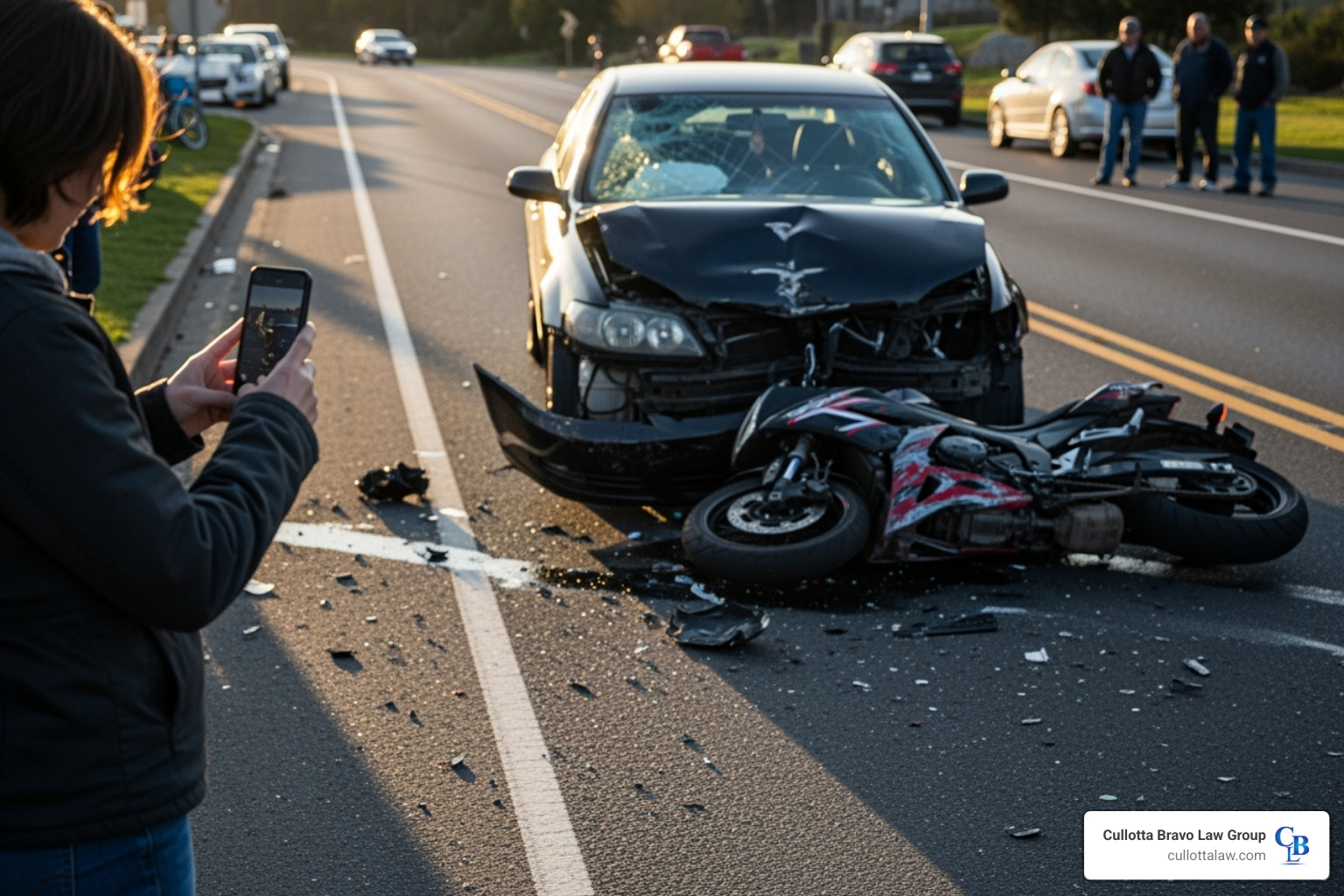
- Take photos of both vehicles, your injuries, skid marks, debris, and street signs.
- Photograph the other driver’s license plate and insurance card.
- Get names and phone numbers from any witnesses. Their unbiased account is invaluable.
Be careful what you say. Don’t apologize or admit fault, as this can be twisted by insurance companies. Stick to the facts. Also, don’t touch your damaged motorcycle beyond moving it from traffic if necessary. The bike is now evidence, and its condition can help experts prove how the crash happened.
Why Immediate Action is Crucial
Taking these steps protects your future for several key reasons:
- Evidence disappears fast. Road crews clean up debris, and witnesses’ memories fade. The photos and information you gather at the scene may be the only way to prove what happened.
- The legal clock starts ticking. In Illinois, you have only two years from the accident date to file a lawsuit. Miss that deadline, and you lose your right to compensation forever. Complex claims take time to prepare.
- Insurance companies are already working against you. While you recover, adjusters are looking for any reason to minimize or deny your claim. Learn more about their strategies in our guide on Insurance Company Denial Tactics.
By documenting everything and seeking immediate medical care, you build a strong foundation for your case. For a complete overview of the legal process, see our guide on the 8 Steps of a Personal Injury Case After an Auto Accident. The sooner you take these protective steps, the stronger your motorcycle accident injury claim will be.
Building Your Case: Proving Negligence in a Motorcycle Accident Injury Claim
Even if you’re a careful rider, you’ll likely face unfair bias after a crash. Insurance companies often portray motorcyclists as reckless to minimize payouts. It’s a frustrating reality we must fight in every motorcycle accident injury claim.
Fighting Stereotypes with Facts
We overcome these stereotypes by building an airtight case based on evidence. As experienced motorcycle accident lawyers serving Aurora, Chicago, Naperville, and Joliet, we know how to present your case effectively. Our team gathers every piece of evidence, sometimes working with accident reconstruction specialists to scientifically demonstrate the crash dynamics. This factual approach makes it much harder to unfairly blame the rider. Learn more in our guide on What’s Motorcycle Accident Reconstruction and How Does It Work?.
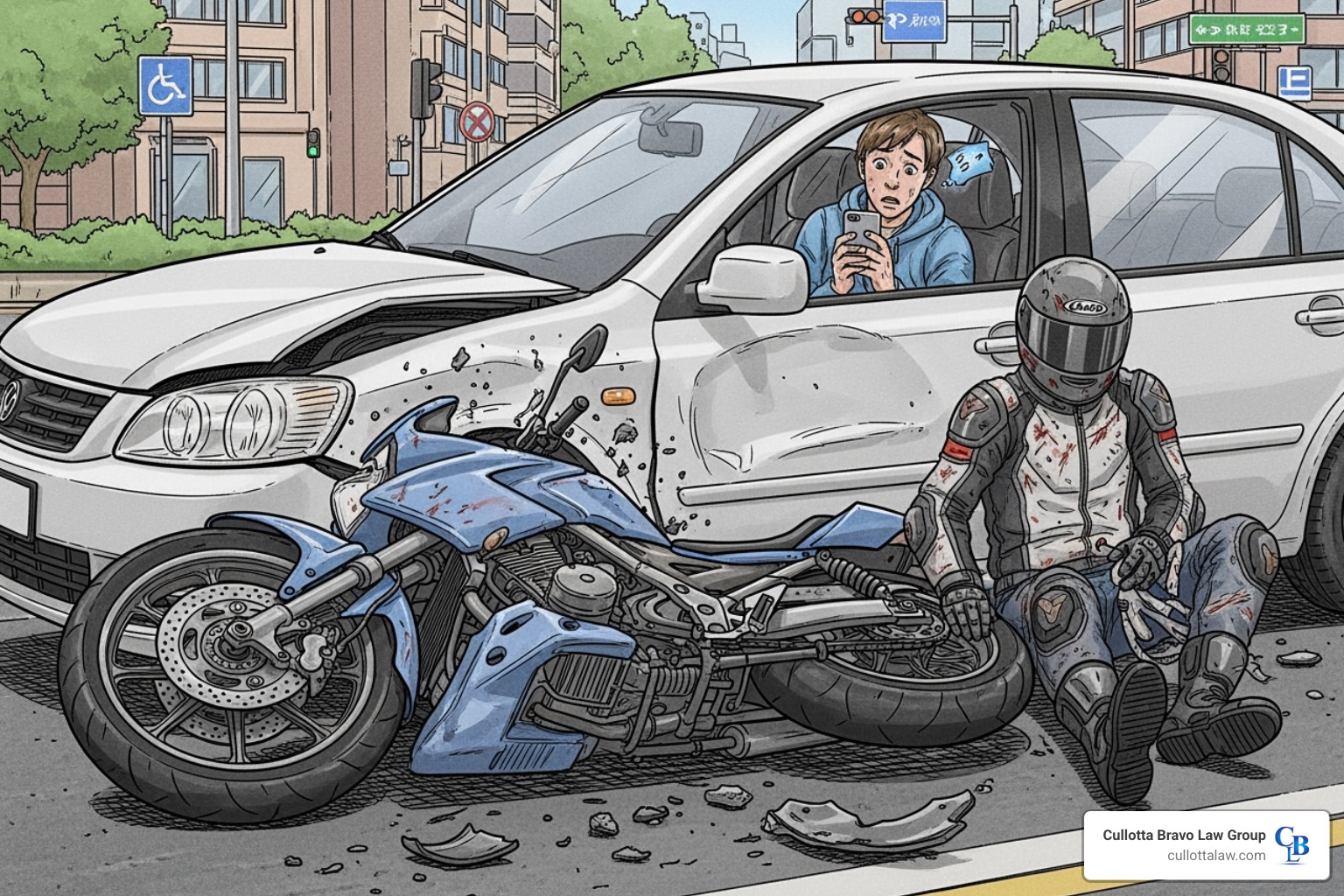
Certain scenarios repeatedly put riders at risk due to driver negligence. Left-turn accidents are particularly common, as drivers often claim they “never saw” the motorcycle. Other major threats include unsafe lane changes, rear-end collisions by distracted drivers (see our resource on Rear-End Accidents in Illinois), and intersection accidents where drivers fail to yield or run traffic signals, as detailed in our guide on Accidents at Traffic Lights.
The Four Elements of Negligence You Must Prove
To win your claim, we must legally prove the other driver was negligent by establishing four elements:
- Duty of Care: Every driver has a legal obligation to operate their vehicle safely.
- Breach of Duty: The driver failed to meet this standard (e.g., by texting, speeding, or running a stop sign).
- Causation: The driver’s breach of duty directly caused the accident and your injuries.
- Damages: You suffered actual losses, such as medical bills, lost wages, and pain and suffering.
What Evidence is Crucial for a Motorcycle Accident Injury Claim?
Building a strong motorcycle accident injury claim requires a solid foundation of evidence. We leave nothing to chance by gathering:
- Police reports: The official account of the accident.
- Medical records: To document your injuries and link them to the crash.
- Photos and videos: From the scene, including damage, skid marks, and any helmet or dash cam footage.
- Witness statements: Independent verification of your account.
- Expert testimony: From accident reconstructionists, medical experts, and economists to explain the crash and its full impact.
A comprehensive evidence package shows the insurance company you have a well-prepared case, making a fair settlement more likely. For more strategies, see our guide on Steps to Take to Maximize a Car Accident Settlement Amount.
Calculating Compensation: Damages and Settlement Value
A serious motorcycle accident doesn’t just hurt your body—it can devastate your finances. Understanding the full scope of compensation in your motorcycle accident injury claim is crucial.
The True Cost of a Motorcycle Accident
The financial clock starts with the ambulance ride and the ER visit. Your motorcycle may be totaled, and lost wages add up quickly while your regular bills continue. These immediate costs are just the tip of the iceberg. The true financial burden often reveals itself over time through physical therapy, multiple surgeries, or lifelong specialized care for injuries like a traumatic brain injury (TBI) or spinal cord damage.
The CDC estimates a severe TBI can cost over $1 million in a lifetime. A high cervical spinal cord injury can exceed $1.1 million in the first year alone. If you can’t return to your job, the lost future earnings can be staggering. We work with medical and economic experts to calculate every dollar you’re owed, ensuring you don’t accept a quick offer that falls short of your actual long-term needs. For more on this, read our guide on Calculating Settlement of a Personal Injury Claim.

Types of Damages You Can Claim
Compensation is divided into categories to reflect all your losses:
- Economic damages: These are quantifiable costs like medical bills (past and future), lost wages, lost earning capacity, and property damage.
- Non-economic damages: These compensate for impacts that don’t have a price tag, such as pain and suffering, emotional distress (anxiety, PTSD), loss of enjoyment of life, and permanent scarring or disfigurement.
- Punitive damages: In rare cases of extreme recklessness (like a drunk driver), these may be awarded to punish the wrongdoer.
Our article on What Determines My Car Accident Settlement Amount? explores these factors in more detail.
How is the Settlement Value of a Motorcycle Accident Injury Claim Determined?
There’s no simple formula for calculating settlement value. While averages range from $10,000 to $100,000, every case is unique. Key factors include:
- Severity of your injuries: This is the primary driver of value. Catastrophic injuries like spinal cord damage or amputations can lead to multi-million dollar verdicts. Learn more about Motorcycle Injuries in Chicago and Your Rights.
- Insurance policy limits: The at-fault driver’s coverage can cap your recovery, which is why we investigate all possible sources of compensation.
- Clarity of fault: A case with clear evidence of the other driver’s negligence will have a higher value.
- Quality of evidence: Strong medical records, witness testimony, and expert reports strengthen your position.
- Your legal representation: Insurance companies know which attorneys are prepared to go to trial and offer settlements accordingly.
NHTSA’s Motorcycle Safety Resources provide statistics that support the serious nature of these accidents, but your case’s value depends on its specific facts.
Navigating Common Legal Problems in Illinois
Motorcycle accident injury claims in Illinois come with unique legal challenges. As a firm with deep roots in the Chicagoland area, including Aurora, Chicago, Naperville, and Joliet, we know how Illinois-specific laws can make or break a case. Insurance companies use these rules and local biases to shift blame and reduce payouts. Our experience handling Personal Injury cases throughout Illinois means we know their playbook and how to counter it.
How Does Illinois’ Comparative Negligence Rule Affect Your Claim?
Illinois uses a “modified comparative negligence” rule, meaning fault can be shared. If you are found partially at fault for the accident, your compensation is reduced by your percentage of blame. For example, if you are awarded $100,000 but found 20% at fault, you would receive $80,000.
Crucially, Illinois has a “51% bar rule.” If you are found 51% or more responsible, you get nothing. Insurance companies exploit this by trying to push your fault percentage as high as possible, arguing you were speeding or lane-splitting. We fight these unfair blame-shifting tactics. Learn more in our article: If a Motorcycle Crash Was Partially Your Fault, Can You Still Receive Compensation for Your Injuries?. For general background, see Nolo’s explanation of comparative negligence.
The Impact of Not Wearing a Helmet
While Illinois law doesn’t require helmets for most adult riders, not wearing one can still affect your motorcycle accident injury claim. Insurance companies will argue “injury causation”—that while their driver caused the crash, your head injuries would have been less severe with a helmet. They use this to try to reduce compensation for head and brain injuries specifically.
This doesn’t invalidate your claim, but it can complicate it. Helmets are proven to reduce the risk of head injury by 69% and death by 37%. Wearing one is not only safer but also strengthens your legal position. For guidance, see our article on Choosing the Right Helmet and Protective Gear for Motorcycle Riding and review the IIHS record of state helmet laws.
What is the Statute of Limitations in Illinois?
In Illinois, you have exactly two years from the date of your accident to file a personal injury lawsuit. This is a hard deadline. If you miss it, you lose your right to compensation, no matter how strong your case is. There are very few exceptions.
Waiting is a terrible strategy. Evidence disappears, witness memories fade, and surveillance footage gets deleted. The longer you wait, the harder it is to build a strong case. Gaps in medical treatment also give insurance companies an opening to argue your injuries weren’t serious. The bottom line: don’t wait. Contact an attorney as soon as possible to protect your rights.
Frequently Asked Questions about Motorcycle Accident Claims
After a crash, you’re bound to have questions. Here are answers to the most common ones we hear from clients in Aurora, Chicago, Naperville, and Joliet.
What are the most common injuries in a motorcycle accident?
Without the protection of a car’s frame, motorcyclists often suffer severe and life-changing injuries:
- Traumatic Brain Injuries (TBI): Even with a helmet, the force of impact can cause concussions or severe brain damage. A severe TBI can require over $1 million in lifetime care. See the National Institute of Neurological Disorders’ Information on TBI.
- Spinal Cord Injuries: Damage to the spinal cord can lead to partial or complete paralysis, with lifetime care costs exceeding $5 million.
- Road Rash: This is not a minor scrape but a severe skin abrasion from sliding on pavement, often requiring skin grafts and leaving permanent scars.
- Broken Bones: Fractures of the legs, arms, and collarbones are common and often require surgery and extensive rehabilitation.
- Internal Injuries: Hidden but life-threatening injuries like internal bleeding or organ damage require immediate medical attention.
The severity of these injuries is why we fight so hard for full compensation in our clients’ motorcycle accident injury claims.
How long does a motorcycle accident settlement take?
There’s no simple answer; every case has its own timeline. A simple claim might settle in months, but most serious motorcycle accidents are complex and take longer for good reason. We need time to investigate thoroughly and typically advise clients to complete medical treatment before settling. This ensures your settlement covers all future complications.
The negotiation process itself can be lengthy, as insurance companies rarely make a fair offer initially. If a fair agreement can’t be reached, going to trial can add one to three years. While we aim for an efficient resolution, our priority is securing the full compensation you deserve, not a quick, inadequate settlement. For more on this, see our article on How Long Will You Wait for Your Car Accident Settlement?.
Are motorcyclists always considered at fault?
Absolutely not. This is a harmful stereotype. In fact, research shows that in 64% of multi-vehicle motorcycle crashes, the other driver caused the accident. Most riders we represent are responsible individuals injured by someone else’s negligence.
Common patterns of driver negligence include:
- Left-turn accidents: A driver turns directly into an oncoming motorcycle’s path.
- Unsafe lane changes: A driver fails to check their blind spot.
- Failure to yield: Drivers at intersections don’t give motorcyclists the right-of-way.
- Distracted or impaired driving: Texting or intoxicated drivers who fail to see riders.
We overcome this bias with hard evidence, focusing on the facts to prove who was truly at fault.
Conclusion: Securing the Justice and Compensation You Deserve
In over 35 years of practice, I’ve learned that motorcycle accident injury claims are among the most challenging cases to handle. The journey from impact to compensation is complex, and you shouldn’t have to steer it alone.
Motorcycle crashes often result in catastrophic injuries with lifelong consequences. Compounding this is the unfair bias against riders, which insurance companies exploit to deny fair compensation. They will argue you were reckless, even when evidence shows another driver was at fault.
This is why experienced legal representation is essential. At Cullotta Bravo Law Group, we know how to fight these battles. We understand the insurance companies’ tactics and Illinois’ specific laws, like the comparative negligence rule and the two-year statute of limitations. We build cases on facts, not prejudice, to secure the justice you deserve.
We treat every client with dignity and respect, fighting for the multi-million dollar settlements that are often necessary to cover a lifetime of care and lost income. You didn’t ask for this accident, and you shouldn’t have to face the aftermath alone while insurance companies work against you.
If you or a loved one was injured in a motorcycle accident in Illinois—whether in Aurora, Chicago, Naperville, Joliet, or beyond—we are here to help. Contact a Motorcycle Accident Lawyer in Aurora for a free consultation to discuss your case. Let us fight for the compensation that reflects the true impact this accident has had on your life.