
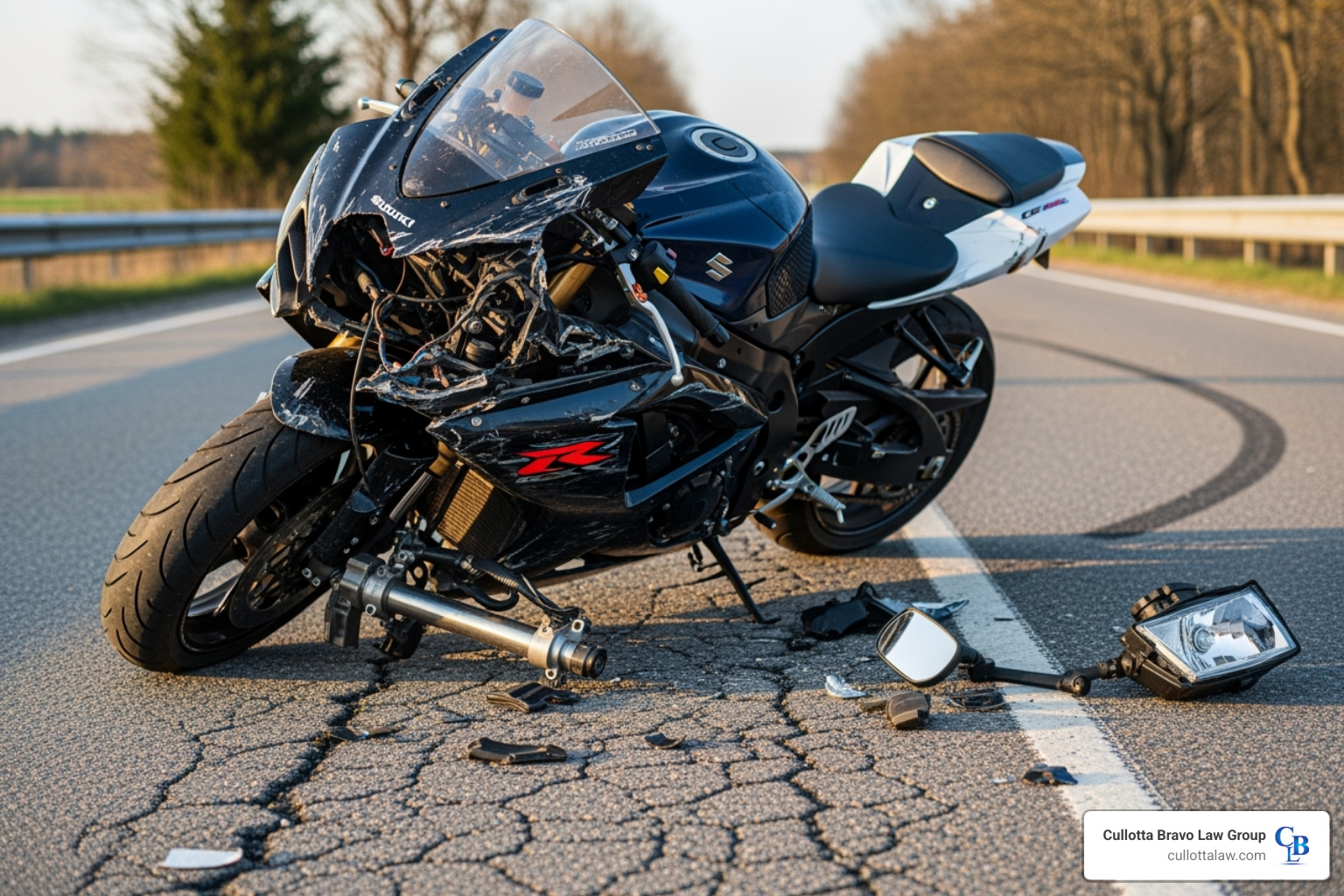
Understanding No-Fault Insurance and How It Affects Motorcycle Riders
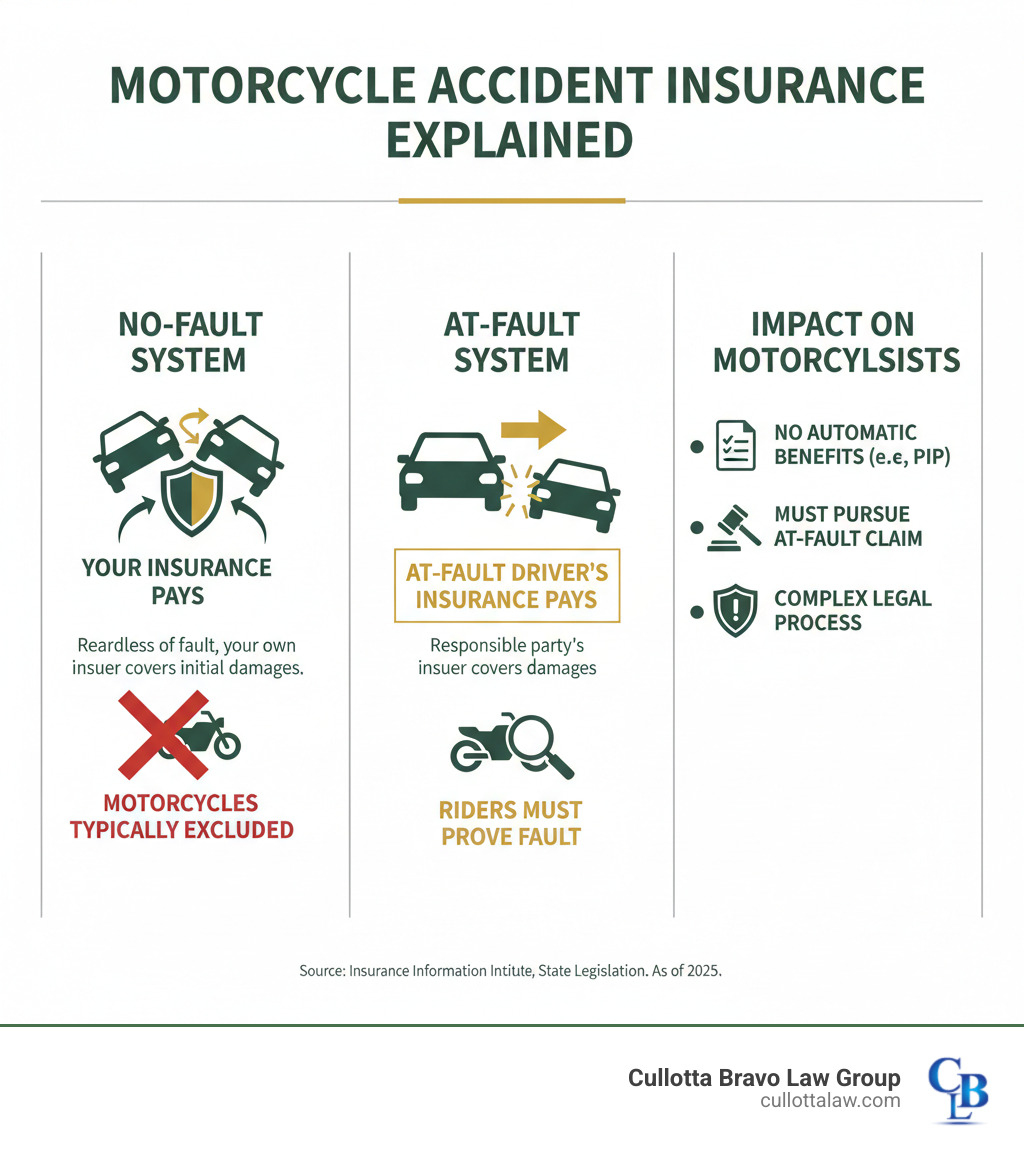
Motorcycle accident no fault claims are confusing because motorcycles are often excluded from no-fault insurance benefits. This leaves injured riders facing a more complex legal process to get compensation.
Quick Answer: Motorcycle No-Fault Rules
- Most states exclude motorcycles from no-fault insurance coverage.
- Riders must prove fault to recover damages from the at-fault driver.
- No automatic benefits like Personal Injury Protection (PIP) for medical bills.
- Pedestrians and car passengers can still claim no-fault benefits in motorcycle crashes.
- Illinois uses comparative negligence – you can recover if less than 51% at fault.
For example, New York State does not grant no-fault coverage to motorcyclists, specifically excluding them from the definition of a “motor vehicle” in its No-Fault Law. This pattern repeats across many states, creating unique challenges for motorcycle accident victims.
Why This Matters for Injured Riders
Without automatic no-fault benefits, you can’t simply file with your own insurance for immediate medical coverage. Instead, you must:
- Prove the other driver was at fault.
- Overcome insurance company bias against motorcyclists.
- Fight for fair compensation without automatic benefits.
- Meet strict legal deadlines and requirements.
I’m Peter Cullotta, founder of Cullotta Bravo Law Group. With over 35 years of experience in personal injury cases, I’ve helped countless motorcycle accident victims understand their rights and secure fair compensation when dealing with motorcycle accident no fault insurance complications.
Understanding No-Fault vs. At-Fault Insurance Systems
How you get compensation after a motorcycle crash depends on your state’s insurance system. For motorcycle accident no fault situations, the rules for riders often differ from those for car drivers.
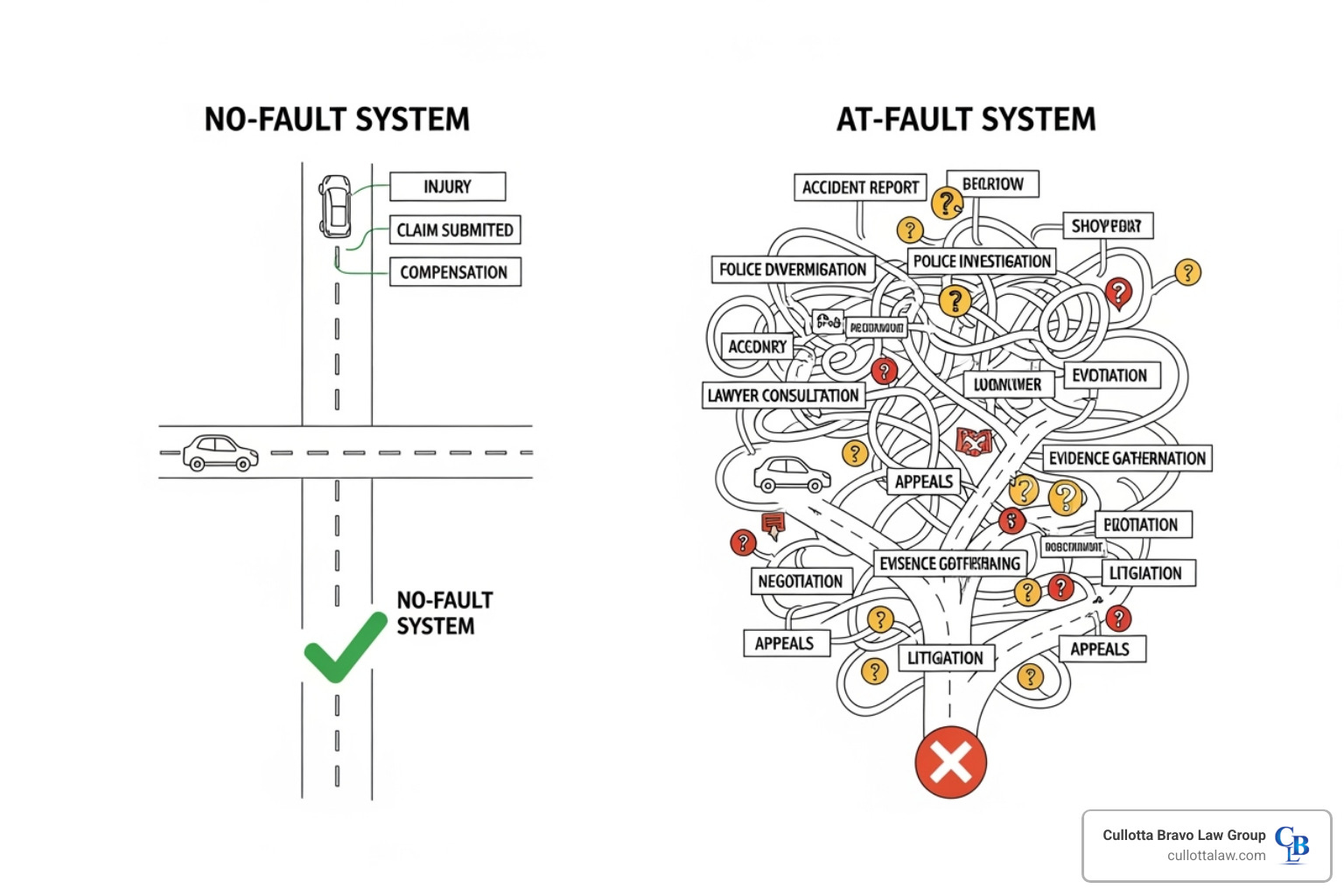
Let’s break down the two main systems.
What is a No-Fault System?
In no-fault states, your own insurance company pays for your initial medical bills and lost wages, regardless of who caused the crash. This coverage, called Personal Injury Protection (PIP), is designed for quick payment of economic losses like hospital visits and missed paychecks.
The main benefit is speed, as you don’t have to prove fault to get your initial bills paid. However, no-fault systems typically limit your right to sue the other driver unless your injuries meet a certain severity threshold. The system prioritizes quick payment over full compensation, which can be a problem for seriously injured victims.
What is an At-Fault (Tort) System?
In an at-fault system, the person who caused the accident is responsible for the damages. To get compensation, you must prove negligence—showing the other driver failed to use reasonable care, causing your injuries.
This system allows you to pursue a wider range of compensation, including pain and suffering and emotional distress. The trade-off is that the process is more complex and time-consuming. You must build a case and deal with the at-fault driver’s insurance company, which will try to minimize its payout.
How Illinois’s “Modified Comparative Negligence” Rule Works
Illinois uses an at-fault system with a crucial rule called modified comparative negligence. This rule determines how much you can recover if you’re partially at fault for the accident.
Under Illinois’s 51% rule, you can recover damages as long as you are less than 51% at fault. Your compensation is simply reduced by your percentage of fault. For example, if your damages are $100,000 and you are found 30% at fault, you can recover $70,000. If you are 51% or more at fault, you recover nothing.
This makes proving the other party’s percentage of fault critical. Insurance companies will try to shift blame onto you to reduce or eliminate their payout. Understanding comparative negligence is key, and we have more information on how fault affects compensation.
| Feature | No-Fault System | At-Fault (Tort) System |
|---|---|---|
| Who Pays First | Your own insurance (PIP/SABs) | At-fault driver’s insurance |
| Proof of Fault | Not required for initial benefits | Required to recover any damages |
| Right to Sue | Limited (only for serious injuries or high damages) | Unlimited |
| Damages Covered | Economic losses (medical bills, lost wages) typically | Economic and non-economic losses (pain & suffering) |
| Goal | Quick compensation, reduced litigation | Full compensation based on fault, broader damages |
Because motorcycles are often excluded from no-fault benefits, most motorcycle accident claims operate under the at-fault system anyway. This makes proving fault essential for riders.
The “Motorcycle Exception”: Why No-Fault Often Doesn’t Apply to Bikers
Even in states with no-fault insurance, motorcycle accident no fault benefits often don’t exist for riders. This is known as the “motorcycle exception.”
While car drivers can turn to their own insurance for immediate PIP benefits, motorcyclists are often left out. The reason is that the higher risk and more severe injuries associated with motorcycles make them a different category for insurance purposes.
The Legal Loophole: Motorcycles Aren’t Always Considered “Motor Vehicles” Under No-Fault Laws
Many state no-fault laws intentionally exclude motorcycles from their definition of a “motor vehicle.” For example, New York’s no-fault law in section 5102(f) specifically excludes motorcycles.
The legislative reasoning is based on cost. Motorcyclists are statistically more likely to suffer severe or fatal injuries in a crash. According to the NHTSA, they are 29 times more likely to be killed than people in passenger cars. To manage the potentially catastrophic costs, insurance companies lobbied for these exclusions, and many states agreed.
Implications for Injured Motorcyclists
If you’re injured in a state with this exception, you have no automatic PIP benefits. This means you must prove fault to get any compensation. Your only option is to pursue a personal injury lawsuit or claim against the at-fault driver to cover medical bills, lost wages, and pain and suffering.
This process takes time, putting injured riders at a significant disadvantage compared to car accident victims who get immediate help. For more insight, see our guide on your rights after a crash.
Who Can Claim No-Fault Benefits in a Motorcycle Crash?
Even if the motorcyclist is excluded, others involved in the crash often are not. The following parties can typically still claim no-fault benefits:
- Pedestrians struck by the motorcycle.
- Passengers in other vehicles involved in the crash.
- Bicyclists struck by the motorcycle.
- Occupants of the car involved in the collision.
As one example shows, “Pedestrians, drivers, or passengers in a vehicle or truck involved in a New York motorcycle accident are eligible for no-fault insurance.” The exclusion is usually specific to the motorcycle operator and passenger. Their claims are processed normally under no-fault rules, while the motorcyclist must proceed through the fault-based system.
Navigating a Motorcycle Accident No Fault Claim and Beyond
Since motorcycle accident no fault benefits typically don’t apply to riders, the steps you take immediately after a crash are critical for protecting your rights and securing fair compensation.
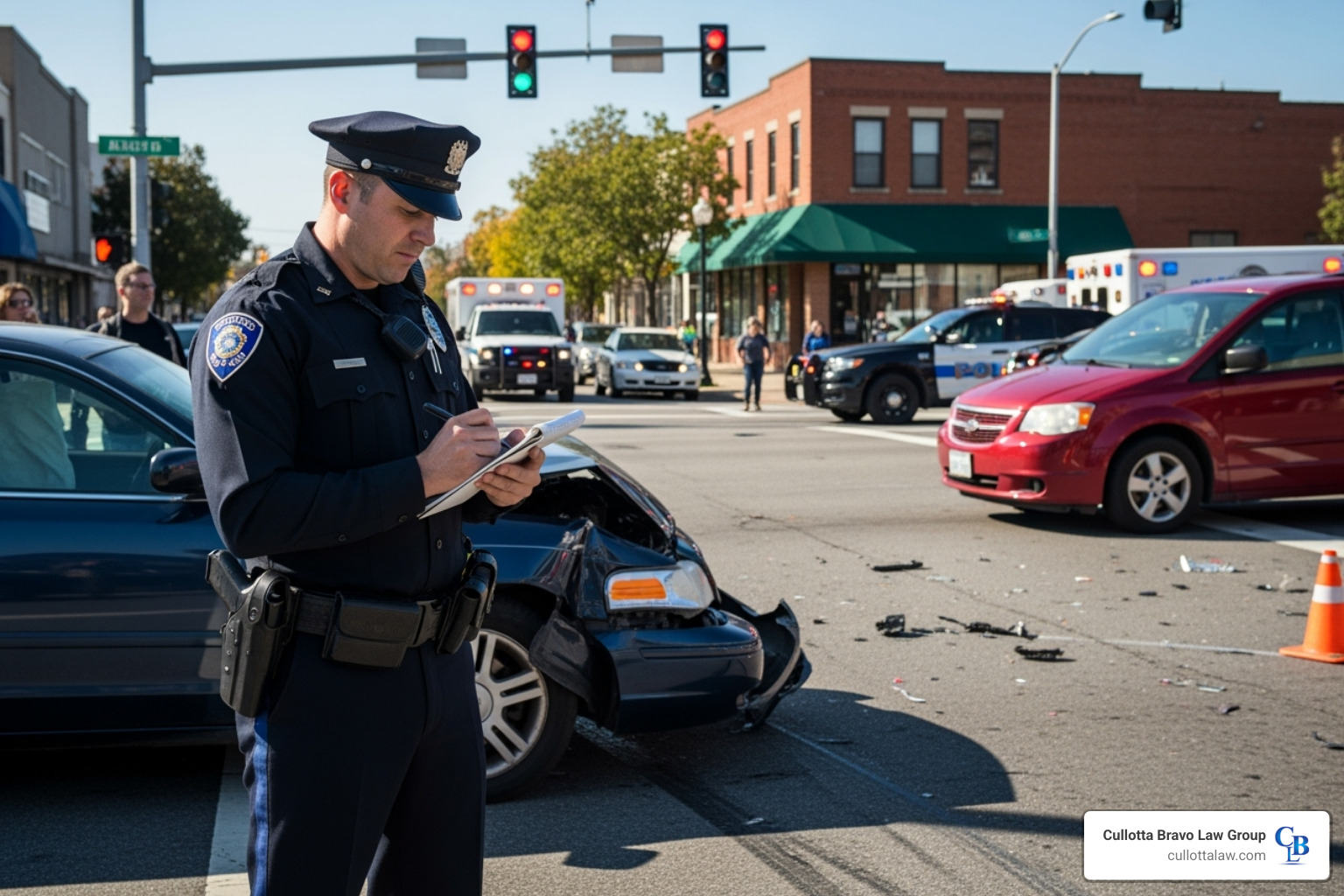
Immediate Steps to Take at the Accident Scene
After a crash, prioritize these actions:
- Ensure safety. Move out of traffic if you can do so safely.
- Call 911. A police report is a vital piece of evidence. In Illinois, you must report accidents involving injury, death, or property damage over $1,500.
- Seek medical attention. Adrenaline can mask serious injuries. A medical record officially links your injuries to the accident.
- Do not admit fault. Avoid saying “I’m sorry” or speculating on what happened. Stick to the facts.
- Gather information. Get the name, insurance details, driver’s license number, license plate, and contact info for all drivers and witnesses.
- Document everything. Use your phone to take photos of vehicle damage, injuries, the scene, road conditions, traffic signs, and debris.
Reporting the Accident and Filing a Claim
Acting quickly is essential, as strict deadlines apply to motorcycle accident claims.
First, contact your own motorcycle insurance company. Your policy may have other important coverages, like uninsured motorist or collision coverage.
Next, we’ll help you report the accident to the at-fault driver’s insurance company. Their goal is to pay as little as possible, so navigating this step carefully is crucial.
Time limits are critical. In Illinois, you have two years from the accident date to file a personal injury lawsuit. Missing this deadline means you lose your right to compensation. The consequences of late reporting can be severe, as insurance companies may argue your injuries aren’t serious or that evidence was lost.
Proving Fault in a Motorcycle Accident No Fault Scenario
Since you can’t rely on no-fault benefits, proving the other driver’s negligence is everything. Key evidence includes:
- Police reports: Provide an official assessment of fault and details of the incident.
- Witness statements: Offer unbiased accounts of what happened.
- Photos and videos: Tell a visual story of the crash scene, damage, and injuries.
- Helmet and dash cam footage: This provides an objective, real-time account that is difficult for insurers to dispute.
- Expert testimony: Accident reconstruction specialists can analyze evidence and provide professional opinions on how the crash occurred and who was at fault. Learn more in our article on What’s Motorcycle Accident Reconstruction and How Does It Work?.
Building a strong case requires gathering this evidence quickly and presenting it effectively to counter insurance company tactics.
Compensation and Overcoming Claim Challenges
When a motorcycle accident no fault exclusion applies, you must understand what compensation to pursue and how to fight for it.
Types of Compensation You Can Pursue
Since you can’t rely on no-fault benefits, we pursue full compensation from the at-fault driver, covering both economic and non-economic damages.
- Economic Damages: These are your tangible financial losses, including current and future medical expenses, lost wages, lost earning capacity, and property damage.
- Non-Economic Damages: These compensate for the non-financial impacts of the accident, such as pain and suffering, emotional distress, loss of enjoyment of life, and loss of consortium for a spouse.
As our research confirms, “Damages include economic damages (medical bills, lost income) and non-economic damages (pain and suffering, loss of enjoyment).” We calculate your current and future losses to build a comprehensive claim. If you’re dealing with an uninsured driver, we explore all options, including Why You Need an Attorney for an Uninsured Motorist Claim.
Dealing with “Biker Bias” and Insurance Companies
Insurance companies often unfairly use “biker bias” against motorcyclists. This is a prejudicial assumption that riders are reckless and responsible for their own accidents. Our research notes, “Biker bias is a prejudicial assumption that all motorcyclists are reckless, cause their own accidents, and deserve whatever misfortune they suffer.”
Insurers exploit this bias to:
- Assign unfair blame to reduce your compensation under Illinois’s comparative negligence rule.
- Make lowball settlement offers that don’t cover your full damages.
- Use delay tactics to frustrate you into settling for less.
- Deny valid claims outright.
We counter this bias with facts, evidence, and by highlighting your responsible riding habits to dismantle harmful stereotypes.
The Role of a Personal Injury Lawyer
When you’re excluded from no-fault benefits and facing insurer bias, an experienced lawyer is essential. We handle every aspect of your case:
- Thoroughly investigating your crash and gathering all evidence.
- Calculating your total damages, including future needs and quality of life impacts.
- Negotiating with insurance adjusters to protect you from their tactics.
- Actively fighting bias by presenting a fact-based case.
- Representing you in court if a fair settlement cannot be reached.
As our research emphasizes, “A lawyer can help you make the best decisions for your case and protect your rights.” With over 35 years of experience, we know how to steer these complex cases. If you need help, Find a top motorcycle accident attorney in Aurora and let us fight for you.
Frequently Asked Questions about Motorcycle Accident No-Fault Claims
Dealing with a motorcycle accident no fault situation raises many questions. Here are answers to the most common concerns we hear from injured riders.
Can I get compensation if the accident was partially my fault?
Yes. Illinois follows a modified comparative negligence rule. This means you can still recover compensation as long as you are found to be less than 51% at fault for the accident. Your final compensation award will be reduced by your percentage of fault.
For example, if your total damages are $100,000 and you are found 30% at fault, you would receive $70,000. However, if you are found 51% or more at fault, you cannot recover any compensation. This is why it’s critical to have a lawyer who can effectively argue against unfair allocations of fault.
What if the at-fault driver has no insurance?
If an uninsured driver hits you, you are not out of options. Your own Uninsured Motorist (UM) coverage is designed for this exact scenario. In Illinois, UM coverage is mandatory for insurers to offer, and it steps in to cover your medical bills, lost wages, and other damages up to your policy limits.
We always recommend carrying as much UM coverage as you can afford, as it provides a crucial safety net against the roughly 14% of drivers who are uninsured. We can help you steer the UM claim process. For more guidance, read our article on Why You Need an Attorney for an Uninsured Motorist Claim.
How long do I have to file a motorcycle accident claim?
In Illinois, the statute of limitations gives you two years from the date of the accident to file a personal injury lawsuit. If you miss this absolute deadline, you lose your right to seek compensation forever.
While two years may seem like a long time, crucial evidence can disappear quickly. Skid marks fade, surveillance footage is erased, and witness memories become less reliable. The sooner you contact an attorney, the sooner we can begin investigating and preserving evidence to build the strongest possible case for you.
We offer a free initial consultation and work on a contingency fee basis, meaning we don’t get paid unless we win your case. There is no reason to delay when your financial future is at stake.
Conclusion
After a motorcycle crash, the insurance system can be daunting. The key takeaway is that motorcycle accident no fault benefits rarely apply to riders, which fundamentally changes your claim process. Most states do not treat motorcyclists the same as car drivers, meaning you will likely need to prove fault to get compensation.
Remember these critical points:
- Biker bias is real and can be used by insurers to unfairly reduce or deny your claim.
- Time is not on your side. The two-year statute of limitations in Illinois passes quickly, and evidence disappears even faster.
- Proving fault is essential. Without it, you cannot recover damages for your injuries.
These complexities make professional legal help vital. You shouldn’t have to battle insurance companies while recovering from serious injuries.
At Cullotta Bravo Law Group, we have over 35 years of experience fighting for riders across Illinois, including Aurora, Chicago, Naperville, and Joliet. We understand insurer tactics and have a proven record of securing multi-million dollar settlements for our clients.
Don’t let the system intimidate you. Contact an experienced Motorcycle Accident Lawyer in Aurora for a free consultation today. We are here to level the playing field and fight for the justice you deserve.