

Overloaded Truck Accident: Causes, Dangers, and Legal Options
When an Overloaded Truck Accident Turns Life Upside Down
An overloaded truck accident can happen in seconds — and leave victims with injuries, bills, and questions that last for years.
Quick answers if you need them now:
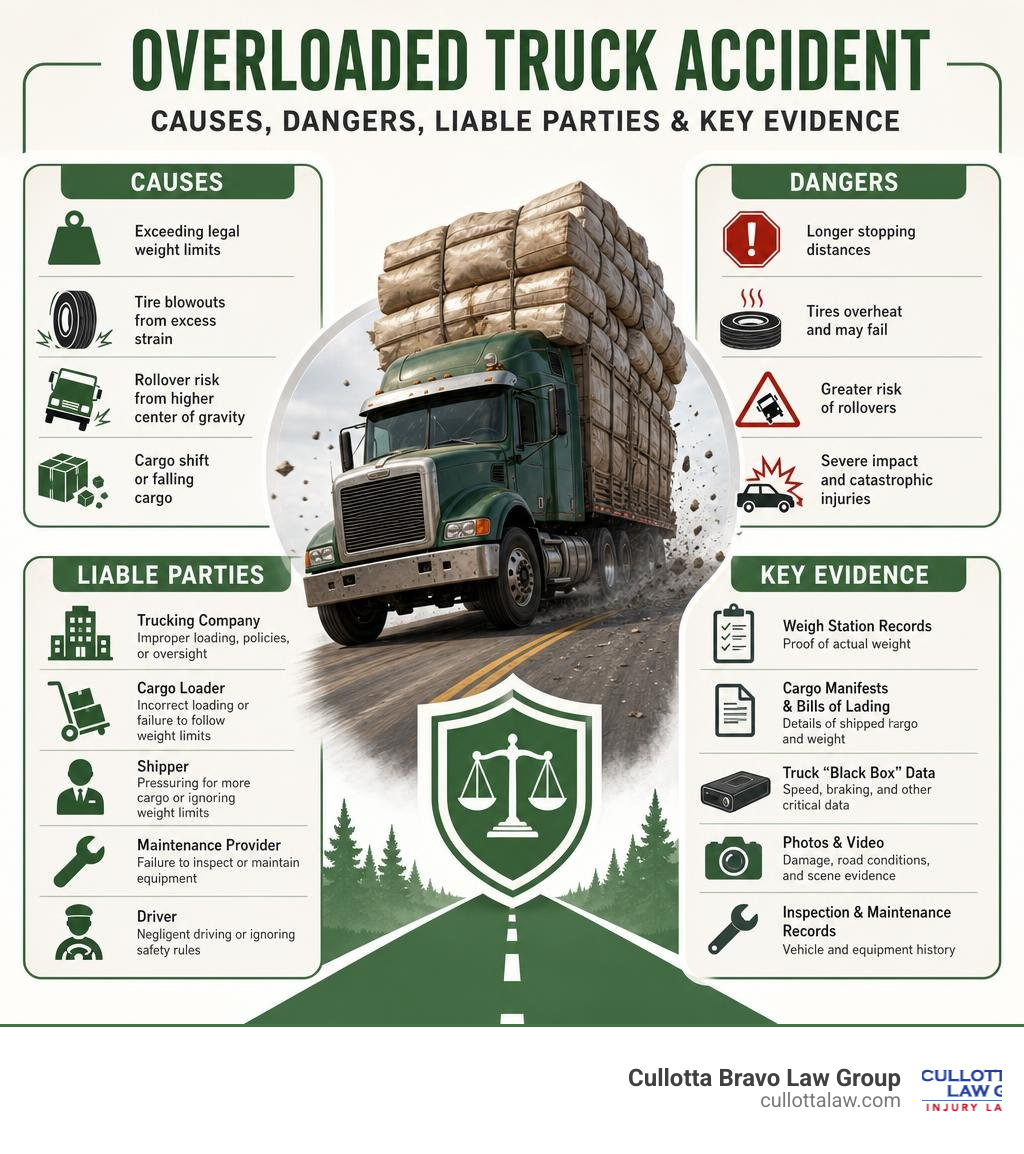
- Overloaded trucks cause accidents through rollovers, tire blowouts, and falling cargo
- Federal law caps most commercial trucks at 80,000 pounds total — many crashes happen when that limit is ignored
- Multiple parties can be liable: the trucking company, cargo loader, shipper, driver, or maintenance provider
- Victims can pursue compensation for medical bills, lost wages, pain and suffering, and more
- Evidence like weigh station records, cargo manifests, and black box data is critical to proving fault
Truck accidents are already among the most devastating crashes on the road. When a truck is carrying more weight than it should, the danger multiplies fast. Stopping distances increase. Tires overheat and fail. Cargo shifts or breaks free. The results can be catastrophic — for drivers, passengers, and anyone else sharing the road.
The numbers tell a grim story. Federal law sets a hard cap of 80,000 pounds for most commercial trucks. Yet some trucking companies push past that limit to move more cargo in fewer trips. In one real-world case, a tipper lorry was found to be carrying 70.67% more than its legal weight limit — the overloading, not a brake failure, caused the crash.
If you or someone you love was hurt in a crash involving an overloaded or overweight commercial truck, understanding what happened — and who is responsible — is the first step toward recovery.
I’m Peter Cullotta, founding partner at Cullotta Bravo Law Group, with over 35 years of trial experience representing injured individuals in Illinois, including victims of overloaded truck accidents involving negligent trucking companies and cargo loaders. This guide walks you through exactly what causes these crashes, who can be held liable, and how to protect your rights.
How an Overloaded Truck Accident Occurs on the Road
To understand why an overloaded truck accident is so violent, we have to look at basic physics. A standard passenger car weighs about 4,000 pounds. A fully loaded commercial semi-truck can legally weigh up to 80,000 pounds. When a trucking company ignores that limit and packs on extra tons, they are essentially launching a massive, uncontrollable kinetic missile down Illinois highways.

Excessive weight alters how a truck behaves in several dangerous ways:
- Impaired Maneuverability: Overloaded trucks are notoriously difficult to steer. The front wheels may lose traction because too much weight is concentrated at the rear of the trailer, making it nearly impossible for the driver to steer out of a dangerous situation.
- Increased Stopping Distance: The heavier the truck, the more braking force is required to stop it. An overweight truck can easily overrun traffic during sudden slowdowns on busy corridors like I-88 or I-55.
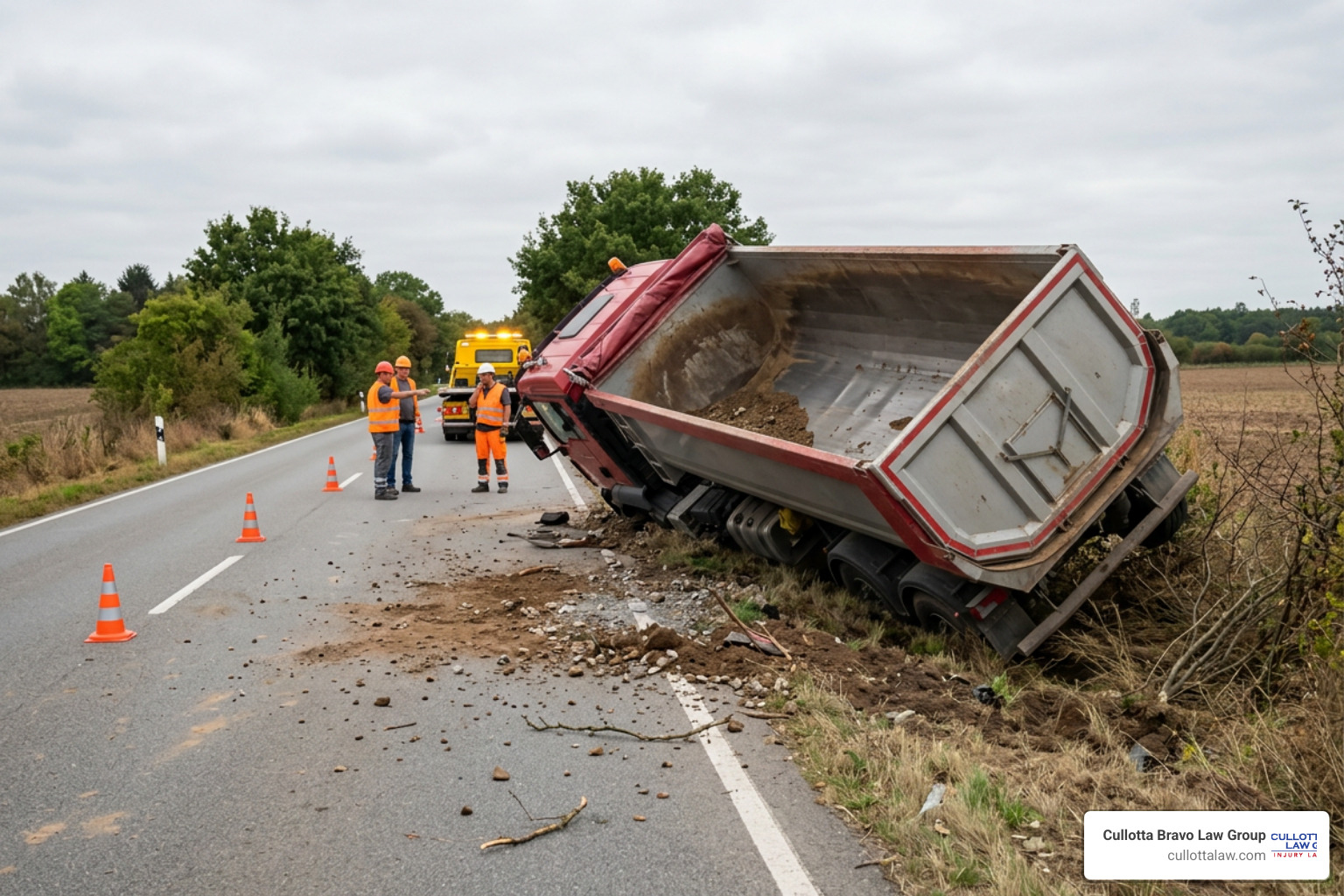
- Extreme Rollover Risks: When a truck carries too much weight, its center of gravity rises, making it highly susceptible to tipping over on sharp curves, exit ramps, or during emergency maneuvers.
We see the real-world consequences of these mechanical strains in news reports globally. For instance, a container truck overturns on expressway at Khandala, traffic disrupted for two hours | Pune News – The Times of India showing how easily these massive vehicles lose balance when carrying heavy, shifting loads on high-speed roads.
Rollovers and Shifting Cargo in an Overloaded Truck Accident
One of the most terrifying aspects of an overloaded truck accident is the suddenness of a rollover. According to the Association for the Advancement of Automotive Medicine (AAAM), errors in loading cargo are the leading cause of truck rollovers.
When cargo is not properly secured, it shifts violently during a turn or sudden lane change. This shifts the truck’s entire center of gravity, pulling the trailer down and taking the cab with it. If the cargo breaks free entirely, it becomes a projectile on the highway, crushing smaller vehicles in its path. You can learn more about your rights in these specific scenarios by reading our guide on what happens if you are injured by cargo falling off a truck.
Mechanical Failures and Tire Blowouts
Overloading places immense physical strain on a truck’s mechanical systems. The tires, suspension, axles, and brakes are only designed to handle specific weight tolerances.
When those tolerances are breached:
- Tires Blow Out: The extreme friction and heat generated by carrying an illegal load cause the tires to disintegrate at high speeds.
- Brakes Fail: The truck’s braking system has to work twice as hard to slow down the excess weight. This leads to “brake fade,” where the brakes overheat and lose their stopping power entirely.
This was tragically illustrated in the Teluk Intan FRU tragedy: Overloaded lorry, not brake failure, to blame, MOT report finds | Malay Mail . Investigators initially suspected mechanical brake failure, but the final government report revealed that the truck was carrying 40,960 kilograms of gravel—exceeding its permitted limit of 24,000 kilograms by a massive 70.67%. The sheer momentum of the overloaded vehicle made it impossible to control during an emergency maneuver, proving that overloading itself is a primary cause of mechanical catastrophe.
Federal Weight Limits and Liability in Overweight Crashes
To protect motorists and preserve infrastructure, the Federal Highway Administration (FHWA) and the Federal Motor Carrier Safety Administration (FMCSA) enforce strict weight limits. In Illinois, these federal rules are closely integrated into state law.
| Weight Category | Legal Limit (Federal & Illinois) | Common Overloading Violations |
|---|---|---|
| Gross Vehicle Weight | 80,000 lbs (combined truck, trailer, and cargo) | Carrying 90,000 to over 100,000 lbs to cut shipping costs |
| Single Axle Weight | 20,000 lbs | Concentrating heavy cargo over a single axle, reducing steering control |
| Tandem Axle Weight | 34,000 lbs | Unevenly distributing heavy machinery or raw materials |
When these limits are violated, it is rarely a simple mistake. It is often the result of systemic negligence. If you have been involved in a collision with an overweight semi, our dedicated team can guide you through the process of filing a claim; read more in our guide on 18 wheeler accidents in Illinois.
Trucking Companies and Cargo Shippers
While the driver is behind the wheel, the trucking company and the third-party cargo shippers often hold the lion’s share of responsibility for an overloaded truck.
Trucking companies have a legal obligation to ensure their fleets comply with federal weight regulations. However, corporate pressure to maximize profits can lead to cutting corners. Shippers may falsify shipping manifests or fail to weigh the cargo before loading it onto the trailer.
The extreme danger of cargo loading errors was put on display in a horrific two people killed in Texas after 350,000 pound load detaches from trailer, crushes vehicle: officials | Fox News incident, where an oversized, ultra-heavy piece of equipment detached from its trailer, instantly crushing a passenger vehicle. This highlights why cargo loaders and shipping companies must be held strictly accountable for their securing and loading practices.
Truck Drivers and Maintenance Providers
Truck drivers also have a duty to perform pre-trip inspections. They must verify that their cargo is secure and that the vehicle’s weight feels manageable. If a driver knows they are hauling an illegal, overweight load but hits the road anyway, they can be held personally liable.
Additionally, maintenance providers can share fault if they fail to identify and repair worn-out brakes, stressed suspension systems, or balding tires that are highly susceptible to failing under heavy loads. Understanding these overlapping areas of liability is crucial, as explored in our resource on tractor trailer crashes in Illinois.
Catastrophic Injuries and Proving Fault
Because of the extreme mass involved in an overloaded truck accident, the physical damage to passenger vehicles is often total, and the injuries to occupants are frequently life-altering.
Common catastrophic injuries resulting from these collisions include:
- Traumatic Brain Injuries (TBI): Caused by violent impacts that fracture the skull or cause severe concussions.
- Spinal Cord Damage and Paralysis: Whiplash, crushed vertebrae, and severed spinal cords can result in permanent paraplegia or quadriplegia.
- Amputations and Loss of Limbs: Limbs can be crushed by collapsing vehicle frames or severed in the crash.
- Severe Burns: Ruptured fuel tanks can lead to intense, fiery explosions.
- Wrongful Death: The sheer force of an overweight truck crash is frequently fatal.
The devastating human cost of commercial vehicle overloading is a global reality. For example, a severe agricultural transport crash occurred when a Andhra Pradesh lorry accident: Nine farm workers killed, 10 others injured after mango-laden lorry overturns near Railway Kodur – The Hindu . The vehicle was carrying an estimated 40 tonnes of mangoes with workers seated on top when it lost control and overturned on a sharp bend, crushing nine people to death. While this occurred internationally, it underscores the universal danger of overloading any commercial haul.
Crucial Evidence in an Overloaded Truck Accident Case
To secure fair compensation, you must prove that the truck was overloaded and that this weight directly contributed to the crash. Because trucking companies move quickly to protect themselves, gathering evidence immediately is vital.
Key evidence we look for includes:
- Weigh Station Records: Records from highway weigh stations showing the truck’s weight shortly before the crash.
- Cargo Manifests and Bills of Lading: Official documentation detailing the weight of the cargo as declared by the shipper.
- Black Box Data (EDR): Electronic data recorders that capture speed, braking patterns, and system failures. To understand how this works, read our article: do commercial trucks have a black box that can be used in a personal injury claim?.
- Logbooks and Maintenance Records: To check if the driver exceeded service hours or if the truck had known mechanical defects.
If you are dealing with the aftermath of a commercial vehicle collision in the western suburbs of Chicago, having a dedicated truck accident lawyer Aurora on your side can make all the difference in preserving this crucial evidence before it is lost or destroyed.
Frequently Asked Questions about Overloaded Truck Accidents
What is the legal weight limit for commercial trucks?
Under federal and Illinois state law, the maximum legal gross weight for a commercial semi-truck is 80,000 pounds, including the weight of the truck, the trailer, and the cargo. There are also specific limits for individual axles: 20,000 pounds for a single axle and 34,000 pounds for tandem axles.
Can a truck driver be held personally liable for an overloaded truck?
Yes. Truck drivers are legally required to perform pre-trip inspections and ensure their vehicle is safe to operate. If a driver knowingly operates an overweight truck or fails to inspect a poorly secured load, they can be held liable. However, the trucking company and the cargo loading company are also frequently named in lawsuits due to corporate pressure and loading errors.
How does overloading affect a truck’s stopping distance?
Overloading dramatically increases a truck’s stopping distance due to basic physics. The increased kinetic energy of the heavy load requires much more braking force to stop. This extra friction can cause the brakes to overheat, lead to “brake fade,” and prevent the driver from stopping in time to avoid a rear-end collision.
Conclusion
An overloaded truck accident is a preventable tragedy. It happens because trucking companies, shippers, or drivers choose to prioritize profit margins over human lives.
At Cullotta Bravo Law Group, we believe that negligent corporations should be held fully accountable for the devastation they cause on Illinois roads. With over 35 years of experience, we provide aggressive, compassionate legal representation to victims in Aurora, Chicago, Naperville, Joliet, and throughout Illinois. We work on a contingency fee basis, meaning you pay nothing unless we win your case.
Don’t fight the trucking companies and their insurance adjusters alone. Contact an experienced Illinois truck accident attorney at Cullotta Bravo Law Group today for a free, no-obligation consultation, and let us help you secure the compensation you deserve.