

Why Understanding Your Personal Injury Settlement Value Matters
A personal injury settlement is a legal agreement where an injured person receives compensation from the at-fault party without going to trial. Here are the key facts:
Key Settlement Facts:
- 95% of personal injury cases settle out of court.
- Settlement amounts can range from thousands to millions of dollars.
- Key factors include injury severity, medical costs, lost wages, and pain and suffering.
- Legal representation increases settlement amounts by an average of 3.5 times.
After an accident, you face mounting medical bills and lost income while dealing with physical pain. This is when understanding your claim’s value is crucial. The settlement process involves negotiating with insurance companies trained to minimize payouts. Their first offers are often far less than what you deserve. Without knowing your claim’s true worth, you risk accepting an inadequate amount.
I’m Peter Cullotta, a trial attorney with 35 years of experience securing millions in personal injury settlement awards for clients in the Chicagoland area. I know that understanding the settlement process is the first step toward securing the fair compensation you need to recover.
What Types of Damages Are Covered in a Settlement?
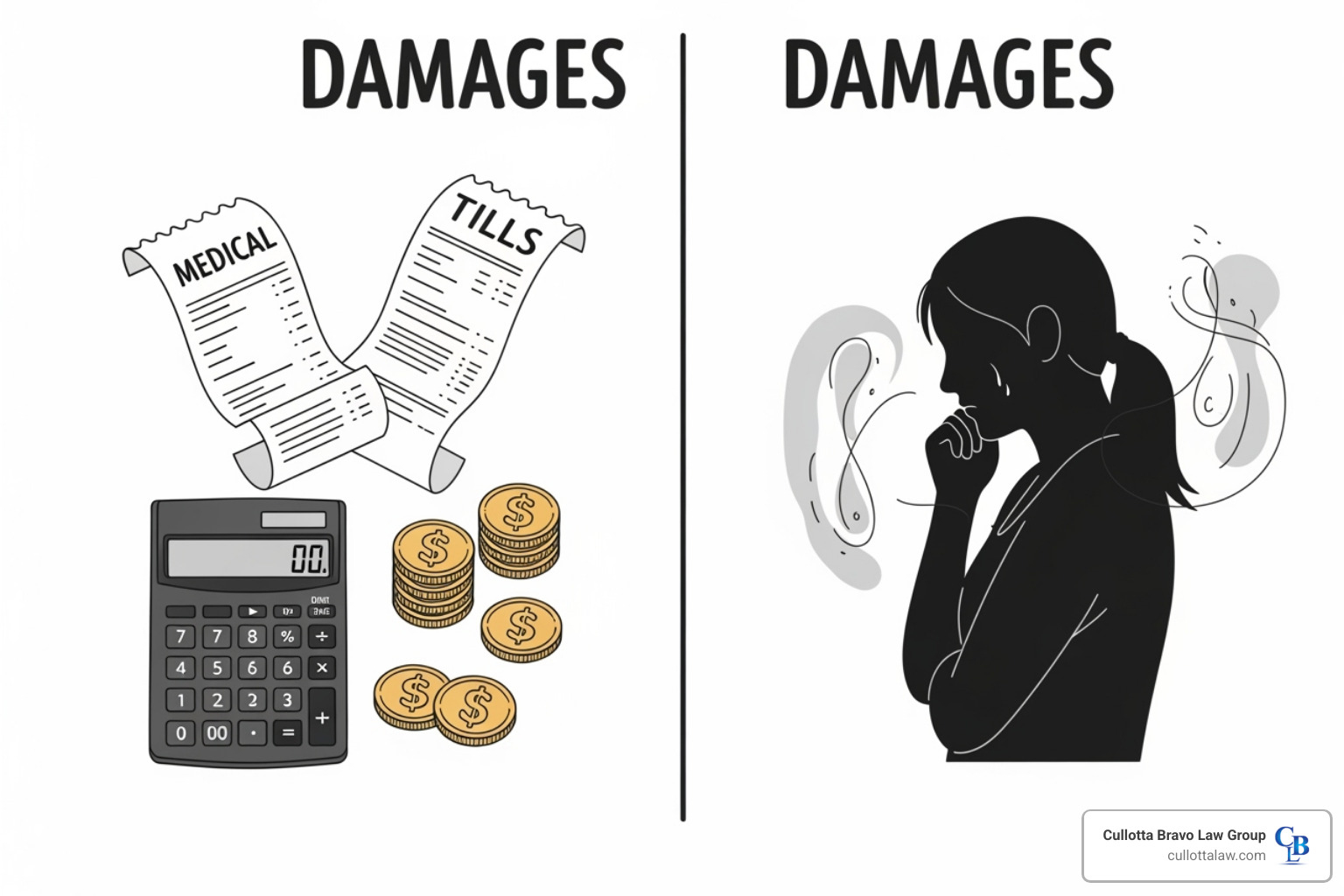
A personal injury settlement aims to make you “whole” again by covering all the ways an injury has affected your life—from tangible bills to intangible suffering. Many people focus only on medical bills, but a fair settlement includes everything.
The law recognizes three main types of damages: economic (financial losses), non-economic (human impact), and punitive (punishment). Understanding these helps you see your claim’s full value. For a deeper dive, see our guide on calculating settlement of a personal injury claim.
Economic Damages (Tangible Losses)
These are the concrete financial costs of your injury, backed by receipts and paperwork.
- Medical Expenses: This includes everything from emergency room visits and ambulance rides to physical therapy and prescriptions. Crucially, we also fight for your future medical care, as ongoing treatments can add up for years. The CDC notes that personal injuries cost the economy hundreds of billions annually, partly due to these long-term costs.
- Lost Wages: Compensation for the income you missed while unable to work, including salary, bonuses, and commissions.
- Loss of Earning Capacity: If your injury prevents you from returning to your old job or reduces your ability to work, this covers the impact on your future income.
- Property Damage: In a car accident, this covers the repair or replacement of your vehicle.
- Rehabilitation Costs: This includes assistive devices, home modifications, vocational training, and psychological counseling.
Non-Economic Damages (Intangible Losses)
These damages compensate for the non-financial ways your injury has changed your life. They are often the most significant part of a settlement.
- Pain and Suffering: Covers the physical pain and emotional distress you’ve endured, from the moment of impact to the daily discomfort and anxiety during recovery.
- Emotional Distress: This can manifest as depression, PTSD, or anxiety directly resulting from the accident.
- Loss of Enjoyment of Life: Compensation for the inability to participate in hobbies, activities, or daily routines you once enjoyed.
- Loss of Consortium: If your injury negatively impacts your relationship with your spouse (e.g., companionship, affection), your spouse may have a claim for these damages.
- Disfigurement: Covers permanent scars, burns, or other physical changes that affect your appearance and self-esteem.
For examples, see our article on back and neck injury cases: what do they settle for?
Punitive damages are rare. They are not meant to compensate you but to punish the at-fault party for extremely reckless behavior, like drunk driving. They can significantly increase a settlement when applicable.
Factors That Influence Your Personal Injury Settlement Value
No two personal injury settlement values are identical. Insurance companies use complex formulas to evaluate claims, but they also look for reasons to pay less. Understanding what drives settlement values gives you a stronger negotiating position. Learn more in our guide on what determines my car accident settlement amount?.

- Injury Severity: The most significant factor. A traumatic brain injury will command higher compensation than a minor fracture. Insurers review medical records and long-term prognosis.
- Clear Liability: When the other party is clearly at fault, settlements are often higher and faster. Disputed fault leads to tougher negotiations.
- Solid Evidence: Strong documentation can be more influential than injury severity. Good evidence makes your claim credible.
- Insurance Policy Limits: The at-fault party’s policy limits can cap your recovery. If damages exceed the limit, we must explore other options like your own underinsured motorist coverage.
The Role of Evidence and Documentation
Strong evidence is the foundation of your claim. We gather and organize all necessary documentation to build a compelling case.
- Medical Records: Every visit, test, and prescription tells the story of your injury and connects it to the accident.
- Police Reports: Provides an official account of the incident, often containing key details and initial fault determinations.
- Witness Statements: Testimony from neutral parties can be incredibly powerful in proving what happened.
- Expert Testimony: Accident reconstructionists and medical experts can explain complex details in terms adjusters understand.
- Photos and Videos: Visual evidence of injuries, vehicle damage, and the accident scene is hard to dispute.
- Employment Records: Pay stubs and employer statements prove lost wages and diminished earning capacity.
- Pain Journal: A daily log of your pain levels and how the injury affects your life helps quantify non-economic damages.
For more tips, see our guide on steps to take to maximize a car accident settlement amount.
How Insurance Companies Minimize Payouts
Insurance companies are businesses focused on their bottom line, not your well-being. After 35 years, I’ve seen all their tactics.
- Lowball Offers: They often start with an offer that is a fraction of your claim’s true value, hoping you’re desperate or uninformed.
- Delay Tactics: They drag out the process by requesting duplicate documents or extending investigations, pressuring you to settle for less.
- Disputing Liability: They will try to shift blame to you. In Illinois, this can reduce or eliminate your settlement under comparative negligence laws.
- Downplaying Injuries: They may claim your injuries were pre-existing or that you’re exaggerating your pain.
- Surveillance: They might hire investigators to film you, hoping to find evidence that contradicts your injury claims.
- Recorded Statements: They will ask for a recorded statement without your lawyer present to trap you into saying something they can use against you. Never give one.
We know these tricks and how to counter them. Read more in our guide on insurance company denial tactics.
The Settlement Process: Timeline and Key Legal Problems
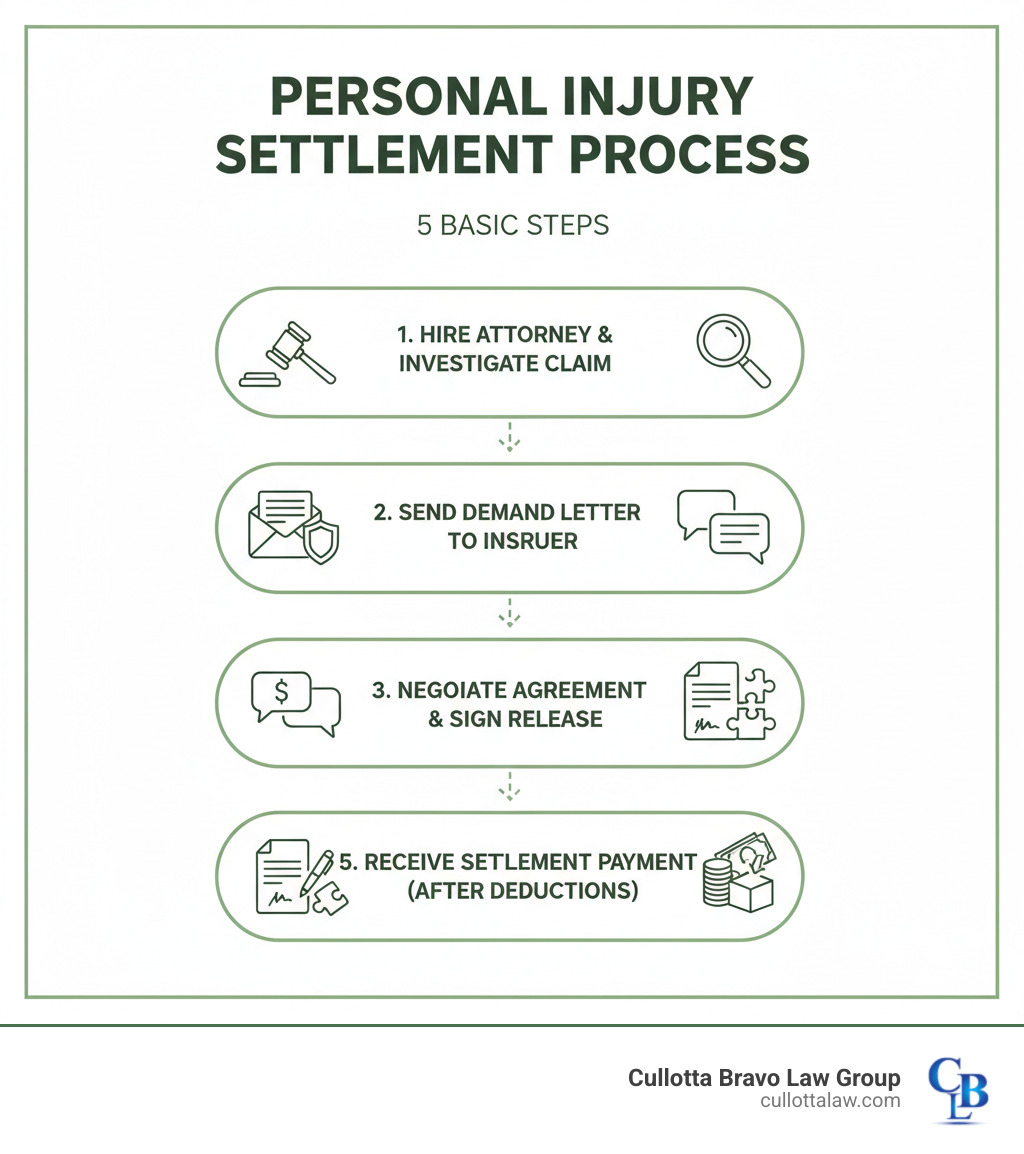
Navigating a personal injury settlement follows a general path, though the timeline can vary. Understanding the stages helps you know what to expect. Our guide on the 8 steps of a personal injury case after an auto accident provides a detailed overview.
The process generally includes:
- Investigation and Treatment: While you focus on medical care, we gather evidence. This can take weeks or months.
- Demand Letter: Once your treatment stabilizes, we send a formal demand to the insurance company outlining your case and its value.
- Negotiation: The insurer will counter our demand. This back-and-forth is where our experience is critical.
- Mediation or Lawsuit: If negotiations stall, we may use a neutral mediator or file a lawsuit. Filing a suit doesn’t guarantee a trial; many cases settle before reaching court, but it provides significant leverage.
Illinois Statute of Limitations
This is a critical deadline you cannot miss. In Illinois, you generally have two years from the date of your injury to file a lawsuit. If you miss this deadline, your right to compensation is permanently lost.
There are exceptions. The findy rule may apply if you don’t realize you’re injured right away; the clock starts when you find (or reasonably should have finded) the injury. The statute of limitations is also different for injuries to minors and cases involving government entities, which have shorter deadlines.
Illinois also has a “modified comparative negligence” rule, which can affect your recovery if you are partially at fault. The bottom line: don’t wait. Contacting an attorney quickly protects your rights.
How Long Does a Personal Injury Settlement Take?
The timeline for a personal injury settlement varies. A simple case might resolve in a few months, while a complex one could take a year or more.
Factors influencing the timeline include:
- Case Complexity: Multiple parties or disputed liability extends the process.
- Injury Severity: We typically wait until you reach “maximum medical improvement” to ensure all future damages are included. Settling too early means leaving money on the table.
- Negotiation Length: Some insurance companies are more difficult to deal with than others, prolonging negotiations.
- Court Backlogs: If a lawsuit is filed, court schedules can add months to the timeline.
Our priority is securing a fair settlement, not just a fast one. Patience often results in a significantly higher recovery. Learn more in our article on how long will you wait for your car accident settlement?.
How a Lawyer Maximizes Your Settlement
Is hiring a lawyer worth it? According to the Insurance Research Council, people with attorneys receive 3.5 times more compensation than those who handle claims alone. That’s the difference between covering your losses and accepting an inadequate offer.
With 35 years of experience, I’ve seen how insurance companies change their approach when dealing with a seasoned attorney. Here’s how we make a difference:
- Accurate Case Valuation: We calculate the full value of your claim, including future medical care, lost earning capacity, and pain and suffering—damages you might overlook.
- Negotiation Expertise: We know the insurance playbook and counter their lowball offers with a compelling, evidence-backed case for full compensation.
- Trial Readiness: Our reputation as trial lawyers who aren’t afraid of the courtroom often forces insurers to make better settlement offers to avoid a costly legal battle.
- Managing Communication: We handle all communication with insurers, protecting you from their tactics, like asking for recorded statements designed to hurt your claim.
We also manage all evidence gathering, from medical records to expert testimony, so you can focus on your recovery. For help choosing the right legal partner, see our article on how do I find the right personal injury attorney in Illinois?.
Understanding Contingency Fees
We work on a contingency fee basis for personal injury settlement cases, so you don’t have to worry about costs while you’re already struggling financially.
- No Upfront Costs: You pay nothing out of pocket. We cover all case expenses, from filing fees to expert witness costs.
- Payment Only Upon Success: We only get paid if we win your case. If you don’t get a recovery, you owe us no attorney’s fees.
- Typical Percentages: Fees typically range from 20% to 40% of the final settlement. This is discussed upfront with no surprises.
- Disbursements: Case expenses we advance are reimbursed from the settlement in addition to our fee.
This arrangement ensures everyone has access to quality legal help. Learn more about how can personal injury attorneys afford to work on contingency?.
Structured Settlements and Tax Implications
You can receive your personal injury settlement as a single lump-sum payment or as a structured settlement with payments spread over time.
A structured settlement provides long-term financial security, which is ideal for those with severe injuries requiring lifelong care. It protects against mismanagement of funds and provides guaranteed income. There is an ethical debate on this topic, as explored in this article: Is it ethical to hand over a personal injury settlement, knowing a client will blow it?.
Generally, compensation for physical injuries is tax-free. However, portions covering lost wages (which replace taxable income) and any punitive damages are typically taxable. We always advise consulting a tax professional to understand your specific obligations.
Frequently Asked Questions about Illinois Settlements
After 35 years and thousands of personal injury settlement cases across our Aurora, Chicago, Naperville, and Joliet offices, we’ve heard every question imaginable. Here are answers to the most common concerns.
What are typical settlement ranges for common injuries?
While every case is unique, general ranges can help set realistic expectations. The key factor is not just the injury type, but how it impacts your daily life and long-term health.
- Soft Tissue Injuries (e.g., whiplash, sprains): Typically settle for $10,000 to $50,000. Severe, chronic cases requiring ongoing therapy can exceed $100,000.
- Broken Bones: Simple fractures may settle for $20,000 to $50,000. Cases requiring surgery average 3.5 times more, often ranging from $50,000 to $150,000+.
- Traumatic Brain Injuries (TBI): Mild TBIs might settle for $50,000 to $100,000, while severe cases requiring lifelong care can result in multi-million dollar settlements.
- Spinal Cord Injuries: These catastrophic injuries often result in settlements from $250,000 to several million dollars, depending on the level of paralysis and lifetime care needs.
In Illinois, car accident settlements without surgery often fall between $10,000 and $25,000, while surgical cases frequently exceed $100,000. For more details, see our guide on what’s the average car accident settlement in Illinois?.
How does Illinois’ “modified comparative negligence” rule affect my settlement?
Illinois follows a “modified comparative negligence” rule (735 ILCS 5/2-1116) that can significantly impact your personal injury settlement. If you are found partially at fault, your settlement is reduced by your percentage of fault. For example, if your damages are $100,000 and you are 20% at fault, you would receive $80,000.
However, if you are found to be 51% or more at fault, you are barred from recovering any compensation. You get nothing. This makes proving the other party’s fault absolutely critical, as insurers will try to shift blame onto you to reduce or eliminate their payout.
How long after signing a release do I get my money?
Signing the release form means you are in the final stretch. The insurance company typically issues the check within a few days to two weeks. Before we disburse your funds, we must resolve any medical liens from healthcare providers or insurers who covered your treatment. We often negotiate these liens down to maximize your net recovery.
After deducting our contingency fee and case expenses, we issue your final payment. The entire process, from signing the release to receiving your money, usually takes a few weeks to a couple of months. We keep you updated throughout this final stage.
Secure the Compensation You Deserve
Recovering from a personal injury is difficult enough without worrying about the legal battle for fair compensation. The personal injury settlement process is complex, and insurance companies have teams dedicated to minimizing your payout. You deserve an equally dedicated advocate fighting for you.
From calculating future medical costs to presenting critical evidence, every step requires legal expertise. Our 35 years of experience have shown that clients with legal representation receive, on average, 3.5 times more than those who go it alone. We know how to counter insurance company tactics and build a case designed to win.
At Cullotta Bravo Law Group, we combine aggressive representation with the dignity and respect you deserve. Our track record of multi-million dollar settlements for clients in Aurora, Chicago, Naperville, and Joliet speaks for itself.
Don’t let an insurance company dictate your future. Let us handle the legal fight so you can focus on healing.
Contact a Naperville personal injury lawyer for a free consultation today. We will review your case, explain your options, and help you understand what your claim is truly worth. We work on a contingency fee basis, so you pay nothing unless we win.