

Serving Up Justice: How Restaurant Workers Get Compensation
What Every Restaurant Server Should Know About Workers Comp
Workers compensation for servers is a no-fault insurance system that pays for medical treatment and replaces a portion of lost wages when you get hurt on the job — and it covers you whether you work full-time, part-time, or even if you earn most of your income from tips.
Here is a quick overview of what workers comp provides for servers:
| Benefit | What It Covers |
|---|---|
| Medical care | Doctor visits, surgery, physical therapy, prescriptions |
| Lost wages | Roughly two-thirds of your average weekly wage, including tips |
| Disability payments | Temporary or permanent, depending on injury severity |
| Death benefits | Paid to families of workers killed on the job |
| Eligibility | Full-time, part-time, temporary, and undocumented workers |
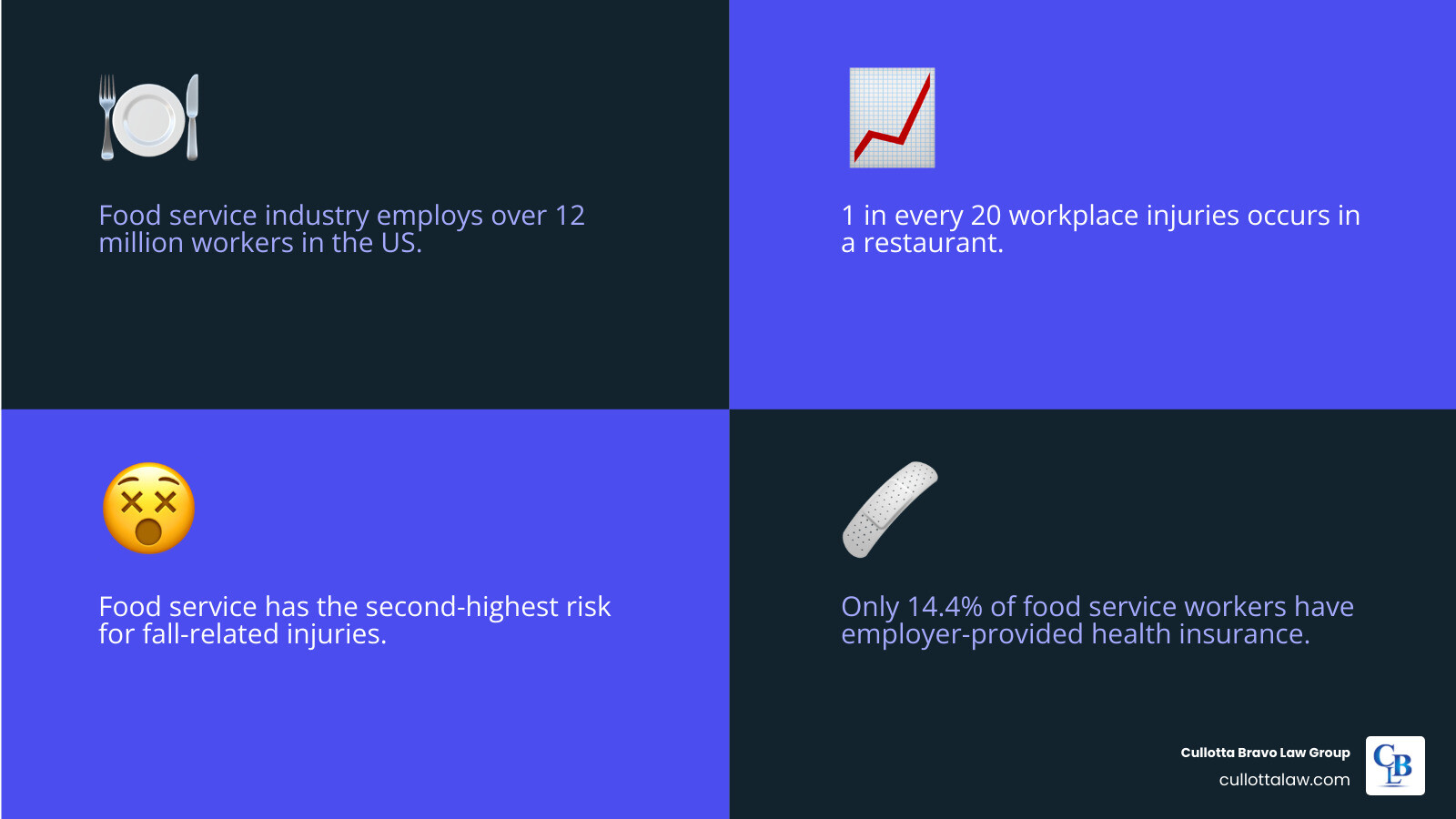
Working as a server is harder on your body than most people realize. The food service industry employs over 12 million people in the United States — and one in every 20 workplace injuries happens inside a restaurant. Food service workers carry the second-highest risk of any industry for fall-related injuries, and that is before you factor in burns, cuts, and the daily grind of carrying heavy trays for hours on end.
Yet only 14.4 percent of food service workers have employer-provided health insurance, compared to nearly half of workers in other industries. That gap makes workers compensation not just useful — it makes it essential.
Despite that reality, many servers never file a claim. Some do not know their rights. Others worry about their immigration status or fear retaliation. And some are simply told by managers to “shake it off and keep going.”
You deserve better than that.
I’m Peter Cullotta, founding partner of Cullotta Bravo Law Group, and over my 35+ years as a trial lawyer in the Chicagoland area, I have fought for injured workers — including servers and restaurant staff — to make sure they receive every dollar of workers compensation for servers they are entitled to under Illinois law. In the sections below, I will walk you through exactly how the system works, what your benefits are worth, and what to do if your claim gets denied.
Understanding Workers Compensation for Servers

When we talk about workers compensation for servers, we are talking about a safety net that exists regardless of who caused the accident. In Illinois, workers’ comp is a “no-fault” system. This means that even if you tripped over your own feet while carrying a tray of appetizers, you are still likely entitled to benefits. You don’t have to prove your boss was “negligent” or did something wrong to get your medical bills paid.
In exchange for this guaranteed coverage, the law generally prevents you from suing your employer in civil court. It is a trade-off: you get faster access to medical care and wage replacement without a long-winded court battle, and the employer gets protection from massive lawsuits.
Under the Illinois Workers’ Compensation Commission guidelines, almost every employer in the state is required to carry this insurance. Whether you work for a small family-owned diner in Aurora or a massive steakhouse in downtown Chicago, you are protected from day one. For more details on the scope of these protections, you can explore our general guide to workers-compensation/.
Eligibility and Workers Compensation for Servers
One of the biggest myths in the restaurant industry is that you only get “workman’s comp” if you are a full-time, “on-the-books” employee. That is simply not true. In Illinois, eligibility is broad.
- Part-time and Temporary Staff: If you only work weekend brunch shifts or you were hired as seasonal help for the holidays, you are still covered.
- Undocumented Workers: Your immigration status does not bar you from receiving workers’ compensation benefits. The law focuses on the fact that you were working when the injury happened, not your paperwork.
- Misclassified Workers: Sometimes restaurants try to call servers “independent contractors” to avoid paying for insurance. If your employer controls your schedule, provides your uniform, and tells you exactly how to do your job, you are likely an employee in the eyes of the law. We provide specialized legal help for misclassified workers to ensure they aren’t cheated out of their rights.
Tipped Employees and the No-Fault System
The “no-fault” aspect is particularly important for waitstaff because restaurants are chaotic. Between a busy kitchen, narrow walkways, and demanding customers, accidents happen in the blink of an eye.
The system provides a financial safety net that covers:
- Medical Expenses: 100% of reasonably necessary care.
- Wage Replacement: Helping you stay afloat while you can’t work.
- Liability Protection: You won’t be personally sued by your employer for an accidental breakage or spill that led to your own injury.
Even if you are earning the tipped minimum wage (which can be significantly lower than the standard minimum wage), the insurance must account for the reality of your take-home pay.
Common Hazards and Injuries in Food Service
Restaurants are obstacle courses. From the front of the house to the “back of the house,” hazards are everywhere. According to industry statistics, one in 20 workplace injuries occurs in a restaurant.
The most common culprit? Slippery floors. Whether it’s spilled soda, grease near the fryers, or freshly mopped tiles, servers face the second-highest risk of falling of any profession. These falls often lead to serious orthopedic injury claims, including broken wrists, hip fractures, and herniated discs.
Physical Strains and Repetitive Motion
Not all injuries happen in a single, dramatic moment. Many servers suffer from “cumulative trauma”—injuries that develop over months or years of repetitive stress.
- Tray Carrying: Balancing heavy, oversized trays on one hand puts immense pressure on the shoulder and neck. This frequently leads to torn rotator cuff claims.
- Silverware Rolling & Constant Movement: The constant motion of rolling silverware, pouring drinks, and clearing tables can lead to repetitive stress injury details like carpal tunnel syndrome or tendonitis.
- Back Strain: Standing for 8 to 12 hours a day on hard surfaces causes chronic lower back pain and spinal issues.
Burns, Cuts, and Workplace Violence
The kitchen is a high-heat environment. Servers often have to reach over hot lines or handle plates that have been under industrial heat lamps.
- Burns: Steam burns from espresso machines or hot oil splashes can cause permanent scarring.
- Cuts: Broken glassware is a daily reality. A server reaching into a glass rack or cleaning up a dropped plate can suffer deep lacerations.
- Workplace Violence: Unfortunately, the service industry also sees a high rate of workplace violence protections. This can range from physical altercations with intoxicated patrons to tragic instances of robbery. If you are a victim of a crime while on the clock, there is specific crime-related employer liability that may apply to your case.
Calculating Benefits for Tipped Employees
Calculating workers compensation for servers is more complex than for a typical office worker because of tips. If the insurance company only looked at your hourly base pay (like $8.40/hour), your benefit check would be tiny.
In Illinois, your benefits are based on your Average Weekly Wage (AWW). This must include your hourly pay plus your tips.
| Wage Type | Standard Employee | Tipped Server |
|---|---|---|
| Base Pay | $1,000/week | $340/week |
| Average Tips | $0 | $600/week |
| Total AWW | $1,000 | $940 |
| TTD Benefit (2/3) | $666.67 | $626.66 |
As noted in reports like Bartenders get injured all the time — and their employers rarely provide insurance, many employers fail to properly report or insure these wages. If you have been underpaid, we can help you fight for partial disability success by ensuring every dollar of your tips is counted.
Temporary and Permanent Disability
The type of check you receive depends on your recovery status:
- TTD (Temporary Total Disability): These are the checks you get while you are off work recovering. They usually equal two-thirds of your AWW.
- PPD (Permanent Partial Disability): If you lose some function in a body part (like a permanent loss of range of motion in your shoulder), you may be entitled to a “settlement” or award based on a “schedule” of injuries.
- PTD (Permanent Total Disability): For life-altering injuries that prevent you from ever working again, permanent total disability provides long-term support.
- Disfigurement: Illinois offers specific awards for permanent scars, which are common in burn or laceration cases for servers.
- Death Benefits: In the most tragic cases, we assist families in securing death-benefits/ to cover burial costs and lost financial support.
The Illinois Claims Process: Reporting and Medical Care
Time is your enemy in a workers’ comp case. In Illinois, you generally have 45 days to notify your employer of an injury. If you wait longer, you could lose your right to benefits entirely.
We recommend notifying your supervisor immediately. Do not just tell a co-worker; make sure a manager knows. Follow up your verbal report with a written one (even a text or email) so there is a timestamped record. For a step-by-step guide, see our article on filing-for-workers-comp-in-aurora-il/.
Filing a Claim for Workers Compensation for Servers
Reporting the injury to your boss is not the same as filing a formal claim with the Illinois Workers’ Compensation Commission. To protect your rights, a formal “Application for Adjustment of Claim” should be filed.
To build a strong case, you should:
- Gather Evidence: Take photos of the spill or the broken stairs that caused your fall.
- Witness Statements: Get the names and numbers of co-workers or customers who saw what happened.
- Document Everything: Keep copies of your “work status” slips from the doctor.
- Avoid Pitfalls: Check out our list of 7-mistakes-that-can-hurt-your-workers-compensation-claim/ to ensure you don’t accidentally tank your own case.
Choosing Your Doctor and Returning to Work
In Illinois, you generally have the right to choose your own doctor. However, your employer may have a Preferred Provider Program (PPP).
- If they have a PPP, you can choose a doctor within that network.
- You also have the right to “opt-out” of the PPP in writing, but this counts as one of your “two choices” of medical providers allowed under the law.
When the doctor says you can return to work but with “light duty” (like no lifting over 10 pounds), your employer must honor those restrictions. If they can’t find a light-duty job for you, they must continue paying your TTD benefits. We stay on top of all legislative changes, including the illinois-workers-comp-coronavirus-rule-repealed/ updates, to ensure our clients are always following current law.
Frequently Asked Questions
Can I get workers’ comp if I am an undocumented server?
Yes. In Illinois, every worker is entitled to medical care and wage replacement regardless of their immigration status. Your employer cannot use your status as a “threat” to prevent you from filing a claim. If they try, they may be subject to severe legal penalties.
How are my tips included in my weekly check?
Your AWW is calculated by looking at the 13 weeks of pay prior to your injury. We look at your gross pay plus the tips you declared. If you have been underreporting tips to the IRS, it can make your workers’ comp check smaller, but we can often use pay stubs and other records to prove your true income.
What should I do if my restaurant claim is denied?
Don’t panic. Claims are denied all the time for silly reasons—like the insurance company claiming your injury was “pre-existing.” You have the right to request a hearing before an arbitrator. Roughly half of workers who appeal a denial end up winning their benefits. Having an aggressive legal team makes a huge difference in these hearings.
Conclusion
If you have been injured while working in the hospitality industry, you don’t have to navigate the complex world of workers compensation for servers alone. At Cullotta Bravo Law Group, we bring over 35 years of experience to the table. We have seen every trick in the book that insurance companies use to underpay servers, and we know how to push back.
We handle these cases on a contingency fee basis, which means you pay nothing out of pocket. We only get paid if we win your case. Whether you are in Aurora, Naperville, Chicago, or Joliet, we are here to treat you with the dignity you deserve while fighting for the maximum settlement possible.
Don’t let a workplace injury ruin your financial future. Contact a personal injury lawyer at Cullotta Bravo Law Group today for a free, confidential consultation. Let us serve up the justice you deserve.