

Slip and fall law: 5 Critical Steps to Win
When Property Hazards Lead to Legal Claims
Slip and fall law governs injuries that occur after slipping or tripping on someone’s property. These cases fall under premises liability, a branch of personal injury law holding property owners accountable for dangerous conditions. To have a valid claim, you must prove the owner had a duty of care to keep the property safe, breached that duty, and this failure caused your injuries, resulting in actual damages like medical bills. A key element is notice: the owner knew or should have known about the hazard.
Not every fall creates legal liability. In Illinois, you must prove the property owner was aware of a dangerous condition—like a wet floor, uneven surface, or poor lighting—and failed to act. Falls are a major cause of injury, sending over 8 million Americans to the ER annually, with slip and fall incidents accounting for about one million of those visits. These accidents can cause broken bones, traumatic brain injuries, and spinal cord damage.
Illinois imposes strict deadlines for these claims. You typically have two years to sue for an incident on private property, but only one year for claims against the government. Missing these deadlines can permanently bar your claim.
I’m Peter Cullotta, and with 35 years as a trial lawyer in the Chicagoland area, I’ve helped countless clients steer these complexities and fight insurance company tactics to secure the compensation they deserve.
The Legal Foundation: Premises Liability and Duty of Care
Premises liability is the legal foundation of every slip and fall law case. It means property owners have a legal duty to keep their property reasonably safe for visitors, as outlined in the Illinois Premises Liability Act explained. This duty of care requires owners to fix known hazards and inspect their property to find problems before they cause foreseeable harm. If an owner knows (or should have known) about a danger and fails to fix it or warn visitors, they can be held liable for resulting injuries. For rental properties, landlords have specific duties for common areas, which you can learn about in our guide on Understanding Landlord Liability in Chicago, Aurora, IL.

What is the Property Owner’s Duty of Care in Illinois?
The level of care owed depends on your visitor status. Invitees (like store customers) receive the highest protection, while licensees (social guests) and trespassers have fewer protections. For lawful visitors, owners must use reasonable care. This involves regular inspection and maintenance to find and fix hazards like broken flooring or poor lighting. If a hazard can’t be fixed immediately, the owner has a duty to warn people with signs or barriers.
Illinois has a specific natural accumulation rule for snow and ice under the Snow and Ice Removal Act (745 ILCS 75/2). Generally, property owners aren’t liable for injuries from naturally accumulated snow. However, they can be liable if they negligently remove snow or ice, creating a new, unnatural hazard. As courts have affirmed, if a structural defect on the property makes ice accumulation worse, it can create a foreseeable risk beyond natural conditions. These cases are complex, as detailed in our article Black Ice and Snow in Illinois: Who’s Liable If There’s an Injury?.
Commercial vs. Government Property Liability
The duty of care differs for various property types. Commercial properties like stores and restaurants owe a higher duty of care because they invite the public for profit. They are expected to conduct regular inspections, and their maintenance logs are key evidence in a lawsuit. They can be held liable if they had actual notice of a hazard or constructive notice (meaning the hazard existed long enough that they should have found it).
Government property rules are much stricter due to the Tort Immunity Act (745 ILCS 10/). This law provides broad immunity, and to sue a government entity, you often must prove gross negligence—a much higher standard than ordinary negligence. Government claims also have shorter notice periods, typically a one-year statute of limitations and sometimes requiring written notice within days of the accident. These rules apply to falls on public sidewalks or roads, a topic we cover in When Your Accident is Due to a Defective Road. Understanding these distinctions is crucial for any slip and fall case.
Building Your Case: Critical Steps and Deadlines
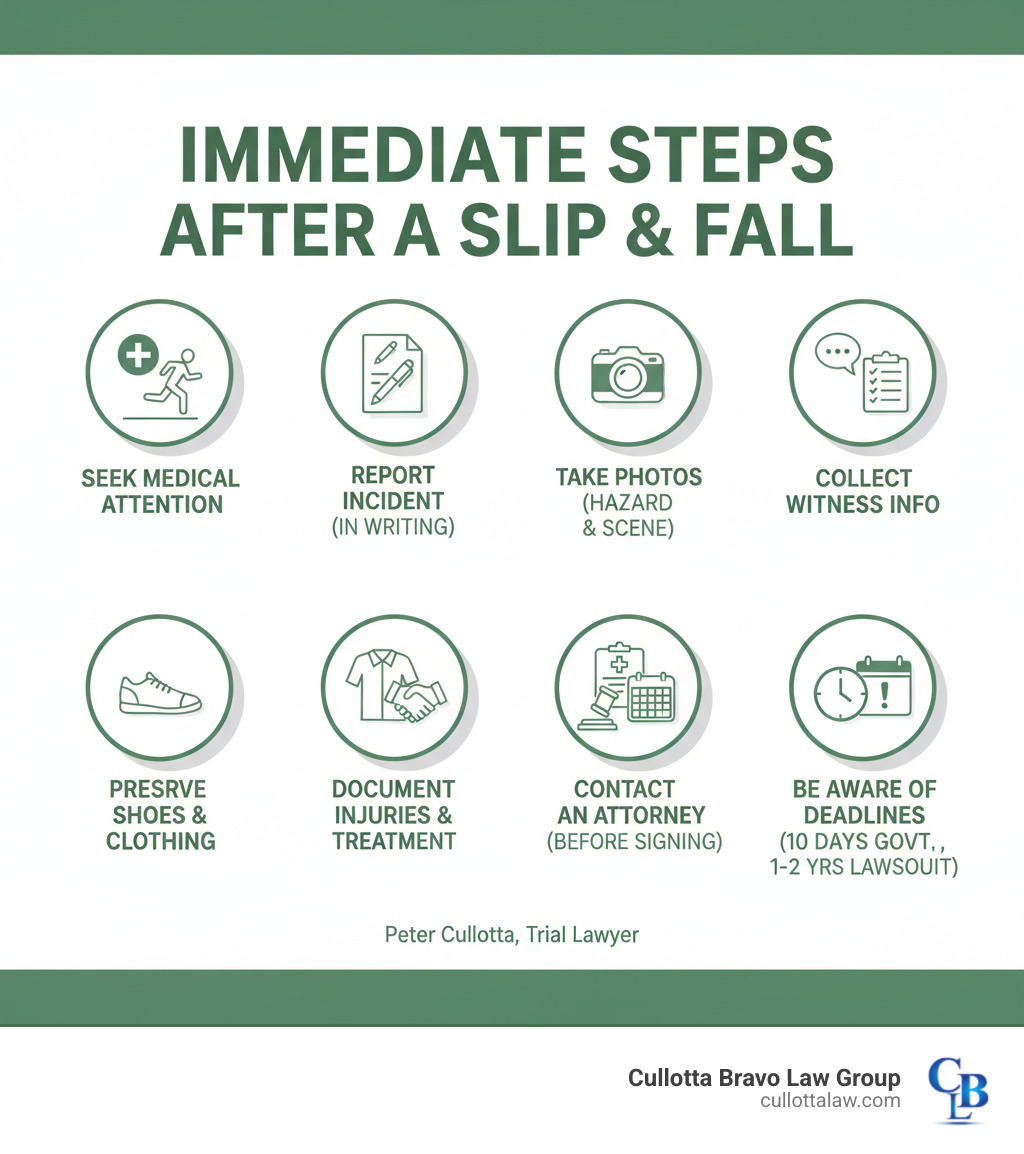
After a slip and fall, the steps you take are critical for building a strong legal case under slip and fall law. Your health is the top priority, so seek immediate medical attention. This not only ensures your well-being but also creates an official record linking your injuries to the fall. Next, report the incident to the property owner or manager. Insist on getting a copy of the written incident report to document that the fall occurred on their property.

Be aware of Illinois’s strict deadlines. You generally have two years to file a lawsuit for personal injury, but this shrinks to just one year for claims against government property. Missing these deadlines will permanently bar your claim. For a full breakdown, see our guide on How long do you have to file a personal injury claim in Illinois?.
Essential Evidence for Your Slip and Fall Law Claim
The strength of your claim depends on the evidence you gather.
- Photographs and videos of the scene: Document the specific hazard from multiple angles before it’s cleaned up or repaired.
- Witness contact information: Independent testimony can corroborate your account of what happened.
- Your footwear and clothing: Preserve the items you were wearing. They may contain evidence that links you to the hazard.
- Medical records and bills: These documents prove the extent of your injuries and their financial cost.
- Accident reports: Obtain a copy of the report you filed with the property owner to ensure its accuracy.
- Weather condition reports: For outdoor falls, historical weather data can be crucial for proving conditions at the time of the incident.
Understanding Notice Periods and the Statute of Limitations
Time is your enemy in a slip and fall law case. The statute of limitations in Illinois is a hard deadline: two years for claims against private parties and only one year for claims against most government entities. Some government claims require written notice in as little as 10 days. Acting quickly is also vital because evidence like surveillance footage and witness memories disappears over time. The consequences of missing deadlines are absolute—your right to sue is lost forever, regardless of the evidence. This is why we always say: You Must Act Fast!.
Proving Fault: Navigating Liability in Slip and Fall Law
Proving fault in slip and fall law requires showing the property owner was negligent. It’s not enough to prove you fell; you must demonstrate they knew or should have known about a dangerous condition and failed to act. Common hazards include wet floors, uneven surfaces like cracked sidewalks or torn carpets, poor lighting, and clutter in walkways. For falls on stairs, see our guide on Staircase Accidents. Weather-related hazards like snow and ice add another layer of complexity, with different standards for residential and commercial properties.
What if I Was Partially at Fault? Illinois’s Modified Comparative Negligence
Insurance companies will often try to blame you for the fall. However, Illinois uses a “modified comparative negligence” rule. This means you can still recover compensation as long as you are found to be less than 51% at fault. If you are 50% or less at fault, your compensation is simply reduced by your percentage of fault. For example, if you are 20% at fault for a $100,000 claim, you can recover $80,000. But if you are found 51% or more responsible, you recover nothing. This rule makes the allocation of fault a critical battleground in your case, similar to what we see in Understanding Comparative Fault in Illinois Car Accident Cases.
Common Defenses Property Owners Use
Property owners use several standard defenses to avoid liability.
- The “open and obvious” defense: They argue the hazard was so apparent that you should have seen and avoided it. However, this defense has exceptions, especially if a distraction was foreseeable. Learn More on the “open and obvious” defense.
- Lack of notice: The owner claims they didn’t know about the hazard. We counter this by proving either “actual notice” (they were told) or “constructive notice” (the hazard existed long enough that they should have found it).
- Blaming the victim: They may assert you were distracted (e.g., on your phone) or wearing inappropriate shoes.
- Assumption of risk: This defense argues you knowingly and voluntarily proceeded despite a clear warning of danger.
An experienced attorney knows how to anticipate and dismantle these common defense strategies.
The Aftermath: Injuries and Fair Compensation
A slip and fall can cause far more than bruised pride. Under slip and fall law, a case often involves severe injuries that disrupt every aspect of a person’s life, leading to physical pain, emotional trauma, and immense financial strain. The aftermath can involve surgeries, extensive physical therapy, and a permanent loss of mobility or independence. Understanding the full scope of these impacts is key to pursuing fair compensation, as detailed in our guide on The Real Cost of a Personal Injury: Medical Bills, Lost Wages, and Non-Economic Damages.
What Types of Injuries Result from Falls?
Falls can cause devastating harm because the body is not meant to absorb such sudden impacts.
- Broken bones: Fractures to wrists, arms, ankles, and hips are common and can require surgery and long-term rehabilitation. Our Broken Bones Attorney page has more information.
- Traumatic Brain Injuries (TBI): A blow to the head can cause anything from a concussion to severe, life-altering brain damage with cognitive and emotional effects. Learn more on our Severe Brain Injury Lawyer page.
- Spinal cord injuries: These can range from herniated discs causing chronic pain to paralysis.
- Back, neck, sprains, and strains: Soft tissue injuries can lead to chronic pain and limited mobility that affects your ability to work and live normally.
What Compensation Can Be Claimed?
Illinois slip and fall law allows you to seek compensation for all your losses. This is about making you whole again.
- Economic damages cover your measurable financial losses. This includes all past and future medical bills, lost wages, and reduced future earning capacity (loss of earning capacity). It also includes out-of-pocket costs for things like medication and home modifications.
- Non-economic damages compensate for intangible losses that diminish your quality of life. This includes pain and suffering, emotional distress, disability and disfigurement, and loss of enjoyment of life—for the activities and hobbies your injury has taken from you.
Calculating the full value of a claim is complex, as insurance companies will try to undervalue your losses. Our approach is explained in Calculating Settlement of a Personal Injury Claim.
Frequently Asked Questions about Slip and Fall Claims
When you’re pursuing a slip and fall law claim, you’re bound to have questions. Here are answers to some of the most common concerns I’ve addressed over 35 years of practice.
How much is my slip and fall case worth?
Every case is unique, so there’s no simple answer. The value of your claim depends on several factors:
- Injury severity: More serious injuries that cause long-term or permanent disability lead to higher values.
- Medical costs: This includes all past and future medical treatment required for your recovery.
- Lost income: We calculate wages you’ve already lost and any impact on your future ability to earn.
- Strength of evidence: Clear proof of the owner’s negligence strengthens your claim.
- Defendant’s liability: Obvious negligence often leads to better settlement offers.
While we can’t give an exact number upfront, we can provide a realistic valuation after reviewing your case. For general context, see our article on Whats the Average Car Accident Settlement in Illinois?.
Do I have to go to court for a slip and fall claim?
Most slip and fall law claims settle out of court. After building your case, we enter a negotiation process with the insurance company. If negotiations stall, mediation or arbitration can provide alternatives to a trial. The high cost and unpredictability of trials mean insurance companies prefer to settle for a fair amount. However, we prepare every case as if it’s going to trial. This shows the other side we are serious and often encourages a fair settlement. If they refuse to be reasonable, we are always ready to fight for you in court. The process is similar to what’s outlined in our 8 Steps of a Personal Injury Case After an Auto Accident.
How can a lawyer help with my slip and fall case?
An experienced attorney handles every aspect of your claim so you can focus on recovery. We act as your investigator, negotiator, and legal guide.
- Investigating the accident: We secure evidence like surveillance footage, witness statements, and maintenance logs.
- Dealing with insurance companies: We handle all communication, protecting you from adjuster tactics designed to minimize your claim.
- Calculating damages: We work with experts to calculate the full value of your economic and non-economic losses, ensuring nothing is overlooked.
- Navigating legal procedures: We manage all paperwork, deadlines, and court proceedings, ensuring your case is handled correctly from start to finish.
Our Experienced Injury Attorney team has the resources and knowledge to build a powerful case on your behalf.
Conclusion
You now know that slip and fall law in Illinois is complex, requiring proof of negligence, adherence to strict deadlines, and a fight for fair compensation. You don’t have to face this challenge alone. Remember these key takeaways: document everything, act quickly before deadlines expire, and understand your rights. Property owners have a duty to keep you safe, and they must be held accountable when they fail.
At Cullotta Bravo Law Group, we have spent over 35 years fighting for clients in Aurora, Chicago, Naperville, Joliet, and throughout Illinois. We know how to counter the tactics insurance companies use to deny or devalue claims. Our track record of multi-million dollar settlements and verdicts was built by taking every case seriously and treating every client with respect.
Let us handle the legal battle while you focus on healing. If you or a loved one was injured in a slip and fall, the clock is ticking. Contact an Aurora Slip and Fall Accident Attorney for a free consultation today. We’ll review your case at no cost, and you won’t pay a fee unless we win.