
Know the Types of Lane Before You Make Your Next Move
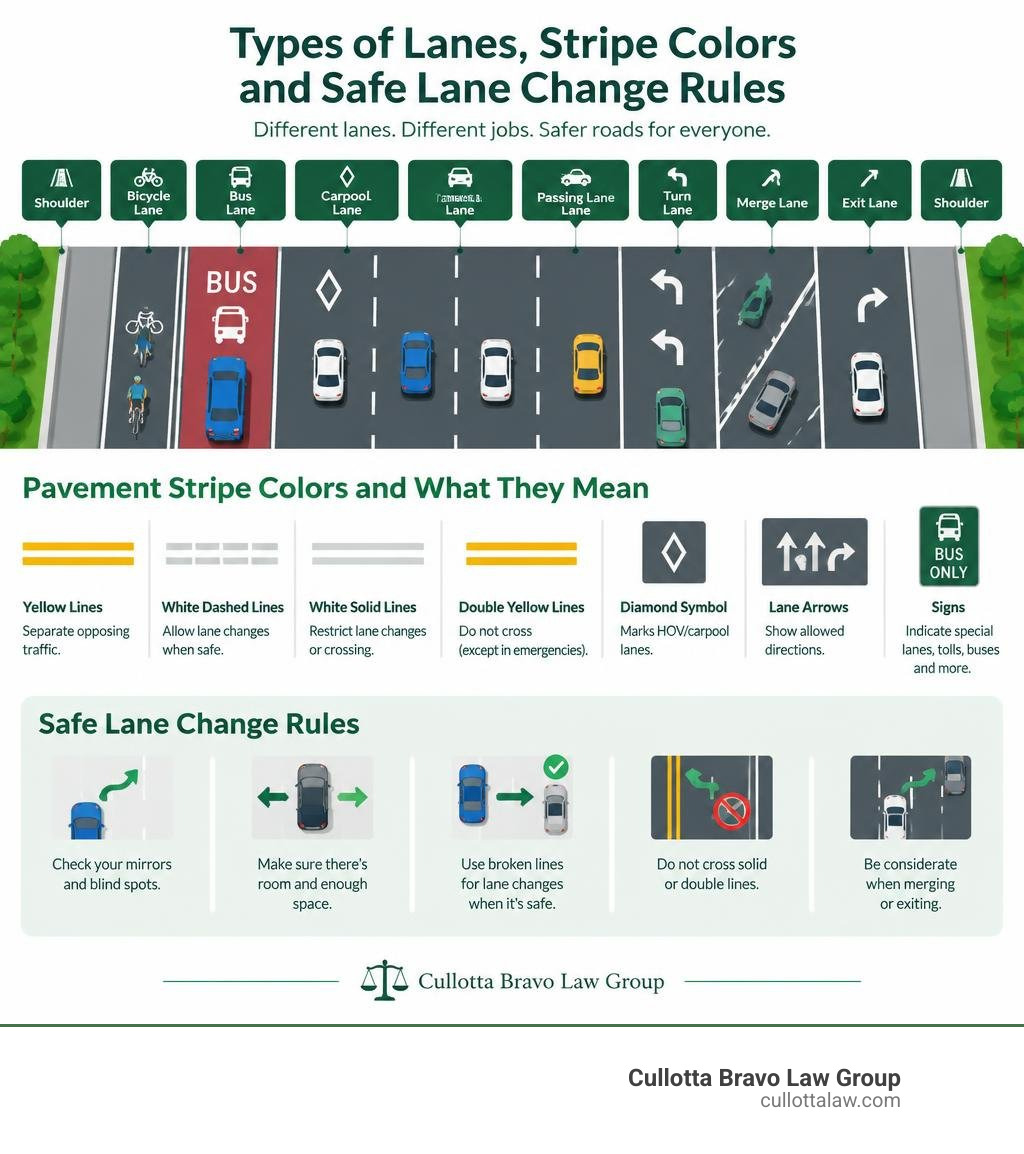
The main types of lane on a highway include travel lanes, passing lanes, turn lanes, merge and exit lanes, carpool lanes, bus lanes, bicycle lanes, and shoulders. Each has a specific job: moving traffic forward, separating vehicles with different speeds or destinations, or reserving space for certain users.
The pavement stripes tell you how to use them. In the U.S., white lines divide traffic moving in the same direction, while yellow lines separate opposing traffic. Broken lines generally allow a lane change when it is safe; solid or double lines restrict crossing. Lane arrows, diamond symbols, and posted signs add rules for turns, HOV access, tolls, buses, and other dedicated uses.
Knowing these markings can help prevent unsafe merges, sideswipes, and head-on crashes. It also matters after a collision, since a driver who crossed a restricted line, failed to yield while merging, or used a lane improperly may be found responsible.
I am Peter Cullotta, a trial lawyer with more than 35 years of experience representing injured people in Illinois and beyond. Understanding the types of lane and the rules drivers must follow can help explain how a serious roadway crash happened.
Primary Functional Types of Lane on Modern Highways
Every roadway corridor relies on specialized design to organize traffic, maintain safe travel speeds, and prevent collisions. According to standard engineering classifications, highway lanes serve distinct operational purposes, balancing capacity and vehicular throughput while reducing friction between turning, merging, and passing vehicles.
| Lane Type | Primary Function | Eligible Vehicles | Standard Pavement Markings |
|---|---|---|---|
| Through (Travel) Lane | Uninterrupted forward traffic movement | All licensed motor vehicles | Broken white line (same direction) |
| Passing Lane | Overtaking slower vehicles on the left | Passing traffic; emergency vehicles | Broken white line on multi-lane roads |
| Auxiliary Lane | Merging, diverging, weaving between interchanges | Entering, exiting, or transitioning vehicles | Dotted or short broken white line |
| Two-Way Left-Turn Lane | Mid-block left turns from either direction | Turning vehicles only (no passing/travel) | Solid outer yellow line with broken inner yellow line |
| HOV / Carpool Lane | Congestion relief for multi-passenger trips | Vehicles meeting minimum occupancy, EV decals | Diamond symbol, buffer lines |
| Dedicated Bike Lane | Safe urban bicycle and micro-mobility transit | Bicycles, e-bikes, authorized micro-mobility | Solid white line with bicycle stencil |
| Hard Shoulder | Emergency pull-off, breakdown refuge | Disabled vehicles, first responders | Solid white right edge line |
Core Travel, Passing, and Auxiliary Types of Lane
At the foundation of any multi-lane highway network are core travel lanes, commonly called through lanes. These lanes accommodate the continuous flow of vehicular traffic continuing straight ahead. On a standard divided highway with right-hand traffic rules, travel lanes are arranged hierarchically:
- Through Lanes: Positioned as the middle and right-hand lanes on multi-lane expressways, through lanes handle standard cruising traffic without forcing drivers into abrupt merging maneuvers.
- Passing Lanes: Located in the leftmost position closest to the median barrier, passing lanes exist strictly for overtaking slower vehicles. Cruising indefinitely in the far-left lane disrupts traffic flow and violates Illinois traffic codes, increasing the risk of rear-end crashes and aggressive tailgating.
- Auxiliary Lanes: These supplemental lanes connect an entrance ramp’s acceleration section directly to the next exit ramp’s deceleration section. They provide a dedicated weaving area, allowing motorists to match expressway speeds or slow down without disrupting through-lane capacity. Drivers must consistently monitor their blind spots when transitioning across these active merge zones.
Turn Lanes, Slip Lanes, and Interchange Ramps
Intersections and interchanges present the highest density of vehicular conflict points. Dedicated turning lanes isolate decelerating traffic from through traffic, reducing severe rear-end impacts:
- Dedicated Left- and Right-Turn Lanes: Marked with directional arrows and word stencils, these lanes store vehicles waiting for traffic signals or gaps in oncoming traffic. Local engineering standards, such as municipal roadway specifications in Aurora, establish precise curb radius and queue storage lengths to prevent turning lines from spilling back into travel lanes.
- Two-Way Left-Turn Lanes (TWLTL): Situated in the center of multi-lane commercial corridors, these lanes allow drivers traveling in either direction to make mid-block left turns into driveways. Drivers must never use them as an acceleration or travel lane.
- Slip Lanes and Interchange Ramps: Slip lanes (often called filter lanes) allow right-turning vehicles to bypass a signalized intersection smoothly. On controlled-access highways, on-ramps and off-ramps provide controlled transition speeds, preventing severe speed differentials between local streets and high-speed corridors.
Specialized and Managed Highway Lane Systems
Urban corridors frequently face severe congestion that cannot be solved by simply paving wider roads. As cataloged in the FHWA specialty lane inventory, managed lanes implement active operational strategies—such as vehicle restrictions, dynamic pricing, and time-of-day allocations—to optimize capacity during peak commuter hours.
Managed and Dedicated Types of Lane: HOV, HOT, and Busways
Dedicated lanes prioritize high-efficiency transit and multi-passenger vehicles over single-occupancy cars:
- High-Occupancy Vehicle (HOV) Lanes: Marked with distinct white diamond pavement symbols, HOV lanes require vehicles to carry a minimum number of passengers (usually 2+ or 3+ individuals). They encourage carpooling and reduce overall vehicle emissions.
- High-Occupancy Toll (HOT) Lanes & Express Toll Lanes: HOT lanes allow single-occupancy vehicles to access carpool lanes by paying a dynamically adjusted toll based on real-time traffic volume.
- Bus-Only Lanes and Transitways: Reserved exclusively for municipal buses and authorized emergency services, bus lanes keep public transit on schedule by bypassing general-purpose gridlock.
- Dedicated Truck Lanes: These facilities segregate heavy commercial trucks from passenger vehicles on high-volume freight corridors, substantially reducing severe pinch-point collisions.
Reversible Lanes, Climbing Lanes, and Express-Local Configurations

Geometric configurations adapt roadways to challenging topography and directional commuting surges:
- Reversible (Tidal Flow) Lanes: Reversible lanes change direction based on morning and evening rush-hour volumes, directed by overhead gantry signals and lane-control lights.
- Climbing (Crawler) Lanes: On steep highway inclines, heavy commercial trucks lose momentum. Climbing lanes provide an extra right-hand lane for slow-moving freight, allowing faster passenger vehicles to ascend unimpeded.
- Express-Local Systems: High-volume interstates frequently separate through-traffic from local traffic. Express lanes bypass intermediate suburban exits, while local lanes handle frequent entering and exiting vehicles, minimizing unsafe high-speed lane weaving.
Protected Bikeways and Non-Travel Shoulder Lanes
Modern Complete Streets initiatives incorporate non-motorized infrastructure alongside motor vehicle lanes. According to urban bikeway classifications, bicycle networks range from painted lanes to physically separated cycle tracks and buffered lanes that protect cyclists from adjacent traffic.
Non-travel vehicle lanes include:
- Hard Shoulders: Paved refuge areas alongside the roadway boundary designed for emergency stops, broken-down vehicles, and first-responder access.
- Part-Time Shoulder Use (PTSU): During peak congestion, traffic management centers may open hard shoulders as active travel lanes, using digital dynamic signage to indicate when shoulder driving is permitted.
- Parking and Fire Lanes: Dedicated curbside zones designated for stationary vehicle storage or reserved exclusively for emergency firefighting apparatus.
Understanding Highway Pavement Markings and Stripe Colors
Pavement markings serve as a universal language for road users. Regulated by the Federal Highway Administration’s Manual on Uniform Traffic Control Devices (MUTCD) and state guidelines like the Illinois DOT safety roadway features, stripe colors and line patterns define boundaries, establish right-of-way, and maintain traffic discipline.
Longitudinal Lines: Yellow vs. White Striping Rules
Longitudinal pavement markings run parallel to the direction of travel, using color coding to communicate traffic directionality:
- Yellow Markings: Delineate the separation of traffic flows moving in opposite directions. A yellow line should always remain on the driver’s left side on a standard two-way roadway. Yellow is also used for the left-hand edge line on divided one-way roadways and dual-carriageway medians.
- White Markings: Separate traffic lanes moving in the same travel direction. White lines are also used for the right-hand outside edge line (fog line), pedestrian crosswalks, stop lines, and pavement channelization arrows.
Solid, Broken, and Double Line Safety Regulations
Line patterns dictate whether changing lanes or passing is legal:
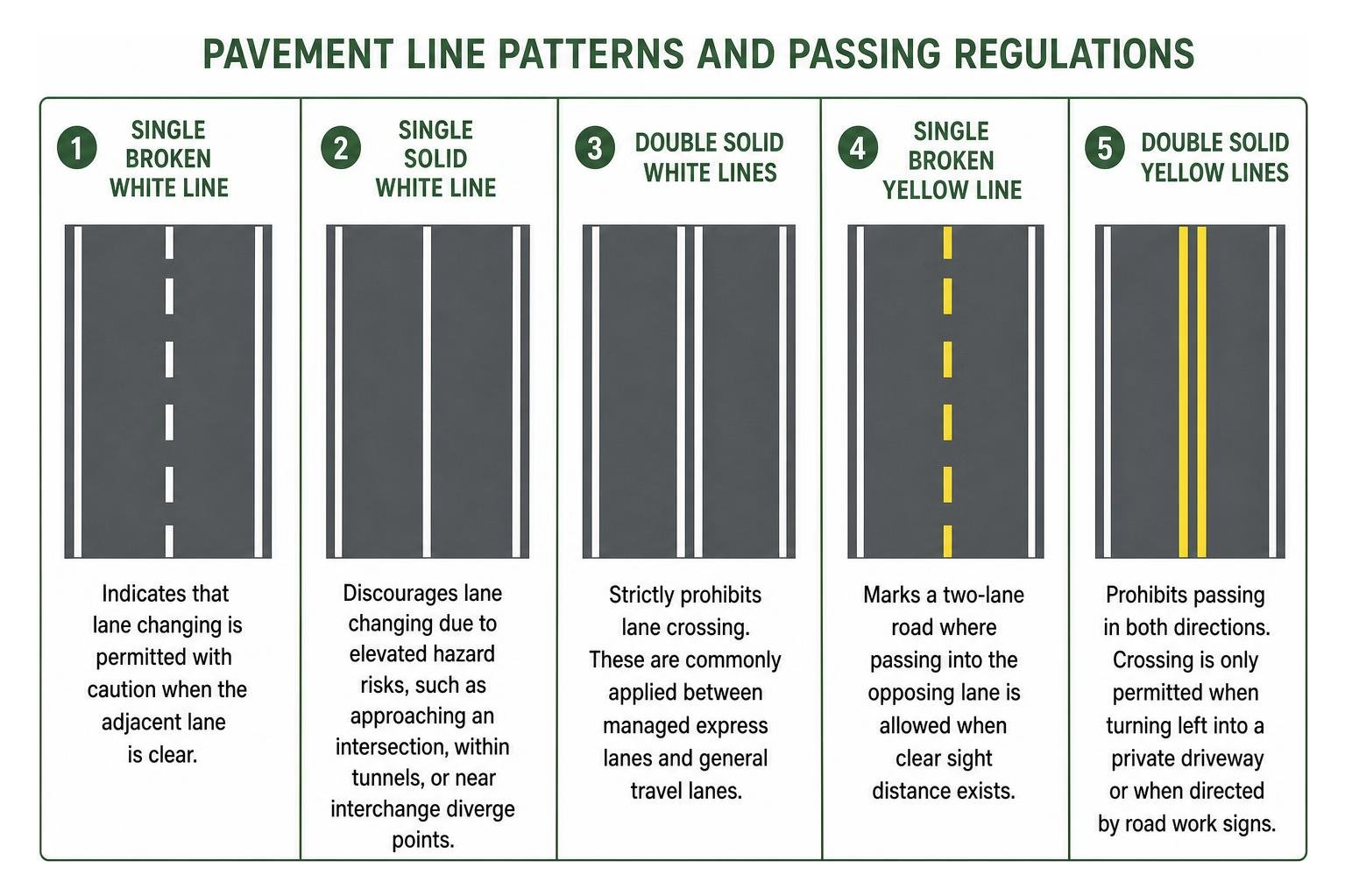
- Single Broken White Line: Indicates that lane changing is permitted with caution when the adjacent lane is clear.
- Single Solid White Line: Discourages lane changing due to elevated hazard risks, such as approaching an intersection, within tunnels, or near interchange diverge points.
- Double Solid White Lines: Strictly prohibits lane crossing. These are commonly applied between managed express lanes and general travel lanes.
- Single Broken Yellow Line: Marks a two-lane road where passing into the opposing lane is allowed when clear sight distance exists.
- Double Solid Yellow Lines: Prohibits passing in both directions. Crossing is only permitted when turning left into a private driveway or when directed by road work signs.
- Mixed Solid and Broken Yellow Lines: Passing is permitted only for vehicles traveling adjacent to the broken line side; drivers on the solid line side face a strict no-passing zone.
Road Design Standards, Lane Widths, and Accident Reduction
Lane geometry directly impacts driver psychology, vehicle operating speeds, and collision severity across rural and urban road networks.
Lane Width Standards and Geometric Safety Impacts
Standard U.S. Interstate highway travel lanes are engineered to a width of 12 feet (3.7 meters), accommodating large freight trucks and high operating speeds. On urban streets, lane widths typically range from 10 to 11 feet to calm traffic, shorten pedestrian crossing distances, and reduce vehicle impact speeds.
Research indicates that excessively wide lanes on surface streets can encourage speeding, while lanes narrower than 9 feet on high-speed corridors increase sideswipe crashes. Additionally, horizontal curves require widened lanes to account for the physical off-tracking of long commercial semi-trailers.
Pavement Marking Materials and Retroreflective Performance

Maintaining visible lane delineation is essential for nighttime visibility and adverse weather navigation:
- Standard Waterborne Paints: Economical for low-volume roadways but subject to wear from traffic abrasion and winter snowplows, requiring frequent reapplication.
- Thermoplastic Markings: Applied at high temperatures, thermoplastic lines bond strongly with asphalt, delivering a durable profile lasting up to five years.
- Glass Bead Retroreflectivity: Embedded micro-glass beads reflect vehicle headlight beams directly back to the driver’s eyes, dramatically improving nighttime visibility.
- Raised Pavement Markers (RPMs) & Milled Rumble Strips: RPMs provide physical and visual delineation, while centerline and shoulder rumble strips alert drifting drivers through sound and vibration, reducing run-off-road collisions.
Frequently Asked Questions About Roadway Markings
What is the purpose of a center two-way left-turn lane?
A center two-way left-turn lane allows motorists traveling in either direction to transition out of the flow of through traffic while waiting to complete a safe left turn into driveways or commercial plazas. To maintain safety, drivers should enter the lane only within 200 feet of their intended turn and must never use it as a passing or continuous driving lane.
What does a double solid white line signify on a multi-lane highway?
A double solid white line indicates that lane changes are strictly prohibited between adjacent lanes moving in the same direction. Highway authorities install double solid white lines to separate special-purpose corridors, such as HOV or express toll lanes, from general-purpose lanes, or to prevent hazardous weaving near toll plazas, tunnels, and interchange gore points.
How does lane width impact overall crash risk?
Lane width affects vehicle speed, driver lateral positioning, and collision rates. While 12-foot lanes provide safety margins on high-speed interstates, narrower 10-foot lanes on urban streets help modulate traffic speeds and improve pedestrian safety. Applying clear edge lines, centerlines, and reflective delineators can reduce roadway departure and curve-related crashes by up to 45%.
Conclusion
Understanding roadway striping, lane functions, and right-of-way regulations is crucial for preventing devastating motor vehicle accidents. When drivers ignore pavement markings, speed in restricted lanes, or weave aggressively across multi-lane highways, severe multi-vehicle collisions frequently follow.
Evaluating driver actions and identifying the safest lane on the highway helps motorists make proactive, defensive choices behind the wheel. If you or a family member has suffered an injury due to an improper lane change, illegal passing, or reckless highway driving in Illinois, Cullotta Bravo Law Group is here to help. With more than 35 years of trial experience across Aurora, Chicago, Naperville, and Joliet, we aggressively protect our clients’ rights and pursue the full compensation they deserve. Contact our team today to schedule your comprehensive case evaluation.