

Upgrade Your View with These Semi Truck Blind Spot Mirrors
Why a Semi Truck Blind Spot Mirror Can Be the Difference Between Safe and Deadly
A semi truck blind spot mirror is a specialized mirror — or set of mirrors — designed to reduce the massive “no-zones” around large commercial trucks that standard flat mirrors simply cannot cover.
The best semi truck blind spot mirrors at a glance:
| Mirror Type | Best For | Key Benefit |
|---|---|---|
| Convex side mirror | Lane changes, merges | Wider field of view than flat mirrors |
| Fender-mounted convex mirror | Right-side blind spot | Covers the most dangerous no-zone |
| Hood-mounted mirror | Front blind spot | Eliminates the 20-foot front no-zone |
| Look-down mirror | Passenger-side window area | Targets right-side curb blind spot |
| Fishbowl/spot mirror | Backing, tight spaces | 360-degree wide-angle visibility |
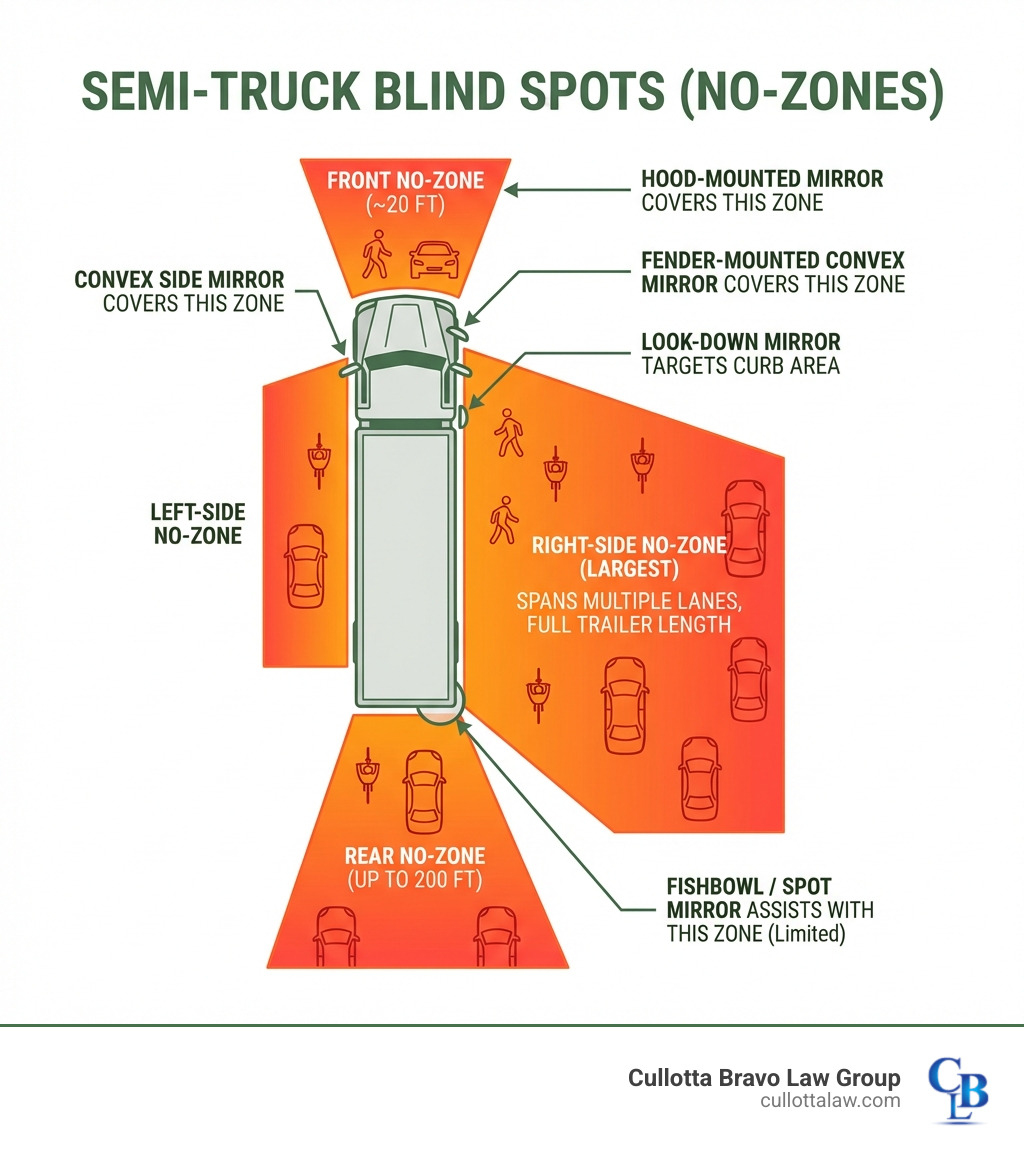
Semi-trucks have four main blind spots — directly in front (up to 20 feet), directly behind (up to 200 feet), the left side, and the especially dangerous right side, which can stretch the full length of the trailer across multiple lanes. Standard flat mirrors leave huge gaps in these areas.
According to data from the Federal Motor Carrier Safety Administration (FMCSA), blind spots contribute to nearly one-third of all large truck accidents. That is not a small problem. And the people who pay the highest price are not usually the truck drivers — it is the pedestrians, cyclists, and passenger vehicle occupants who are invisible to the driver in those no-zones.
The right mirror setup does not just protect drivers. It protects everyone sharing the road.
I’m Peter Cullotta, a trial lawyer with over 35 years of experience representing people seriously injured in commercial truck accidents — including many crashes directly tied to inadequate semi truck blind spot mirror coverage. Understanding how these mirrors work, what the law requires, and where the gaps are has been central to building successful cases for my clients.
The High Cost of Visibility: Blind Spot Accident Statistics
When we talk about a semi truck blind spot mirror, we aren’t just talking about a piece of glass; we are talking about a life-saving tool. The statistics regarding visibility-related crashes are staggering. According to the Large Truck Crash Causation Study (LTCCS), inadequate surveillance—which essentially means the truck driver didn’t see the other road user—is a contributing factor in roughly 14% of all large-truck crashes.

In our experience handling 18-wheeler accidents in Illinois, we see the same patterns repeat. Research shows that “mirror-relevant” crashes—which include lane changes, merges, turns, and backing maneuvers—account for nearly 20% of all truck crash involvements.
The danger is not distributed equally around the truck, either. Lane change and merge crashes to the right occur over four times more frequently than those to the left. This is because the right-side blind spot is the largest and most difficult to manage without a high-quality semi truck blind spot mirror.
The human cost is even more sobering:
- Right-side impacts account for 21% of pedestrian fatalities and 40% of cyclist fatalities in single-vehicle collisions with tractor-trailers.
- Roughly 300 people are killed annually in the U.S. in crashes directly attributable to these “no-zones.”
- What happens when trucks hit bicyclists is often catastrophic because the driver may not even realize a collision has occurred until they are alerted by witnesses.
Essential Types of Semi Truck Blind Spot Mirrors
To combat these “no-zones,” modern rigs use a variety of mirror types. Relying on a single flat mirror is a recipe for disaster. Here is a breakdown of the equipment every safe driver should have.
Planar (Flat) Mirrors
These are your standard primary mirrors. They provide a “unit magnification” view, meaning they don’t distort the size or distance of objects. While they are great for seeing what is directly behind the rig (up to 200 feet), they have a very narrow field of view.
Convex Mirrors
Often called “spot mirrors” or “fishbowl mirrors,” these use curved glass to provide a much wider field of vision. They are essential for seeing vehicles in adjacent lanes that have disappeared from the flat mirror. However, they do distort distance—objects are closer than they appear!
Fender and Hood-Mounted Mirrors
These are game-changers for the right-side blind spot. Mounted on the front corners of the truck, they allow the driver to see down the side of the cab and trailer without craning their neck. Research indicates that trucks lacking right fender mirrors are significantly over-involved in crashes resulting in death or injury.
Look-Down Mirrors
Usually mounted at the top of the passenger-side door or window, these mirrors point straight down. They are specifically designed to help drivers see small cars, cyclists, or pedestrians sitting right next to the cab at a red light.
| Feature | Flat (Planar) Mirror | Convex (Spot) Mirror |
|---|---|---|
| Magnification | 1:1 (Realistic size) | Wide-angle (Distorted) |
| Field of View | Narrow | Very Wide |
| Primary Use | Distance & Speed judgment | Blind spot detection |
| Limitation | Large blind spots | Hard to judge distance |
Choosing the Right Semi Truck Blind Spot Mirror for Your Rig
When you are looking to upgrade your view, quality matters. We recommend looking for mirrors made with stainless steel housings and ozone-resistant vinyl gaskets. These materials withstand the harsh Illinois winters and highway vibrations better than cheap plastic alternatives.
For the glass itself, look for heated options to clear frost and fog instantly. A high-quality semi truck blind spot mirror should also feature a “stay-put” adjustment mechanism so it doesn’t vibrate out of position every time you hit a pothole on I-90.
Aftermarket vs. OEM Semi Truck Blind Spot Mirror Options
Many drivers wonder if they should stick with Original Equipment Manufacturer (OEM) parts or go aftermarket.
- OEM Mirrors: These are designed specifically for your truck’s make and model (like Kenworth or Peterbilt). They offer perfect fitment but can be expensive.
- Aftermarket Mirrors: These are often more cost-effective and offer “universal fitment.” Some popular aftermarket options include 6-inch convex mirrors with self-adhesive backing that can be added to any existing mirror assembly.
Regardless of which you choose, durability and vibration resistance are the most important factors. If you’ve been in an accident, a truck-accident-lawyer-aurora will often look at whether your mirror setup was compliant and functional at the time of the crash.
DOT and FMCSA Regulatory Requirements for Mirrors
The government doesn’t just suggest you have mirrors; they mandate it. The Federal Motor Carrier Safety Administration (FMCSA) and Federal Motor Vehicle Safety Standard (FMVSS) 111 set the bar for what is legal.
Key DOT Mirror Requirements for Semi Trucks include:
- Two Exterior Mirrors: Every truck must have at least two mirrors, one on each side.
- Unit Magnification: For vehicles over 25,001 lbs GVWR, the primary mirrors must be flat (unit magnification) and have at least 323 square centimeters of reflective surface.
- Visibility Distance: Mirrors must provide a view of the highway at least 200 feet to the rear.
- Stable Mounting: Mirrors must be mounted on stable supports to prevent excessive vibration.
It is also worth noting that some states have specific quirks. For example, while Illinois is fairly standard, Pennsylvania has strict limits on how far a mirror can extend past the width of the rig (usually 6 inches).
The Camera Revolution: Recently, the FHWA and FMCSA have granted enforcement discretion for Camera Monitoring Systems (CMS). These digital systems use cameras and cab-mounted screens to replace or supplement traditional mirrors. While they aren’t mandatory yet, they offer benefits like better low-light visibility and “hydrophobic” lenses that stay clear in the rain.
Professional Techniques for Mirror Adjustment and Maintenance
Even the most expensive semi truck blind spot mirror is useless if it is pointed at the sky or covered in grime. At Cullotta Bravo Law Group, we often see tractor-trailer-crashes-in-illinois that could have been avoided with a simple pre-trip adjustment.
The “Lean and Adjust” Method
To properly set your mirrors, sit in your normal driving position.
- Left Mirror: Lean your head until it almost touches the driver’s side window, then adjust the mirror so you can just see the side of your trailer.
- Right Mirror: Lean your head toward the center of the cab and adjust the mirror until the side of the trailer is just visible.
- Result: When you sit back up straight, you won’t see your trailer in the mirrors, but your field of view into the blind spots will be significantly wider.
The Scanning Routine
Professional drivers don’t just stare ahead. You should be scanning your mirrors every 5 to 8 seconds. A typical routine looks like this: Left Mirror → Front View → Right Mirror → Instrument Gauges → Repeat. In heavy Chicago traffic, this frequency should increase.
Maintenance Checklist
- Cleanliness: Road salt and bugs can render a mirror useless. Clean them at every fuel stop.
- Tighten Fasteners: Vibration is a mirror’s worst enemy. Check brackets and bolts weekly.
- Inspect for Cracks: Even a small crack can distort your view of a trailing vehicle.
- Check the Heater: Before winter hits, ensure your mirror heaters are drawing current.
Frequently Asked Questions about Semi Truck Blind Spots
Are camera monitoring systems (CMS) legal replacements for mirrors?
Yes, but with caveats. The FMCSA has granted five-year exemptions to several manufacturers allowing CMS to replace traditional mirrors. These systems must provide a field of view that is equivalent to or better than traditional glass. According to the Notice of Enforcement Discretion, states are encouraged not to penalize drivers using these approved digital systems. However, most drivers still prefer having physical mirrors as a fail-safe.
Why is the right-side blind spot more dangerous than the left?
It comes down to geometry and cab design. Because the driver sits on the left, the angle to see the right side is much sharper. The hood and the passenger door create a massive “blind zone” that can easily hide a full-sized SUV. Statistics show right-side lane change crashes are 4.4 times more frequent than left-side ones because of this asymmetry.
How often should a truck driver scan their mirrors?
Expert consensus suggests a scan every 8 to 10 seconds during normal highway driving, and every 5 to 8 seconds in congested areas or when preparing for a maneuver. If you are changing lanes, you should check your mirrors at least three times: before signaling, after signaling, and during the move.
Conclusion
A semi truck blind spot mirror isn’t just an accessory; it’s a fundamental safety requirement. Whether you are a fleet owner looking to upgrade your equipment or a passenger vehicle driver trying to stay safe on the I-55, understanding these “no-zones” is vital.
At Cullotta Bravo Law Group, we have seen the devastating results of what happens when visibility is ignored. We provide aggressive legal representation for those injured in truck accidents across Aurora, Chicago, Naperville, and Joliet. We believe that safety technology and driver responsibility go hand-in-hand.
If you or a loved one has been involved in a collision with a commercial vehicle, don’t navigate the complex legal waters alone. Contact an experienced Illinois truck accident attorney at Cullotta Bravo Law Group today. We treat every client with dignity and fight for the multi-million dollar settlements our clients deserve. Safety starts with a clear view, but justice starts with the right legal team.