
Visualizing Danger: The Best Semi Truck Blind Spot Diagrams
What a Semi Truck Blind Illustration Actually Shows You
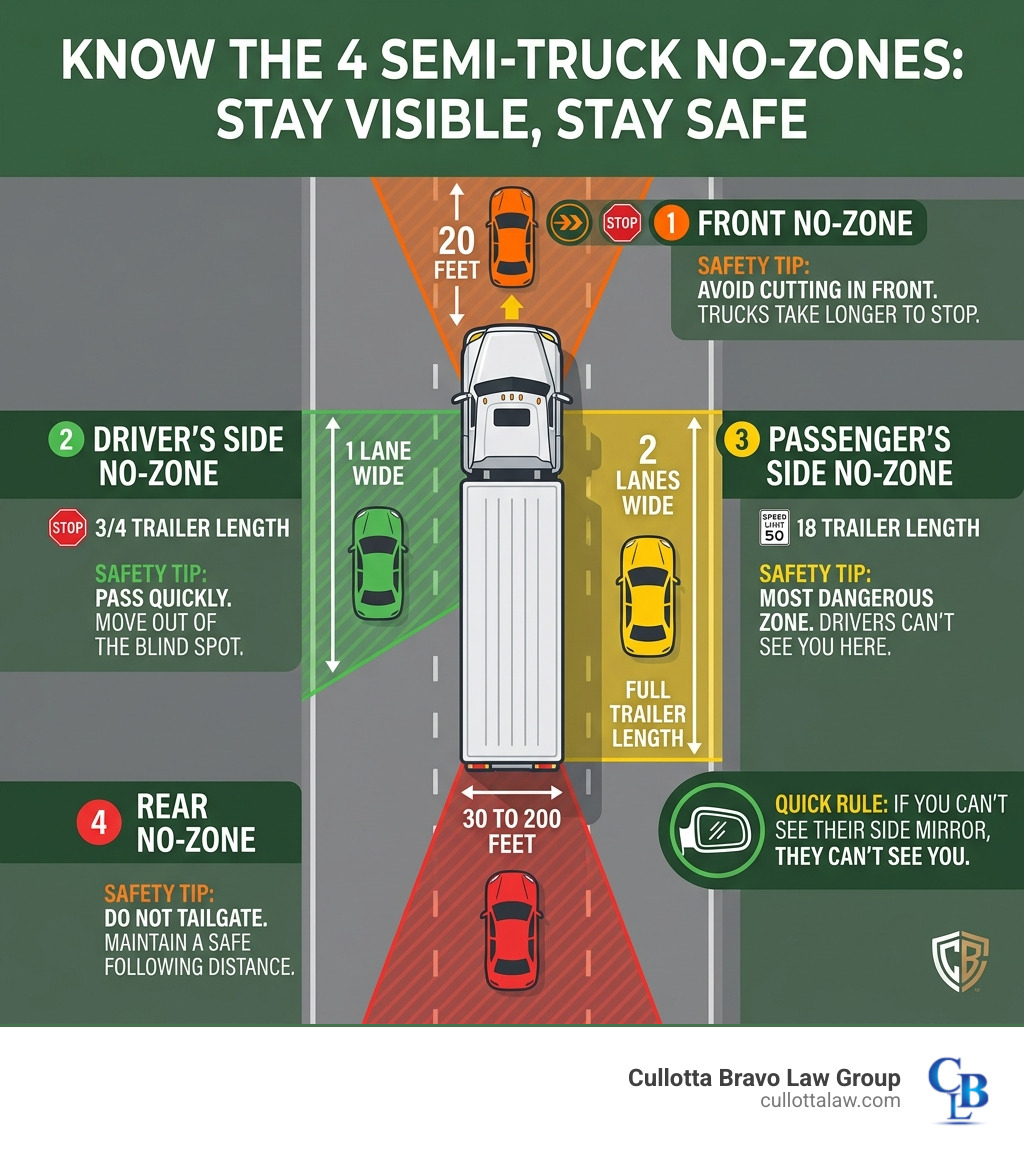
A semi truck blind illustration maps out the four dangerous zones around an 18-wheeler where the truck driver literally cannot see your vehicle — zones that can turn a routine highway drive into a fatal crash.
Here are the four blind spots (called “No-Zones”) you need to know:
| Location | Approximate Size |
|---|---|
| Front | 20 feet ahead of the truck’s grille |
| Driver’s side | 1 lane wide, roughly 3/4 of the trailer’s length |
| Passenger’s side | 2 lanes wide, the full length of the trailer |
| Rear | 30 to 200 feet behind the trailer |
Quick rule: If you can’t see the truck driver’s face in their side mirror, they cannot see you.
These aren’t minor visibility gaps. A car can completely disappear inside any one of these zones — and because big rigs weigh 20 to 30 times more than a typical passenger car and take up to 40% longer to stop, being invisible to that driver even for a few seconds can be catastrophic.
I’m Peter Cullotta, founding partner at Cullotta Bravo Law Group, and with over 35 years representing victims of serious truck accidents throughout Illinois, I’ve seen the devastating injuries that result when drivers don’t understand what a semi truck blind illustration is really warning them about. If you or someone you love was hurt in a crash involving a large commercial truck, understanding these No-Zones is the first step — and knowing your legal rights is the next.
Understanding the “No-Zone” Through Semi Truck Blind Illustration
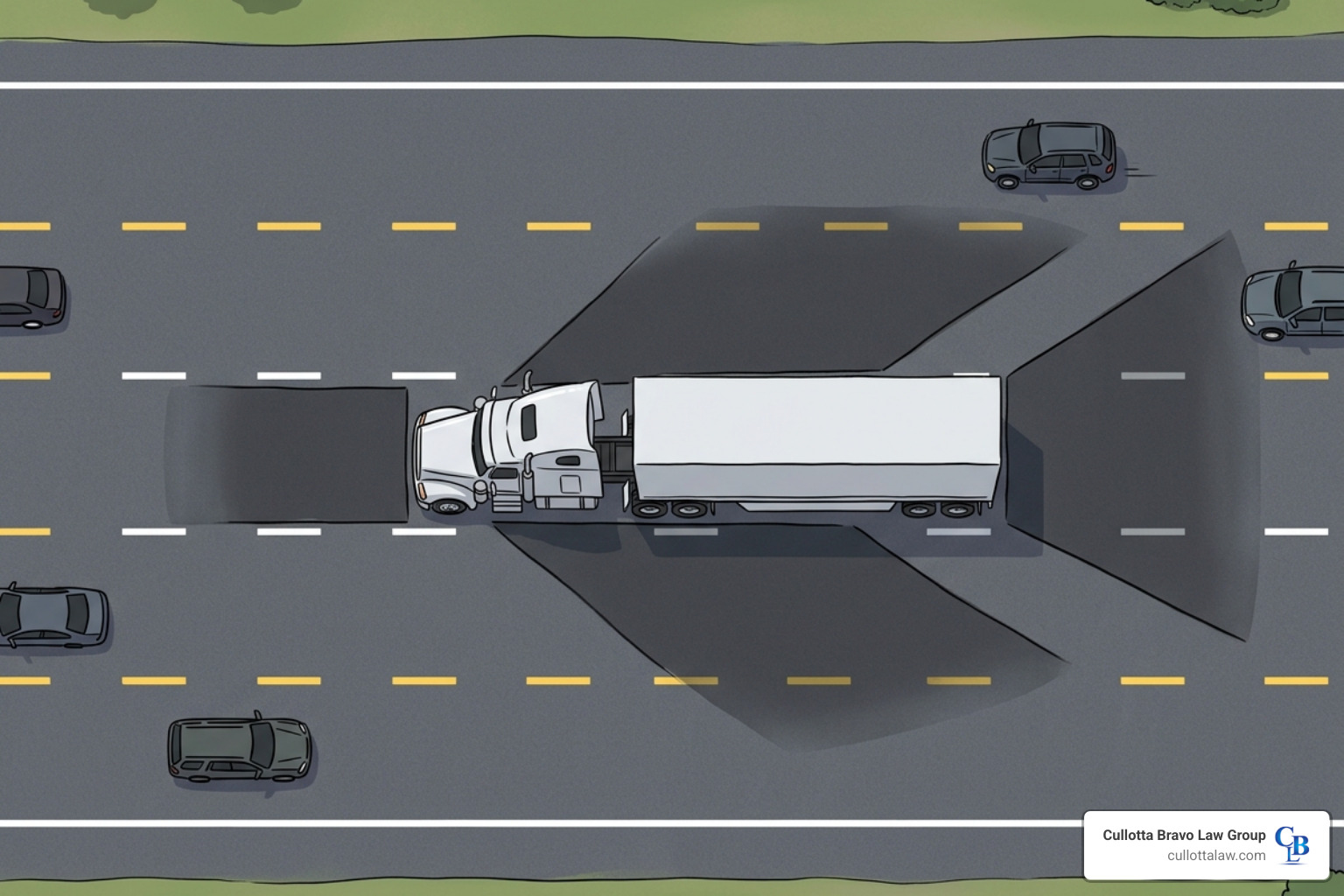
When we talk about a semi truck blind illustration, we are looking at a map of “No-Zones.” These are the specific areas around a commercial vehicle where the driver has zero visibility. Unlike your family sedan or SUV, which has a rearview mirror and relatively small pillars, an 18-wheeler is a wall of steel and cargo.
According to Truck Blind Spots stock illustrations, these areas are not just small pockets; they are expansive “death zones” that can swallow an entire car, motorcycle, or bicyclist. In our experience handling Tractor Trailer Crashes In Illinois, we’ve found that many motorists assume that because a truck is so large, the driver must have a “commanding view” of the road. In reality, the larger the vehicle, the larger the blind spot.
These dimensions are staggering. A typical semi-truck can be 70 to 80 feet long. If you are driving alongside the trailer, you might think you are visible, but the driver’s mirrors are angled in a way that creates a massive “V” shape of invisibility. If you aren’t careful about your clearance, you are essentially driving in the dark as far as the trucker is concerned.
The Front No-Zone: Why 20 Feet Matters
It sounds counterintuitive—how can a driver not see what is directly in front of them? The answer lies in the height of the cab and the length of the hood. The front No-Zone extends at least 20 feet ahead of the truck’s grille.
If you cut off a truck and settle into that 20-foot gap, you have disappeared. This is particularly dangerous because Why Do Trucks Still Have Big Blind Spots Despite Huge Advances In Vehicle Safety Technology remains a major issue; even with modern sensors, the physical height of the engine and the grill creates a literal wall between the driver and your rear bumper. If that truck needs to engage in sudden braking, and you are in that 20-foot zone, the laws of physics are not on your side. Trucks take 40% longer to stop than cars, and if they can’t see you, they won’t even know they need to hit the brakes until it’s too late.
Side No-Zones: A Detailed Semi Truck Blind Illustration
The sides of the truck are where the most common side-swipe accidents occur.
- The Driver’s Side: This blind spot stretches for one lane in width and extends nearly three-fourths of the trailer’s length. It is smaller than the passenger side, but still large enough to hide a car.
- The Passenger’s Side: This is the most dangerous area. It extends outward for two full lanes and stretches past the end of the trailer.
Because the driver sits on the left, their visibility to the right is severely limited. When a truck driver attempts a lane change to the right, they are relying on mirrors that may not capture a vehicle traveling parallel to the rear wheels. This is why we always emphasize passing on the left—the “blind” area is significantly smaller and shorter on the driver’s side.
Why Big Rigs Have Massive Blind Spots Compared to Cars
Why is the visibility so poor? It’s a combination of design and physics. As noted in What are the blind spots for large truck or bus drivers? – Quora, truck drivers do not have a rearview mirror. They have nothing looking directly out the back window because there is no back window—just a massive trailer full of cargo.
| Feature | Passenger Car | Semi-Truck |
|---|---|---|
| Rearview Mirror | Yes | No |
| Side Mirror Size | ~6-8 inches | Up to 25 inches |
| Weight | ~3,000 – 4,000 lbs | Up to 80,000 lbs |
| Blind Spot Length | Minimal | Up to 200 feet (Rear) |
The structural pillars of the cab are much thicker to support the weight and safety of the driver, and the mirrors, while large (up to 25 inches tall), can only do so much. The height of the cab means anything low to the ground—like a sports car or a motorcycle—is even harder to spot. Furthermore, the sheer length of the trailer means that by the time the light reflects off your car and into their mirror, the angle might be too sharp for the driver to perceive your presence.
Critical Safety Techniques to Avoid the Death Zone
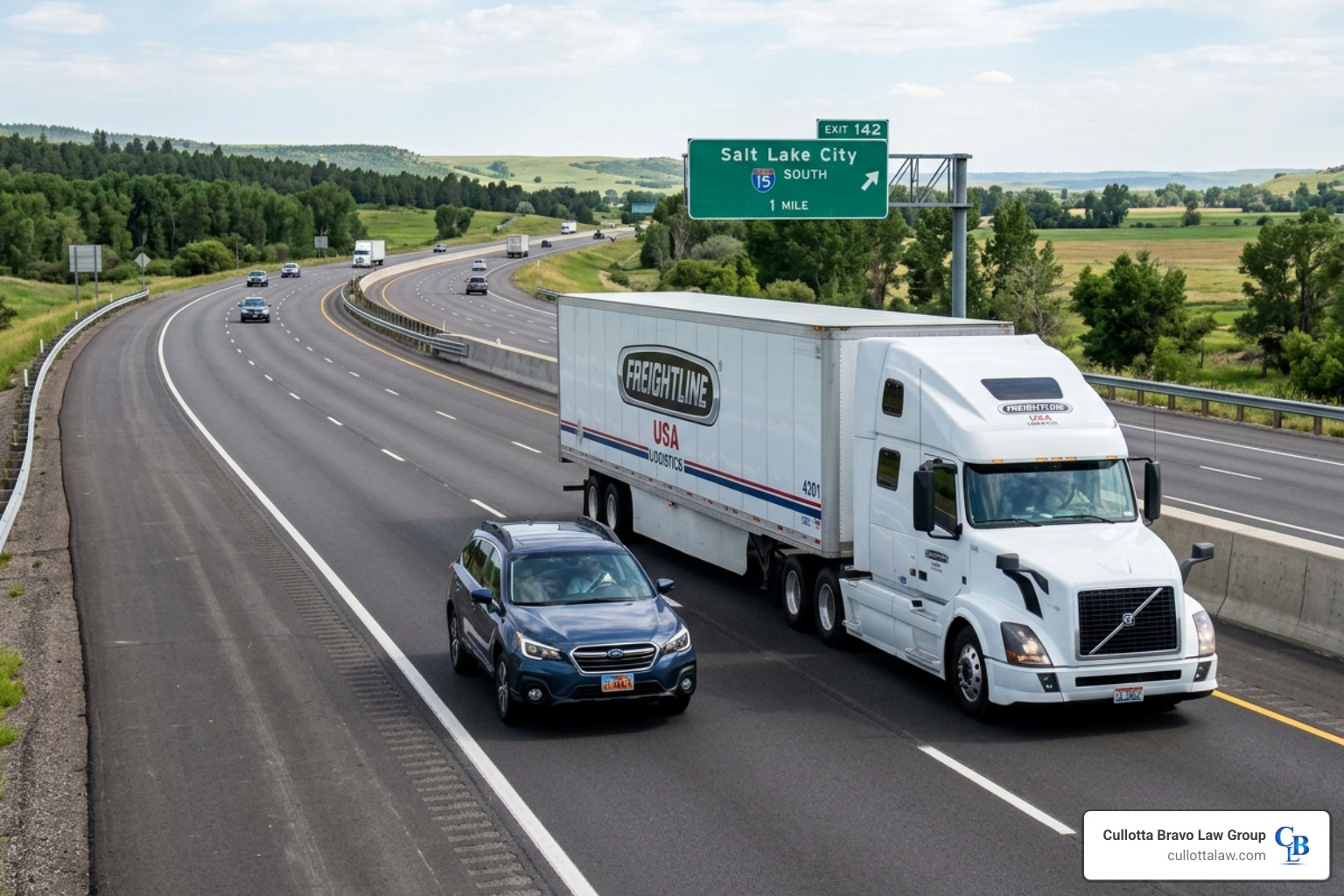
Sharing the road with 18-wheelers in Chicago or Joliet requires a defensive mindset. Our team at Cullotta Bravo Law Group recommends these specific techniques to stay safe:
- Pass Quickly and on the Left: Never linger beside a truck. If you are going to pass, do it decisively. Always pass on the driver’s side where visibility is better. For a deeper dive, check out How To Safely Pass A Truck On The Highway and How Do You Safely Pass Trucks On The Freeway.
- The Mirror Rule: This is the golden rule of the road. If you cannot see the driver’s face in their side mirror, they cannot see you. Period.
- Maintain a 30-Foot Rear Gap: Tailgating a truck is a recipe for disaster. Not only can the driver not see you, but you also cannot see the road ahead. If the truck hits debris or brakes suddenly, you will have zero reaction time.
- Give 200 Feet of Visibility: The rear No-Zone can actually extend nearly 200 feet. While 30 feet is the “immediate” danger zone for visibility, staying further back allows you to see traffic patterns and avoid being caught in a “squeeze” play.
Using a Semi Truck Blind Illustration to Gauge Your Position
By April 2026, road safety protocols have become even more stringent, yet the basic human element of driving remains. As highlighted by Semi-trucks have four large blind spots – Facebook, you should use visual cues to ensure your safety.
If you are behind a truck and can’t see both of its side mirrors, you are in the rear No-Zone. If you are merging in front of a truck, make sure you can see the entire cab of the truck in your own rearview mirror before you move over. This ensures you have cleared that 20-foot front No-Zone. Eye contact is also a powerful tool—if you can see the driver looking at you through the mirror, you have a much higher chance of being recognized as a fellow traveler on the road.
The Primary Dangers of Driving in a Truck’s Blind Spot
The stakes are incredibly high. A typical semi-truck weighs 20 to 30 times as much as your car. When a collision occurs because a driver was in a No-Zone, the results are rarely “minor.”
One of the most terrifying outcomes is an underride crash, where a smaller vehicle slides underneath the trailer. These are often fatal. We also see many cases involving vulnerable road users; What Happens When Trucks Hit Bicyclists is often a story of a truck making a wide right turn and not seeing a cyclist in the passenger-side blind spot.
There are 18 Wheels And A Dozen Types Of Accidents that can occur, ranging from jackknifing to rollovers, but blind-spot-related side-swipes remain among the most frequent. Because of the weight disparity, a truck might not even feel the initial impact with a small car, dragging the vehicle for hundreds of feet before realizing there is a problem. This leads to catastrophic injuries, including traumatic brain injuries, spinal cord damage, and permanent disability.
Frequently Asked Questions about Truck Blind Spots
How far does the rear blind spot actually extend?
While the most critical “danger zone” is the first 30 feet directly behind the trailer, the total rear No-Zone can extend nearly 200 feet. If you are following closer than 30 feet, the driver has no way of knowing you are there. This is why tailgating is so dangerous; if the truck driver doesn’t know you’re there, they may brake hard for an obstacle they see, but you don’t. Furthermore, Dubious Trucking Industry Practices And How They Put Drivers At Risk sometimes include inadequate maintenance of rear lighting, making it even harder for you to judge distances at night.
Why is the passenger side more dangerous than the driver side?
The passenger side blind spot is roughly twice as wide as the driver’s side, extending across two lanes of traffic. This is due to the angle of the mirrors and the distance from the driver’s seat. When a truck makes a right-hand turn, they often have to “swing wide” to the left first. A car attempting to pass on the right during this maneuver can easily be crushed between the truck and the curb. If you’ve been involved in such an accident, seeking a Truck Accident Lawyer Aurora is vital to investigate whether the driver failed to check their mirrors or signal properly.
What should I do if a truck starts merging into my lane?
If you realize a truck is merging into you, it means you are likely in their No-Zone.
- Honk your horn immediately: A long, loud blast is necessary to get the driver’s attention over the engine noise.
- Assess your escape route: Can you safely move to the shoulder?
- Speed up or slow down: Depending on where you are relative to the cab, it may be safer to floor it to get into their field of vision or brake hard to fall behind the trailer.
If a collision occurs, contact a Truck Accident Attorney Aurora Il as soon as possible. Evidence like dashcam footage and electronic logging data needs to be preserved immediately.
Conclusion
At Cullotta Bravo Law Group, we believe that education is the best way to prevent tragedies on Illinois roads. However, we also know that even the most careful drivers can be victimized by a negligent trucking company or a distracted driver.
If you have been involved in a collision, you need an Illinois Truck Accident Attorney who understands the complexities of these cases. From our offices in Aurora and Chicago, we provide aggressive legal representation to ensure our clients are treated with the dignity they deserve. We have a long history of securing multi-million dollar settlements for accident victims, and we are ready to fight for you.
Don’t let a trucking company’s “No-Zone” defense stop you from getting justice. If they couldn’t see you, it’s often because they weren’t using the right equipment or exercising the necessary caution required for a vehicle of that size. Stay safe, stay visible, and if the worst happens, give us a call at Cullotta Bravo Law Group.