
When Disaster Strikes: Understanding Your Critical First Steps
What to do motorcycle accident scenarios happen without warning. A driver fails to see you, and suddenly you’re on the ground. The statistics are sobering: motorcycle accidents occur 28 times more often than car accidents, despite motorcyclists being only 5% of all drivers.
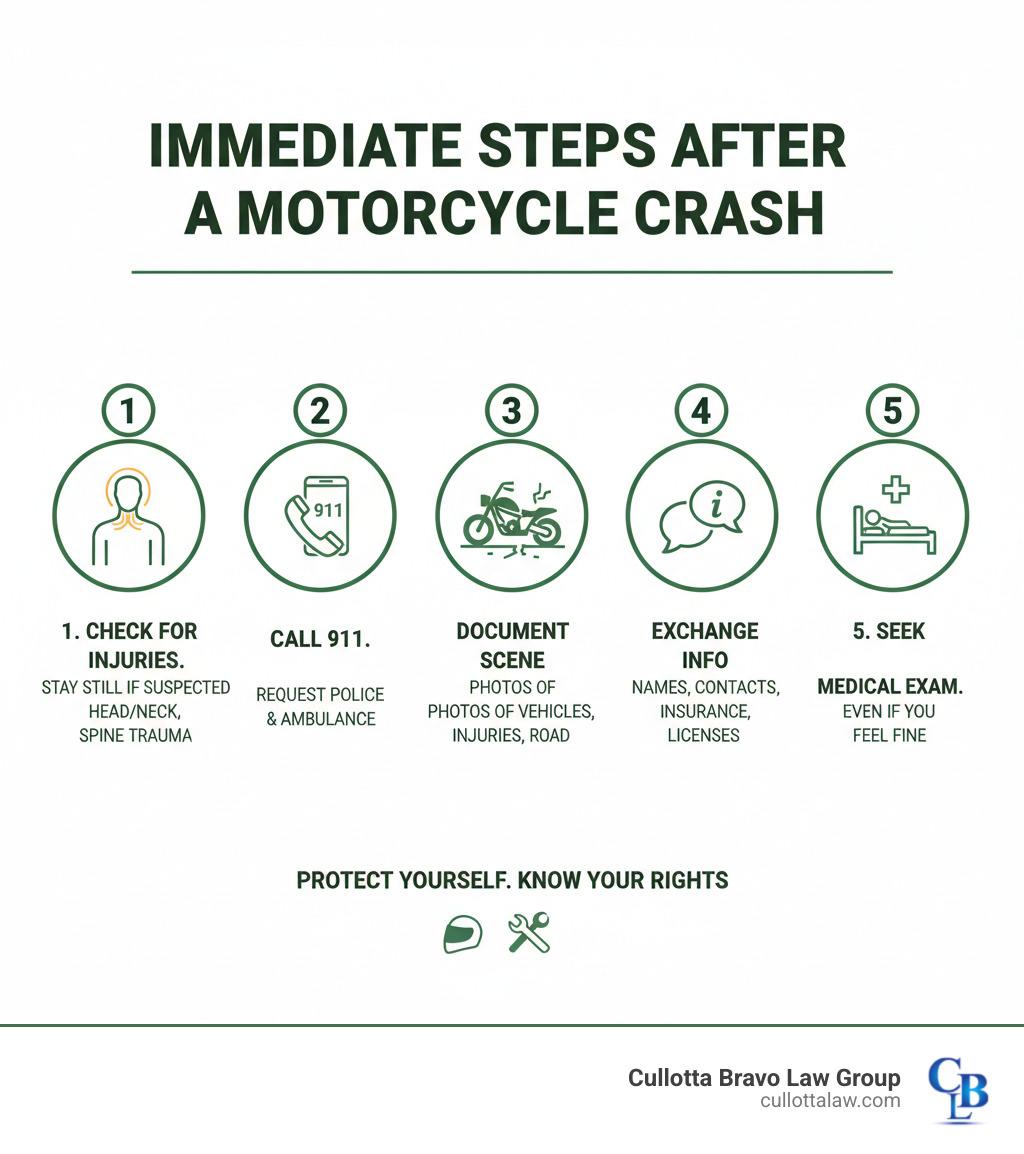
If you’re involved in a motorcycle accident, here are the immediate steps to take:
- Check for injuries – Stay still if you suspect head, neck, or spine injuries
- Call 911 – Request police and ambulance even for minor-seeming accidents
- Document everything – Take photos of vehicles, injuries, road conditions, and skid marks
- Exchange information – Get names, contact details, insurance, and license numbers
- Seek medical care – Get examined even if you feel fine, as adrenaline can mask injuries
The moments after a crash are chaotic. Shock and adrenaline can cloud your judgment, which is why having a clear action plan is crucial to protect your health and legal rights.
Whether you’re the rider or a bystander, knowing these steps can prevent years of financial struggle. This guide covers every critical decision, from the scene to dealing with insurance and legal options.
I’m Peter Cullotta, and over my 35 years as a trial attorney, I’ve helped countless motorcycle accident victims steer the aftermath of a crash and secure the compensation they deserve. Having handled numerous what to do motorcycle accident situations, I understand the immediate challenges and long-term legal strategies needed to protect your rights.
Immediate Actions at the Scene: A Step-by-Step Guide
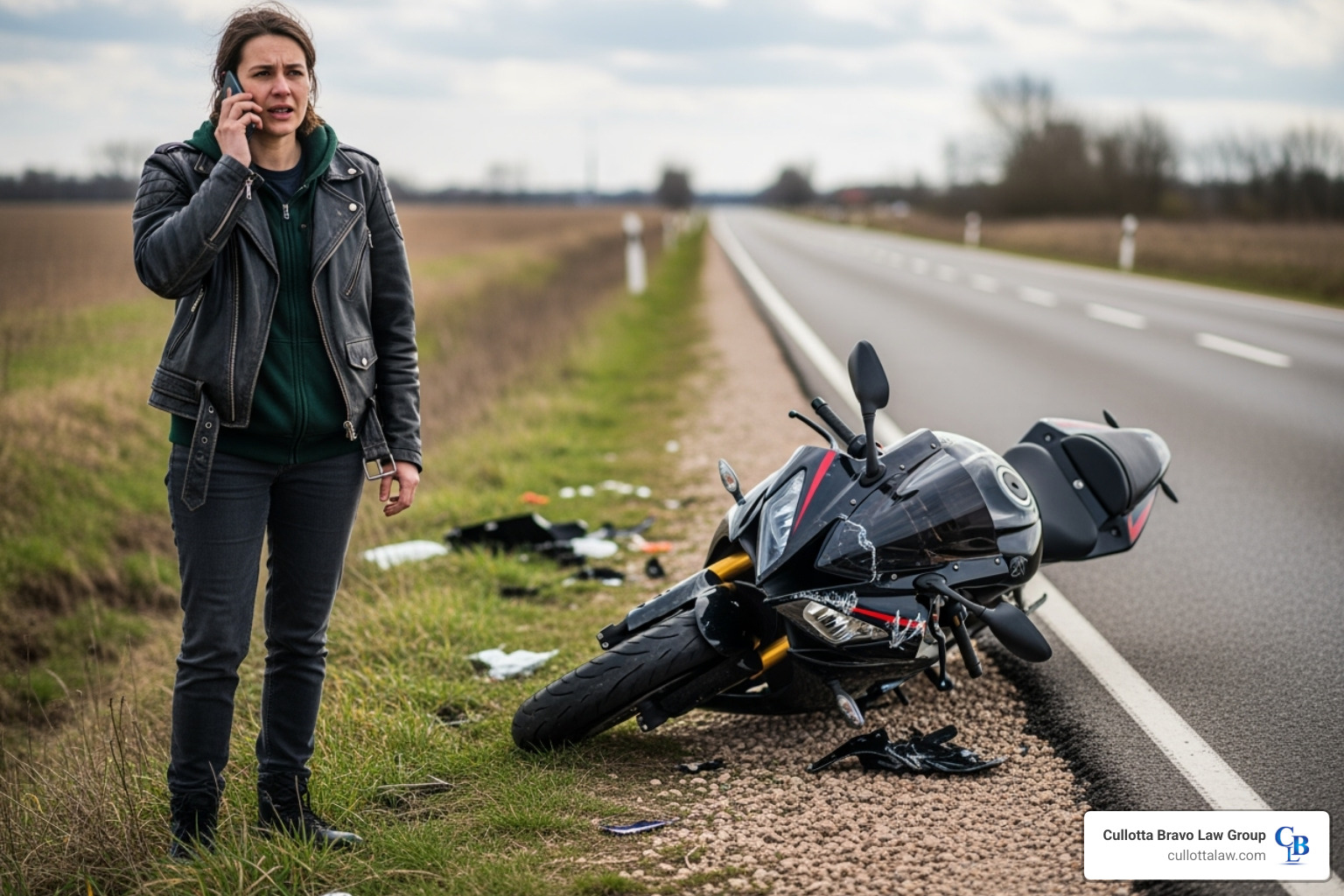
After a crash, your heart is pounding and your mind is racing. Adrenaline floods your system, which can help you focus but also mask serious injuries. What to do motorcycle accident situations start with one principle: safety first. I’ve seen too many riders insist they’re fine, only to find internal injuries later. Statistics show eight out of ten motorcycle accidents result in injury or death, so a methodical approach is vital.
For the Rider: Prioritizing Your Safety and Health
Your first instinct might be to check on your bike, but your health is the priority. Start by checking yourself for injuries, but do it carefully. Don’t rush to stand up. If you feel any pain in your head, neck, or spine, stay exactly where you are until paramedics arrive. Moving the wrong way could turn a manageable injury into a life-changing one.
Whether to stay put or move depends on your immediate safety. If you’re in traffic or near a fire, get to safety. But if you can stay where you are without immediate danger, that’s the safer choice. It’s better to lie on the pavement for a few extra minutes than to risk making an injury worse.
Keep your helmet on until a medical professional says otherwise; it could be providing crucial support. Watch for signs of shock like pale, clammy skin or dizziness. If you’re bleeding, apply direct pressure. A compact first aid kit is a must-have for any rider and can help with minor cuts while you wait.
For Bystanders: How You Can Help Effectively
If you witness a motorcycle accident, you can make a real difference by following a few basic steps. Call 911 immediately—don’t assume someone else has. Give the exact location and mention a motorcycle is involved.
Secure the scene if it’s safe to do so. Use hazard lights or a flashlight to alert other drivers. When you approach the injured rider, speak calmly. They might be disoriented, and sudden movements could startle them. Always assume potential head, neck, and spine injuries.
Don’t move the rider unless they’re in immediate life-threatening danger. I’ve seen well-meaning people cause additional injuries by trying to help someone sit up. If the person isn’t breathing, CPR takes priority. Otherwise, keep them still.
Focus on the ABCs: Airway, Breathing, and Circulation. Make sure they can breathe and help keep them warm, as shock can cause chills. Never try to remove their helmet—that’s a job for trained paramedics.
What to do motorcycle accident: Documenting the Scene and Exchanging Information

Once everyone is safe and help is on the way, start documenting the scene. The evidence you gather now is critical for your future legal case. Getting a police report is absolutely critical. In Illinois, you must report any accident with injury, death, or over $1,500 in property damage. Get the officer’s name, badge number, and the report number.
Information exchange is essential. Get everyone’s full name, contact information, driver’s license numbers, and insurance details. Don’t forget contact information from any witnesses.
Taking photos and videos with your smartphone is one of the most important things you can do. Capture everything: vehicle damage, your injuries, where vehicles ended up, skid marks, road conditions, traffic signals, and road signs.
Preserve your damaged motorcycle and protective gear as evidence. Don’t repair or discard your torn jacket or cracked helmet. These items tell the story of the impact’s severity and are valuable for your settlement.
Navigating the Aftermath: Medical, Insurance, and Police Interactions
After the crash scene clears, your journey isn’t over. The decisions you make in the following days will shape your recovery and compensation. Every doctor’s visit and piece of documentation helps build your case while you steer a complex system designed to minimize payouts.
Seeking Prompt Medical Attention
Many riders feel “fine” after a crash due to adrenaline, only to find serious injuries days later. Getting a thorough medical examination is vital for your health and for creating an official record linking your injuries to the accident. This connection is crucial when insurance companies question your claim.
Delayed symptoms are incredibly common. Concussions, internal bleeding, and whiplash may not appear for hours or days. We’ve represented riders who felt invincible at the crash site, only to end up in the emergency room 48 hours later. When you see a doctor, be honest about every symptom.
Don’t overlook the mental health impact. Post-Traumatic Stress Disorder (PTSD) affects many motorcycle accident survivors, causing flashbacks, anxiety, and depression. These psychological injuries are just as real and deserving of treatment as physical ones.
Interacting with Police and Insurance Companies
How you handle interactions with police and insurance companies can make or break your case. When police officers ask what happened, stick to the facts you know for certain. Describe what you saw and felt, but resist speculating. The difference matters more than you might think.
Always ask for the police report number. In Illinois, accidents involving injury, death, or property damage over $1,500 must be reported to police, so an official report should exist.
Report the crash promptly to your own insurance company, but be careful. Provide basic facts but avoid discussing your injuries in detail until you’ve been fully evaluated. The golden rule for insurance conversations: never agree to a recorded statement without speaking to an attorney first. Adjusters are skilled at asking questions that can be used to minimize your claim. Your natural response of “I’m okay” could come back to haunt you.
Most importantly, never admit fault, even partially. Phrases like “I’m sorry” can devastate your ability to recover fair compensation. The other driver’s insurance company isn’t your friend; their job is to pay as little as possible.
Understanding the Legal Landscape of a Motorcycle Accident Claim
When dealing with what to do motorcycle accident situations, understanding the legal landscape is crucial. Motorcycle accident claims are more complex and often fought more aggressively by insurance companies who know riders face unique biases. The legal world of these accidents revolves around liability (who’s at fault), negligence (what they did wrong), and damages (what you’ve lost).
How Liability is Determined and the Impact of Statements
Proving another driver caused your accident requires showing they were negligent, meaning their unsafe actions directly led to your injuries.
Proving negligence involves four critical elements. First, we show the other driver owed you a duty of care to follow traffic laws. Second, we prove they breached that duty by, for example, running a red light or texting while driving.
The third element is demonstrating their careless action directly caused your accident and injuries. Finally, we document that you suffered actual damages. When we can show a motorist violated specific rules of the road, it often constitutes “negligence per se,” making our case much stronger.
Every word you say matters. Casual comments at the scene, like “I’m sorry,” can be used against you by insurance adjusters, even if you were just being polite or were in shock. Insurance companies have tactics to shift blame onto motorcyclists, often painting them as reckless. This bias against motorcyclists is real and unfair, but we know how to fight it with solid evidence.
What is Comparative Negligence and How Does It Affect Your Claim?
Sometimes both parties are at fault, and Illinois law accounts for this with comparative negligence. This legal concept can significantly impact your compensation.
Illinois follows a modified comparative negligence rule, meaning your compensation is reduced by your percentage of fault. If a jury finds you 20% responsible for an accident and awards you $100,000, you’d receive $80,000.
Here’s the critical part: Illinois has a 51% fault bar. If you’re found to be 51% or more at fault, you cannot recover any damages. This makes fighting unfair blame crucial to your case.
Insurance companies use this rule to their advantage, working hard to assign you as much fault as possible to reduce or eliminate what they have to pay. We’ve seen them blame motorcyclists for everything—from “riding too fast” to “not being visible enough.”
Can you still receive compensation if partially at fault? Absolutely, but it requires aggressive legal representation to ensure you’re not unfairly blamed.
Types of Damages You Can Recover After a Crash
A motorcycle accident can devastate your finances, health, and quality of life. The law allows you to seek compensation for multiple types of losses.
Economic damages cover tangible financial losses like medical bills (current and future), lost wages, diminished earning capacity, and property damage to your motorcycle and gear.
Non-economic damages address the non-monetary impact on your life. This includes pain and suffering, emotional distress, and loss of enjoyment of life if you can no longer pursue hobbies or activities you once loved.
Punitive damages are rare but may be awarded if the other driver’s behavior was especially reckless, like drunk driving. This is meant to punish the wrongdoer.
Recoverable damages include:
- Medical expenses (current and future)
- Lost income and earning capacity
- Property damage and replacement costs
- Pain and suffering
- Emotional distress
- Loss of enjoyment of life
- Disfigurement and scarring
- Loss of consortium for spouses
The challenge is proving the full extent of your losses and fighting insurers that want to minimize your claim. That’s where experienced legal representation makes all the difference.
Frequently Asked Questions about What to do motorcycle accident
After a motorcycle crash, your mind is probably racing with questions. In my 35 years of practice, I’ve heard the same concerns from countless riders and their families. Let me address the most important ones.
What are the most common causes of motorcycle accidents?
Understanding how these accidents happen helps us build your case. Cars making left turns are the biggest culprit, as drivers often fail to see motorcycles. Unsafe lane changes are another major problem, with drivers not checking their blind spots.
Other common causes include distracted driving (texting, talking), speeding by either party, road hazards like potholes that are more dangerous for bikes, and dooring accidents where a person in a parked car opens their door into a rider’s path.
What makes motorcycle accident claims different from car accident claims?
Motorcycle cases are a different beast. The higher severity of injuries is the biggest factor, as riders lack the protection of a car. Eight out of ten motorcycle crashes result in injury or death.
There’s also an unfair bias against riders that we constantly fight. Many people assume motorcyclists are reckless, which can affect police investigations and jury perceptions. We work to challenge these unfair assumptions.
Different insurance rules in no-fault states can also complicate things if you’re traveling. Finally, motorcycle accident reconstruction is often crucial to scientifically determine what really happened when liability is disputed.
When should I consider hiring a motorcycle accident attorney?
If you’re asking when you need legal help, you probably already do. It’s absolutely essential in these situations:
If you sustained serious injuries that require extensive medical treatment, result in lost wages, or lead to long-term disability. The compensation you deserve is substantial, and insurers will fight to minimize it.
If liability is disputed and the other driver is denying fault or blaming you. You need an advocate who can build a strong case and fight unfair blame.
If the insurance company makes a low settlement offer or denies your claim. This is a red flag. Studies show that injured parties who hire an attorney receive settlements 3.5 times larger on average than those who go it alone.
If you feel overwhelmed by the process. You’re dealing with injuries and complex paperwork. We can handle the legal heavy lifting so you can focus on getting better.
The bottom line is that motorcycle accidents are serious, and the stakes are too high to steer the process without experienced legal guidance.
Conclusion: Taking Control and Protecting Your Future
A motorcycle accident can turn your world upside down, but knowing what to do motorcycle accident situations require gives you power when things feel out of control.
To recap, the critical steps are: prioritize safety, seek immediate medical care, document everything, and be careful in conversations with police and insurers. This is your roadmap to fair compensation. Your actions in the first hours and days matter more than you might realize. Adrenaline can mask injuries, and insurance adjusters may try to use your words against you.
You don’t have to steer this alone. The legal landscape is complicated by comparative negligence rules, insurance tactics, and unfair rider biases. What seems straightforward rarely is.
At Cullotta Bravo Law Group, our 35 years of experience means we know how to fight for injured motorcyclists in Illinois. We understand insurance company tactics and the unique challenges riders face. We treat every client with the dignity and respect you deserve after a traumatic accident.
Don’t let anyone minimize your injuries or your rights. Whether you’re dealing with serious injuries, disputed liability, or a difficult insurance company, experienced legal guidance can make the difference.
If you’ve been in a motorcycle accident in Aurora, Chicago, Naperville, Joliet, or anywhere in Illinois, we’re here to help. Don’t steer this complex process alone – contact an experienced Motorcycle Accident Lawyer in Aurora to protect your rights and your future.
We offer free consultations because we believe every rider deserves to know their options. Let us listen to your story and help you understand what comes next. Your recovery starts with taking control—and that begins with a simple phone call.