

Workers Comp Settlement Attorney: Essential 2025 Guide
Why a Workers Comp Settlement Attorney Makes All the Difference
A workers comp settlement attorney is a specialized lawyer who represents injured workers in negotiating settlements with insurance companies. They handle all legal complexities to ensure you receive fair compensation for medical expenses, lost wages, and permanent disabilities, typically working on a contingency fee basis (around 20%), so you pay nothing unless you win.
Key reasons to hire a workers comp settlement attorney:
- Calculate true claim value – Attorneys determine what you’re actually owed, as insurance companies often undervalue claims.
- Negotiate effectively – Experienced attorneys know and counter the tactics adjusters use to minimize payouts.
- Steer the legal process – They handle all paperwork and hearings so you can focus on recovery.
- Protect future benefits – Attorneys ensure you don’t give up critical rights without fair compensation.
- Level the playing field – Insurance companies have lawyers; you should too.
Navigating a workers’ comp claim alone is an overwhelming challenge. The process involves complex calculations and legal deadlines where mistakes can cost you tens of thousands. As one attorney noted, “No person who suffers a work injury should be required to go up against an insurance company alone.”
I’m Peter Cullotta, and with over 35 years of experience as a trial lawyer, I’ve helped injured workers throughout the Chicagoland area secure millions in settlements. As a workers comp settlement attorney, I know how insurance companies operate and what it takes to negotiate a settlement that reflects your claim’s true value.
Understanding Workers’ Compensation Settlements
When you’re hurt on the job, it’s important to understand what a workers’ compensation settlement means for your future.
A workers’ compensation settlement is an agreement with your employer’s insurance company to resolve your claim for a specific amount of money. In return, you give up rights to future benefits, so it’s critical to get a fair deal before closing your case. A workers comp settlement attorney ensures you aren’t shortchanged.
In Illinois, settlements are typically a lump-sum payment (one check, case closed) or, less commonly, a structured settlement (payments over time). We help you decide which is best for your future. For more details on the system, see our page on Workers’ Compensation.
| Feature | Lump-Sum Settlement | Structured Settlement (Annuity) |
|---|---|---|
| Payment Method | Single, one-time payment | Series of periodic payments over time |
| Finality | Typically closes entire case, including future rights | Can sometimes leave certain rights open, or close all |
| Control of Funds | Full control of funds immediately | Payments disbursed over a set schedule |
| Common Use | Most common for full and final resolution | Less common, sometimes for catastrophic injuries |
| Flexibility | High (can invest, pay debts, etc.) | Low (fixed payment schedule) |
Why Settle Instead of Going to Trial?
Most workers’ comp cases settle for good reasons. Settling offers certainty over the unpredictable outcome of a trial, where you could get less than the offer or nothing. It also provides a faster resolution, getting you needed funds much quicker than a legal battle that could last for years. You retain control over the outcome through negotiation, rather than leaving it in a judge’s hands. Finally, settling avoids the significant stress and costs of a trial, keeping more of your compensation in your pocket.
What Rights Are You Giving Up?
When you sign a full and final settlement in Illinois, you permanently give up valuable rights. It’s crucial to understand what’s at stake:
- Future Medical Care: The insurance company stops paying for all treatment related to your injury, including doctor visits, prescriptions, and future surgeries. Settling without accounting for these potential costs is a major risk.
- Future Wage Loss Benefits: You waive the right to additional payments if your injury later prevents you from working or forces you into a lower-paying job.
- Vocational Rehabilitation: The insurer will no longer cover costs for retraining if you need to switch careers due to your injury.
- Finality: Once an arbitrator approves the settlement, the case is closed forever. You cannot reopen it if your condition worsens.
These waivers are serious, as general information like Minnesota’s information sheet on workers’ compensation settlements highlights. Our job as your workers comp settlement attorney is to calculate the true value of these future rights and ensure your settlement fully reflects them. We make sure you understand exactly what you’re giving up before you sign, because there are no second chances.
How Settlement Value is Determined
Determining your settlement’s true worth is a detailed process. As your workers comp settlement attorney, we don’t accept the insurance company’s initial offer; we calculate what you’re truly owed based on several key components.

- Medical Expenses: This includes all past bills and, crucially, the estimated cost of future medical care like surgeries or ongoing treatment. The National Safety Council notes that serious injuries can cost tens of thousands of dollars.
- Lost Wages: We account for all income you’ve already lost plus your diminished future earning capacity if you can’t return to your old job.
- Permanent Disability: You are entitled to compensation for any lasting impairment. This is calculated using a permanent partial disability (PPD) or permanent total disability (PTD) rating. Learn more about severe cases on our Permanent Total Disability page.
- Vocational Retraining: If you need to learn new skills for a different career, these costs can be included in your settlement.
Key Factors That Influence Your Settlement Amount
Several key factors drive your final settlement amount:
- Severity of Your Injury: A minor strain will settle for less than a herniated disc requiring surgery. Serious injuries, like those discussed on our Workers’ Compensation Orthopedic Injuries page, command higher values.
- Age and Occupation: A younger worker in a physical job has more potential lost future earnings than someone nearing retirement.
- Pre-Injury Wages: Since benefits are based on your average weekly wage, higher pre-injury earnings lead to a more valuable settlement.
- Strength of Medical Evidence: Clear, consistent medical records that link your injury to your job are powerful negotiating tools.
- Need for Future Surgery: The projected cost of future operations is a significant factor that must be included in your compensation.
How Third-Party Claims Affect Your Settlement
If your injury was caused by someone other than your employer—like a reckless driver in a Workers’ Compensation on the Job Vehicle Accident or a faulty piece of equipment—you may have a “third-party claim.” This allows you to seek damages like pain and suffering, which aren’t available through workers’ comp.
However, your workers’ comp insurer has a right to be reimbursed from your third-party recovery for the benefits they paid (a process called subrogation). As your workers comp settlement attorney, we steer this complex area to maximize your total recovery. We use Illinois’s “common fund doctrine” to make the insurer pay their share of legal costs, and we negotiate to reduce their lien. Getting this balance right can put thousands more in your pocket, ensuring you receive every dollar you deserve from all sources.
The Settlement Process and Finality
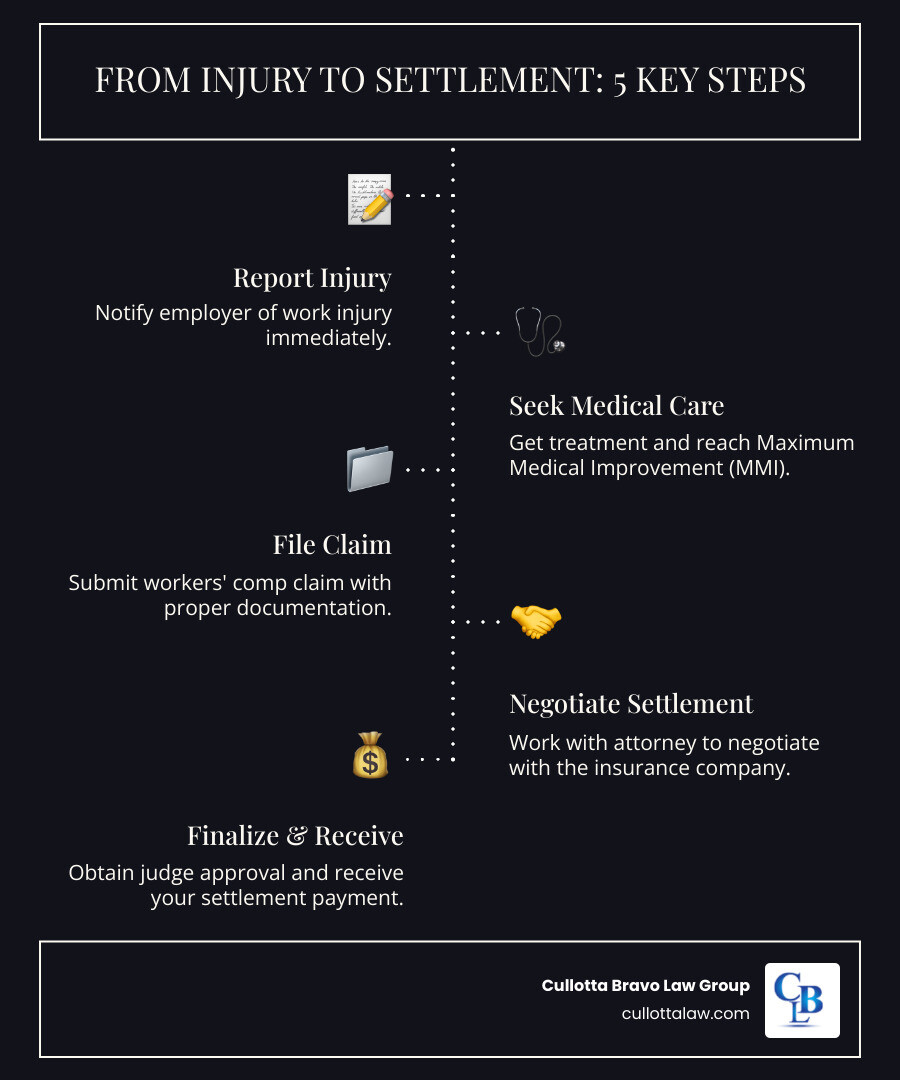
As your workers comp settlement attorney, we guide you through each step of the settlement process to protect your interests.

- Reaching Maximum Medical Improvement (MMI): The process usually starts after your doctor determines your condition has stabilized (MMI). This allows us to accurately assess your permanent limitations and future medical needs, which is crucial for calculating a fair settlement.
- Negotiation: We then negotiate with the insurance adjuster. Armed with medical evidence and detailed loss calculations, we counter their lowball offers and fight for the full value of your claim.
- Formal Documentation: Once an agreement is reached, we carefully review the binding legal contracts with you to ensure every detail protects your interests.
- Judge’s Approval: The final step is a hearing where an arbitrator from the Illinois Workers’ Compensation Commission reviews the settlement to ensure it’s fair and you understand the terms. This oversight is a key protection for injured workers.
To avoid common pitfalls, review these 7 Mistakes That Can Hurt Your Workers’ Compensation Claim.
When is the Right Time to Settle?
Timing is critical for maximizing your settlement. The ideal time to settle is generally:
- After you reach MMI, so we have a full picture of your permanent limitations.
- When your future medical needs are clear, ensuring costs for future surgeries or treatments are included.
- Once your permanent disability has stabilized, allowing for accurate calculation of its long-term impact.
An exception exists for cases with significant weaknesses. In such situations, settling early might be a strategic move to secure a better outcome than risking a trial. We provide honest advice on the strengths and weaknesses of your case to help you decide.
Can a Finalized Settlement Be Reopened?
One of the most common questions is whether a settlement can be reopened. The answer is almost always no. Once a settlement is approved by an Illinois arbitrator, it is final. You cannot go back for more money if your condition worsens or you realize the amount was too low. This finality is why getting the settlement right the first time is the only option.
Extremely rare exceptions exist for proven fraud or a mutual mistake of fact, but these are incredibly difficult to establish. Like other states that use final waiver forms, such as New York’s C-32 final waiver, Illinois law is designed to make settlements permanent. As your workers comp settlement attorney, we treat every negotiation as your one and only chance to secure your future. We carefully calculate your present and future needs to ensure the final agreement is one that fully protects you.
The Critical Role of a Workers Comp Settlement Attorney
Facing an insurance company alone is a losing battle. They have teams of lawyers dedicated to paying as little as possible. A workers comp settlement attorney is essential to protecting your future.

We level the playing field. We know insurance company tactics—the lowball offers, the pressure to settle quickly, the frustrating paperwork—and we know how to fight back. Research shows that claimants with legal representation receive significantly more compensation. At Cullotta Bravo Law Group, we’ve secured multi-million dollar settlements by maximizing claim value and handling all legal complexities.
We protect your rights and manage the entire process, so you can focus on what matters most. As we tell our clients, “We fight hard so you can focus on healing.” It’s our commitment to every person we represent.
Why You Need a Workers Comp Settlement Attorney
While going it alone might seem like it saves money, it often costs you far more in a devalued settlement. A workers comp settlement attorney from Cullotta Bravo Law Group provides critical services:
- Calculate Your Claim’s True Value: We analyze medical records, lost wages, and future needs to determine what you’re really owed, not just what the insurer offers.
- Negotiate with Adjusters: We are experienced negotiators who know how to counter adjusters’ tactics and push for a fair outcome.
- Handle All Legal Complexities: We manage all paperwork, deadlines, and procedures with the Illinois Workers’ Compensation Commission.
- Represent You at Hearings: If a hearing is necessary, we will be by your side, making the strongest possible case for you.
- Avoid Costly Mistakes: We prevent you from accepting a lowball offer, signing away future medical rights, or missing critical deadlines that could derail your claim entirely.
Finding the Right Workers Comp Settlement Attorney
Choosing the right workers comp settlement attorney is crucial. When looking for representation in Aurora, Chicago, Naperville, Joliet, or anywhere across Illinois, consider these factors:
- Specific Experience: Look for a lawyer who focuses on workers’ compensation law. Our firm has decades of dedicated experience in this complex field.
- Track Record: Ask about their history of success. We have recovered millions for injured workers.
- Contingency Fee: Ensure they work on a contingency basis, meaning you pay no fees unless you win. Our fee is a standard 20% of the recovery.
- Client Testimonials: See what past clients say about their experience and the firm’s approach.
- Local Knowledge: An attorney familiar with local Illinois arbitrators and procedures has a distinct advantage.
If you’re facing a work injury, contact Cullotta Bravo Law Group for a consultation. We offer honest answers and a clear path forward with no obligation.
Frequently Asked Questions about Workers’ Comp Settlements
After years of helping injured workers, we’ve heard just about every question imaginable. Here are answers to the most common concerns we hear at Cullotta Bravo Law Group.
How much does a workers’ comp settlement attorney cost?
Hiring a workers comp settlement attorney requires no upfront payment. We work on a contingency fee basis, meaning we only get paid if we win your case. Our fee is a standard 20% of your settlement amount in Illinois workers’ compensation cases. If we don’t secure a recovery for you, you owe us no attorney’s fees.
Case costs, such as for medical records or expert witnesses, are separate from fees and are typically reimbursed from the settlement. We explain this transparently in our agreement so there are no surprises.
How long does it take to get a workers’ comp settlement?
The timeline for a settlement varies from a few months to over a year, depending on several factors:
- Medical Treatment: We typically must wait until you reach Maximum Medical Improvement (MMI) to know the full extent of your injuries and costs.
- Case Complexity: Simple injuries resolve faster than severe cases involving disputes or third-party claims.
- Insurer’s Conduct: A responsive insurance company speeds things up, while one that delays or makes low offers extends the timeline.
- Negotiation: Proper negotiation takes time. We prioritize maximizing your compensation over rushing to a quick, but lower, settlement.
Will my settlement be taxed?
The good news is that workers’ compensation settlements are generally not taxable by the federal or state government. The money for your medical bills, lost wages, and disability is typically tax-free.
However, there are a few exceptions. If you also receive Social Security Disability Insurance (SSDI), your settlement could reduce those benefits through an “offset.” We can often structure a settlement to minimize this impact. Also, if a portion of your settlement is for interest, penalties, or from a separate third-party lawsuit, that specific money may be taxable.
While we are experts in workers’ comp law, we always recommend you consult a tax professional about your specific financial situation.
Conclusion
A work injury is overwhelming, and navigating the Illinois workers’ compensation system alone is a risk you shouldn’t have to take. As we’ve discussed, a settlement is a final decision, and getting it right the first time is critical for your future.
Professional guidance from a workers comp settlement attorney is essential. An insurance company has a team of lawyers; you deserve an expert fighter in your corner. Our goal isn’t just any settlement—it’s a fair settlement that covers all your medical expenses, lost wages, and future needs.
For over 35 years, Cullotta Bravo Law Group has secured millions for injured workers across Chicagoland. We provide aggressive representation while treating you with the dignity you deserve. Don’t face the insurance company by yourself. Let us handle the legal battle so you can focus on healing.
If you’re in Aurora, Chicago, Naperville, Joliet, or anywhere in Illinois, we are ready to help. Start Filing for Workers’ Comp in Aurora, IL today to get the compensation you deserve.