

Workers compensation for truck drivers aurora: 3 Essential Steps
Why Workers’ Compensation Matters for Truck Drivers in Aurora
Workers compensation for truck drivers aurora offers vital financial and medical protection if you’re injured on the job. Commercial trucking is one of Illinois’s most dangerous occupations, with thousands of drivers suffering injuries each year from accidents, heavy lifting, and repetitive strain.
Illinois’s no-fault workers’ compensation system allows you to receive benefits regardless of who caused the accident. However, navigating the claims process can be challenging. Companies may dispute your employment status or try to minimize your injuries. Understanding your rights is crucial.
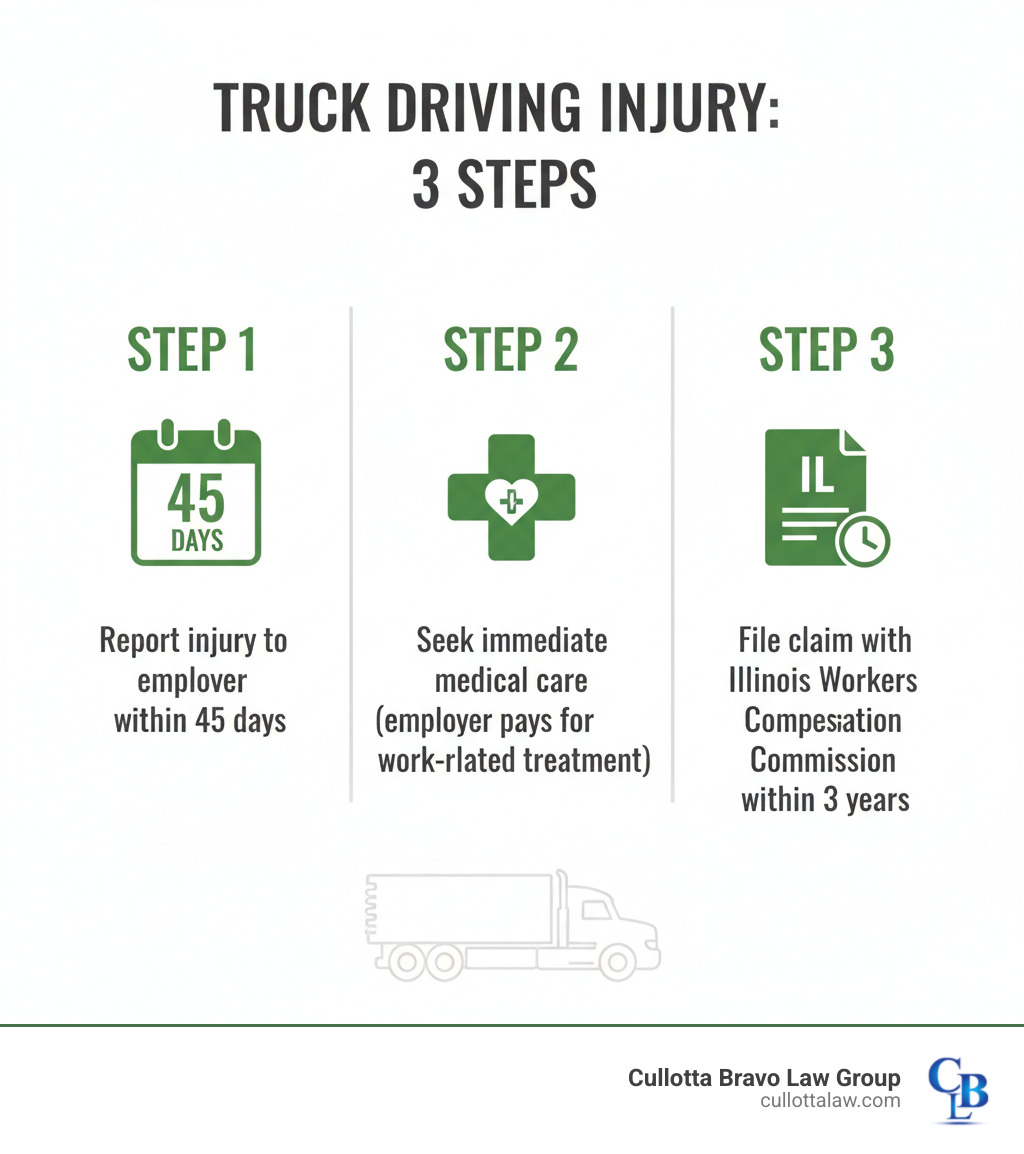
Key Steps After a Truck Driving Injury:
- Report your injury to your employer within 45 days.
- Seek immediate medical treatment; your employer is responsible for work-related care.
- File your claim with the Illinois Workers’ Compensation Commission within 3 years.
- Document everything, including medical visits, lost wages, and communications.
You are generally eligible if you are an employee and your injury arises out of and occurs in the course of your employment—whether driving, loading, or performing other work-related tasks.
I’m Peter Cullotta, and for over 35 years, I’ve helped injured truck drivers in the Chicagoland area secure the workers compensation for truck drivers aurora benefits they deserve. My firm fights against insurers who prioritize profits over people, ensuring you have the guidance needed for a full financial recovery.
Understanding Your Rights: Workers’ Comp for Aurora Truckers
If you’re an Aurora truck driver injured on the job, workers compensation for truck drivers aurora is your legal right under Illinois law, not a favor. The state uses a “no-fault” system, meaning you can receive benefits even if you were partially at fault for the injury. The key is that your injury must “arise out of” and occur “in the course of employment.”
This means the injury must be linked to your job duties and happen while you’re performing them. For truckers, this covers more than just driving. It includes injuries from loading cargo, conducting inspections, or even slipping on ice while entering your cab. The physical demands of trucking lead to common injuries like repetitive stress conditions (carpal tunnel), back and neck injuries from vibration and lifting, and severe trauma from loading/unloading accidents.

Are You an Employee or an Independent Contractor?
A major hurdle for many drivers is being misclassified as an “independent contractor.” Trucking companies use this tactic to avoid paying for workers’ compensation insurance. However, what your contract says doesn’t override Illinois law.
The crucial factor is the “right to control” test. The law looks at whether the company has the right to control how you perform your job, not just whether they exercise that right. Ask yourself:
- Who owns the truck?
- Who sets your routes and schedule?
- Do you work exclusively for one company?
- Who pays for fuel, maintenance, and insurance?
If the company controls these aspects, you are likely an employee entitled to workers compensation for truck drivers aurora benefits, regardless of your job title. The IWCC Handbook on rights and obligations provides more detail. Don’t accept your employer’s classification without question; your financial future could depend on it.
Common Injuries Covered for Truck Drivers
Workers compensation for truck drivers aurora covers a wide range of injuries common to the profession. Understanding what qualifies helps you know when to file a claim.
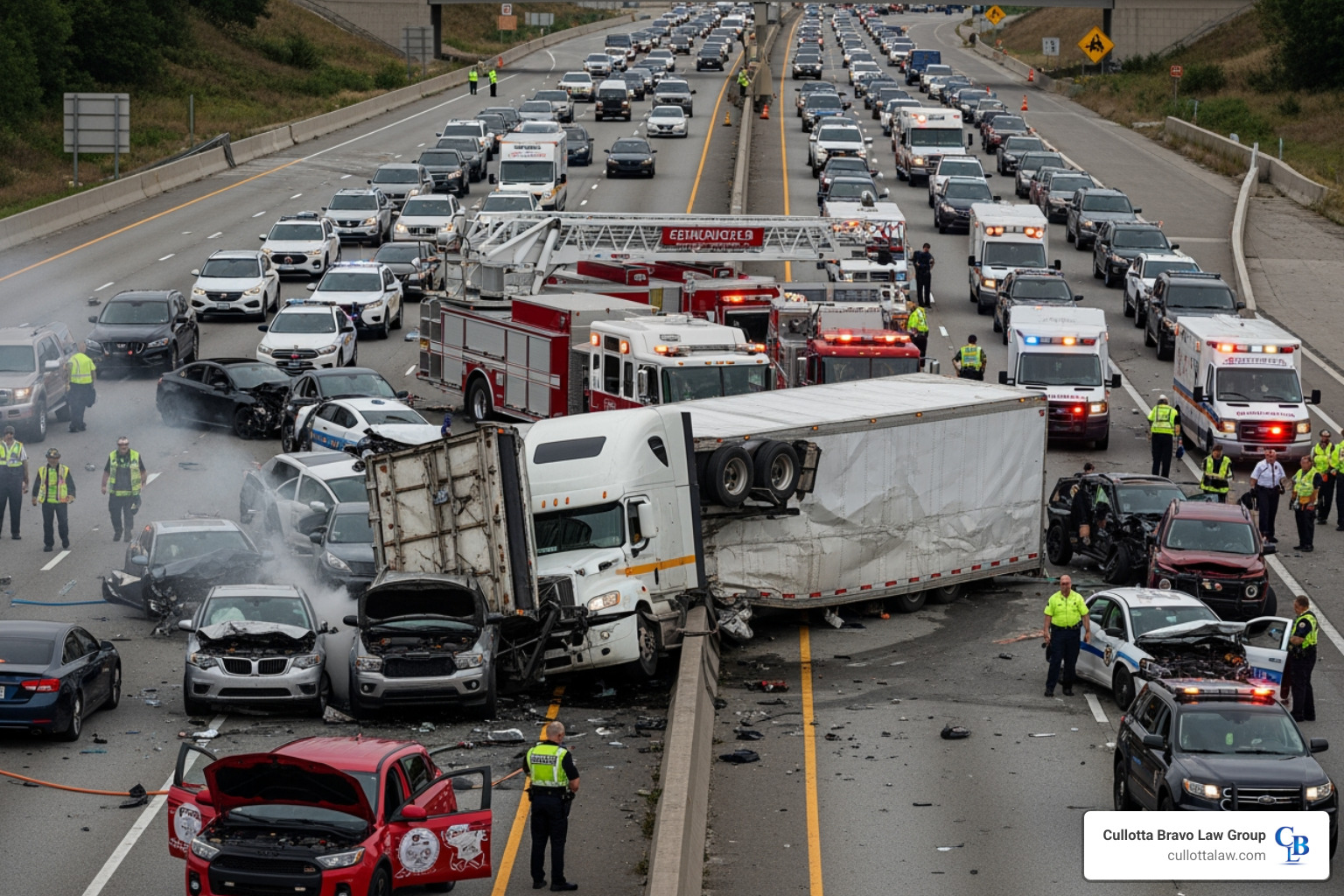
- Traffic accidents: Collisions, rollovers, and jackknife accidents causing injuries from whiplash to catastrophic harm are covered.
- Slips, trips, and falls: These frequently occur on loading docks, in truck stops, or while getting in and out of the cab, leading to fractures, sprains, and head injuries.
- Overexertion and lifting injuries: Straining to lift or move cargo often results in muscle tears, sprains, and herniated discs.
- Repetitive motion injuries: Constant steering, shifting, and gripping can cause conditions like carpal tunnel syndrome, tendinitis, and rotator cuff problems.
- Vibration-related injuries: Long hours on the road cause whole-body vibration, contributing to chronic back pain and disc degeneration.
- Exposure to hazardous materials: Illnesses or burns from hauling dangerous substances are covered occupational diseases.
- Aggravation of pre-existing conditions: If your job duties worsen a prior injury or condition, that aggravation is considered a new work injury.
For all these injuries, the workers’ compensation system is designed to cover your medical treatment and replace lost wages, allowing you to focus on recovery.
The Step-by-Step Guide to Filing Your Claim in Aurora
Filing for workers compensation for truck drivers aurora can seem complex, but following a clear process protects your rights. Taking immediate action is the best way to build a strong claim.
- Report Your Injury Immediately: While Illinois law gives you 45 days, report your injury to your employer as soon as possible. Do it in writing (email or text) to create a time-stamped record.
- Get Medical Care Right Away: Your health is the priority. Tell every medical provider that your injury is work-related. Your employer must pay for all reasonable and necessary medical care, and you have the right to choose up to two doctors.
- File Your Claim with the IWCC: To formalize your case, you must file an “Application for Adjustment of Claim” with the Illinois Workers’ Compensation Commission (IWCC) through its CompFile system. This officially notifies your employer’s insurer that you are seeking benefits.

Critical Deadlines You Can’t Miss
Missing a deadline can result in a complete loss of your benefits. These time limits are strict and unforgiving.
- 45-Day Notice Rule: You must notify your employer of your injury within 45 days of the accident. For repetitive stress injuries, the clock starts when you realize the condition is work-related. Report immediately to prevent the insurer from questioning your claim’s validity.
- Three-Year Statute of Limitations: You must file your official claim with the Illinois Workers’ Compensation Commission (IWCC) within three years of the injury date.
- Two-Year “Last Payment” Rule: If your employer voluntarily pays benefits, your deadline to file is extended to two years from the date of the last payment. This makes meticulous record-keeping essential.
The Official Filing Process with the IWCC
Filing with the IWCC is the formal start of your claim. The process begins by submitting the Application for Adjustment of Claim via the IWCC’s CompFile portal. While you can represent yourself, insurance companies have experienced attorneys, and navigating the legal requirements alone is risky.
Once filed, you must prove your case. This involves gathering medical records linking your injury to your work, documenting the incident, and confirming your status as an employee. If the insurer disputes your claim, the case proceeds to an arbitrator hearing, which is similar to a trial. The arbitrator reviews evidence and testimony before issuing a decision.
This process can take months or years. Many cases settle before a hearing, where the insurer offers a lump sum to close the claim. It is vital to have legal counsel review any settlement offer to ensure it fairly covers your current and future medical needs and lost wages. We handle the deadlines, paperwork, and negotiations so you can focus on healing.
Maximizing Your Benefits: What to Expect from Workers Compensation for Truck Drivers Aurora
An approved workers compensation for truck drivers aurora claim provides a range of benefits to support your physical and financial recovery. These benefits are your lifeline, addressing both immediate bills and long-term consequences of a work injury.

Types of Financial and Medical Benefits Available
Illinois law entitles you to several types of benefits:
- Medical Benefits: Covers all “reasonably necessary” medical care, including doctor visits, surgery, physical therapy, prescriptions, and medical equipment. You have the right to choose your own doctors.
- Temporary Total Disability (TTD): Replaces a portion of your lost wages if your doctor says you cannot work at all.
- Temporary Partial Disability (TPD): Compensates for the wage difference if you return to a light-duty job at lower pay.
- Permanent Partial Disability (PPD): Provides compensation for the permanent loss of function of a body part or the lasting impact of an injury on your earning capacity.
- Permanent Total Disability (PTD): Offers lifetime weekly payments if your injury prevents you from ever working again.
- Vocational Rehabilitation: Includes services like job retraining and counseling if you cannot return to your former job.
- Survivors’ and Burial Benefits: Provides financial support to dependents and covers funeral expenses if a work injury is fatal.
How Your workers compensation for truck drivers aurora Benefits Are Calculated
Benefit calculations are based on your Average Weekly Wage (AWW), which is your gross earnings (including overtime and bonuses) for the 52 weeks before your injury, divided by 52.
- TTD Benefits: Paid at two-thirds (66 2/3%) of your AWW, subject to state minimums and maximums.
- TPD Benefits: Paid at two-thirds of the difference between your pre-injury earnings and your current light-duty wages.
- PPD Benefits: Calculation depends on the injury. For specific body parts (e.g., hand, leg), it’s based on a statutory schedule. For other injuries (e.g., back, neck), it’s based on a “person as a whole” impairment rating, considering factors like your age, occupation, and future earning capacity.
- PTD Benefits: Paid at two-thirds of your AWW for life.
Insurance companies often try to undercalculate your AWW to reduce payouts. At Cullotta Bravo Law Group, we ensure your earnings are documented correctly so you receive every dollar you are owed. We manage the complex calculations and fight for the full benefits you deserve under Illinois law.
When Your Claim Hits a Roadblock: Denials and Third-Party Lawsuits
It’s stressful when your workers compensation for truck drivers aurora claim is denied, but a denial is not the final word. You have the right to appeal, and you may have other legal options for compensation.
What to Do If Your Workers’ Comp Claim is Denied
Insurance companies often deny valid claims, hoping injured workers will give up. Common reasons for denial include arguments that the injury wasn’t work-related, you’re an independent contractor, or you reported it too late.
If you receive a denial letter, don’t panic. Read it carefully to understand their reasoning, then begin gathering evidence to build your appeal. This includes medical records, accident reports, and witness statements. The next step is to file a petition with the Illinois Workers’ Compensation Commission to formally dispute the denial. An arbitrator will then hear your case.
Fighting a denial requires strong legal strategy. Insurance companies have lawyers dedicated to protecting their interests; you need an experienced attorney fighting for yours. We have successfully overturned countless denials for truck drivers by proving their cases with solid evidence.
Can You File a Personal Injury Lawsuit Too?
Yes, in many situations. While workers’ compensation is your “exclusive remedy” against your employer (meaning you can’t sue them for negligence), you can file a separate personal injury lawsuit against a negligent third party who contributed to your injury.
A third-party lawsuit is important because it allows you to seek compensation for damages not covered by workers’ comp, such as pain and suffering, emotional distress, and your full lost earning capacity.
Examples of liable third parties include:
- A negligent driver who caused your truck accident.
- The manufacturer of a defective truck part (e.g., faulty brakes or tires).
- A government entity responsible for unsafe road conditions.
- A cargo company that improperly loaded your freight.
- A repair shop that performed negligent maintenance.
Illinois uses a comparative fault rule, meaning your compensation can be reduced by your percentage of fault. You cannot recover damages if you are found to be more than 50% at fault. The statute of limitations for personal injury lawsuits in Illinois is just two years from the date of injury, so you must act quickly.
Our firm handles both workers’ compensation and personal injury cases, allowing us to coordinate your claims and maximize your total recovery without one case compromising the other.
Conclusion: Secure Your Future After a Work Injury
The path to recovery after a work injury can be difficult, but you don’t have to face it alone. As a truck driver, your rights to workers compensation for truck drivers aurora are protected by Illinois law. Whether you suffered a sudden accident or a repetitive strain injury, you are entitled to benefits for medical care, lost wages, and any permanent disability.
However, the system is complex, and insurance companies are focused on their bottom line, not your well-being. This is about more than just a claim; it’s about your family’s financial security. Having experienced legal guidance can make the difference between a fair recovery and financial hardship.
At Cullotta Bravo Law Group, we have spent over 35 years fighting for injured workers in Aurora, Chicago, and across Illinois. We know the tactics insurers use and have secured multi-million dollar results for our clients. We work on a contingent fee basis, meaning you pay nothing unless we win your case.
Don’t wait to act. Critical deadlines like the 45-day notice rule and the two-year statute of limitations for third-party claims are already ticking. Contact us today for a free consultation to review your case and explain your options. Learn more about filing for workers’ comp in Aurora, IL and take the first step toward securing your future.