

What You Need to Know About Filing a Car Accident Lawsuit
From Crash to Court: Understanding Your Car Accident Lawsuit
A car accident lawsuit is a formal legal action filed in civil court to recover compensation when settlement negotiations fail or an insurer refuses to offer fair payment for your injuries. After a crash, adrenaline can mask injuries that appear hours or days later, making it crucial to understand your legal options when facing medical bills, lost wages, or disputes over fault.
Quick Answer: When to Consider a Car Accident Lawsuit
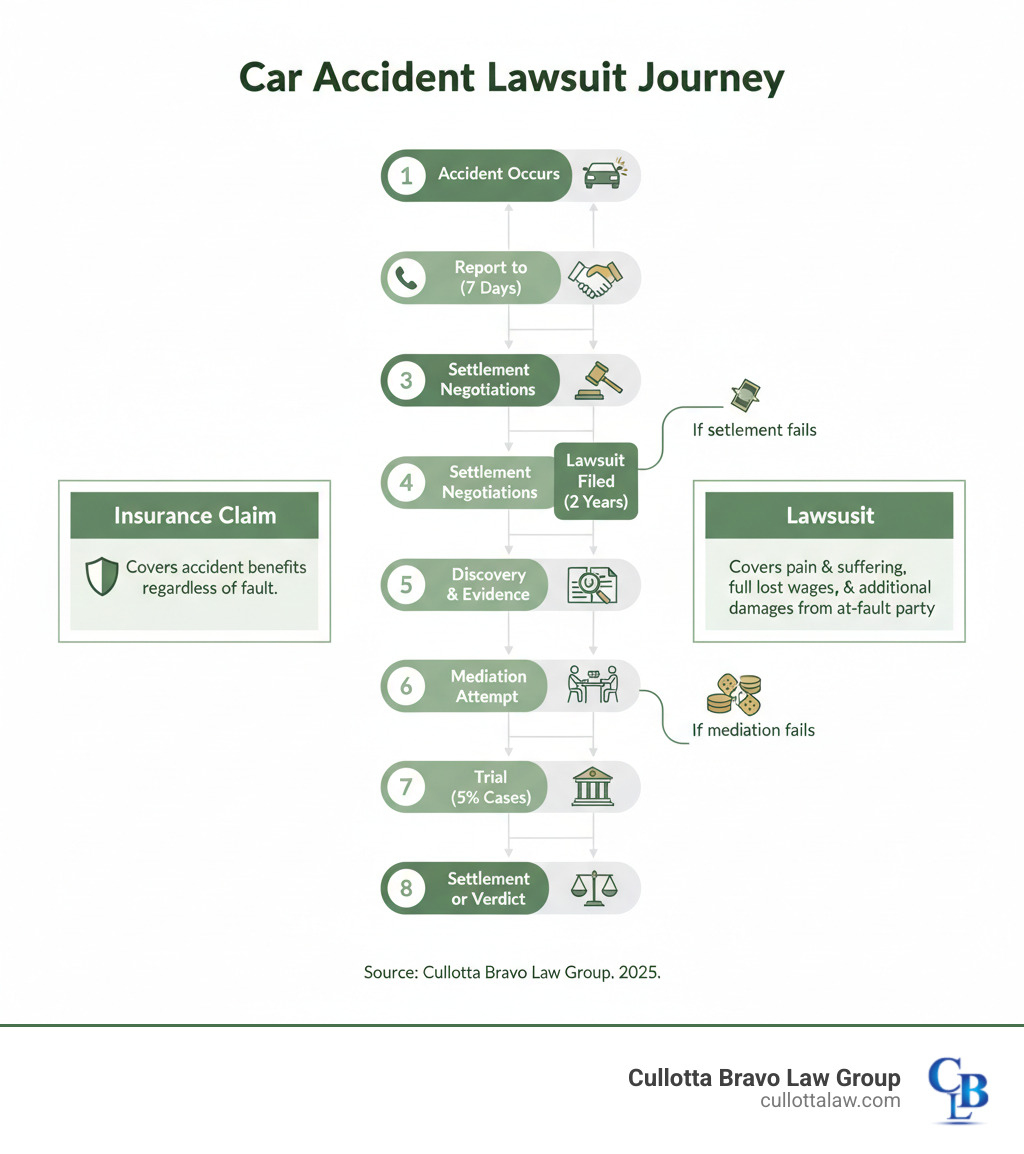
- Insurance claim settled: Most cases (about 95%) resolve through negotiation with insurance companies before any lawsuit is filed.
- Settlement stalled: File a lawsuit when parties can’t agree on fault, injury severity, or fair compensation.
- Lawsuit timeline: Expect 9-12 months to reach trial in Illinois, though many cases still settle during this period.
- Two-year deadline: Illinois law gives you typically two years from the accident date to file a personal injury lawsuit.
- Two types of claims: You can pursue insurance benefits (no-fault) and sue the at-fault driver for additional damages like pain and suffering.
Statistics show that an estimated 6.1 million police-reported crashes occurred in 2021, with about 2.1 million resulting in injuries. While only about 5% of car accident lawsuits go to trial, filing a lawsuit can pressure the insurance company to negotiate a fair settlement.
I’m Peter Cullotta, founding partner at Cullotta Bravo Law Group, with over 35 years of experience securing millions for injured individuals in the Chicagoland area. I’ve seen how proper legal representation makes the difference between inadequate offers and fair compensation that covers all medical expenses, lost wages, and pain and suffering. Let me guide you through what happens when a crash leads to court.
Must-know Car accident lawsuit terms:
The Crossroads: Insurance Claim vs. Car Accident Lawsuit
After a car accident, you face a critical choice: steer an insurance claim or file a car accident lawsuit. While both aim for compensation, they operate very differently.
An insurance claim is an informal process where you notify the at-fault driver’s insurance company you are seeking damages. In Illinois’s “at-fault” system, their insurer is typically responsible. This process begins with settlement negotiations with an adjuster whose goal is to protect their company’s bottom line. We’ve seen every trick, from delays to outright Insurance Company Denial Tactics designed to make you accept less.
Low-ball offers are common. An adjuster may offer a quick settlement that doesn’t cover your medical bills or dispute the severity of your injuries. When negotiations stall, liability is disputed, or your severe injuries demand more than the insurer will offer, it’s time to consider a lawsuit.
A car accident lawsuit is a formal legal action where you (the plaintiff) sue the at-fault driver (the defendant). This involves filing a complaint in court and serving the defendant with a formal service of process. It’s more complex but also more powerful, signaling to the insurance company that you are serious.
Here’s how these two paths compare:
| Feature | Insurance Claim (Initial) | Car Accident Lawsuit (Formal) |
|---|---|---|
| Process | Informal negotiation with insurance adjuster | Formal legal action in civil court |
| Goal | Settle for damages without court intervention | Obtain a judgment or court-ordered settlement |
| Parties Involved | You, your insurer, at-fault driver’s insurer | You (plaintiff), at-fault driver (defendant), their insurer |
| Complexity | Simpler, but can become complex with disputes | Involves legal procedures, findy, potentially trial |
| Timeline | Can be quicker if settled, but may drag on | Longer, often 9 months to several years |
| Outcome | Settlement agreement | Settlement or court verdict |
| Damages Covered | Varies by policy; may include medical, property, some lost wages | Comprehensive, including pain and suffering, future losses |
Deciding Between Settling and Suing
The decision to settle or sue is a balance between a certain amount now and potentially more later. We perform a detailed case valuation to guide this choice. This includes economic damages (quantifiable losses like medical bills, lost income, and future loss of earning capacity) and non-economic damages (pain and suffering, emotional distress, and loss of enjoyment of life).
We compare the settlement offer to our valuation. If an insurer offers $20,000 for a case we value at $40,000-$60,000, a car accident lawsuit is a strong consideration. However, an offer of $52,000 in that range might be a reasonable settlement to avoid the risks of litigation. The potential for a higher recovery must justify the added time and expense. There are many Reasons to file a car accident lawsuit, and we help you understand which apply to your case.
Why Most Cases Settle Before Trial
The vast majority of personal injury cases settle before trial. Settlement statistics show that about 95% of car accident lawsuits resolve beforehand. This is due to several factors.
First, the costs of litigation are high for both sides. Trials are expensive, with case expenses easily exceeding $10,000. Second, the time commitment is significant, with lawsuits often taking nine months to a year or more to reach trial. A settlement offers a quicker resolution.
Most importantly, a trial verdict is unpredictable. Both sides risk an unfavorable outcome. A settlement provides a guaranteed result. However, the leverage of a lawsuit often forces the insurance company to negotiate a more reasonable settlement. We prepare every case for trial, which strengthens our negotiating position and often leads to a fair settlement without the need for a court battle. But if a trial is necessary for justice, we are always ready.
Building Your Case: The Essential Steps to Filing a Lawsuit
Once you decide to pursue a car accident lawsuit, building a strong case requires careful preparation and a strategic approach. The effort you put in now directly impacts the outcome.

We start by assessing your case and beginning evidence collection. This includes medical records, the police report, witness statements, and documenting all expenses. With this evidence, we file a complaint, the formal legal document starting your case. The complaint is then delivered to the defendant through a process called serving the defendant.
This begins the findy phase, where both sides exchange information and take depositions. Settlement negotiations often continue, and many cases resolve once the insurer sees the strength of our evidence. The steps you take immediately after a crash are vital; our guide on 10 Steps to Take Immediately After a Car Accident in Chicago can be crucial for your future claim.
Gathering Crucial Evidence for Your Car Accident Lawsuit
Evidence is everything in a car accident lawsuit. Strong documentation can make or break a case. Scene documentation is the first step. If you are able, use your phone to take Photos of the accident, capturing vehicle damage, skid marks, traffic signals, and debris. Get contact information for any witnesses.
The police report provides an official account, and we review it for accuracy. Your medical documentation is the core of your injury claim. We gather all records, from ER notes to physical therapy logs, to prove the extent of your injuries and connect them to the accident. Proof of lost wages comes from your employer, and if your earning capacity is affected, we may use vocational experts to calculate future losses.
For complex cases, we may hire accident reconstruction experts to show how the collision occurred or medical experts to explain your injuries to a jury. Finally, your own journal detailing your pain, daily struggles, and emotional state provides a powerful personal account of your damages.
The Importance of Prompt Medical Treatment
Adrenaline after a car accident can mask serious injuries. It’s common for victims to feel fine initially, only to experience severe pain or symptoms of whiplash, concussions, or internal injuries hours or days later. Research in The American Journal of Emergency Medicine confirms this delayed presentation of symptoms.
Insurance companies exploit delayed medical treatment. They will argue that if you didn’t go to the ER, you weren’t badly hurt, or that your injuries were caused by something else. Seeking prompt medical attention (within 24-72 hours) is critical because it establishes causation—the medical link between the crash and your injuries. A doctor’s report creates a clear record that counters the insurance company’s arguments.
If you did wait to seek treatment, be honest with your doctor about when your symptoms began. We can work with this timeline, but we need the truth to build a credible case. Your health is the priority, and documenting your injuries immediately protects both your physical recovery and your legal rights.
Who is Liable and What Can You Claim?
In Illinois’s at-fault system, the party whose negligence caused the accident is liable for damages. However, personal liability can extend beyond the at-fault driver. When building a car accident lawsuit, we identify all potential defendants.
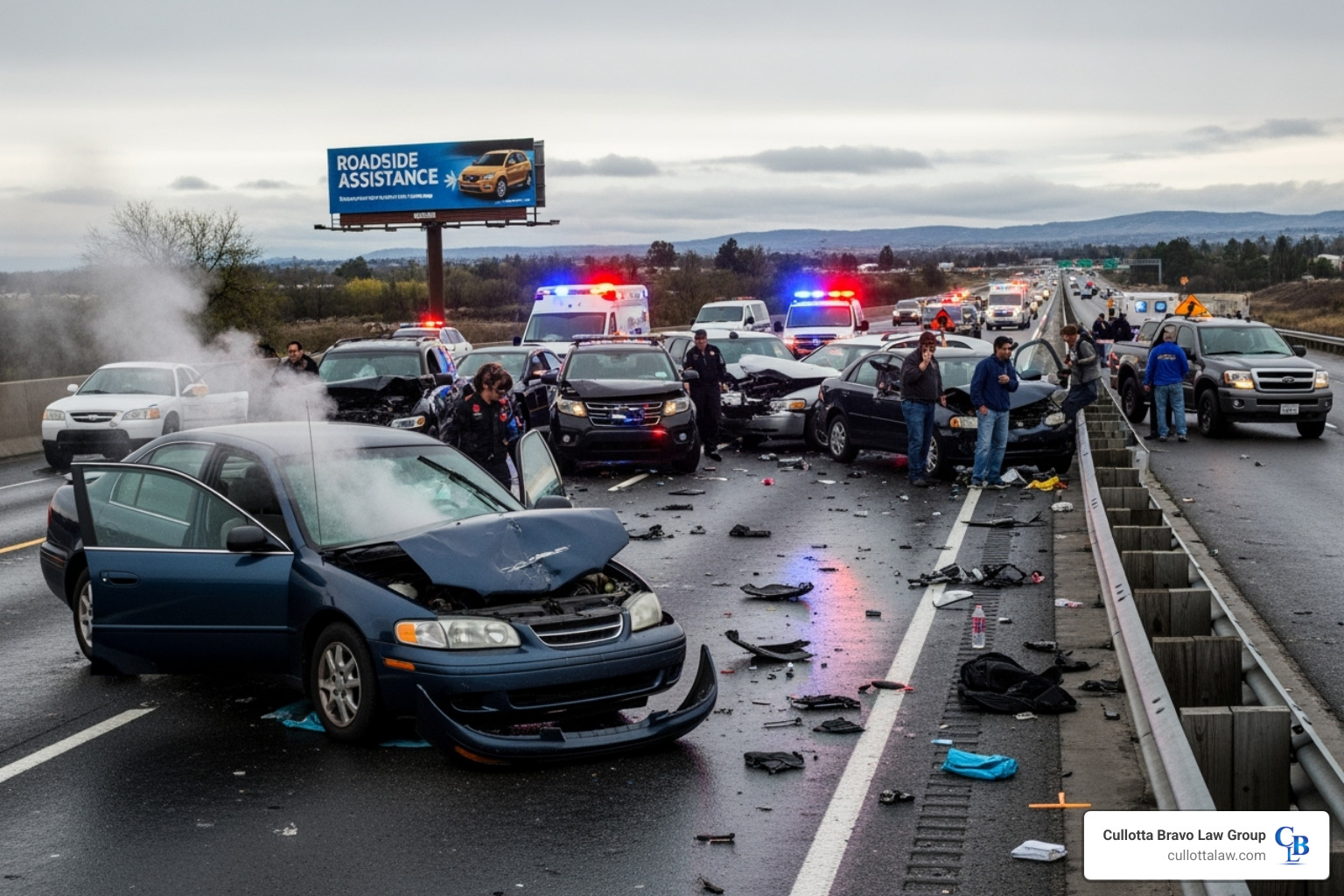
If a driver was working, their employer might be liable. If someone lent their car to an impaired driver, the vehicle owner could be held accountable. In some cases, claims can be made against vehicle manufacturers for defects or government entities for poor road maintenance. The compensation available is meant to make you whole again, covering both tangible bills and intangible suffering.
Determining Fault in Illinois
Illinois uses a modified comparative fault system, specifically the 51% bar rule. This means you can recover damages even if you are partially at fault, as long as your share of the blame is not 51% or more. If you are found 20% at fault for a $100,000 claim, you can recover $80,000. If you are 51% at fault, you recover nothing. Understanding Comparative Fault in Illinois Car Accident Cases is key to your claim’s success.
Driver negligence is the most common cause, including distracted driving, running red lights, or driving under the influence. Speeding Accidents are also frequent. We investigate every piece of evidence—skid marks, witness statements, traffic footage, and cell phone records—to establish who was truly at fault.
Types of Damages You Can Recover in a Car Accident Lawsuit
In a car accident lawsuit, you can claim two categories of damages. Economic damages are calculable losses, including all past and future medical bills, lost income, and reduced future earnings. Damage to your vehicle and other property also falls into this category.
Non-economic damages compensate for the personal impact of the accident. This includes pain and suffering, emotional distress (anxiety, depression, PTSD), and loss of enjoyment of life—the hobbies, activities, and simple pleasures taken from you. Unlike some states, Illinois does not place statutory caps on these damages in most car accident cases, allowing us to pursue full compensation for your losses.
While you can see What’s the Average Car Accident Settlement in Illinois?, every case is unique. Your claim deserves individual valuation to ensure you receive every dollar you are entitled to.
Navigating the Legal System: Timelines, Costs, and Alternatives
Pursuing a car accident lawsuit means navigating a complex legal system. We guide you through every step, from court dates to legal terminology, so you know what to expect.

The Statute of Limitations and Lawsuit Timeline
In Illinois, you generally have two years from the date of your accident to file a personal injury lawsuit. This deadline, the statute of limitations, is strict. Missing it usually means losing your right to sue. Exceptions exist, such as the “findy rule” for injuries found later or extended deadlines for minors. You can learn more about Statutes of Limitation on Accidents in Illinois.
Once filed, a typical car accident lawsuit in Illinois takes nine months to a year to reach trial, though many settle sooner. The timeline depends on case complexity, the number of parties, and court schedules. Litigation costs, such as filing fees and expert witness fees, can exceed $10,000 for a trial. This is why most personal injury lawyers work on a contingency fee basis, meaning you pay nothing upfront, and we only get paid if we win your case.
Alternatives to a Full Trial
About 95% of personal injury cases settle before trial. We use several effective alternatives, known as Alternative Dispute Resolution (ADR), to save you time, money, and stress.
Mediation is the most common. A neutral mediator facilitates negotiations between both sides to reach a settlement. The mediator does not make decisions but helps the parties find common ground in a flexible, informal setting.
Arbitration is more formal. A neutral arbitrator hears evidence from both sides and makes a decision, which can be binding (final) or non-binding (a recommendation). It is typically faster and less expensive than a trial.
Settlement conferences, often overseen by a judge, are another tool where both sides present their cases to work toward a negotiated resolution. These alternatives offer more privacy and control over the outcome than a jury trial. Our goal is to secure fair compensation as efficiently as possible, whether through negotiation or in court.
Frequently Asked Questions about Car Accident Lawsuits
It’s normal to have questions about car accident lawsuits. This is complex territory, and you’re navigating it while recovering from an injury. Here are straight answers to the questions we hear most often.
How much can you sue for after a car accident?
There is no fixed limit. The amount you can sue for is based on your specific, provable damages. This includes all medical bills (current and future), lost wages, property damage, and non-economic damages like physical pain, emotional distress, and the impact on your quality of life.
The severity of your injuries is a primary factor. A claim for a resolved concussion will be valued differently than one for a spinal cord injury requiring lifelong care. Calculating the settlement of a claim is a detailed process, often requiring input from medical and economic experts to project future losses.
What happens if the at-fault driver is uninsured?
This is a stressful but common scenario. If you have Uninsured/Underinsured Motorist (UM/UIM) coverage on your own auto insurance policy, you are protected. This coverage acts as the at-fault driver’s insurance when they have none or not enough.
You file a claim with your own insurer, which then compensates you for your damages up to your policy limits. This type of claim should not raise your rates, as you were not at fault. If you lack this coverage, you could sue the driver directly, but collecting a judgment from someone who cannot afford insurance is difficult. We strongly recommend carrying adequate UM/UIM coverage as a safety net. You can learn more about your options in uninsured accidents.
How are attorney fees handled in a car accident lawsuit?
Legal representation should be accessible to everyone, regardless of their financial situation. That’s why our firm, like most personal injury attorneys, works on a contingency fee basis. This means you pay no upfront fees.
Our fee is contingent on winning your case. If we secure a settlement or verdict, we receive a pre-agreed percentage of the total recovery, typically 33% to 40%. If we do not win your case, you owe us nothing for our legal fees. We take on the financial risk, not you. This aligns our interests with yours—we only succeed when you do. Case-related expenses are handled separately, and we are always transparent about these costs from the start. You can learn how attorneys work on contingency to better understand this model.
Conclusion
After a car accident, you’re not just healing from injuries—you’re facing insurance companies, medical bills, and a potential car accident lawsuit. It’s an overwhelming process where every step matters.
Remember these key points: Time is not on your side. You have two years in Illinois to file a lawsuit, but evidence disappears and insurers act fast to minimize payouts. Seeking immediate medical care and documenting everything—from scene photos to a pain journal—is crucial to protecting your legal rights.
Understanding your rights is your greatest asset. Knowing when to push past an insufficient insurance claim and file a car accident lawsuit can be the difference between a low-ball offer and a fair recovery. You deserve compensation for your medical bills, lost work, and the pain and suffering that has altered your life.
You don’t have to do this alone. Insurance companies have lawyers protecting them; you need an advocate protecting you. At Cullotta Bravo Law Group, we have over 35 years of experience fighting for clients in Aurora, Chicago, Naperville, and Joliet. We build winning cases on a contingency fee basis, so you pay nothing unless we win for you.
If you’ve been injured, don’t steer the path from crash to court by yourself. Contact an experienced Personal Injury Lawyer in Naperville to understand your options. Let us handle the legal fight while you focus on healing.