

Demystifying Illinois Workers Compensation Benefits
What You Need to Know About Workers’ Compensation Benefits in Illinois
Workers’ compensation benefits in Illinois are available to most employees who suffer a work-related injury or illness — covering medical costs, lost wages, and more, regardless of who was at fault.
Here is a quick overview of what Illinois workers’ comp provides:
| Benefit Type | What It Covers |
|---|---|
| Medical Benefits | All necessary treatment, surgery, therapy, and prescriptions |
| Temporary Total Disability (TTD) | 66⅔% of your average weekly wage while unable to work |
| Temporary Partial Disability (TPD) | Partial wage replacement if you return to lighter-duty work |
| Permanent Partial Disability (PPD) | Compensation for lasting impairment to a body part or function |
| Permanent Total Disability (PTD) | Lifetime benefits if you can never return to work |
| Death Benefits | Payments to dependents for up to 25 years or $500,000 |
| Vocational Rehabilitation | Job retraining if you cannot return to your previous role |
The Illinois Workers’ Compensation Act covers over 91% of workers in the state. If your employer has even one part-time or full-time employee, they are generally required by law to carry coverage.
But knowing your rights and actually getting your benefits are two very different things. Insurance companies routinely challenge claims, dispute injuries, and delay payments — leaving injured workers frustrated and financially strained.
I’m Peter Cullotta, founding partner of Cullotta Bravo Law Group, and over my 35+ years as a trial lawyer in the Chicagoland area I have helped countless clients navigate workers’ compensation benefits in Illinois — from initial claims through arbitration and appeals. In this guide, I’ll walk you through everything you need to know to protect your rights.
Who is Eligible for workers compensation benefits Illinois?

In Illinois, the workers’ compensation system is designed to be incredibly broad. Coverage starts the very first second you begin your job. There is no waiting period to become eligible for coverage; whether you are injured on your first day or your tenth year, you are protected.
Generally, almost every employee working for a private company, a charitable organization, or state and local governments is covered. This includes full-time, part-time, seasonal, and even temporary workers. If you are injured while performing duties that benefit your employer, you should be eligible for workers compensation benefits Illinois offers.
However, a major battleground in workers’ compensation is employment status. Employers sometimes try to save money on insurance premiums by labeling their staff as “independent contractors” when they are actually employees. Under Illinois law, simply signing a contract that says you are an independent contractor does not make it so. If the employer controls your hours, provides your tools, and directs how you do your job, you are likely an employee in the eyes of the law. If you believe you have been misclassified, you should read our guide on Workers Compensation for Misclassified Workers to understand your legal rights and how to claim the benefits you deserve.
Covered Injuries and Occupational Diseases
When people think of workers’ comp, they often picture dramatic accidents: a construction worker falling from a scaffold or a warehouse worker injured in a forklift collision. While these traumatic events are certainly covered, the law also protects workers who suffer from less obvious, gradual conditions.
Covered injuries and illnesses in Illinois include:
- Traumatic Injuries: Sudden accidents resulting in broken bones, lacerations, concussions, or spinal damage.
- Orthopedic Injuries: Severe joint damage often requiring surgery. If you have suffered a joint injury, you can learn more about your options by reviewing our resources on Workers Compensation Orthopedic Injuries.
- Repetitive Stress Injuries: Damage caused by performing the same physical motion thousands of times over months or years. For more details on how to prove these claims, read our guide on Repetitive Stress Injury.
- Occupational Diseases: Illnesses resulting from prolonged exposure to toxic chemicals, mold, asbestos, or poorly ventilated workspaces.
- Pre-Existing Conditions: If you have a prior injury (like a bad back or arthritis) and your job duties or a specific workplace incident makes that condition significantly worse, you are still entitled to full benefits under Illinois law.
Exemptions and Special Rules
While coverage is nearly universal, the 820 ILCS 305/ – Workers’ Compensation Act does outline a few specific exemptions and special rules:
- Sole Proprietors and Partners: Business owners, partners, and members of LLCs are not automatically covered, but they can actively elect to cover themselves under their insurance policy.
- Corporate Officers: Officers of a corporation can choose to opt out of workers’ comp coverage by providing written notice to their insurance carrier.
- Agricultural Workers: Small agricultural enterprises that employ fewer than 400 working days of labor per quarter are generally exempt from mandatory coverage.
- Domestic Workers: Individuals employed in private homes (such as housekeepers or nannies) are covered only if they work a minimum number of hours per week for a single household.
Understanding the Core Benefits and 2026 Rates
If you are injured on the job, the Illinois Workers’ Compensation Act, specifically 820 ILCS 305/8, outlines the core benefits you are entitled to receive. These benefits are designed to address both your physical recovery and your financial stability.
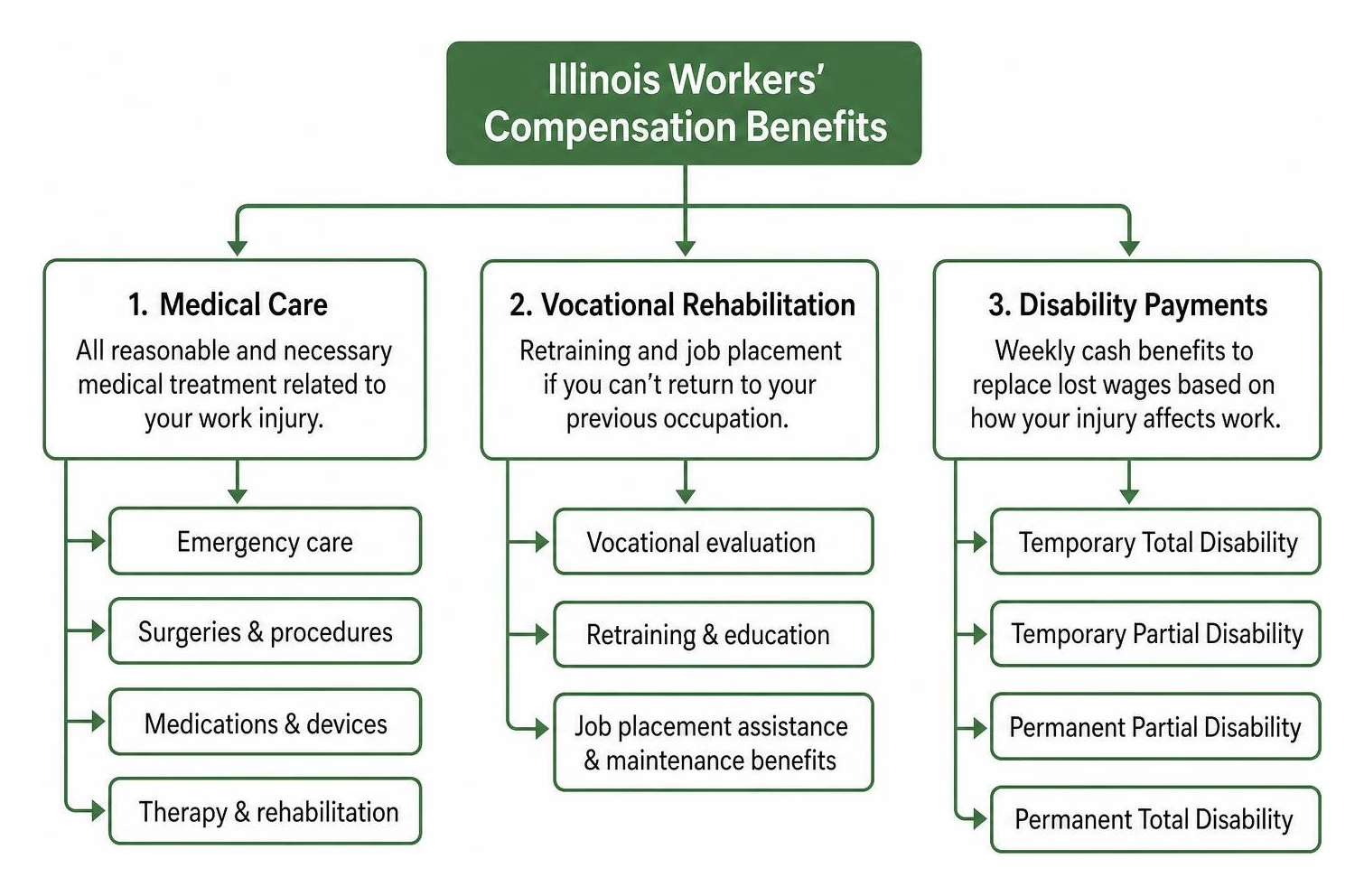
The primary categories of benefits include:
- Medical Care: Your employer’s insurance must pay for all reasonable and necessary medical care to cure or relieve the effects of your injury. This includes emergency room visits, surgeries, physical therapy, prescription medications, and medical devices.
- Vocational Rehabilitation: If your injury prevents you from returning to your previous occupation, you may be entitled to vocational retraining and job placement services, along with maintenance benefits while you undergo retraining.
- Disability Payments: Weekly cash benefits to replace lost wages, categorized by how much your injury limits your ability to work.
Types of workers compensation benefits Illinois Provides
The financial assistance you receive while recovering is split into several distinct disability categories:
- Temporary Total Disability (TTD): Paid when your doctor states you cannot work at all while recovering, or if your employer cannot accommodate your temporary light-duty restrictions. It pays 66⅔% of your average weekly wage.
- Temporary Partial Disability (TPD): If you can return to light-duty work but earn less than your pre-injury wage, TPD pays 66⅔% of the difference between your old wage and your new light-duty wage.
- Permanent Partial Disability (PPD): Paid if your injury results in a permanent physical impairment but you are still able to work in some capacity. This is often resolved via a scheduled loss of a body part, a wage differential, or a disfigurement award.
- Permanent Total Disability (PTD): If you are permanently and completely unable to work in any stable job market, or if you have lost both hands, both arms, both feet, both legs, or both eyes (or any combination of two), you qualify for lifetime weekly benefits. You can read more about how these life-changing claims are handled in our guide to Permanent Total Disability.
- Death Benefits: If a worker tragically loses their life due to a work-related accident or illness, their surviving dependents (spouse and children) are entitled to burial expenses up to $8,000 and ongoing weekly compensation. For more details on survivor rights, see our article on Death Benefits.
2026 Benefit Rates and Maximums
Workers’ compensation rates in Illinois are not static; they are adjusted twice a year based on the Statewide Average Weekly Wage (SAWW) calculated by the Illinois Department of Employment Security.
As of the current period in July 2026, here are the key rates and maximums you need to know:
- Statewide Average Weekly Wage (SAWW): For the period of January 15, 2026, through July 14, 2026, the SAWW is set at $1,506.49.
- Maximum TTD and PTD Benefit: The maximum weekly benefit for TTD, PTD, and death benefits is $2,008.60 (which is 133⅓% of the SAWW).
- Minimum TTD Benefit: The absolute minimum weekly benefit for TTD is linked to the state minimum wage and the number of dependents you have. For a single worker with zero dependents, the minimum weekly rate is $400.00. This increases up to $600.00 weekly if you have four or more dependents.
- Maximum PPD Benefit: For permanent partial disability (non-amputation scheduled injuries), the maximum weekly rate is $1,084.66 (covering injuries between July 1, 2025, and June 30, 2026).
- Mileage Reimbursement: If you must travel for medical treatments or insurance-ordered exams, you are entitled to mileage reimbursement. For 2026, the rate is $0.725 per mile.
To verify the most up-to-date rates for your specific injury date, you can consult the official Benefit Rates – Resources page.
Employer Obligations and the Claims Process

Employers in Illinois have strict legal responsibilities when it comes to workers’ compensation. Under the law, any business with at least one employee must carry workers’ compensation insurance.
If an employer willfully and knowingly fails to secure coverage, they face severe penalties, including a minimum civil fine of $10,000. Additionally, the Illinois Workers’ Compensation Commission can issue stop-work orders and fine the uninsured business up to $500 per day of non-compliance. Furthermore, an employer without insurance loses their protection under the Act, meaning an injured worker can sue them directly in civil court for personal injury damages.
When an employee reports an injury, the employer is legally obligated to:
- Provide immediate first aid or medical services.
- Report the injury to their insurance carrier.
- File an Employer’s First Report of Injury (Form 45) with the Commission if the worker misses more than three days of work.
- Promptly begin paying TTD benefits or provide a written explanation of why the claim is being delayed or denied.
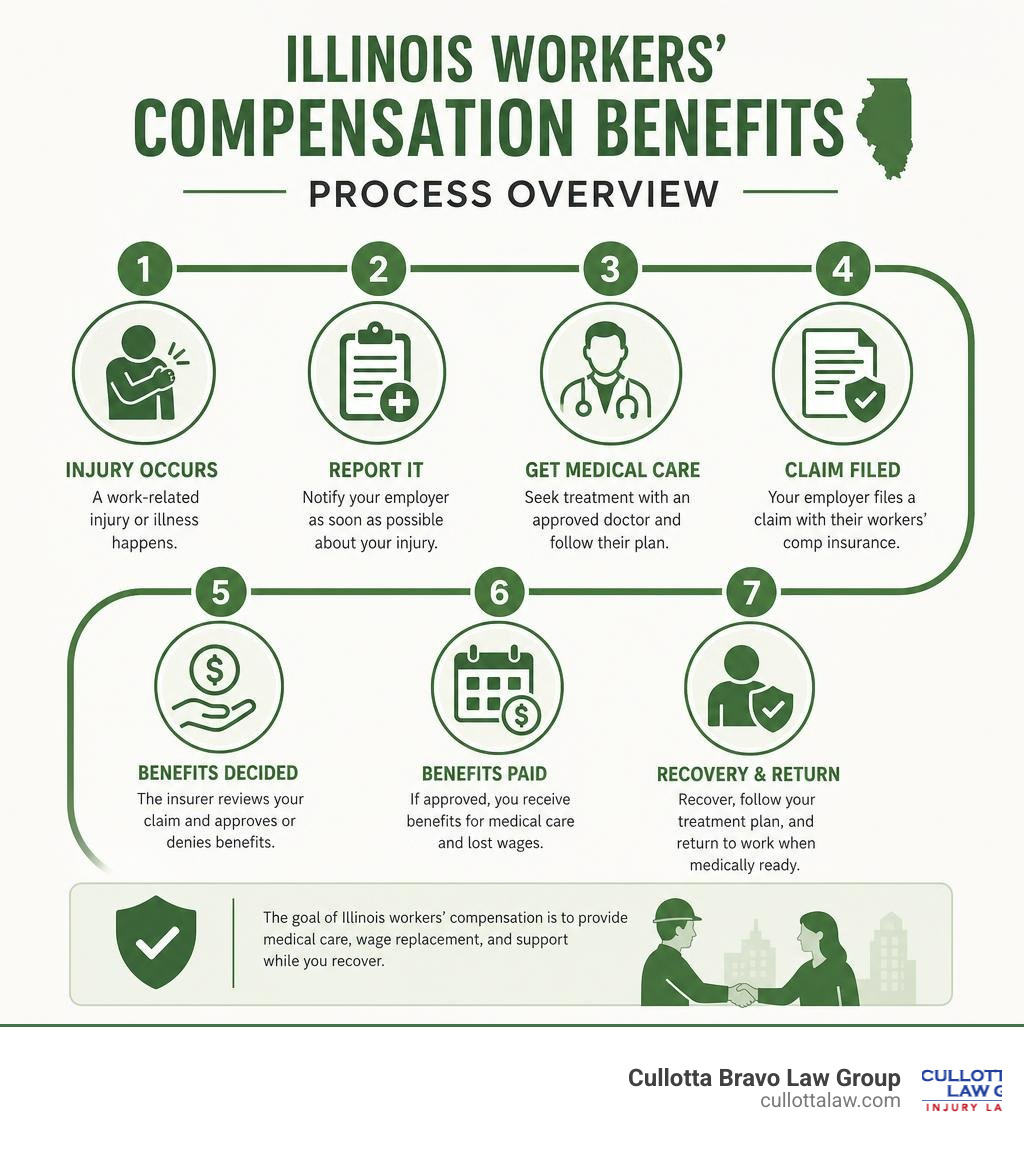
How to Secure Your workers compensation benefits Illinois
To protect your rights and ensure your benefits are paid smoothly, you must follow a specific set of steps. Failing to do so can give the insurance company an excuse to deny your claim.
- Step 1: Seek Medical Help Immediately. Go to an emergency room, urgent care, or your primary doctor. Make sure to tell the medical staff that your injury happened at work so it is documented in your medical records.
- Step 2: Notify Your Employer. You must notify your employer of your injury as soon as practicable, but no later than 45 days after the accident. While oral notice is legally acceptable, we always recommend giving written notice (via text, email, or a physical letter) so you have proof.
- Step 3: File a Formal Claim. Simply telling your boss is not the same as filing a legal claim. To protect your rights, you must file an Application for Adjustment of Claim with the Commission. The statute of limitations generally requires you to file this within three years of the injury date, or within two years of the last compensation payment, whichever is later. For step-by-step guidance, read our guide on Filing for Workers Comp in Aurora IL.
- Step 4: Avoid Common Pitfalls. Insurance companies look for any excuse to stop paying. To keep your claim safe, avoid the critical errors outlined in our guide on 7 Mistakes That Can Hurt Your Workers Compensation Claim.
Resolving Disputes and Appeals
It is highly common for insurance companies to dispute legitimate claims. They might argue that your injury didn’t happen at work, that your medical treatment is unnecessary, or that you are fully recovered before your doctor agrees.
If your benefits are stopped or reduced, the dispute is resolved through a formal legal process:
- Arbitration: Your case will be assigned to an Arbitrator at the Commission. Think of this as a trial. Both sides present medical records, witness testimony, and legal arguments.
- The Commission Review: If either party disagrees with the Arbitrator’s decision, they can appeal to a three-commissioner panel.
- Court Appeals: If the dispute remains unresolved, it can be appealed further to the Illinois Circuit Court, and in rare cases, the Appellate Court.
If you find yourself facing a disputed claim, our comprehensive Denied Workers Comp Guide 2026 offers essential strategies for fighting back and securing your benefits.
Detecting and Avoiding Workers’ Comp Scams
Unfortunately, injured workers are sometimes targeted by scammers. These fraudsters may pose as insurance adjusters, state employees, or medical billing companies, demanding personal information, Social Security numbers, or even direct payments to “process” your claim.
To protect yourself:
- Never pay out of pocket to have your workers’ comp claim processed.
- Verify all communications. If you receive a suspicious phone call, letter, or email regarding your claim, do not provide any personal information. Instead, verify its legitimacy by emailing
wcc.compfile@illinois.govor calling the Commission directly at 312-814-6500. - For official procedures and guidelines, you can review the state’s Handbook013013 letter size.
Frequently Asked Questions About Illinois Workers’ Comp
What is the waiting period for workers’ compensation in Illinois?
Illinois has a three workday waiting period before TTD benefits are paid. You will not receive wage replacement for the first three days you miss work unless you are disabled for 14 or more calendar days. If your injury keeps you out of work for 14 days or longer, the insurance company must retroactively pay you for those initial three waiting days.
Are workers’ compensation benefits taxable in Illinois?
No. Workers’ compensation benefits are completely tax-free under both state and federal law. You do not have to report your weekly TTD, PPD, or PTD payments as income on your tax returns.
Can I choose my own doctor for a work injury in Illinois?
Yes, but with limits. Under the “two-choice rule,” you are allowed to choose up to two medical providers (and any specialists they refer you to) at your employer’s expense. If your employer participates in an approved Preferred Provider Program (PPP), you can choose to opt out of the PPP, but doing so counts as your first choice of doctor.
Conclusion
Navigating the workers’ compensation system in Illinois can feel like walking through a legal minefield. While the law is designed to protect you, the insurance companies are focused on protecting their bottom line.
At Cullotta Bravo Law Group, we have over 35 years of experience fighting for injured workers in Aurora, Chicago, Naperville, Joliet, and throughout Illinois. We treat our clients with the dignity they deserve and aggressively pursue the maximum compensation possible.
If you or a loved one has been injured on the job, don’t face the insurance companies alone. Contact us today for a free, no-obligation consultation, or visit our Cullotta Bravo Law Group Workers’ Compensation Services page to learn how we can help you secure the benefits you deserve.