

Don’t Let the Clock Run Out on Your Illinois Injury Claim
Your Illinois Injury Claim Has an Expiration Date — Here’s What You Need to Know
How long do you have to file a personal injury claim in Illinois? Here’s the short answer:
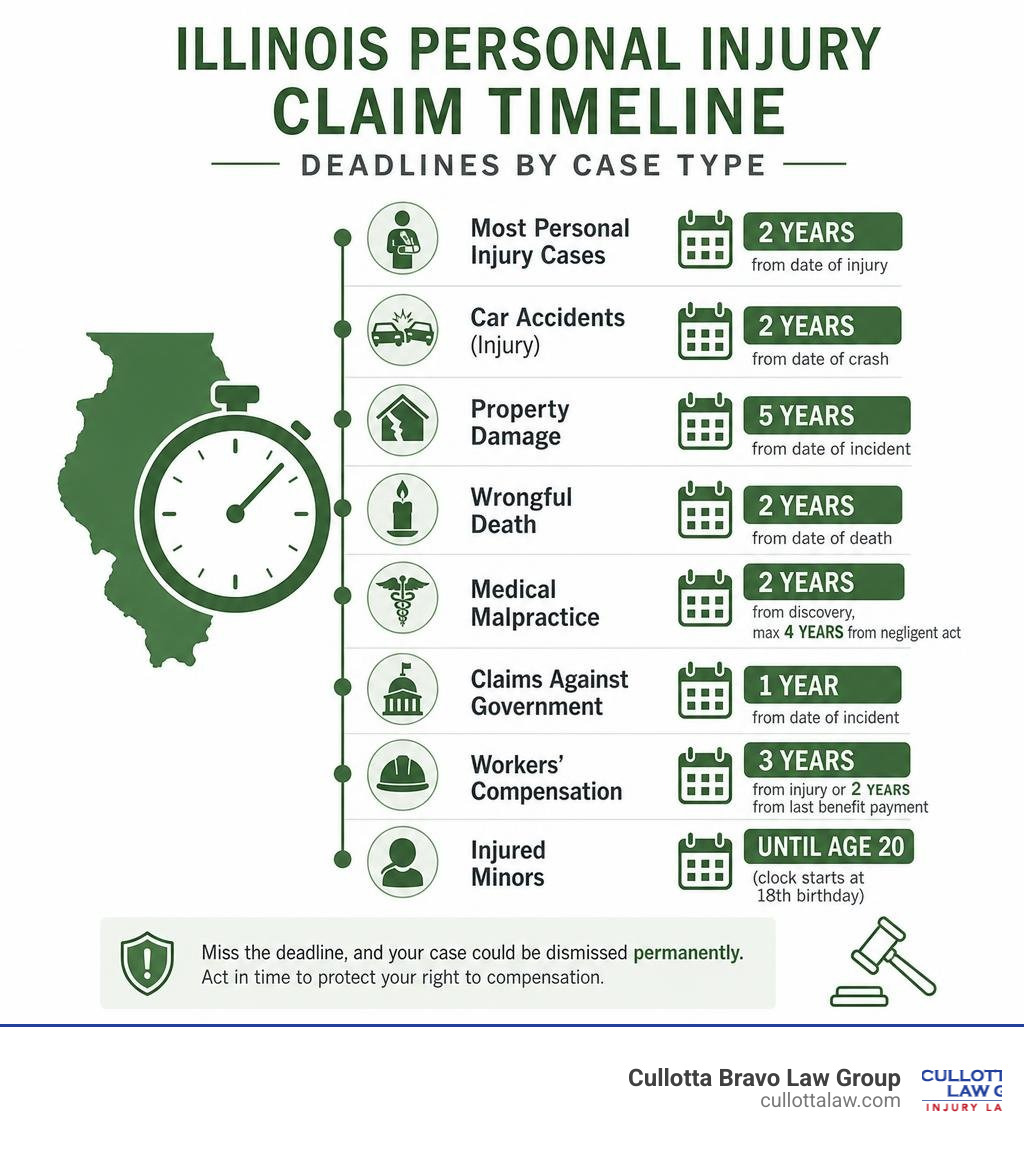
| Claim Type | Filing Deadline |
|---|---|
| Most personal injury cases | 2 years from date of injury |
| Car accidents (injury) | 2 years from date of crash |
| Property damage | 5 years from date of incident |
| Wrongful death | 2 years from date of death |
| Medical malpractice | 2 years from discovery, max 4 years from negligent act |
| Claims against government | 1 year from date of incident |
| Workers’ compensation | 3 years from injury or 2 years from last benefit payment |
| Injured minors | Until age 20 (clock starts at 18th birthday) |
Miss that deadline and your case is over — permanently. It doesn’t matter how clear the other side’s fault was or how serious your injuries are. Illinois courts will dismiss your claim with no exceptions for being close.
Every year, injured people in Illinois lose winnable cases simply because they waited too long. They assumed the insurance company was working toward a fair settlement. They thought they had more time. They didn’t know the rules were different for government claims. By the time they realized the mistake, it was too late.
This guide explains exactly how these deadlines work, where the traps are, and what you need to do to protect your right to compensation.
I’m Peter Cullotta, founding partner at Cullotta Bravo Law Group, and with over 35 years of trial experience representing injured people throughout Chicagoland, I’ve seen how critical it is to understand how long you have to file a personal injury claim in Illinois — and the serious consequences of missing that window. In the sections below, I’ll walk you through every key deadline, exception, and warning sign so you can act with confidence.
How Long Do You Have to File a Personal Injury Claim in Illinois?

When you are hurt in an accident due to someone else’s negligence in Illinois, the state imposes a strict timeframe for taking legal action. This timeframe is known as the “statute of limitations.” Under Illinois Compiled Statutes 735 ILCS 5/13-202, the standard statute of limitations for personal injury claims is two years from the date the cause of action accrued.
But what does “accrued” actually mean? In most standard personal injury cases, the accrual date is the exact day the accident occurred. For example, if you were injured in a slip-and-fall or a motor vehicle collision in Aurora, IL, on June 15, 2026, your two-year clock begins ticking that very day. This means you must file a formal lawsuit in court on or before June 15, 2028.
It is vital to distinguish between filing an insurance claim and filing a lawsuit. Many people mistakenly believe that as long as they have opened an active insurance claim with the negligent party’s insurer, they are safe. This is a dangerous misconception. The two-year statute of limitations dictates the deadline to file a lawsuit in civil court. Insurance companies are well aware of this deadline and may intentionally slow-walk negotiations, hoping you will let the two-year window close. Once that clock runs out, you lose all leverage because you can no longer threaten to take them to court. To learn more about the broader legal definitions of liability, explore More details on personal injury claims.
How the Deadline Varies by Case Type
While the general rule is two years, Illinois law establishes different deadlines depending on the specific nature of your injury. Below is a detailed breakdown of how these timelines shift based on the type of case you are pursuing.
| Case Type | Governing Statute | Standard Deadline | Key Detail to Remember |
|---|---|---|---|
| Car Accident Injury | 735 ILCS 5/13-202 | 2 Years | Clock starts on the date of the crash. |
| Property Damage | 735 ILCS 5/13-205 | 5 Years | Applies to vehicle repairs and physical property only. |
| Medical Malpractice | 735 ILCS 5/13-212 | 2 Years from discovery | Subject to a strict 4-year absolute statute of repose. |
| Wrongful Death | 740 ILCS 180/2 | 2 Years | Clock starts on the date of death, not the date of the injury. |
| Workers’ Compensation | Workers’ Comp Act | 3 Years (or 2 years from last payment) | Claims must be filed with the Illinois Workers’ Compensation Commission. |
Car Accidents and Property Damage
If you are involved in a car crash in Joliet, Naperville, or Chicago, your case will likely involve both physical injuries and damage to your vehicle. Under Illinois law, these two components are treated differently:
- Bodily Injury: You have two years from the date of the crash to file a lawsuit for your physical injuries, pain and suffering, and medical bills.
- Property Damage: Under 735 ILCS 5/13-205, Illinois allows a five-year limit to seek compensation for damaged property. This means if you only want to sue for the cost of repairing your car, you have five years to do so.
However, because most car accident claims involve both injury and property damage, we highly recommend resolving both issues simultaneously. Waiting to file your injury claim while focusing on property damage can lead to a disastrous missed deadline. For a comprehensive look at navigating these complex claims, read our Guide to car accident lawsuits.
Medical Malpractice and the Statute of Repose
Medical malpractice cases are highly complex and governed by 735 ILCS 5/13-212. Unlike a car crash, where you immediately know you’ve been hurt, a surgical error or misdiagnosis may not be apparent for months or even years.
To address this, Illinois applies the discovery rule. The two-year clock does not start until the patient knows, or reasonably should have known, that they suffered an injury due to negligent medical care.
However, this rule does not extend indefinitely. Illinois imposes a strict four-year statute of repose on medical malpractice claims. This means that regardless of when you discovered the error, you cannot file a lawsuit more than four years after the date the negligent act or omission occurred. For example, if a surgeon left a medical sponge inside a patient during a surgery in Chicago, and the patient did not discover it until five years later, the claim would unfortunately be barred by the statute of repose.
Wrongful Death Claims
If a loved one passes away due to the negligence of another party, the surviving family members may pursue a wrongful death action under 740 ILCS 180/2.
The statute of limitations for a wrongful death claim in Illinois is two years, but the clock starts on the date of death, not the date of the underlying accident or injury. For instance, if a victim is injured in a truck accident on July 1, 2026, but succumbs to those injuries on October 1, 2026, the two-year deadline to file a wrongful death lawsuit expires on October 1, 2028. These claims must be filed by the personal representative of the deceased person’s estate on behalf of the surviving beneficiaries (such as a spouse or children).
Workers’ Compensation Claims
If you are injured on the job in Illinois, your recovery falls under the Illinois Workers’ Compensation Act rather than standard personal injury tort law.
To secure benefits, you must file an Application for Adjustment of Claim with the Illinois Workers’ Compensation Commission within three years from the date of the injury, or within two years from the date of the last payment of workers’ compensation benefits, whichever is later. Failing to meet this administrative deadline will result in the loss of your right to medical coverage, temporary total disability payments, and permanent partial disability settlements.
Key Exceptions and Tolling Provisions in Illinois Law

In legal terms, “tolling” means pausing or delaying the ticking of the statute of limitations clock. Illinois law recognizes several situations where it would be unfair to strictly enforce the standard two-year deadline.
Claims Involving Minors
When a child under the age of 18 is injured in an accident, they are not legally permitted to file a lawsuit on their own behalf. Because of this, Illinois tolls the statute of limitations for minors under 735 ILCS 5/13-211.
The two-year clock is paused until the minor’s 18th birthday. This means an injured child generally has until their 20th birthday (two years after turning 18) to file a personal injury lawsuit.
Note on Medical Negligence Exception: If the claim involves medical malpractice, the rules are slightly different. A minor injured by medical negligence must file their claim within eight years of the negligent act, but the lawsuit cannot be filed after the victim’s 22nd birthday.
Legal Disability and Incapacity
If a person is under a legal disability (such as severe mental incapacity or being in a coma) at the time of the injury, the statute of limitations is tolled. The clock will not begin to run until the disability is officially removed. If a guardian is appointed to manage the disabled person’s affairs, the standard two-year clock may begin running from the date of the guardian’s appointment, making it critical to consult a qualified attorney immediately.
Fraudulent Concealment and Defendant Out-of-State
If the negligent party actively uses fraud or deception to conceal the fact that they caused your injury, Illinois law may grant you extra time to file once the fraud is discovered. Additionally, if the defendant leaves the state of Illinois or goes into hiding to avoid being served with a lawsuit, the time they are absent from the state may not count toward your two-year limit.
The Government Claims Trap: Shorter Deadlines for Public Entities
One of the most dangerous traps for injured victims in Illinois involves claims against government entities. Whether you slip on an icy patch of sidewalk outside a municipal building in Naperville, get hit by a Chicago Transit Authority (CTA) bus, or are struck by an Aurora police cruiser, standard personal injury rules do not apply.
Under the Local Governmental and Governmental Employees Tort Immunity Act (745 ILCS 10/8-101), you must file a lawsuit against a local government entity within one year of the date of the incident.
Furthermore, many government claims require you to serve a formal, highly detailed written notice of your claim to the appropriate government office within this strict timeframe. If you miss this one-year deadline by even a single day, or if you fail to format the written notice correctly, your claim will be dismissed immediately.
What Happens If You Miss the Filing Deadline?
If you miss the statute of limitations deadline in Illinois, the consequences are absolute and unforgiving:
- Case Dismissal: If you attempt to file a lawsuit after the deadline, the defendant’s legal team will file a motion to dismiss. The judge will grant this motion, and your case will be thrown out.
- Absolute Bar on Recovery: A missed deadline serves as an absolute bar to recovery. It does not matter if your medical bills total millions of dollars or if the defendant admitted full fault.
- Loss of Settlement Leverage: Once the deadline passes, insurance companies will immediately stop negotiating. They know you have no legal power to force them to pay.
Understanding the timing of your claim is a fundamental part of building a strong case. To see how filing fits into the overall timeline of an injury case, read about Understanding the steps of an auto injury case.
Frequently Asked Questions About Illinois Injury Deadlines
How long do you have to file a personal injury claim in illinois after a car crash?
For physical injuries resulting from a car crash, you have exactly two years from the date of the collision to file a lawsuit under Illinois law. While you should notify your insurance company as soon as possible after the accident, the formal legal deadline applies to filing a lawsuit in court. You can read more about these statutory limits on the Illinois Legal Aid Online resource page.
Does negotiating with an insurance company pause the timeline?
No. This is one of the most common and costly mistakes injured victims make. Engaging in settlement negotiations with an insurance adjuster does not toll or pause the statute of limitations. The only way to stop the clock is to file a formal complaint in court, or to have the insurance carrier sign a legally binding, written tolling agreement (which they rarely do). To understand how to protect your claim’s value during negotiations, check our guide on Calculating your settlement value.
How long do you have to file a personal injury claim in illinois if the injury was discovered later?
If your injury was latent (not immediately apparent), the discovery rule may apply. In these narrow circumstances, you have two years from the date you discovered, or reasonably should have discovered, the injury and its connection to the defendant’s negligence. However, you must be prepared to present strong medical documentation to prove why the injury could not have been discovered sooner.
Conclusion
When it comes to personal injury claims in Illinois, time is your greatest asset — and your biggest enemy. Waiting to speak with an attorney can result in lost evidence, faded witness memories, and missed deadlines that permanently destroy your right to compensation.
At Cullotta Bravo Law Group, we provide aggressive, compassionate legal representation to injured individuals throughout Aurora, Chicago, Naperville, and Joliet. With over 35 years of experience and a proven history of securing multi-million dollar settlements, we treat our clients with the dignity they deserve while fighting relentlessly for their rights.
Do not let the clock run out on your recovery. Contact us today to schedule your free, no-obligation consultation. To learn more about how we protect our clients’ rights, read our comprehensive Protect your rights with our Illinois accident statute guide.