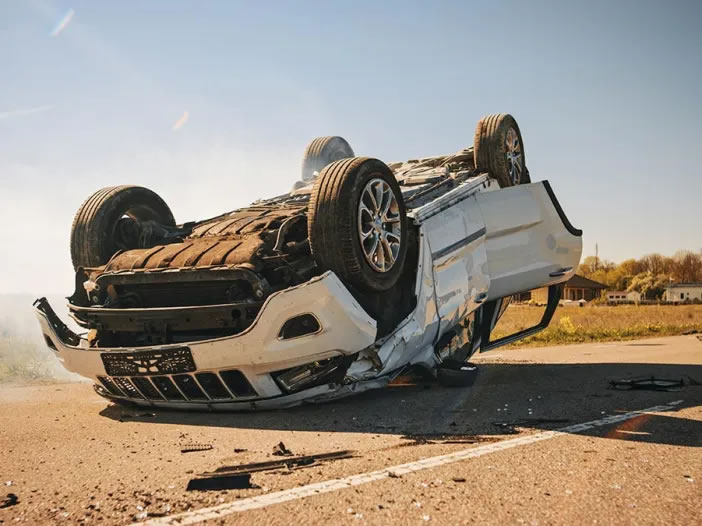
Rollover accidents are among the most dangerous and deadly types of vehicle accidents. In fact, while rollovers occur in only three (3) percent of accidents, they account for nearly one-third of all passenger vehicle fatalities, according to the National Highway Traffic Safety Administration (NHTSA).
Rollovers can be caused by many things, but quite often, they occur in collisions with other vehicles or due to manufacturer defects. Whatever the cause, the sheer momentum of rollovers means that if you’re involved in one, your chances for severe injury are quite high. Rollover accidents often involve serious injuries such as traumatic brain injury (TBI), spinal cord damage, internal organ damage, and broken bones. The medical bills associated with these injuries can be astronomical, and if you are unable to work due to your injuries, you may be facing a very uncertain future.
Proving liability in rollover accidents can be challenging because of all the variables involved. If you or a loved one have been involved in a rollover accident, it is important to seek legal counsel as soon as possible. The experienced rollover injury attorneys at Cullotta Bravo Law can help you navigate the complex legal process and help you get the compensation you deserve. For legal help in Chicago and Aurora, Illinois, call 630-898-7800.
Common Causes of Rollover Accidents
Generally speaking, rollover accidents occur when something causes the vehicle’s center of gravity to overtake its momentum. The more “top-heavy” a vehicle is, the more likely it is to roll over when this occurs. Among the most common triggers for rollover accidents include:
- “Tripping”: when a vehicle suddenly strikes an obstacle that causes it to lunge forward (e.g., a curb, pothole, debris, or making contact with another vehicle).
- Swerving or tight turns: when the vehicle makes a turn that is too tight related to its speed, or when a driver suddenly swerves to avoid an obstacle or another vehicle.
- Tire blowouts: suddenly losing a tire can throw a vehicle off balance.
- Bad weather conditions: vehicles with a wide profile (e.g., tall SUVs or semi-trucks) can be knocked over by sudden gusty crosswinds. Likewise, icy road conditions can contribute to rollovers, not by the slick spots themselves, but when the tires grip the road again after sliding.
- Vehicle defects: poor manufacturer designs can make certain vehicles more susceptible to rollovers. So can malfunctioning parts.
Why You Need a Rollover Accident Attorney
Because rollovers can be caused by a variety of factors (and quite often a combination of factors), it can be difficult to prove liability. Insurance companies in particular thrive on the ambiguity and may be quick to argue that you were at fault Call the Cullotta Bravo Law Firm at 630-898-7800 to schedule a free consultation.
Who Is Liable in a Rollover Accident?
If your rollover accident occurred due to someone else’s negligence, a good Illinois personal injury attorney will be able to gather the evidence to prove it. Depending on the circumstances surrounding the accident, any or all of the following might be liable:
- The other driver. If your vehicle rolled over due to a collision with another vehicle where the other driver was at fault–or if you swerved to avoid that vehicle and rolled yours–that driver may be held responsible for your injuries.
- The vehicle and/or parts manufacturer. If the rollover was triggered by a design flaw or failed part, you can hold the manufacturer liable.
- The government. If your rollover occurred due to unsafe road conditions from lack of maintenance, you may be able to hold liable whatever government jurisdiction is responsible for maintaining the safety of that road.
Why You Need a Rollover Accident Attorney
Because rollovers can be caused by a variety of factors (and quite often a combination of factors), it can be difficult to prove liability. Insurance companies love this kind of ambiguity, and even if there is an at-fault driver involved, they may be quick to argue that you were at least partly at fault in causing your own rollover accident and offer you a far lower settlement than you deserve. Only a personal injury attorney with experience in the complexities of rollover accidents can compile the evidence to prove your claim and negotiate skillfully to make sure you get fairly compensated for your injuries.
Call an Experienced Chicago/Aurora Personal Injury Attorney Today
If you are injured in a rollover accident, you may be eligible to recover a wide range of damages to compensate for your injuries, including medical expenses, lost wages, pain and suffering, and more. Call the experienced attorneys at Cullotta Bravo Law Firm today at 630-225-8341 or contact us online.