
Mechanics of Side Mirror Impacts and Common Accident Scenarios
When a side mirror strike causes severe damage, the parties who may pay for a truck mirror injury claim include the truck driver, the motor carrier through its mandatory commercial liability insurance, and in some cases third-party maintenance contractors or mirror manufacturers. Liability is established by showing driver negligence, carrier safety violations, or defective equipment. Understanding how these collisions unfold is essential to proving fault.
When people think of truck accidents, they usually envision a head-on collision, a jackknife, or a massive rear-end pileup. Few realize that an assembly extending just a foot or two from a truck’s cab—its side mirror—can inflict life-altering trauma. Commercial truck mirrors are heavy-duty, reinforced pieces of equipment mounted on steel brackets designed to withstand highway winds. When that heavy assembly strikes a human body or vehicle glass at 35, 45, or 65 miles per hour, the physics are devastating.
The Federal Motor Carrier Safety Administration (FMCSA) recognizes four primary “no-zones” around any large commercial vehicle: directly in front of the cab, directly behind the trailer, along the left side, and along the entire right side. The right-side blind spot is especially perilous because the driver must look across the cab’s full width. A miscalculated lane change, an improperly adjusted bracket, or a failure to maintain ongoing visual checks turns these mirrors into high-speed battering rams.

Pedestrian and Cyclist Strikes from Protruding Mirrors
Pedestrians standing on curbs, workers in construction zones, and cyclists riding within marked bike lanes are exceptionally vulnerable to protruding mirror assemblies. A commercial truck can remain technically inside its travel lane while its extended mirror swings across the curb line, striking someone on the sidewalk at head or shoulder level.
The physical consequences are catastrophic. In severe cases, direct impacts cause traumatic brain injury (TBI), facial fractures, skull fractures, and cervical spine trauma. In one documented Florida trial, a pedestrian hit by a truck mirror suffered brain damage: lawsuit proceedings resulted in a jury verdict of $30,185,488.89 after a commercial vehicle mirror struck the victim’s head.
Cyclists face severe hazards when commercial trucks navigate tight city corners or merge near bike paths. Front blind spots directly beneath the windshield are notoriously difficult to monitor without specialized Class VI “cyclops” mirrors. In notable legal precedents regarding equipment blind spots, courts have established that failing to properly check and adjust blind-spot mirrors creates primary liability when an extended vehicle sweeps an unsuspecting rider under its wheels.
Sideswipes, Blind Spot Merges, and Shattered Glass Hazards
In high-density traffic—such as morning commutes on the Kennedy Expressway or the Tri-State Tollway—unsignaled lane shifts and mirror-to-mirror impacts trigger severe multi-vehicle crashes. When a commercial truck drifts over lane markers, its rigid side mirror can impact the driver-side window of an adjacent passenger car.
The immediate result is explosive tempered glass failure. Broken shards project inward at high velocity, causing corneal abrasions, facial lacerations, and head trauma. As highlighted in a reported incident where a driver injured by side mirror impact with oncoming truck suffered serious head injuries and late-onset concussions, vehicle occupants often absorb direct mechanical impact alongside sharp flying debris. The secondary hazard is equally severe: the unexpected shock and loud blast of the impact frequently causes motorists to swerve into adjacent lanes or roadside barriers.
Determining Liability in Commercial Vehicle Mirror Collisions
Establishing fault after a mirror strike requires unraveling commercial transportation regulations and corporate structures. Commercial drivers must operate under strict standards, and motor carriers cannot simply dismiss a mirror strike as an unavoidable blind-spot mishap.
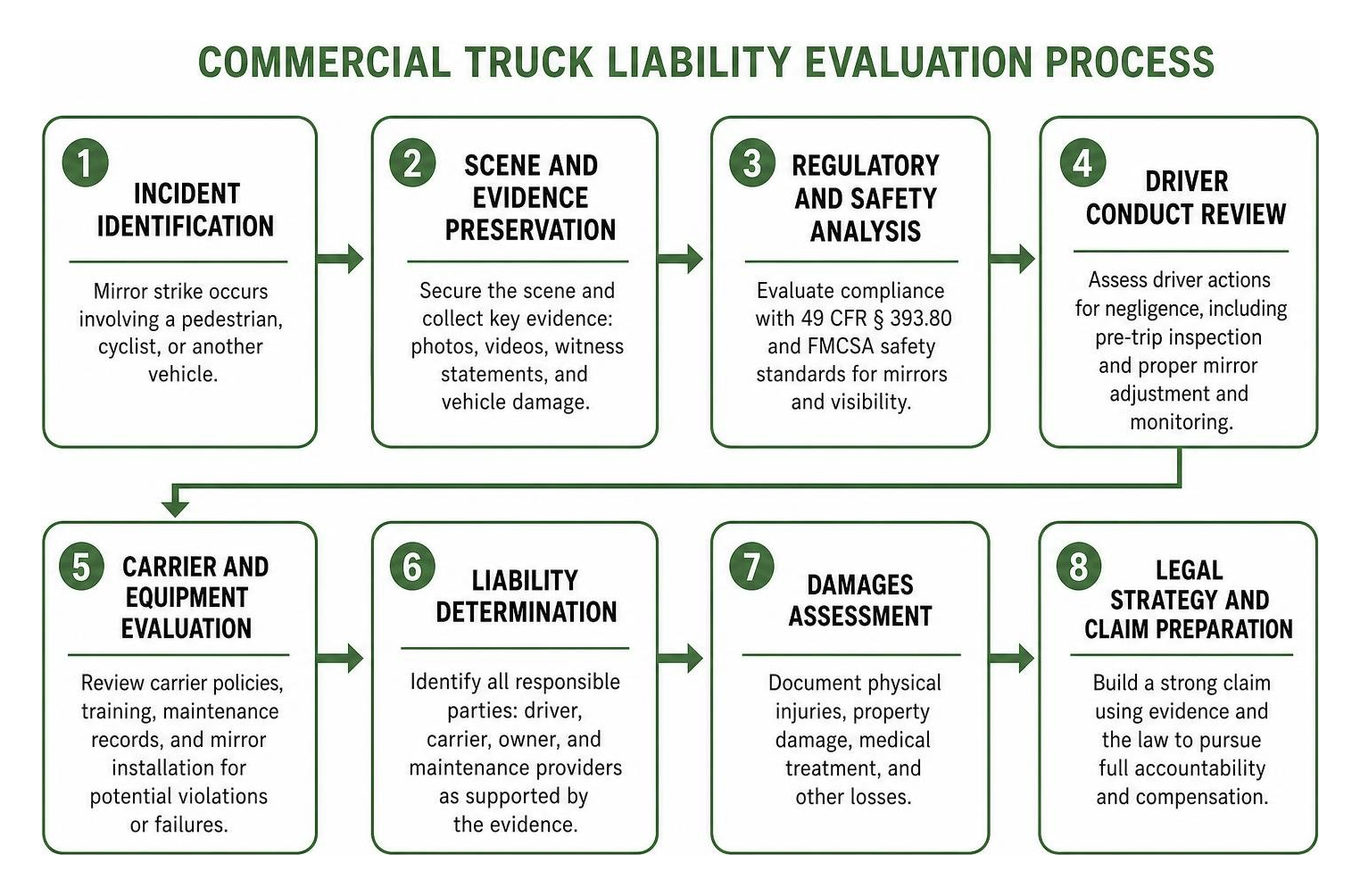
Federal law under 49 CFR § 393.80 requires every commercial bus, truck, and truck tractor to be equipped with two rearview mirrors, one on each side, firmly attached and adjusted to provide the driver with a clear, unobstructed view along both sides of the vehicle. When that visibility is compromised or when a driver fails to monitor their mirrors, the law provides pathways to hold every responsible entity accountable.
Driver Negligence and Improper Mirror Adjustments
Truck drivers are professional operators held to commercial driver’s license (CDL) standards. A driver acts negligently when they:
- Fail to conduct a pre-trip inspection to verify that flat and convex mirrors are securely mounted and properly aligned.
- Make a lane transition after a single visual glance rather than maintaining continuous situational awareness.
- Rely entirely on mirror sightlines without recognizing where vehicle blind spots fall during tight turns.
- Engage in distracted driving, cell phone use, or driver fatigue that causes cab drift over painted lane dividers.
A single mirror check does not satisfy a driver’s legal duty. Traffic environments change by the millisecond, and commercial operators must actively verify lane clearance before executing any lateral maneuver.
Trucking Company Liability and Federal Equipment Standards
Trucking companies carry direct and vicarious liability for crashes caused by their employees under the doctrine of respondeat superior. In addition, motor carriers can be sued directly for independent negligence, including:
- Negligent Hiring and Retention: Employing drivers with past safety violations, poor vision screenings, or a history of sideswipe collisions.
- Negligent Training: Failing to train drivers on proper mirror positioning, convex lens interpretation, and wide-turn clearance techniques.
- Maintenance Violations: Forcing drivers onto the road with cracked mirror glass, loose bracket arms, or missing wide-angle auxiliary mirrors.
Under 49 CFR Part 387, commercial motor carriers must maintain substantial liability insurance policies:
- $750,000 minimum for for-hire carriers transporting non-hazardous freight.
- $1,000,000 minimum for carriers hauling certain oil and petroleum products.
- $5,000,000 minimum for carriers hauling hazardous materials.
These mandatory insurance minimums ensure adequate funds exist to compensate victims for catastrophic injuries, long-term rehabilitation, and permanent disability.
Third-Party Maintenance and Defective Mirror Assembly
Liability does not always end with the driver and carrier. Commercial mirrors endure constant road vibrations, wind loads, and thermal stress. If an independent maintenance contractor fails to torque mounting bolts correctly or ignores metal fatigue on an arm assembly, that bracket can sag into an adjacent lane or shear off at highway speeds.
Similarly, if a mirror manufacturer sells an assembly with defective mounting housings or glass that distorts visual distance, a product liability claim can be pursued against the equipment manufacturer.
| Liability Area | Driver Negligence | Carrier Maintenance Negligence | Third-Party Repair Negligence |
|---|---|---|---|
| Primary Cause | Distraction, missed mirror checks, speeding | Poor training, deferring mirror repairs | Incorrect torque, installing non-OEM parts |
| Federal Violation | 49 CFR § 392.2 (Rules of the Road) | 49 CFR § 396.3 (Inspection & Maintenance) | Industry Standard Mechanical Negligence |
| Key Proof | Dashcam, cell logs, driver deposition | DVIR records, terminal repair logs | Service invoices, mechanic certifications |
| Primary Target | Driver & Carrier (Vicarious) | Direct Motor Carrier Claim | Independent Maintenance Contractor |
Critical Evidence and Overcoming Insurer Defenses
Commercial fleet insurers defend mirror strike claims aggressively. Their standard defense playbooks attempt to pin blame on passenger car drivers, cyclists, or pedestrians, arguing that the victim lingered in a known “no-zone” or cut off the truck. Overcoming these tactics requires objective, undeniable physical and digital evidence.
Critical Evidence Needed for a Truck Mirror Injury Claim
Because commercial carriers have immediate access to accident investigators, you must secure objective proof before it is altered, repaired, or deleted:
- Side Camera and Forward Dashcam Footage: Modern fleet trucks use multi-camera systems that monitor the cab’s perimeter. This footage reveals exact turn signal timing, trailer drift, and road positioning. However, fleets use short recording cycles that automatically overwrite video within days unless an attorney serves a formal spoliation letter.
- Electronic Control Module (ECM) Telemetry: The truck’s “black box” records crucial operational parameters, including travel speed, steering angle inputs, throttle position, and whether the brakes were applied before or after mirror impact.
- Driver Vehicle Inspection Reports (DVIR): Federal regulations require drivers to complete daily inspection logs. These reports expose whether the driver previously documented loose brackets, cracked glass, or mirror vibration issues that the carrier failed to fix.
- Physical Evidence and Fragment Mapping: Preserving broken mirror housing fragments, paint transfer on vehicle side panels, and measuring the exact height of impact against pedestrian injury locations establishes vehicle lane encroachment.
How Comparative Fault Affects Your Truck Mirror Injury Claim
In commercial vehicle claims, insurance adjusters frequently argue that the injured driver was partially at fault for sitting in a blind spot. How this affects your financial recovery depends on state negligence laws.
In Illinois, courts follow a modified comparative fault standard (735 ILCS 5/2-1116). Under this law:
- You can recover damages as long as you are 50% or less at fault for the collision.
- Your final financial recovery is reduced by your assigned percentage of fault. For example, if a jury awards $500,000 but finds you were 10% responsible for driving too close to the lane line, your final recovery is $450,000.
- If you are found to be 51% or more at fault, you are completely barred from recovering compensation.
Comparative fault laws differ across state lines. In Ohio, injured victims have two years to file a claim under O.R.C. § 2305.10, and Ohio uses modified comparative negligence under O.R.C. § 2315.33, allowing recovery if the victim is 50% or less at fault. Contrast this with jurisdictions that enforce pure contributory negligence (such as North Carolina), where an injured victim is barred from recovery if they contribute even 1% to the accident.
To overcome these aggressive blame-shifting defenses, an attorney must present objective telematics, lane measurements, and video evidence showing the truck driver made an improper maneuver.
Key Steps to Filing a Successful Truck Mirror Injury Claim

Navigating a commercial truck injury case requires a disciplined approach from the moment the collision occurs. Missing an early procedural step can compromise your ability to recover full financial damages.
Immediate Actions at the Accident Scene
If you are involved in a collision involving a truck mirror, prioritize your physical safety and take clear, decisive steps:
- Call 911 Immediately: Ensure local police or state troopers respond to the scene and generate an official crash report detailing point of contact and vehicle positions.
- Photograph the Entire Scene: Capture close-up photos of mirror damage, broken housing brackets, glass debris patterns, tire positions relative to lane markers, and your visible injuries.
- Identify the Commercial Entity: Write down the USDOT and MC numbers displayed on the truck cab, the license plate numbers of both cab and trailer, and the carrier’s corporate name.
- Collect Independent Witness Information: Speak with passing motorists, pedestrians, or nearby business employees who saw the impact and obtain their names and phone numbers.
- Seek Comprehensive Medical Care: Concussions, spinal disc herniations, and internal trauma often mask initial symptoms due to adrenaline. A prompt medical examination creates a clear clinical record connecting your injuries to the crash.
- Send a Formal Spoliation Letter: Retain legal counsel immediately to send a legal preservation demand to the motor carrier, halting the routine destruction of dashcam video, ECM data, and dispatch communications.
Pursuing Commercial Policy Limits and Maximum Compensation
A mirror impact can lead to complex multi-policy litigation. In many crashes, compensation can be recovered from multiple insurance sources simultaneously:
- Primary Commercial Auto Liability: The motor carrier’s mandatory federal liability policy covering bodily injury, medical bills, and pain and suffering.
- Underinsured Motorist (UIM) Coverage: If the trucking company’s coverage is disputed or insufficient to cover severe long-term injuries, your own personal auto policy’s UIM coverage can provide additional compensation.
- Personal Injury Protection (PIP) or MedPay: First-party benefits that assist with immediate hospital bills and lost income while liability is established.
The power of combining multiple insurance policies was shown in a reported legal settlement where a plaintiff injured when struck by mirror of passing pickup successfully recovered the $100,000 policy limit from the at-fault driver, an additional $351,000 in underinsured motorist benefits, and $191,000 in no-fault benefits, securing a total recovery of $642,000.
Victims of commercial mirror collisions are entitled to seek both economic and non-economic damages, including past and future medical expenses, physical therapy, lost earnings, loss of future earning capacity, physical pain, emotional distress, and permanent disfigurement.
Frequently Asked Questions About Commercial Truck Mirror Accidents
Can I sue if a truck mirror hit my parked car and caused injuries?
Yes. Moving vehicles owe a high duty of care to avoid stationary objects and parked cars. Even if your vehicle was parked slightly away from the curb or within a tight shoulder zone, the driver of the moving commercial vehicle is almost always presumed negligent for failing to maintain a safe lateral clearance. If you were sitting inside your parked vehicle and sustained whiplash, head trauma, or glass-related injuries when a truck’s extended mirror struck your side window, you have grounds to file a personal injury claim against the driver and carrier.
What happens if a truck mirror collision was a hit-and-run?
Commercial drivers sometimes strike pedestrians, cyclists, or adjacent mirrors and continue driving, either claiming they did not feel the impact or deliberately fleeing to avoid drug and alcohol testing. In many jurisdictions, leaving the scene of an accident involving injury or substantial property damage is a severe criminal offense. If you are the victim of a hit-and-run mirror strike:
- Check the area immediately for municipal traffic cameras, tollway transponder readers, or nearby commercial security cameras.
- Work with investigators to track vehicle registrations using partial license plates or fleet trailer markings.
- File a claim under your own Uninsured Motorist (UM) policy, which steps into the shoes of the fleeing driver to pay for medical care and lost income.
How long do I have to file a lawsuit after a truck mirror strike?
Every state sets strict statutory deadlines for filing personal injury lawsuits. In Illinois, the general statute of limitations for personal injury claims is two years from the date of the accident (735 ILCS 5/13-202). In neighboring jurisdictions such as Ohio, an injured victim also has two years to file an injury claim under O.R.C. § 2305.10.
However, you should never wait until the statutory deadline approaches. Critical digital proof—including dashcam video, side camera loops, and black box telematic logs—is routinely wiped or overwritten by commercial carriers within weeks or months. Consulting an attorney immediately ensures your rights and the necessary proof are preserved.
Conclusion
A side mirror impact is never just a minor scuffle; it is a violent mechanical collision that can derail your health, your career, and your financial stability. Proving fault in commercial vehicle accidents requires deep knowledge of federal safety regulations, rapid evidence collection, and aggressive litigation against corporate insurers looking to protect their bottom line.
At Cullotta Bravo Law Group, our legal team brings more than 35 years of dedicated personal injury experience to the table. We represent injured individuals across Aurora, Chicago, Naperville, Joliet, and surrounding Illinois communities, fighting relentlessly to secure the multi-million dollar settlements and verdicts our clients deserve. Motor carriers must keep their vehicles safe, maintain compliance with federal safety codes, and equip properly adjusted commercial safety mirror systems to protect everyone sharing the road.
If you or a loved one has suffered an injury due to a commercial truck mirror strike, do not let the trucking company control the narrative. Contact Cullotta Bravo Law Group today to schedule your free, confidential case evaluation.