

Wrongful Death Car Accident: Essential Guide 2025
When a Car Accident Becomes a Wrongful Death Case
A wrongful death car accident occurs when a person dies due to another party’s negligence or wrongful act on the road. If you’ve lost a loved one in a fatal crash, Illinois law gives you the right to seek justice and compensation through a civil claim.
What You Need to Know:
- Who Can File: The personal representative of the deceased’s estate must bring the claim.
- Time Limit: You have 2 years from the date of death to file in Illinois.
- What You Can Recover: Economic damages (medical bills, lost income) and non-economic damages (loss of companionship, grief).
- Burden of Proof: You must prove the other party’s negligence directly caused the death.
- Comparative Fault: You can recover damages even if your loved one was partially at fault (if less than 51% responsible).
The loss of a family member is devastating. In 2023, approximately 40,990 people died in U.S. motor vehicle accidents. Behind each statistic is a family facing grief and complex legal questions.
While no amount of money can replace your loved one, a wrongful death claim can provide financial stability and hold the responsible party accountable.
I’m Peter Cullotta. For over 35 years, I’ve helped families in the Chicagoland area secure millions in verdicts and settlements after a wrongful death car accident, providing the accountability and compensation they deserve.
Simple wrongful death car accident glossary:
Understanding a Wrongful Death Car Accident Claim in Illinois
When a car accident takes a life, the legal path forward is a wrongful death claim. This civil action is essentially the personal injury lawsuit the deceased would have filed if they had survived. Because they cannot, Illinois law allows their estate to pursue it on behalf of the surviving family members.
This claim is separate from any criminal charges and focuses on securing financial compensation for the family’s losses. At Cullotta Bravo Law Group, we’ve guided families in Aurora, Chicago, and throughout Illinois through these difficult cases for decades.
What Constitutes a Wrongful Death in a Car Accident?
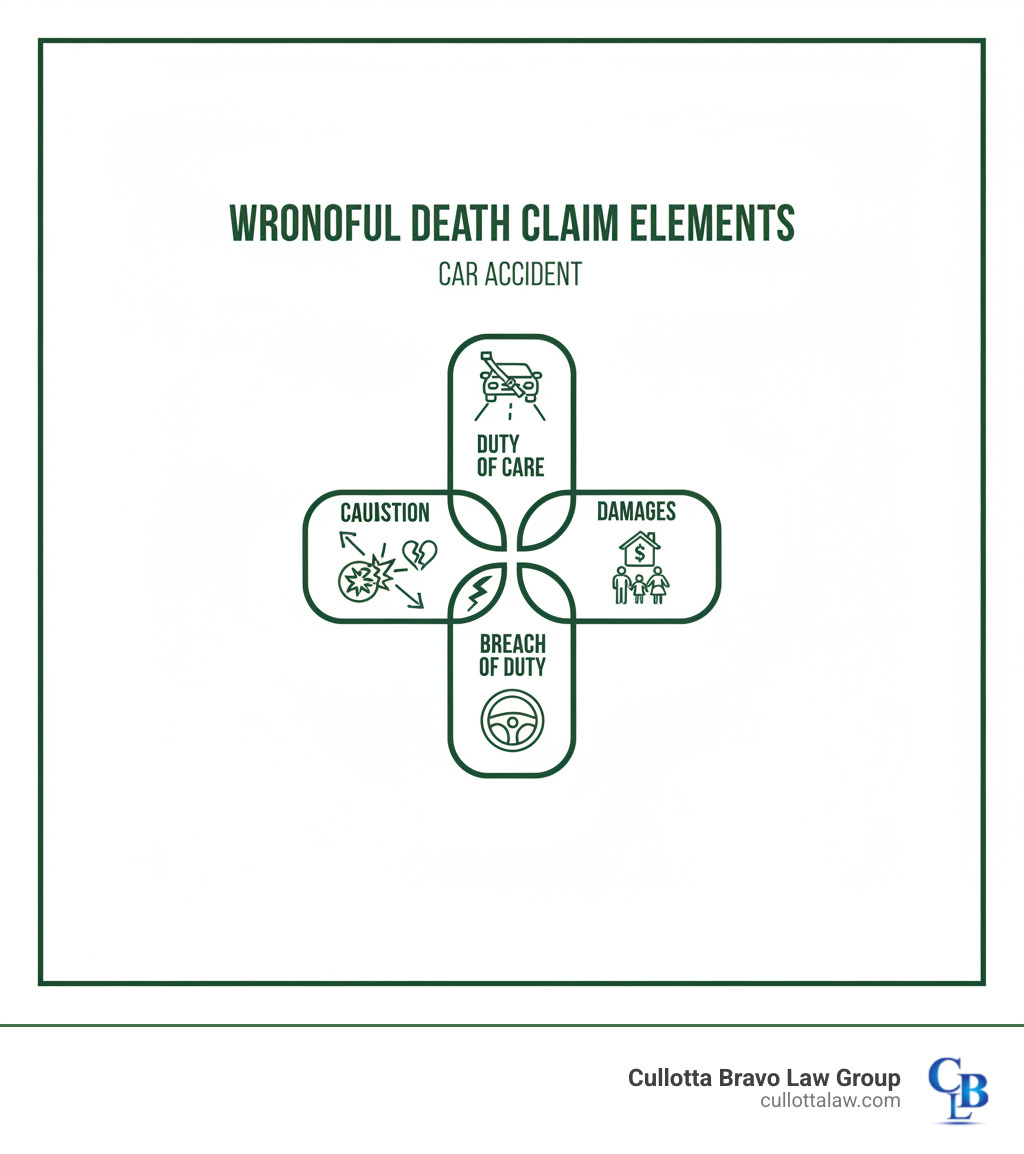
A wrongful death occurs due to another’s “wrongful act, neglect, or default.” In car accidents, this usually means proving the other driver was negligent. We must establish four elements:
- Duty of Care: Every driver has a legal duty to operate their vehicle safely and follow traffic laws.
- Breach of Duty: The driver violated this duty. Common examples include speeding, impaired driving, and distracted driving. Proving the driver responsible for your accident was using a cell phone can be a key part of a case.
- Causation: The driver’s breach of duty directly caused the crash and the resulting fatal injuries.
- Damages: The death resulted in measurable financial and emotional losses for the family.
Who Is Legally Permitted to File a Claim?
According to the Illinois Wrongful Death Act (740 ILCS 180/), only the personal representative of the deceased’s estate can file the lawsuit.
This is often the executor named in a will. If there is no will, the probate court can appoint a family member, such as the surviving spouse or another next of kin. The personal representative acts on behalf of all beneficiaries, who are typically the spouse and next of kin (children, parents, siblings). Any compensation recovered is distributed among these surviving family members.
Civil Wrongful Death Claim vs. Criminal Charges
It’s crucial to understand the difference between a civil claim and criminal charges, as they are separate proceedings.

A civil wrongful death claim is filed by the family to seek compensation for their losses. The burden of proof is a “preponderance of the evidence,” meaning we must show it’s more likely than not that the defendant was responsible.
Criminal charges are brought by the state to seek punishment (jail time, fines) for breaking the law. The burden of proof is much higher: “beyond a reasonable doubt.”
A driver can face both types of cases. A criminal conviction can help the civil claim, but it is not required to win your wrongful death lawsuit. You can learn more about what to expect if your car accident has both civil and criminal aspects.
The Legal Process: Pursuing a Wrongful Death Claim
Pursuing a wrongful death claim is a complex process that our firm manages so you can focus on your family. The path is similar to the 8 Steps of a Personal Injury Case After an Auto Accident but involves additional legal layers due to the tragic outcome.
Step 1: Investigation and Gathering Evidence
A strong case is built on solid evidence, and we must act quickly before it is lost. Our investigation includes:
- Collecting police reports, witness statements, and the death certificate.
- Gathering all medical records related to the fatal injuries.
- Securing photos and videos from the accident scene, traffic cameras, or nearby businesses.
- Retrieving data from the vehicle’s “black box” or data recorder, which can provide critical information about speed and braking. This is especially important in commercial vehicle cases, as discussed in our article on Do Commercial Trucks Have a Black Box That Can Be Used in a Personal Injury Claim?.
- Documenting financial losses using employment records and receipts for funeral expenses.
- Hiring accident reconstruction specialists or other experts when necessary to prove how the crash occurred.
Step 2: Identifying All Liable Parties
The at-fault driver may not be the only party responsible. Maximizing your family’s compensation requires identifying all potential defendants, which could include:
- The at-fault driver.
- The driver’s employer, if they were working at the time (a key issue for a Truck Accident Attorney Aurora, IL).
- The vehicle owner, if different from the driver.
- A government entity if a Road in Poor Condition contributed to the crash.
- The car manufacturer if a vehicle defect was a factor, leading to a Product Liability Injuries in Illinois claim.
- Multiple drivers in a multi-vehicle pileup.
Step 3: Filing the Claim and Negotiating a Settlement
Once we have built the case, we send a formal claim notice and a detailed demand letter to the liable parties and their insurance companies. This begins settlement negotiations.
Insurance companies aim to minimize payouts and may use Insurance Company Denial Tactics. We counter these strategies, negotiating aggressively for a settlement that reflects the full value of your loss. Most wrongful death cases are resolved through settlement, which provides faster compensation and avoids a stressful trial. The timeline can vary, as explained in How Long Will You Wait for Your Car Accident Settlement?.
Step 4: Filing a Lawsuit
If an insurance company refuses to offer a fair settlement, we will file a lawsuit. This formal process involves:
- Filing a Complaint: We file a legal document with the court outlining the allegations against the defendants.
- Findy: Both sides exchange information through written questions, document requests, and depositions (sworn testimony).
- Motions and Mediation: Attorneys may file motions on legal issues, and the court often requires mediation to facilitate a settlement.
- Trial: If no settlement is reached, the case is presented to a judge or jury, who will determine liability and damages.
We manage every stage of this process, keeping you informed while you focus on your family. For more on this, see our guide on What to Expect Legally After Suffering a Car Accident Injury in Chicago.
Compensation and Settlement Value in a Fatal Car Accident
While no amount of money can fill the void left by your loved one, a wrongful death claim can provide the financial stability your family needs to move forward. At Cullotta Bravo Law Group, our goal is to ensure you receive full compensation for your devastating loss.

A settlement should cover both the tangible and intangible losses your family has suffered. For a general overview, see our guide on Calculating Settlement of a Personal Injury Claim.
Types of Damages You Can Recover
Illinois law allows for the recovery of several types of compensatory damages:
- Economic Damages: These are the measurable financial losses, including medical expenses incurred before death, funeral and burial costs, lost wages and benefits the deceased would have earned, loss of future inheritance, and the value of lost household services (like childcare or home maintenance).
- Non-Economic Damages: These compensate for the profound human losses that have no price tag. This includes the loss of companionship, love, and guidance (known as “loss of consortium”), as well as the grief, sorrow, and mental suffering of the surviving family members.
- Punitive Damages: In rare cases involving extreme recklessness, such as a severely intoxicated driver, punitive damages may be awarded. These are intended to punish the defendant and deter similar conduct, rather than to compensate the family.
How Is the Value of a Wrongful Death Settlement Determined?
There is no “average” settlement amount, as every case is unique. The value of a claim is determined by several key factors:
- Age and Health: A younger victim had more years of life and earning potential ahead of them.
- Earning Capacity: The deceased’s income, education, and career trajectory are used to project a lifetime of lost financial support.
- Number of Dependents: The number of family members who relied on the deceased for financial and emotional support.
- Degree of Negligence: Egregious behavior by the at-fault party can increase the case’s value and support a claim for punitive damages.
- Insurance Policy Limits: The amount of available insurance coverage is a practical factor that can cap recovery. This is why we explore all potential sources, including uninsured or underinsured motorist coverage.
- Strength of Evidence: A well-documented case with clear proof of liability commands a higher settlement value.
While we can’t give an average, we have secured multi-million dollar settlements for families when the circumstances warranted it. Learn more about What Determines My Car Accident Settlement Amount?.
Key Legal Considerations for Your Case
Navigating a wrongful death car accident claim requires understanding several key legal rules that can affect your case. Our firm specializes in Navigating Legalities After an Accident with Cullotta Bravo Law Group and will guide you through these complexities.
What Is the Statute of Limitations for a Wrongful Death Car Accident Claim?
A statute of limitations is a strict legal deadline for filing a lawsuit. Missing it will permanently bar your claim.
In Illinois, you generally have two years from the date of your loved one’s death to file a wrongful death lawsuit. The clock starts on the date of death, not the date of the accident.
There are limited exceptions. For example, the deadline may be extended for deaths caused by violent intentional conduct. Claims against government entities have much shorter deadlines and specific notice requirements. It is critical to contact an attorney immediately to protect your rights. For more details, see our guide on Statutes of Limitation on Accidents in Illinois.
Can You Sue if the Deceased Was Partially at Fault?
Yes. Illinois follows a “modified comparative negligence” rule. This means your family can still recover compensation even if your loved one was partially at fault for the accident.
Under this rule, you can pursue a claim as long as your loved one was less than 51% at fault. Your total compensation will be reduced by their percentage of fault. For example, if damages are $1 million and your loved one was found 20% at fault, your family would receive $800,000. If they are found 51% or more at fault, you cannot recover any damages. Insurance companies often try to shift blame, which is why strong legal representation is vital. Learn more by Understanding Comparative Fault in Illinois Car Accident Cases.
The Role of Insurance Coverage
Insurance is the primary source of compensation in most wrongful death cases. Key policies include:
- At-Fault Driver’s Liability Insurance: This is the first source of recovery. However, many drivers carry only the minimum required coverage, which is often insufficient for a fatal accident claim.
- Policy Limits: An insurance company is only required to pay up to its policy limit. If your family’s damages exceed this amount, we must identify other sources of recovery.
- Uninsured/Underinsured Motorist (UM/UIM) Coverage: This is coverage on your own auto policy that applies when the at-fault driver has no insurance or not enough insurance. It is a crucial source of compensation that many families overlook. Navigating a UM/UIM claim can be complex, which is Why You Need an Attorney for an Uninsured Motorist Claim.
Frequently Asked Questions about Wrongful Death Claims
When grieving the loss of a loved one, you will have many questions. Here are honest answers to some of the most common ones we hear from families.
How long does a wrongful death lawsuit take?
The timeline for a wrongful death car accident case varies. A straightforward case where liability is clear might settle in 12 to 18 months. However, if the case is complex or the insurance company is unreasonable, we may need to file a lawsuit. Litigation can extend the timeline to two or three years, or even longer if an appeal is filed.
The good news is that the vast majority of wrongful death claims settle before going to trial. We work to resolve your case as efficiently as possible without compromising the full compensation your family deserves.
Is there an average settlement for a wrongful death car accident?
No, there is no meaningful “average” settlement amount. Any attorney who gives you a number without a full investigation is not being honest. The value of a claim is unique to each family and depends on factors like the deceased’s age, income, and number of dependents, as well as the severity of the defendant’s negligence and the available insurance coverage.
While some cases settle for millions, as seen in reports of settlements for $6.125 million, $18.85 million, and $37 million, these figures are not predictive. Our focus is on calculating your family’s specific losses to determine what your case is worth. For more, review What Determines My Car Accident Settlement Amount?.
Do I have to go to court to resolve the claim?
It is unlikely. Most wrongful death cases are resolved through a negotiated settlement. We build a strong case and present it to the insurance company, often leading to a fair offer without ever filing a lawsuit. Even if a suit is filed, many cases settle during mediation before trial.
However, we are always prepared to go to trial if that is what it takes to achieve justice for your family. As a trial attorney with over 35 years of experience, I will not hesitate to let a jury hear your story if an insurer refuses to be fair. The final decision to settle or go to trial is always yours.
Why You Need an Experienced Attorney for a Wrongful Death Case
When you lose a loved one in a wrongful death car accident, you are faced with overwhelming grief. The last thing you should have to do is steer a complex legal battle alone.

Hiring an experienced wrongful death attorney is essential to hold the responsible party accountable and secure your family’s financial future. At Cullotta Bravo Law Group, we combine aggressive representation with the compassion and respect you deserve.
Here’s why you need a dedicated attorney:
- Navigating Legal Complexity: Wrongful death claims are governed by specific Illinois statutes with strict deadlines. We know these laws and procedures, ensuring your case is handled correctly from the start.
- Fighting the Insurance Companies: Insurers are not on your side. Their goal is to pay as little as possible. We have decades of experience countering their tactics and negotiating from a position of strength.
- Maximizing Your Compensation: We have the resources to conduct a thorough investigation and work with experts to calculate the full value of your loss. This includes future lost income, lost companionship, and your family’s grief and suffering.
- Giving You Space to Grieve: Most importantly, we handle the legal burden so you can focus on your family. You don’t have to deal with adjusters or paperwork. You can begin to heal, knowing your case is in capable hands.
If you’re unsure How Do I Find the Right Personal Injury Attorney in Illinois?, start with a free, no-obligation consultation. If you’ve lost a loved one in a wrongful death car accident, please reach out. Contact an experienced car accident lawyer in Aurora today. Let us fight for the justice and security your family deserves.