

Car Accident & Lost Wages: A Step-by-Step Guide to Getting Your Due
Understanding Your Right to Lost Wages After a Car Accident
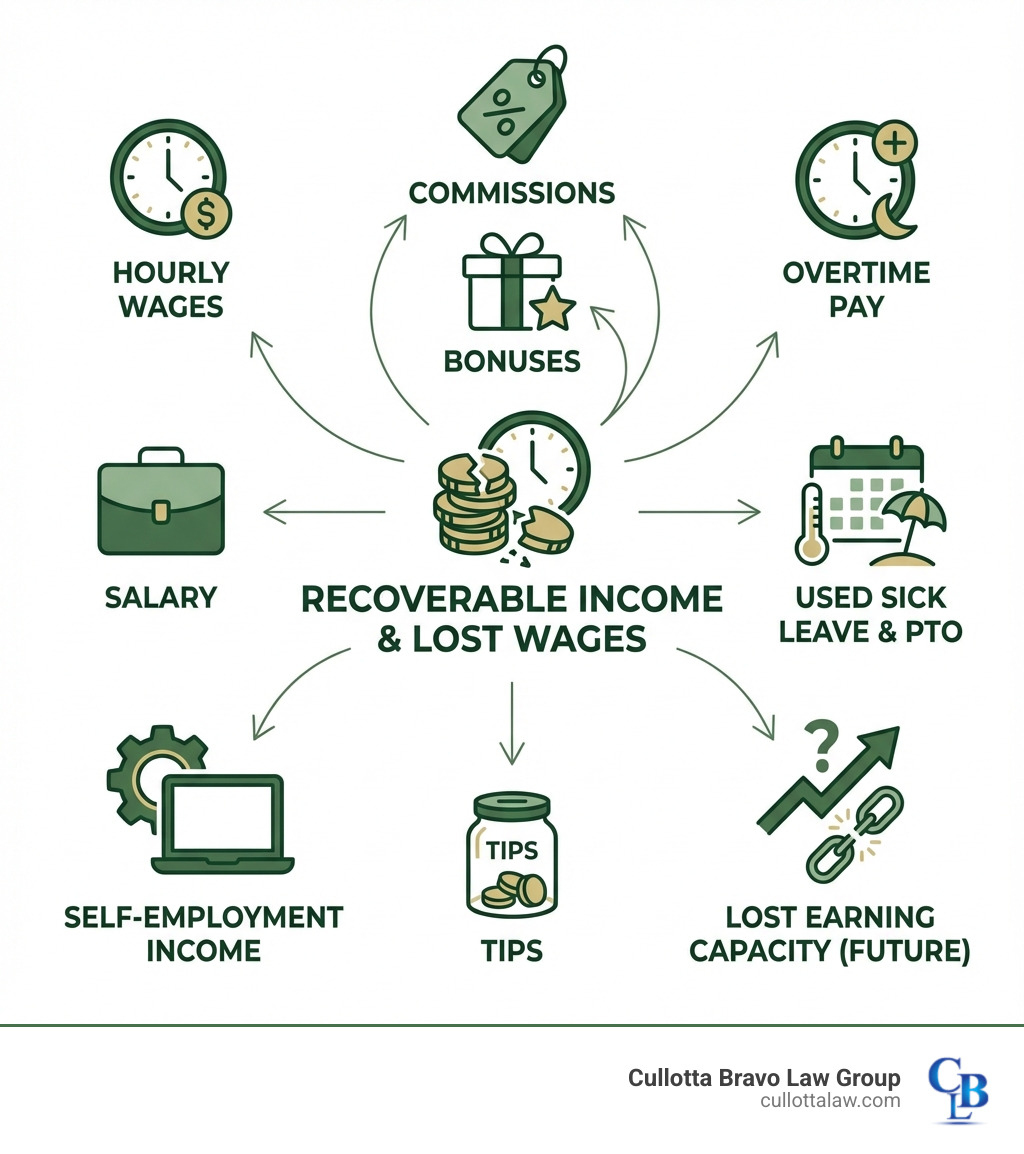
Lost wages car accident claims allow you to recover income you couldn’t earn because of injuries from a crash. Here’s what you can claim:
- Regular pay – Hourly wages, salary, or self-employment income you missed
- Medical appointment time – Hours spent at doctors, physical therapy, or follow-ups
- Additional income – Lost overtime, bonuses, commissions, and tips
- Used benefits – Sick leave, vacation days, or PTO you burned during recovery
- Future losses – Reduced earning capacity if you can’t return to your previous job
Lost wages are economic damages, meaning they have a specific dollar value you can calculate and prove. Whether you’re a salaried employee, hourly worker, freelancer, or business owner, you’re entitled to compensation for income you lost because someone else’s negligence put you in the hospital instead of at work.
The insurance company won’t simply hand you a check. You’ll need to document your losses, prove the connection between the accident and your missed work, and often negotiate hard to get what you deserve. Insurance adjusters are trained to minimize payouts, and they’ll look for any reason to reduce or deny your claim.
I’m Peter Cullotta, founding partner at Cullotta Bravo Law Group, and in over 35 years of personal injury practice, I’ve helped countless clients recover lost wages car accident compensation through mediation, arbitration, and trial. This guide walks you through every step of calculating, documenting, and claiming the income you’ve lost.
Explore more about Lost wages car accident:
How to Calculate Your Lost Income

Calculating lost income after a lost wages car accident requires meticulous attention to detail. It’s not just about the hours you missed; it’s about accurately reflecting the earnings you would have genuinely received had the accident never happened. The goal is to determine your gross income (before taxes and deductions) for the period you were unable to work, or for the income opportunities you missed directly due to your injuries or the accident’s aftermath. Gathering initial proof, like recent pay stubs and employment records, is your first crucial step.
Calculating Lost Wages Car Accident Claims for Different Employment Types
The method for calculating lost wages car accident claims varies depending on how you’re employed. Here’s how we approach it for different employment scenarios:
- Hourly Employees: For hourly workers, the calculation is straightforward. We multiply your hourly wage by the number of hours you missed due to the accident. For example, if you earn $20 per hour and missed 40 hours of work, your lost wages would be $800. Remember to account for any regular overtime you typically worked, as that can also be part of your lost income.
- Salaried Employees: Salaried employees’ lost wages are calculated by determining your effective hourly rate and multiplying it by the hours missed. A common way to do this is to divide your annual salary by 2080 (which represents 40 hours per week for 52 weeks). For instance, a $60,000 yearly salary converts to approximately $28.85 per hour. If you missed 80 hours (two weeks) of work, your lost wages would be $2,308. We can use an online salary-to-hourly-pay converter to help with this conversion.
- Self-Employed Individuals and Gig Economy Workers: This category often presents the most complex calculations, but it doesn’t mean you can’t claim lost wages car accident compensation. Instead of pay stubs, we rely on a combination of financial documents to demonstrate your income. This includes:
- Previous tax returns: Showing your income over the past 2-3 years provides a baseline.
- Invoices and client contracts: Proof of projects or gigs that were canceled or delayed due to your injuries.
- Profit and Loss (P&L) statements: For business owners, these show your business’s financial performance before and after the accident.
- Bank statements: Reflecting deposits that ceased or decreased.
- Client statements or testimonials: Confirming missed work or opportunities. Sometimes, a forensic accountant may be needed to accurately quantify these losses, especially for significant or long-term impacts.
- Commission and Bonus Earners: If a significant portion of your income comes from commissions or regular bonuses, these are absolutely recoverable. We calculate this by looking at your past earnings records (e.g., average commissions over the past year) and demonstrating how the accident prevented you from earning similar amounts. This can include lost sales opportunities, missed performance targets, or bonuses tied to specific metrics that you couldn’t meet because of your injuries.
Accounting for Other Lost Financial Opportunities
Beyond direct wages, a lost wages car accident can cost you in other less obvious but equally significant ways. We also seek compensation for these:
- Missed Promotions and Lost Bonuses: If you were on track for a promotion with a higher salary or a specific bonus that you missed due to your injuries or absence, we can include this in your claim. This requires evidence of your eligibility and the likelihood of receiving it.
- Canceled Projects: For self-employed individuals, canceled projects mean lost revenue. Document all communication related to these cancellations and the projected income.
- Missed Job Interviews: If you had job interviews scheduled that you couldn’t attend because of your injuries, this represents a lost opportunity for new or better employment. While harder to quantify, acknowledging these losses can still contribute to your overall settlement.
- Used Sick Leave and PTO: This is a crucial point many people overlook. Even if your employer paid you for the time you missed by using your accrued sick leave, vacation days, or Paid Time Off (PTO), you can still claim these as part of your lost wages car accident compensation. Why? Because these are valuable benefits that you earned and would have had available for other purposes if not for the accident. Using them for accident recovery means they are depleted, and you deserve to be reimbursed for their value.
Proving Your Lost Wages Car Accident Claim: Documentation and Process

A strong lost wages car accident claim hinges on thorough and accurate documentation. Insurance companies are not going to take your word for it, and they will scrutinize every detail. Our job is to build an undeniable case that proves your injuries directly led to your income loss. This involves compiling a comprehensive “demand package” that clearly outlines your losses.
Essential Documentation You Will Need
We will help you gather and organize the following critical documents to support your lost wages car accident claim:
- Doctor’s Note with Work Restrictions: This is paramount. Your treating physician must provide a written statement on official letterhead detailing your injuries, the specific dates you were unable to work, and any ongoing work restrictions. The note should clearly state that your inability to work (or work at full capacity) is a direct result of your accident-related injuries.
- Employer Verification Letter: We will request a letter from your employer (on company letterhead) that includes:
- Your name and position.
- Your pay rate (hourly or salary).
- Your normal work schedule or hours.
- The exact dates and hours you missed from work due to your injuries.
- Confirmation of any lost overtime, commissions, or bonuses.
- Pay Stubs and W-2s: Provide recent pay stubs (typically for the 6-12 months preceding the accident) to establish your regular earnings. Your W-2 forms from the past 2-3 years will further verify your income history.
- Tax Returns: For both employed and self-employed individuals, tax returns (typically the previous year, or 2-3 years if your income fluctuates) serve as official proof of your gross income. Insurance adjusters only have a right to see the gross income portion, not your entire return.
- Invoices and 1099s for Self-Employed Individuals/Independent Contractors: As discussed, these are crucial for proving lost income if you work for yourself. Keep meticulous records of all client communications, canceled projects, and financial transactions.
The Step-by-Step Filing Process
Navigating a lost wages car accident claim can be intricate, but following a structured process increases your chances of success:
- Seek Immediate Medical Attention: Your health is the top priority. Prompt medical care also creates a vital record linking your injuries to the accident, which is essential for any claim, including lost wages. Consistent treatment, as recommended by your doctor, is key.
- Report the Accident: Notify the police and your insurance company promptly. While you should inform your insurer, be cautious about giving recorded statements to any insurance adjuster (including your own) without consulting with us first.
- Gather Documentation (as listed above): Start collecting all necessary medical and employment records as soon as possible.
- Calculate Your Losses: We will work with you to accurately calculate all your lost wages and other related economic damages.
- Compile the Demand Package: This comprehensive package includes all your medical records, bills, proof of lost wages, a detailed account of the accident, and a “demand letter” outlining your claim and proposed settlement amount.
- Submit the Demand Package: We will submit this package to the at-fault driver’s insurance company.
- Negotiate with Adjusters: This is where our experience becomes invaluable. Insurance adjusters will try to minimize payouts. We will negotiate on your behalf, countering their arguments and presenting a strong case for the full compensation you deserve. Most personal injury cases in Illinois, between 90% and 95%, settle before trial.
- Understand the Statute of Limitations: In Illinois, you typically have two years from the date of the crash to file a personal injury lawsuit. However, this period can be shorter if a government entity is involved (e.g., 6 months). It’s crucial to act quickly to preserve your legal rights. For more detailed information on car accident claims, we recommend exploring resources like this guide on car accident claims.
Navigating Complex Issues and Maximizing Your Claim
After a lost wages car accident, understanding who is responsible for paying your lost income and how to maximize your claim can be complex. While the at-fault driver’s insurance is usually the primary target, other avenues might exist, and certain pitfalls can derail your claim.
Lost Wages vs. Lost Earning Capacity
It’s crucial to understand the difference between these two related but distinct concepts when dealing with a lost wages car accident claim:
| Feature | Lost Wages | Lost Earning Capacity |
|---|---|---|
| Definition | Income you actually lost from the date of the accident up to the settlement/judgment date due to missed work. | Diminished ability to earn income in the future due to permanent or long-lasting disability/limitations caused by the accident. |
| Focus | Past and present income loss. | Future income loss, considering the long-term impact on your career and potential for advancement. |
| Proof Required | Pay stubs, employer letters, tax returns, medical notes confirming inability to work. | Medical expert testimony on permanent impairment, vocational expert analysis on job market impact, forensic economist calculations of future financial losses. |
| Complexity | Generally more straightforward to calculate and prove with proper documentation. | Often highly complex, requiring expert witnesses to project future earnings, growth rates, and the impact of disability on career trajectory. |
| Examples | Missing two weeks of work due to a broken leg. | A construction worker with a severe back injury can no longer perform physically demanding work and must retrain for a lower-paying desk job. |
When injuries from a lost wages car accident result in long-term or permanent disability, we work with vocational experts and forensic economists. These professionals can assess your pre-injury earning potential versus your post-injury earning capacity, providing expert testimony to quantify future income losses. This is particularly important if you are unable to return to your previous job or must take a lower-paying role.
Common Pitfalls to Avoid in Your Lost Wages Car Accident Claim
Insurance companies are skilled at finding reasons to deny or reduce claims. Avoiding these common pitfalls is essential to protect your lost wages car accident compensation:
- Inconsistent Medical Treatment: Gaps or delays in your medical treatment can be used by insurers to argue that your injuries aren’t serious or weren’t caused by the accident. Always follow your doctor’s recommendations and attend all appointments.
- Vague Documentation: “I missed a lot of work” isn’t enough. You need precise dates, hours, and clear documentation linking your absence directly to your injuries.
- Giving Recorded Statements to Adjusters: Never provide a recorded statement to any insurance company (including your own, if they ask) without speaking with us first. Adjusters are trained to ask leading questions that can be used against you.
- Accepting a Quick, Low Settlement: Early settlement offers are almost always far below the true value of your claim. Insurers want to close cases quickly and cheaply. Once you accept, you waive your right to seek further compensation, even if your injuries worsen or your lost wages increase.
- Posting on Social Media: Anything you post online can be found and used by insurance companies to undermine your claim. Photos of you smiling at an event, even if you’re in pain, can be taken out of context to suggest your injuries aren’t as severe as you claim. It’s best to avoid posting about your accident, injuries, or activities until your case is resolved.
Frequently Asked Questions About Lost Wage Claims
Can I claim lost wages if I wasn’t physically injured?
Yes, surprisingly, you can. While most lost wages car accident claims are tied to physical injuries, there are situations where you might miss work due to the accident’s aftermath even without bodily harm. For example:
- Missed work for car repairs or replacement: If your vehicle was severely damaged or totaled, you might have to take time off work to deal with tow trucks, insurance adjusters, body shops, or finding a new vehicle. This time is compensable.
- Time spent dealing with insurance and legal matters: Attending depositions, meeting with adjusters, or consulting with us about your case can take you away from work.
- Doctor’s appointments for psychological trauma: Car accidents can cause significant emotional distress, including PTSD, anxiety, or depression. If a medical professional determines these psychological injuries prevent you from working, your lost wages can be claimed, even if there were no physical injuries. We ensure these less visible damages are recognized.
How do Personal Injury Protection (PIP) benefits cover lost wages?
In Illinois, unlike true “no-fault” states, Personal Injury Protection (PIP) coverage is not mandatory but can be purchased as an add-on to your auto insurance policy. If you have PIP coverage, it can provide benefits for medical expenses and, in some cases, a portion of your lost wages car accident compensation, regardless of who was at fault for the accident.
- PIP Coverage Limits: The amount PIP covers for lost wages depends on your specific policy limits. These limits can vary significantly.
- Percentage of Wages Covered: If your policy includes lost wage coverage, it typically covers a percentage of your gross lost wages (e.g., 75-80%), up to your policy’s maximum.
- How Medical Bills Can Exhaust PIP Benefits: A crucial point is that PIP benefits often have a single overall limit that applies to both medical expenses and lost wages. If your medical bills are extensive, they can quickly deplete your PIP coverage, leaving little or nothing for lost wages. This is why, in Illinois, it’s often necessary to pursue compensation from the at-fault driver’s insurance for full recovery.
What happens in accidents involving commercial trucks or rideshare vehicles?
Accidents involving commercial vehicles (like semi-trucks, delivery vans) or rideshare vehicles (Uber, Lyft) are often more complex than standard passenger car accidents, especially concerning lost wages car accident claims.
- Higher Insurance Policy Limits: Commercial vehicles typically carry much higher insurance policy limits than personal vehicles. This means there’s potentially more coverage available to compensate for significant lost wages and other damages.
- Multiple Liable Parties: Liability can be complicated. Besides the driver, the trucking company, the rideshare company, the vehicle owner, or even the cargo loader could be partially at fault. This “deep pocket” scenario requires experienced legal investigation to identify all responsible parties.
- Complex Corporate Policies: Commercial and rideshare companies have intricate insurance policies and legal teams dedicated to minimizing payouts. Navigating these corporate structures and their specific policies requires specialized knowledge.
- Importance of Immediate Legal Advice: Due to the increased stakes and complexity, securing immediate legal advice is paramount. We can help you steer the multiple insurance companies, understand the nuances of commercial liability, and ensure your lost wages car accident claim is handled effectively. We have extensive experience with these types of cases in Aurora, Chicago, Naperville, and Joliet.
Conclusion: Secure the Full Compensation You Are Owed
Dealing with the aftermath of a lost wages car accident is stressful enough without the added burden of financial uncertainty. We understand that your focus should be on recovery, not on battling insurance companies. That’s where we come in.
As we’ve explored, securing fair compensation for your lost wages requires meticulous documentation, a clear understanding of legal principles, and strategic negotiation. From calculating your specific income losses for hourly, salaried, or self-employed work to accounting for used PTO and future earning capacity, every detail matters. Avoiding common pitfalls like inconsistent medical treatment or speaking prematurely with adjusters is crucial to protecting your claim.
At Cullotta Bravo Law Group, we pride ourselves on aggressive legal representation and treating our clients with the dignity they deserve. With over 35 years of experience serving Aurora, Chicago, Naperville, Joliet, and throughout Illinois, we have a proven track record of securing multi-million dollar settlements for our clients. We know the tactics insurance companies use, and we know how to fight back to get you the full compensation you are owed.
Don’t let a lost wages car accident leave you in financial distress. Let us handle the complexities of your claim so you can focus on healing.
Contact an Aurora car accident lawyer for a free consultation today. We’re here to help you get your due.