
Don’t Get Jackknifed: Understanding These Devastating Truck Crashes and Your Legal Options
Why Jackknife Truck Accidents Demand Immediate Legal Action
A jackknife truck accident lawyer specializes in representing victims injured when a commercial truck’s trailer swings out at a dangerous angle from the cab, often blocking multiple lanes and causing catastrophic multi-vehicle collisions. These cases require immediate investigation to preserve critical evidence like black box data, driver logs, and maintenance records before trucking companies can hide or destroy them.
What a Jackknife Truck Accident Lawyer Does:
- Investigates the crash scene, truck maintenance history, and driver compliance records
- Preserves time-sensitive evidence including electronic logging device (ELD) data and event data recorders
- Identifies all liable parties—driver, trucking company, cargo loaders, maintenance providers, or manufacturers
- Negotiates with aggressive insurance adjusters who aim to minimize your compensation
- Calculates full damages including future medical costs, lost earning capacity, and pain and suffering
- Litigates when settlement offers fall short, backed by accident reconstruction experts and industry specialists
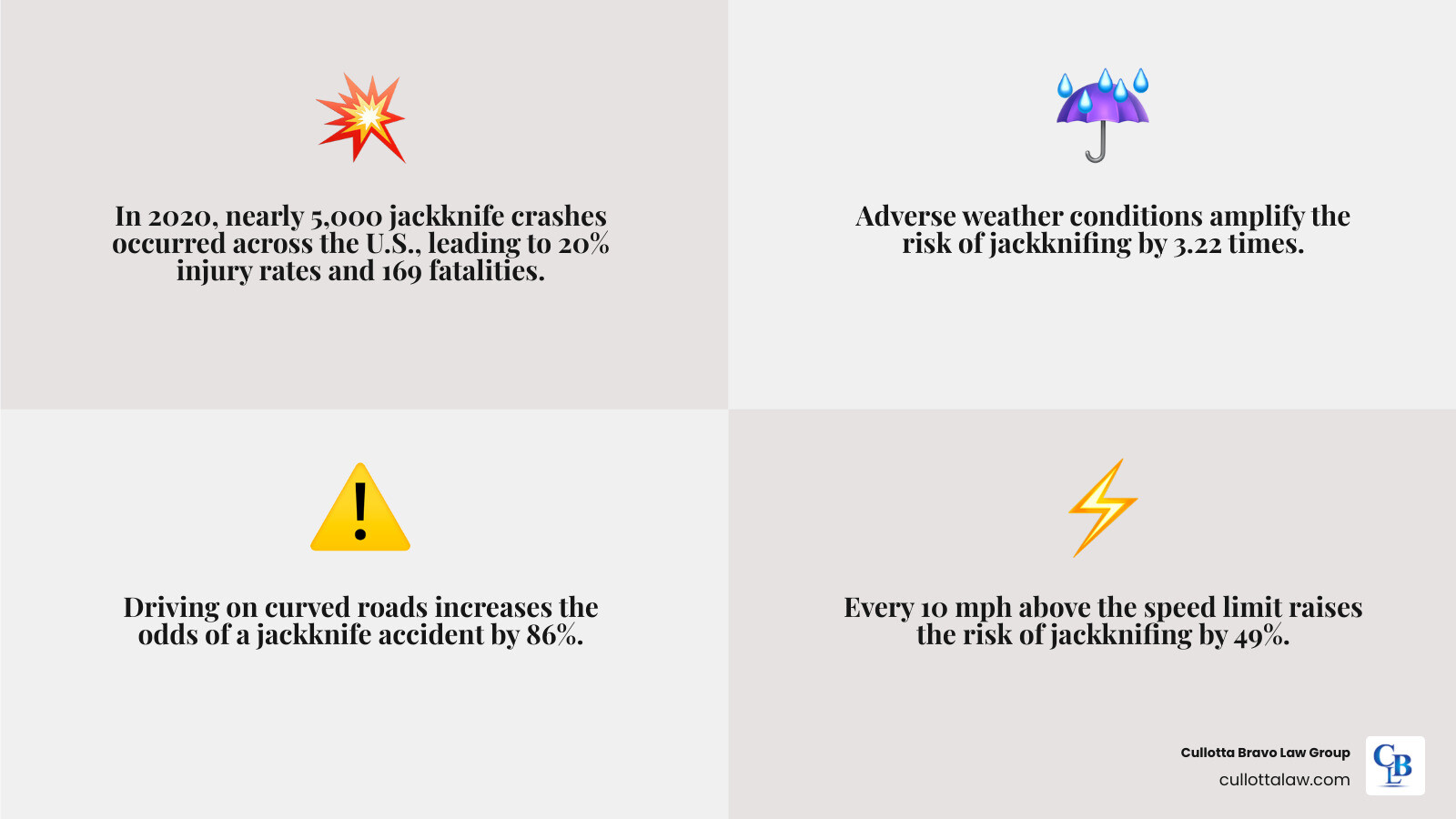
Jackknife truck accidents are not only terrifying but devastatingly destructive. When an 80,000-pound tractor-trailer folds in on itself like a pocket knife, it becomes an uncontrolled barrier spanning multiple lanes—crushing smaller vehicles, triggering chain-reaction pileups, and leaving survivors with life-altering injuries or worse. In 2020 alone, nearly 5,000 jackknife crashes occurred across the U.S., with 20% causing injury and 169 proving fatal. These aren’t random acts of nature—most jackknife collisions stem from preventable driver errors, inadequate training, poor vehicle maintenance, or negligent corporate practices that put profits over safety.
The physics of a jackknife are brutal: sudden braking, excessive speed, or loss of traction causes the trailer’s wheels to lock while momentum keeps the trailer moving faster than the cab. The result? A violent pivot that can send the trailer swinging across traffic at highway speeds, collecting cars in its wake. Weather amplifies the risk—adverse conditions make jackknifing 3.22 times more likely, while curved roads increase odds by 86% and every 10 mph above the speed limit raises the risk by 49%. Yet trucking companies and drivers often ignore these known dangers, failing to adjust speed, maintain brakes, or secure cargo properly.
If you’ve been injured in a jackknife crash, you’re facing more than physical recovery. Trucking companies deploy investigators within hours to protect their interests, insurance adjusters call with lowball settlement offers before you’ve even left the hospital, and critical evidence like truck computer data can be erased or “lost” if not preserved immediately. You need someone who understands the Federal Motor Carrier Safety Regulations, knows how to decode black box data, and isn’t afraid to take on billion-dollar carriers and their legal teams.
I’m Peter Cullotta, and over 35 years I’ve built a track record of holding negligent truckers and carriers accountable, securing millions in compensation for injured clients through trial-ready representation that forces insurers to pay what victims truly deserve. As a jackknife truck accident lawyer, I know that early action—preserving evidence, identifying liable parties, and building an airtight case—makes the difference between a fair recovery and a financial disaster.
Easy Jackknife truck accident lawyer glossary:
What Exactly is a Jackknife Truck Accident?
To understand a jackknife accident, imagine a simple folding pocketknife. A commercial semi-truck consists of two main parts: the tractor (the cab where the driver sits) and the trailer. These are connected at a single pivot point called the fifth wheel. A jackknife occurs when the trailer swings out to the side, forming an acute “V” or “L” shape with the cab.
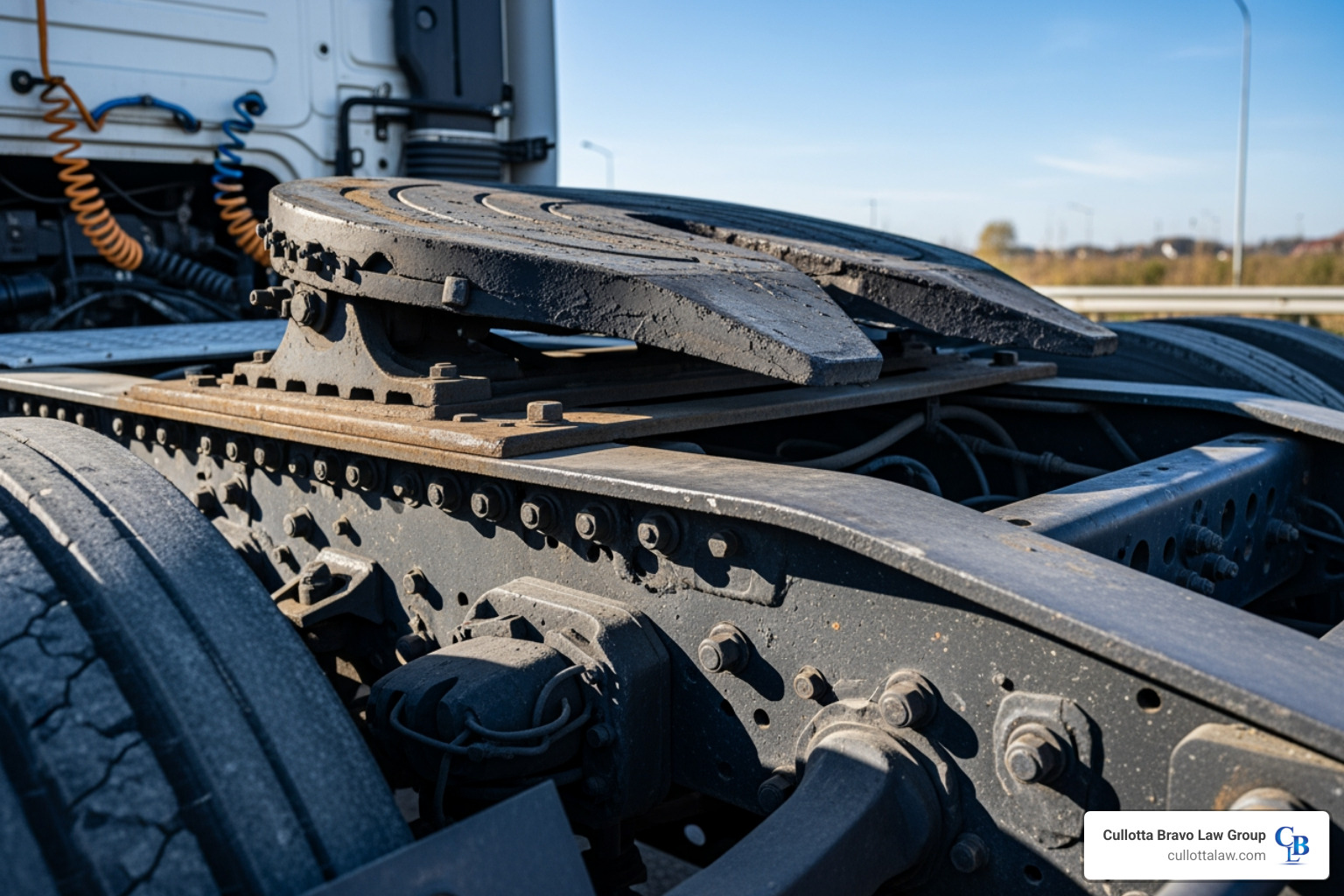
In Tractor Trailer Crashes in Illinois, the mechanics usually involve the trailer traveling faster than the cab. When the drive wheels of the tractor lose traction or lock up, the trailer—which has its own massive momentum—doesn’t stop. It keeps pushing forward. Since it can’t go through the cab, it swings out to the side. According to FMCSA data on jackknife occurrences, while these may represent about 5% of large truck accidents, they are disproportionately dangerous because they often block all lanes of traffic on busy Illinois interstates like I-88, I-55, or I-294.
The Role of a Jackknife Truck Accident Lawyer in Proving Fault
Proving who is to blame for a jackknife isn’t as simple as pointing at the truck. It requires a deep dive into the concept of negligence. At Cullotta Bravo Law Group, we look for a breach in the “duty of care” that drivers and trucking companies owe to everyone else on the road.
When you seek Truck Accident Legal Advice, we immediately look at the Illinois Department of Transportation (IDOT) truck crash data. In 2021, tractor-trailer crashes in Illinois rose to over 11,000 incidents. Our job is to determine if the driver was speeding, if the company skipped a brake inspection, or if the cargo was loaded so poorly that it shifted during a turn. We don’t just take the police report at face value; we dig into the driver’s history and the company’s safety records to find the root cause.
Understanding the “Point of No Return”
There is a terrifying moment in a jackknife sequence known as the “point of no return.” This happens when the trailer has swung out past a certain angle (usually about 15 degrees). At this stage, no amount of steering or braking by the driver can pull the trailer back into line. The momentum of the 80,000-pound rig takes over.
Traction loss is the primary culprit here. Whether it’s due to slick Illinois roads or bald tires, once those wheels lose their grip, the trailer swing becomes a physical inevitability. Drivers often make things worse by overcorrecting—steering too hard in the opposite direction—which can cause the entire rig to flip, leading to Vehicle Rollovers.
Common Causes and Preventability of Jackknife Crashes
Are these accidents truly “accidents”? In our experience, the answer is almost always “no.” Most jackknife crashes are entirely preventable.
| Cause Category | Specific Factor | Why it Leads to Jackknifing |
|---|---|---|
| Driver Error | Speeding Accidents | High speed makes it impossible to stop safely without locking brakes. |
| Driver Error | Sudden Braking | Panic braking causes the tractor to stop faster than the trailer. |
| Mechanical | Brake Failure | Imbalanced brakes cause one side of the truck to pull or lock. |
| Mechanical | Defective ABS | Anti-lock braking systems are designed to prevent wheel lock; if they fail, a slide is likely. |
| Environmental | Black Ice and Snow | Zero traction means the trailer will slide at the slightest curve. |
According to the Federal Highway Administration winter weather stats, about 24% of weather-related crashes occur on snowy or icy pavement. In Illinois, where we deal with brutal winters, truck drivers have a legal responsibility to slow down or even pull over when conditions become too dangerous. Failure to do so is negligence.
How Weather and Road Conditions Impact Jackknifing
Illinois weather is famous for changing in a heartbeat. One minute you’re driving through Naperville on a clear road, and the next you’re hitting a patch of Black Ice and Snow in Illinois.
Jackknifes are 86% more likely to happen on curved roadways than straight ones. When a truck enters a curve too fast on a wet or icy surface, centrifugal force pulls the trailer outward. If the driver hits the brakes while in the curve, the trailer is almost guaranteed to swing. Poor lighting conditions also increase risk by 43%, as drivers may not see a hazard until it’s too late, leading to the kind of sudden braking that triggers a pivot.
Cargo Loading and Mechanical Failures
Sometimes the driver does everything right, but the truck itself fails. “Brake fade” is a common issue where brakes overheat on long stretches or during heavy use, losing their stopping power. If the tractor’s brakes fail but the trailer’s brakes grab, or vice-versa, the resulting imbalance can jerk the rig into a jackknife.
Cargo loading is another massive factor. If a trailer is top-heavy or the weight is all in the back, it becomes unstable. We often ask: What Should You Do If You Are Injured By Cargo Falling Off a Truck? Even if the cargo stays inside, an unbalanced load that shifts during a turn can “push” the trailer out of alignment. Furthermore, “deadheading”—driving with an empty trailer—is surprisingly dangerous. Without the weight of cargo to press the tires into the road, an empty trailer can bounce and slide much more easily than a full one. Issues like Defective Tire Tread Accidents only make this lack of traction more lethal.
Why You Need a Jackknife Truck Accident Lawyer
If you are involved in a jackknife crash, you aren’t just fighting a driver; you are fighting a massive corporation and its insurance company. These entities have “rapid response teams” that arrive at crash scenes within hours to begin building a defense.
This is where “vicarious liability” comes in. Under Illinois law, a trucking company can be held responsible for the actions of its employees. When we handle 18 Wheeler Accidents in Illinois, we look at whether the company forced the driver to stay on the road past legal hours or hired someone with a history of reckless driving.
Insurance adjusters may seem friendly, but their goal is to get you to sign a release for as little money as possible. We guide our clients through the 8 Steps of a Personal Injury Case After an Auto Accident, ensuring that no evidence is lost and no rights are signed away.
Recovering Compensation with a Jackknife Truck Accident Lawyer
The damages in these cases are often astronomical. Because of the sheer size of the vehicles, victims rarely walk away with just “bumps and bruises.” We help you calculate The Real Cost of a Personal Injury, which includes:
- Medical Expenses: ER visits, surgeries, physical therapy, and future care.
- Lost Wages: Not just the time you missed, but the loss of future earning capacity if you can’t return to your old job.
- Non-Economic Damages: Pain and suffering, emotional distress, and loss of enjoyment of life.
- Loss of Consortium: The impact the injury has on your relationship with your spouse.
Our goal is always a Personal Injury Settlement that reflects the total impact on your life. If the insurance company refuses to be fair, we are prepared to take the case to a jury.
Crucial Evidence for Your Jackknife Accident Claim
In trucking litigation, evidence is king. Modern trucks are essentially rolling computers, and that data is vital to your case.
One of the first questions we get is: Do Commercial Trucks Have a Black Box That Can Be Used in a Personal Injury Claim? The answer is a resounding yes. These devices record speed, braking patterns, and even steering angles in the seconds leading up to a crash.
We also secure:
- ELD Data: Electronic logging devices show if a driver was violating “Hours of Service” rules and driving while fatigued.
- Maintenance Logs: To see if the brakes or tires were neglected.
- Spoliation Letters: We send these immediately to legally forbid the trucking company from destroying or altering any evidence.
- Dashcam Footage: Many fleets now have forward-facing cameras that capture the exact moment the trailer began to swing.
- Witness Statements: People who saw the truck speeding or swerving before the impact.
Frequently Asked Questions about Jackknife Accidents
Are jackknife truck accidents preventable?
Yes, absolutely. Prevention starts with proper driver training on how to handle skids and managing speed for the conditions. Trucking companies must also stay on top of vehicle maintenance. For regular motorists, knowing How to Safely Pass a Truck on the Highway can help you stay out of a truck’s “danger zone” if things go wrong.
Who can be held liable in a jackknife truck accident case?
Liable parties can include the truck driver (for errors like speeding), the motor carrier (for negligent hiring or maintenance), the cargo loading company (for an unbalanced load), or even the manufacturer (if a part like the brakes or tires was defective). We often uncover Dubious Trucking Industry Practices where companies encourage drivers to break safety rules to save time.
What are common injuries from these crashes?
Because jackknife accidents often involve the side of the trailer striking smaller cars, the injuries are usually severe. These include Traumatic Brain Injuries from the impact, Spinal Cord Injuries that can lead to paralysis, and multiple broken bones. In the most tragic cases, we serve as a Fatal Truck Accident Attorney for families who have lost a loved one.
Conclusion
A jackknife accident can change your life in a split second, but you don’t have to face the aftermath alone. At Cullotta Bravo Law Group, we bring over 35 years of experience to the table, specifically serving our neighbors in Aurora, Chicago, Naperville, and Joliet. We pride ourselves on aggressive legal representation and a history of multi-million dollar settlements that help our clients rebuild their lives with dignity.
If you or a loved one has been injured, don’t wait for the trucking company to make the first move. Evidence disappears quickly, and the clock is ticking on your right to file a claim. Contact a jackknife truck accident lawyer at Cullotta Bravo Law Group today. Whether you need a Truck Accident Lawyer Aurora, IL or representation elsewhere in Illinois, we are here to fight for the justice you deserve.
Contact Us today for a free, no-obligation consultation.