

Gravity Happens: Recovering from a Naperville Slip and Fall
When the Ground Gives Out: What Naperville Slip and Fall Victims Need to Know
If you need a slip and fall lawyer Naperville residents trust, here is what matters most:
| What You Need to Know | Quick Answer |
|---|---|
| Who can file a claim? | Anyone injured on another’s property due to a hazardous condition |
| What must you prove? | The owner knew (or should have known) about the danger and failed to fix it |
| How long do you have? | 2 years from the date of injury under Illinois law |
| What can you recover? | Medical bills, lost wages, pain and suffering, and more |
| What does it cost to hire a lawyer? | Nothing upfront — most firms work on a contingency fee basis |
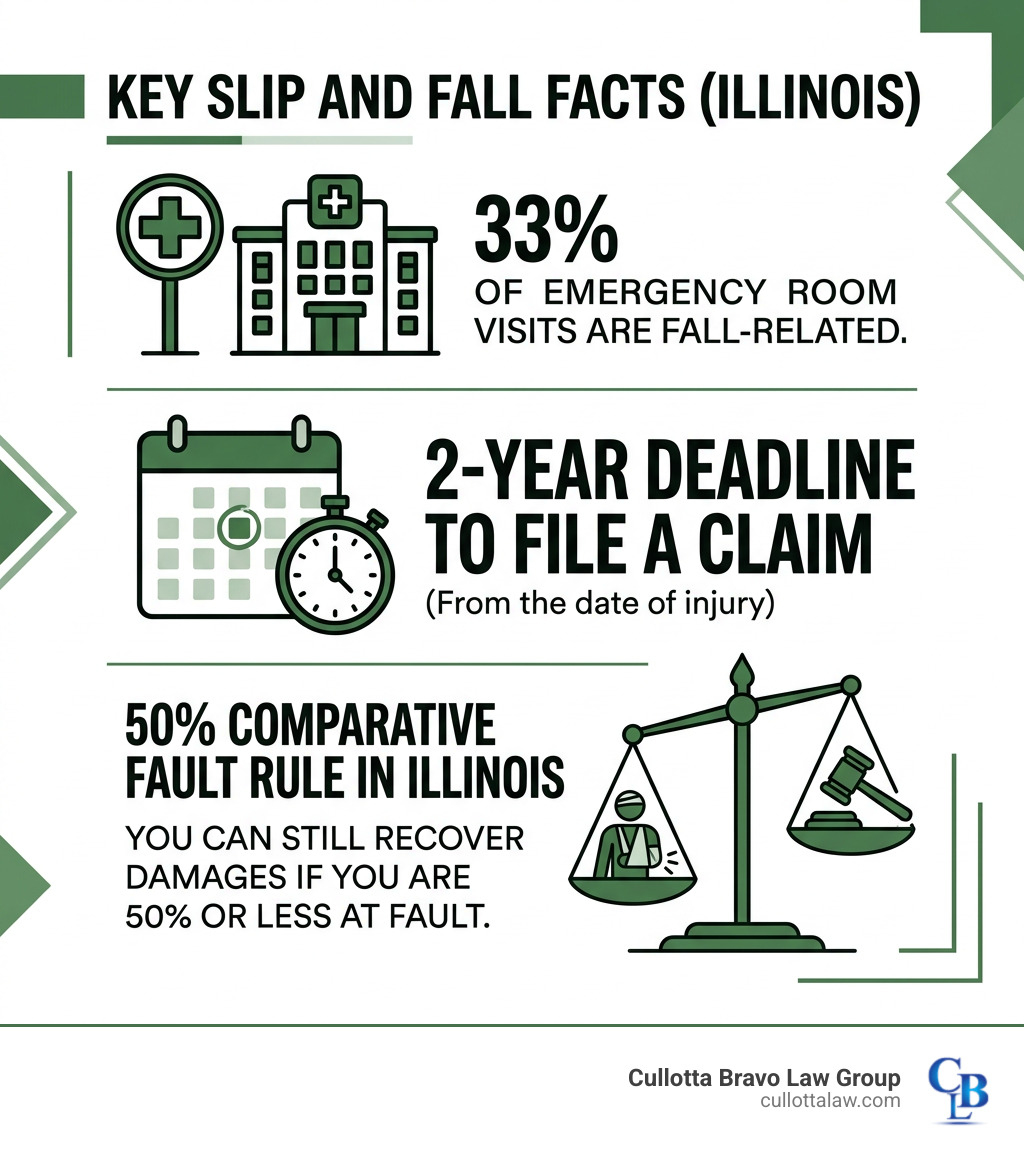
One moment you are walking through a grocery store or crossing a parking lot. The next, you are on the ground — in pain, confused, and facing a stack of medical bills you never planned for. According to the National Safety Council, fall-related injuries account for 33% of all emergency room visits each year. That is not a small number.
These accidents are not jokes. They cause broken bones, spinal injuries, head trauma, and long-term disability. And the financial toll — lost income, rehabilitation costs, home modifications — can follow victims for years.
The good news: Illinois law holds negligent property owners accountable. You have rights, and you have options.
I’m Peter Cullotta, founding partner at Cullotta Bravo Law Group, with over 35 years of experience representing injured individuals throughout the Chicagoland area — including as a slip and fall lawyer Naperville clients have relied on to take on insurers and property owners. In that time, I’ve seen how quickly evidence disappears and how fast insurance companies move to protect themselves, which is why acting quickly and with the right legal team makes all the difference.
Understanding Premises Liability and the Role of a Slip and Fall Lawyer Naperville

When we talk about “premises liability,” we are really talking about the responsibility a property owner has to keep their land and buildings safe. In Illinois, this is largely governed by the Illinois Premises Liability Act. This law essentially says that if you are lawfully on someone else’s property—whether you’re shopping at a store, visiting a friend’s apartment, or dining at a restaurant—the owner or manager owes you a “duty of reasonable care.”
This duty means they must maintain the property in a reasonably safe condition. If a hazard exists, they need to fix it or, at the very least, provide a clear warning (like those yellow “Wet Floor” signs we’ve all seen). If they fail to do this and you get hurt as a result, they may be legally liable for your damages.
However, “liability” isn’t automatic. Just because you fell doesn’t mean the owner is at fault. You have to prove they were negligent. This is where a slip and fall lawyer Naperville becomes your greatest asset. We dig into the details to show that the owner knew about the danger or should have known about it if they were doing their job properly. For those seeking more information on how we handle these cases locally, you can explore our Naperville personal injury services.
Common Hazards and High-Risk Locations in Naperville
Naperville is a beautiful place to live and work, but it isn’t immune to hazards. From the busy aisles of grocery stores near Route 59 to the charming but sometimes uneven sidewalks of the Downtown area, danger can hide in plain sight.
Some of the most common causes of falls in our area include:
- Wet or Oily Floors: Often found in grocery stores due to leaking coolers or in restaurants near the kitchen and restrooms.
- Unnatural Ice Accumulation: While Illinois law generally doesn’t hold owners liable for “natural” snow, they are liable if a broken gutter or poorly placed downspout causes a dangerous patch of ice to form on a walkway.
- Poor Lighting: Stairwells and parking lots without adequate lighting make it impossible to see tripping hazards.
- Broken Stairs and Railings: Rotting wood or loose handrails turn a simple flight of stairs into a trap. You can read more about the specifics of staircase accidents on our blog.
- Cluttered Aisles: Merchandise left in the middle of a walkway is a recipe for a trip and fall.
According to National Safety Council fall statistics, falls are a leading cause of preventable death and injury. Whether it happens at a big-box retailer or a local park, the impact on your life is just as real.
Why You Need a Slip and Fall Lawyer Naperville
You might think, “The store manager saw me fall, they’ll surely do the right thing.” Unfortunately, that is rarely how it works. Property owners and their insurance companies are “crafty”—their goal is to pay you as little as possible, or nothing at all.
They might try to get you to give a recorded statement where they “trap” you into admitting the fall was your fault. They might “lose” the surveillance footage from that day. Or they might argue that the hazard was “open and obvious,” meaning you should have seen it and avoided it.
A slip and fall lawyer Naperville protects you by:
- Preserving Evidence: We send “spoliation letters” to ensure the property owner doesn’t delete video or repair the hazard before we can document it.
- Proving “Notice”: We find evidence to show the owner knew the floor was wet or the stairs were broken long before you arrived.
- Handling the Paperwork: From filing the initial claim to negotiating with aggressive adjusters, we take the stress off your plate.
- Maximizing Value: We know how to calculate the true cost of your injury, including future medical needs and emotional distress. This is especially important when understanding landlord liability, as these cases often involve complex insurance policies.
Proving Negligence: The Key to a Successful Claim
To win a premises liability case in Illinois, you generally have to prove four things:
- A dangerous condition existed on the property.
- The owner knew (actual notice) or should have known (constructive notice) about it.
- The owner failed to fix the hazard or warn you.
- This failure directly caused your injury.
“Notice” is usually the hardest part to prove. Actual notice is simple: an employee saw the spill and walked away. Constructive notice is more common: the spill had been there for three hours, and if the store had a reasonable inspection schedule, they would have found it.
Crucial Evidence to Collect:
- Photos and Video: Take pictures of the hazard (the puddle, the ice, the broken step) from multiple angles.
- Witness Info: Get names and phone numbers of anyone who saw you fall or saw the hazard before you did.
- Incident Report: Always report the fall to management and ask for a copy of the report. (But don’t sign anything that admits fault!)
- Medical Records: See a doctor immediately. If you wait, the insurance company will argue you weren’t really hurt.
- The Clothes/Shoes You Wore: Keep the shoes you were wearing in a safe place; they can prove you had proper traction.
For a deeper dive into the legal mechanics, check out our ultimate slip and fall lawsuit guide.
Proving Negligence with a Slip and Fall Lawyer Naperville
We don’t just take your word for it—we build a wall of evidence. This often involves subpoenaing maintenance records to see when the last time a floor was mopped or inspected. We look for surveillance footage that shows how long a hazard was present. In some cases, we even bring in expert witnesses, like flooring engineers or safety consultants, to testify that the property was “unreasonably dangerous.”
If you want to know more about the types of cases we’ve handled, our page on slip and fall claims offers more context on the hurdles we help our clients clear.
Illinois Laws on Compensation and Comparative Fault
When you are injured, the law allows you to seek “damages.” These are divided into two main categories: economic and non-economic.
| Damage Type | What it Covers | Examples |
|---|---|---|
| Economic | Measurable financial losses | Medical bills, physical therapy, lost wages, future lost earnings |
| Non-Economic | Intangible human costs | Pain and suffering, emotional distress, loss of enjoyment of life, disfigurement |
In Illinois, we follow a rule called modified comparative negligence. This is the “50% rule.” It means that even if you were partially at fault for your fall (maybe you were walking a bit too fast or didn’t see the spill because you were looking at a shelf), you can still recover compensation—as long as you were not more than 50% responsible.
If a jury decides you were 20% at fault and your total damages are $100,000, you would receive $80,000. However, if they decide you were 51% at fault, you get nothing. This is why having a slip and fall lawyer Naperville to argue against these “fault” traps is so vital. You can read the specific text of the Illinois comparative negligence law to see how it might apply to you.
Statute of Limitations and Filing Deadlines
Time is not your friend in a personal injury case. In Illinois, the statute of limitations) for most slip and fall cases is two years from the date of the accident. If you miss this window, you lose your right to sue forever.
However, there are exceptions that make the deadline even shorter:
- Government Entities: If you fall on a sidewalk owned by the City of Naperville or at a government building, you may have only one year to file, and there may be strict notice requirements that must be met within months of the accident.
- Evidence Decay: Even if you have two years to sue, evidence like surveillance video is often overwritten in 30 days or less.
To ensure you don’t miss a beat, consult our slip and fall ultimate guide for a checklist of deadlines and requirements.
Frequently Asked Questions about Naperville Slip and Falls
What should I do immediately after a slip and fall in Naperville?
First, seek medical attention. Even if you feel “fine,” adrenaline can mask serious injuries like herniated discs or internal bleeding. Second, report the fall to the property owner. Third, take photos of the scene. Finally, call a lawyer before you talk to any insurance adjusters.
Can I still recover compensation if I was partially at fault for my fall?
Yes, as long as you are 50% or less at fault. Illinois uses a “modified comparative negligence” system. Your final settlement will simply be reduced by your percentage of fault. For example, if you were 10% at fault, you keep 90% of the award.
How long does it take to resolve a premises liability case in Illinois?
It varies. Some cases where liability is clear can settle in less than a year. However, if the insurance company fights back or if your injuries require long-term treatment, it can take 2 to 4 years if the case goes to trial. We always aim for the fastest resolution that still gets you the full value of your claim.
Conclusion
At Cullotta Bravo Law Group, we know that a slip and fall isn’t just a “clumsy moment”—it’s a life-altering event. With over 35 years of experience and a track record of multi-million dollar settlements, we provide the aggressive legal representation you need to stand up to big insurance companies. We treat every client with the dignity and respect they deserve while fighting relentlessly for the compensation they need to move forward.
If you’ve been injured, don’t wait for the evidence to disappear. Request a consultation with a Naperville personal injury lawyer today. We serve clients in Aurora, Chicago, Naperville, and Joliet, and we don’t get paid unless you win. Let us handle the legal heavy lifting so you can focus on your recovery.