

How Long Do You Have to Sue for a Dog Bite in Illinois?
Illinois Dog Bite Statute of Limitations: The Quick Answer
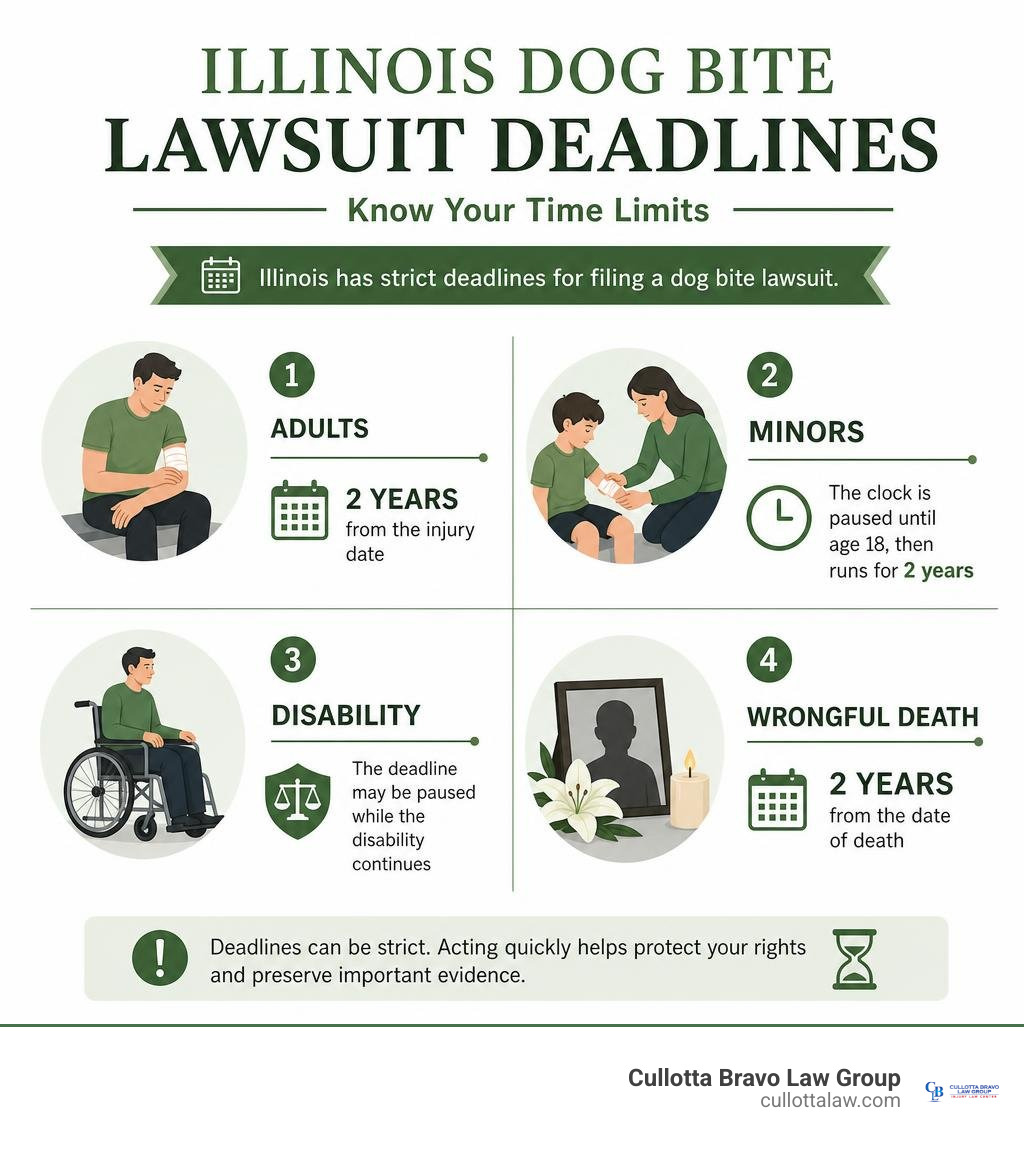
The illinois dog bite statute of limitations is generally two years from the date of the injury. Under 735 ILCS 5/13-202, a person injured by a dog attack usually must file a lawsuit within that period or risk losing the right to recover damages.
| Situation | Usual filing deadline |
|---|---|
| Adult injured in a dog bite or dog-related attack | 2 years from the injury date |
| Minor injured by a dog | The clock is generally paused until age 18, then runs for 2 years |
| Person under a legal disability | The deadline may be paused while the disability continues |
| Fatal dog attack | Generally 2 years from the date of death |
A dog attack can bring medical bills, missed work, scarring, and stress at a time when deadlines are easy to overlook. Illinois has strict liability rules for many dog-related injuries, but a valid claim still must be filed on time, and waiting can make it harder to preserve evidence or identify every responsible party.
I am Peter Cullotta, founding partner of Cullotta Bravo Law Group and a trial lawyer with more than 35 years of experience handling Illinois injury claims and litigation deadlines. I help injured people understand how the illinois dog bite statute of limitations may affect their right to pursue compensation.
Quick look at illinois dog bite statute of limitations:
- Illinois car accident statute of limitations
- Illinois medical malpractice statute of limitations
- Illinois wrongful death statute of limitations
Understanding the Illinois Dog Bite Statute of Limitations
When a dog bite disrupts your life, understanding the clock ticking in the background is critical. In Illinois, civil lawsuits are governed by strict procedural rules designed to keep legal matters moving efficiently. The core deadline governing personal injury claims, including dog bites, is established under Section 13-202 of the Illinois Code of Civil Procedure (735 ILCS 5/13-202).
Under Illinois law, a dog bite or attack is legally categorized as a “sudden traumatic event.” Because the trauma and physical damage happen instantaneously, the law presumes that the victim is immediately aware of their injury and the need to investigate who might be at fault. This means the procedural clock starts running on the very day the attack occurs. Navigating these rules early on ensures that you retain your right to seek financial recovery from all responsible parties.
Standard Two-Year Deadline for the Illinois Dog Bite Statute of Limitations
For the vast majority of adult victims, the illinois dog bite statute of limitations gives you exactly two years from the calendar date of the attack to initiate a formal lawsuit in a civil court. For example, if an unrestrained dog bites you on May 10, 2026, your deadline to file a lawsuit in an Illinois circuit court is May 10, 2028.
If you attempt to file a lawsuit even a single day after this two-year window shuts, the defendant’s legal team will file a motion to dismiss, and the court will almost certainly throw out your case permanently. This strict cutoff applies regardless of how severe your injuries are or how clear the dog owner’s fault may be.
While two years might feel like plenty of time when you are resting at home, building a solid injury case requires substantial preparation. Gathering certified medical records, documenting permanent scarring, obtaining police or animal control reports, and negotiating with stubborn insurance adjusters can consume many months. Understanding overall statutes of limitation on accidents in illinois helps ensure you do not inadvertently let crucial filing deadlines slip through the cracks while recovering.
Tolling Rules and Exceptions in the Illinois Dog Bite Statute of Limitations
Fortunately, Illinois statutory law recognizes that certain victims cannot legally protect their own interests immediately following an injury. In legal terms, “tolling” means temporarily pausing or delaying the running of the statute of limitations clock.
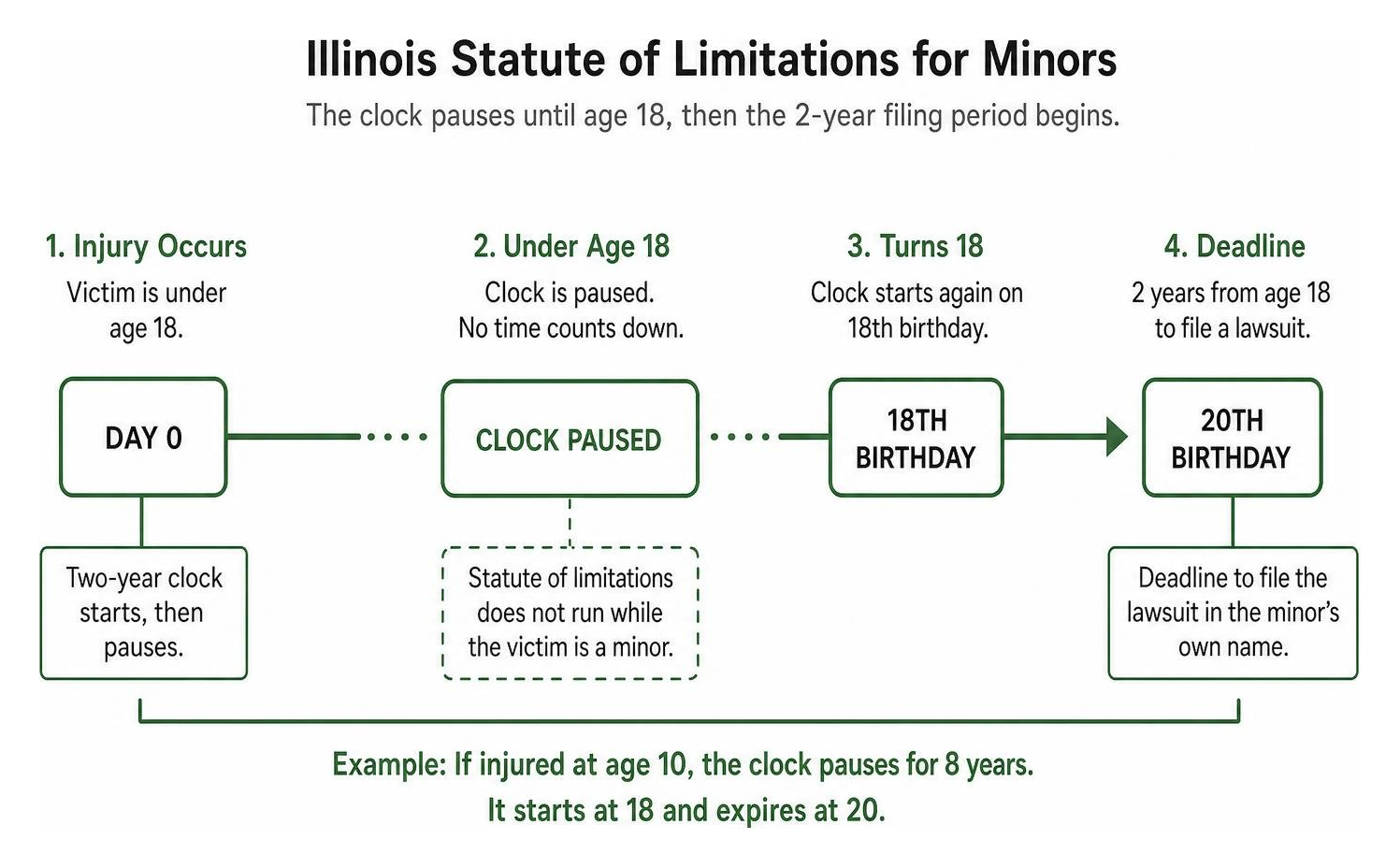
The primary tolling exceptions under Illinois law include:
- Minor Victims (735 ILCS 5/13-211): Children are sadly among the most frequent victims of dog attacks across Chicago, Aurora, Joliet, and Naperville. Under state law, if a victim is under the age of 18 when the attack occurs, the two-year statute of limitations clock is entirely paused until their 18th birthday. Once the young victim turns 18, the two-year clock begins to tick, giving them until their 20th birthday to file a personal injury lawsuit in their own name. However, parents or legal guardians do not have to wait—they can file a lawsuit on behalf of the child at any point while the child is still a minor. Reviewing general Illinois Dog Bite Laws highlights how state laws protect young victims.
- Legally Disabled Victims: If an individual suffers from a mental or legal disability at the time of the dog attack that renders them incapable of managing their own legal affairs, the two-year deadline is tolled. The clock remains paused for as long as the legal disability persists. Once a court officially deems the disability removed, the two-year filing period commences.
Wrongful Death Claims and Discovery Rule Limitations
Tragically, severe dog maulings can sometimes prove fatal. When a dog attack results in a loss of life, the legal nature of the claim shifts. Fatal cases are brought under the Illinois Wrongful Death Act (740 ILCS 180/).
In a wrongful death claim, the two-year statute of limitations clock typically begins running on the date of the person’s death, rather than the date of the original attack. For instance, if a victim is attacked on June 1 but tragically passes away from infection or complication on June 20, the two-year deadline to file a wrongful death lawsuit runs from June 20. Families seeking justice can read more about time limits for illinois wrongful death and survival act claims to protect their rights.
A common question victims ask is whether they can extend their filing deadline if they discover a new responsible party later on. Many personal injury claims utilize a “discovery rule,” which delays the start of the filing deadline until the victim knows or reasonably should know of their injury and its wrongful cause. However, Illinois appellate courts have firmly restricted how this rule applies to dog attacks.
In the landmark case Kimberly A. Kardys v. Chris Lamping et al. (2022 IL App (2d) 220006-U), an injured victim attempted to sue a property management company more than two years after a dog attack at a rented residence, arguing she did not discover the management company’s legal involvement until well into discovery. The Illinois Appellate Court rejected her argument and affirmed the dismissal of her claim. The court held that because a dog attack is a sudden, traumatic event, the victim is put on immediate duty to investigate all potentially liable human parties—such as landlords, harborers, and property managers—from day one. You can examine the official Illinois Appellate Court ruling on discovery rule to see how strictly state courts enforce these filing windows.
How Illinois Dog Bite Liability Laws Work Under the Animal Control Act
Beyond filing deadlines, winning a civil claim requires understanding how liability works in Illinois. The foundational law governing dog attacks in our state is the Illinois Animal Control Act (510 ILCS 5/16).
Under 510 ILCS 5/16, if a dog or other animal, without provocation, attacks, attempts to attack, or injures any person who is peaceably conducting themselves in any place where they may lawfully be, the owner of the animal is liable in civil damages for the full amount of the injury suffered.
Strict Liability vs. One-Bite Rule
Some states still enforce a traditional “one-bite rule,” which means an owner might escape financial liability for a first attack if they had no prior reason to believe their dog was aggressive. Illinois is not a one-bite state. Illinois enforces a strict liability standard for dog bites and dog-related injuries.
Under strict liability, an injured victim does not need to prove that the dog had a history of biting, nor do they need to prove that the owner was negligent in managing or leashing the animal. If the statutory conditions are met, the owner is held automatically liable for the harm caused.
Furthermore, Illinois law defines an “owner” very broadly under 510 ILCS 5/2.16. An owner includes:
- The legal property owner of the dog.
- Anyone keeping or harboring the dog (such as a roommate or long-term caretaker).
- Any custodian or dog-sitter who has care, custody, or control of the dog at the time of the incident.
This expansive definition allows victims to pursue claims against multiple entities, provided action is taken before the illinois dog bite statute of limitations runs out. Consulting an experienced dog bite lawyer illinois can help identify every harborer and custodian who shares legal responsibility.
Defenses to Dog Bite Claims: Provocation and Trespassing
While strict liability strongly favors injured victims, dog owners and their insurance carriers can avoid liability by establishing specific legal defenses. To succeed in an Illinois dog bite claim, the victim must prove three core statutory elements:
- Lawful Presence: The victim was in a place where they had a legal right to be (e.g., on public property or lawfully on private property as a guest, mail carrier, or contractor).
- Peaceable Conduct: The victim was behaving peaceably prior to the attack.
- Lack of Provocation: The victim did not provoke the animal.
Here is a summary of statutory defenses available to dog owners under Illinois law:
- Unlawful Trespassing: If the victim was unlawfully entering private property without permission or illegal intent, the owner may avoid strict liability under the Animal Control Act.
- Intentional or Unintentional Provocation: If the victim struck, teased, cornered, or physically abused the dog, the defense can argue the animal acted in self-defense.
- Assumed Risk or Express Consent: Applied rarely, primarily in professional settings where a person (like a veterinarian or dog groomer) explicitly assumes the physical risk of handling unpredictable animals.
When evaluating provocation, Illinois courts apply an objective “reasonable dog standard.” As established in the key case Kirkham v. Will, courts consider whether an ordinary, reasonable dog would react aggressively under similar circumstances. Accidental actions, like inadvertently stepping on a dog’s tail or petting a dog that unexpectedly snaps, generally do not constitute legal provocation under Illinois law.
Insurance Coverage and Compensation Available for Victims
Nationally, over 4.5 million dog bites occur each year in the United States. According to industry data from the Insurance Information Institute, dog bites and dog-related injuries account for more than one-third of all homeowners insurance liability claim dollars paid out nationwide, costing insurers over $1.12 billion annually.
In 2023, the average cost per dog bite claim paid by homeowners insurers was $58,545. By 2025, that national average figure rose to $65,450 per claim, reflecting increasing medical expenses and legal costs.
Most dog bite claims in Illinois are paid out through homeowners or renters insurance liability policies rather than directly out of an individual owner’s personal savings account. Typical policy limits range anywhere from $100,000 to $300,000 or more. Notably, effective January 2024, Illinois enacted consumer protection legislation forbidding insurance carriers writing policies in the state from denying coverage, refusing policies, or cancelling insurance based solely on specific dog breeds (such as Pit Bulls or Rottweilers).
When you pursue a claim, you can seek recovery for both economic financial losses and non-economic personal impacts:
| Category of Damages | What It Covers | Key Documentation Needed |
|---|---|---|
| Economic Damages | Direct out-of-pocket financial losses resulting from the attack | Emergency room bills, surgeon fees, plastic surgery costs, physical therapy records, pay stubs showing lost wages |
| Non-Economic Damages | Intangible physical, emotional, and psychological harm | Scarring and disfigurement evidence, psychological evaluation for PTSD, pain and suffering testimony |

It is worth noting that the Illinois Animal Control Act covers more than just tooth-to-skin bites. If an unrestrained dog leaps onto you and knocks you down on a sidewalk, causing a fractured hip or head injury, you can still recover full damages under the exact same strict liability standard.
Essential Steps to Take After a Dog Attack to Protect Your Rights
The hours and days following a dog attack are crucial for both your health and your legal claim. Taking swift action protects your physical well-being and ensures vital evidence does not disappear before your lawyer can collect it.
To protect your rights and ensure compliance with Illinois health ordinances, take the following essential steps:
- Seek Immediate Medical Attention: Dog bites carry exceptionally high risks of serious bacterial infections (such as Pasteurella or Capnocytophaga). Emergency room or urgent care treatment creates an immediate, objective medical record of your wounds.
- Report the Incident Immediately: Under Illinois law (510 ILCS 5/18), any animal bite must be reported to local health or animal control authorities within 24 hours. City animal control agencies in Chicago, Aurora, Joliet, and Naperville maintain official records that document the owner’s identity and rabies vaccination history.
- Mandatory 10-Day Rabies Quarantine: Illinois statutory law requires any biting dog to undergo a mandatory 10-day quarantine observation period overseen by a licensed veterinarian to rule out rabies. Depending on municipal ordinances and the dog’s past record, quarantine may occur at a municipal shelter or under strict home confinement.
- Gather Evidence at the Scene: Take photograph evidence of your injuries, torn clothing, bloodstains, the physical location of the attack, and any missing fence panels. Obtain contact names and phone numbers from the dog owner and all eyewitnesses.
- Avoid Recorded Statements with Insurers: Insurance adjusters may reach out quickly after an attack to offer a low settlement or trick you into making statements suggesting you provoked the dog. Always remember that you must act fast to safeguard physical evidence, but consult an attorney before giving recorded statements to an insurance company.
Frequently Asked Questions About Illinois Dog Bite Deadlines
How long after a dog bite can you sue in Illinois?
Under 735 ILCS 5/13-202, an adult victim generally has two years from the date of the dog bite or injury incident to file a personal injury lawsuit in an Illinois court.
Does the Illinois dog bite statute of limitations apply if the victim is a minor?
No, the standard two-year clock is paused (tolled) for minor children under 735 ILCS 5/13-211 until they reach 18 years of age. They then have until their 20th birthday to file a personal injury lawsuit.
What happens if you miss the deadline to file a dog bite lawsuit in Illinois?
If you file your lawsuit after the two-year statute of limitations expires, the court will grant the defense’s motion to dismiss your case with prejudice. You will lose all legal rights to collect financial compensation from the owner or their insurance company.
Conclusion
The illinois dog bite statute of limitations enforces a strict two-year deadline for most injury victims. While two years might seem like plenty of time, physical healing, medical treatment, evidence preservation, and insurance negotiations require immediate action. Delaying your investigation can mean lost animal control records, missing witness testimony, or missing secondary defendants like property management firms.
At Cullotta Bravo Law Group, our legal team brings over 35 years of aggressive trial experience to fighting for dog bite victims across Aurora, Chicago, Naperville, and Joliet. We handle all insurance communications, gather official police and health reports, and ensure all statutory deadlines are met while you focus on recovery.
Contact us today at Cullotta Bravo Law Group to schedule a free, no-obligation consultation. To learn more about state filing deadlines across different types of injury claims, read our practical guide on statutes of limitation on accidents in illinois.