

Don’t Let the Clock Run Out on Your Illinois Auto Accident Claim
Why the Illinois Car Accident Statute of Limitations Could Make or Break Your Claim
The Illinois car accident statute of limitations sets a strict legal deadline on how long you have to file a claim after a crash. Miss it, and you lose your right to compensation — no matter how strong your case is.
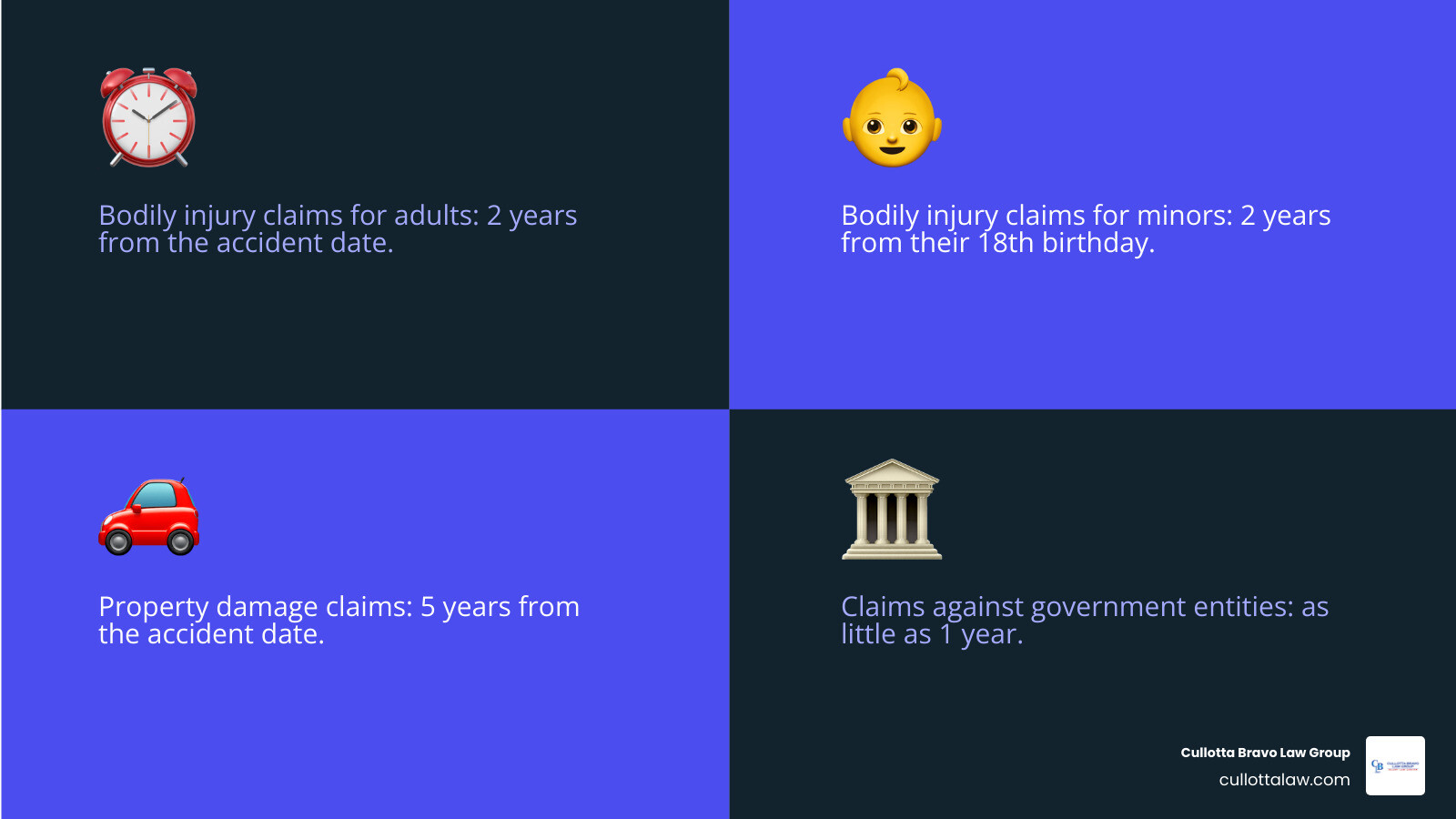
Here are the key deadlines at a glance:
| Claim Type | Deadline |
|---|---|
| Bodily injury (adults) | 2 years from the accident date |
| Bodily injury (minors) | 2 years from their 18th birthday |
| Property damage | 5 years from the accident date |
| Government entity claims | As little as 1 year |
Note: The June 2026 Illinois reforms shortened deadlines further for specific injury types, including whiplash and soft tissue injuries.
After a crash, medical bills pile up fast. Lost wages add pressure. The last thing most people think about is a legal filing deadline. But waiting too long — even by a single day — can permanently bar your claim.
The 2026 Illinois law reforms made this even more urgent. The rules are no longer a simple two-year window for everyone. Deadlines now depend on the type of injury you suffered.
I’m Peter Cullotta, founding partner at Cullotta Bravo Law Group, and I’ve spent over 35 years fighting for injured Illinois drivers navigating exactly these kinds of Illinois car accident statute of limitations issues. In the sections below, I’ll walk you through everything you need to know to protect your rights before time runs out.
Learn more about illinois car accident statute of limitations:
- Illinois medical malpractice statute of limitations
- how long do you have to file a personal injury claim in illinois
Understanding the Illinois Car Accident Statute of Limitations
When you are involved in a motor vehicle collision, the legal system provides a pathway to recover compensation for your losses. However, this pathway is not open indefinitely. In legal terms, the “statute of limitations” is the ultimate, non-negotiable deadline for starting a lawsuit. As noted in legal practice guides, miss this deadline by even a single day, and your case is barred forever. You can read more about these rigid boundaries in this guide on Statutes of Limitations – vLex United States .

In Illinois, a tort claim generally “accrues” at the exact moment the plaintiff suffers the injury—which is almost always the date of the car crash itself. From that moment, the clock begins ticking.
The purpose of these strict timelines is to ensure fairness. Over time, physical evidence disappears, skid marks fade, and witness memories become unreliable. By enforcing a statutory limit, the law encourages victims to pursue their claims diligently while allowing potential defendants to eventually move on without the threat of a lawsuit hanging over their heads forever.
If you are wondering how long do you have to file a personal injury claim in illinois, the answer historically stood at a straightforward two years for bodily injuries. However, as we will discuss below, the landscape has grown significantly more complex.
Bodily Injury vs. Property Damage Deadlines
It is a common misconception that all damages resulting from a car crash must be resolved at the exact same time. Illinois law actually draws a sharp line between physical injuries and physical damage to your vehicle.
- Bodily Injury Claims: For standard personal injury claims involving adults, the illinois car accident statute of limitations requires you to file a lawsuit within 2 years from the date of the accident. This is the timeline within which you must either reach a final settlement with the insurance company or file a formal lawsuit in court.
- Property Damage Claims: If you are only seeking compensation for the destruction of your vehicle, the towing costs, or personal property inside the car, you have a much longer window. The statute of limitations for property damage is 5 years from the date of the accident.
To understand how these timelines interact and how to prevent costly mistakes, it helps to review the core rules surrounding statutes of limitation on accidents in illinois. One key takeaway is that an insurance company cannot refuse to pay an agreed-upon property damage claim simply because your bodily injury claim is still open and being negotiated.
Exceptions for Minors and Government Entities
While the two-year and five-year rules are the standard baselines, Illinois law contains crucial exceptions that can either extend or drastically shorten your filing window.
The Minor Exception
If the injured person was under the age of 18 at the time of the car crash, the statute of limitations clock does not start ticking immediately. Instead, the law “tolls” (pauses) the deadline until they reach legal adulthood. A minor has 2 years from their 18th birthday to file a bodily injury claim, meaning the ultimate deadline is their 20th birthday. This exception applies only to bodily injuries; property damage claims arising from the crash still carry the standard five-year limit from the date of the accident.
Government Entity Claims (The Major Trap)
If your accident involved a government vehicle—such as a city bus, a state highway maintenance truck, or a local police car—the rules change completely. Under the Illinois Local Governmental and Governmental Employees Tort Immunity Act, the statute of limitations for filing a lawsuit against a local government entity is slashed to just 1 year from the date of the accident.
Furthermore, there are strict notice requirements that must be met even earlier. If you do not act quickly when a government entity is involved, you will lose your right to recover anything. This is why we always tell our clients: dont let the clock run out on your illinois injury claim.
The June 2026 Illinois Car Accident Law Reforms
If you are dealing with a car crash in July 2026, you are operating under a brand-new legal framework. The Illinois legislature recently enacted major overhauls to the state’s personal injury laws, which took effect in June 2026.
These reforms represent the most dramatic shift in Illinois car accident litigation in decades, moving the state away from a simple, blanket two-year deadline to a highly complex, bifurcated system. For a detailed breakdown of these legislative shifts, you can read How Illinois’ 2026 Statute Of Limitations Changes Affect Your Car Accident Claim Deadline | Car Accident Injury Calculator .
How the 2026 Reforms Impact the Illinois Car Accident Statute of Limitations
The most controversial element of the June 2026 reforms is the creation of a bifurcated system for personal injury claims. Instead of giving every injured victim two years to file, the law now compresses deadlines based on the specific medical diagnosis of the injury.
Under the new rules:
- Severe Injuries: Major injuries—such as broken bones, spinal cord damage, internal organ damage, or severe lacerations—generally retain the traditional two-year statute of limitations.
- Soft Tissue and Whiplash Claims: The legislature shortened the statute of limitations for claims consisting primarily of soft tissue injuries, muscle strains, and whiplash. If your injury does not involve objective radiological evidence of structural damage (like a fracture), your filing window is compressed.
- Minor-to-Moderate Property Damage with Accompanying Injury: If the physical impact on the vehicle was minor, and the accompanying bodily injury is deemed moderate or soft-tissue related, the deadline to file is also significantly compressed.
This means the old advice of “just wait and see how you feel” is now legally dangerous. If you suffer from whiplash, you no longer have the luxury of waiting two years to see if the pain goes away. To preserve your right to compensation, you must act fast.
New IDOT Accident Reporting Requirements
The 2026 reforms did not just change court filing deadlines; they also tightened the administrative rules. Stricter reporting timelines have been established for filing crash reports with the Illinois Department of Transportation (IDOT).
Failing to comply with these new IDOT reporting windows can have catastrophic consequences for your civil case. Under the new law, insurance carriers—particularly in uninsured or underinsured motorist claims—can use a failure to file a timely, accurate IDOT report as grounds to deny coverage or seek a complete forfeiture of your claim rights, independent of the statute of limitations.
Comparative Negligence and Fault Allocation
Illinois operates under a modified comparative negligence system governed by 735 ILCS 5/2-1116. Understanding how fault is allocated is critical because it directly impacts your final settlement or court award.
Under this law, you can recover damages from another driver as long as you are 50.00% or less at fault for the accident. However, your financial recovery will be reduced by your exact percentage of fault.
For example:
- If you are awarded $100,000 in damages but are found to be 20% at fault for the crash (perhaps because you were driving slightly over the speed limit), your settlement will be reduced by 20%. You will receive $80,000.
- If you are found to be 51% or more at fault, you are completely barred from recovering any compensation under Illinois law.
To see how this works in real-world scenarios, check out our guide on understanding comparative fault in illinois car accident cases.
Minimum Liability Insurance Requirements
To ensure that victims can actually recover the compensation they are awarded, Illinois law mandates that all drivers carry minimum liability insurance. The June 2026 reforms raised these mandatory minimums to reflect modern medical costs.
Below is a comparison of the minimum liability insurance requirements for Illinois motorists:
| Coverage Type | Requirements Prior to June 2026 | New Requirements (Effective June 2026) |
|---|---|---|
| Bodily Injury (Per Person) | $25,000 | $50,000 |
| Bodily Injury (Per Accident) | $50,000 | $100,000 |
| Property Damage | $20,000 | $40,000 |
These new limits provide a larger baseline pool of insurance coverage to compensate injured victims. However, because minimum limits can still be exhausted quickly by a single hospital visit, carrying underinsured motorist coverage remains a vital protection for Illinois drivers.
Protecting Your Claim: Immediate Steps to Take After a Crash
What you do in the minutes, hours, and days following a car accident will directly dictate your ability to successfully navigate the illinois car accident statute of limitations and secure a fair settlement.
If you want to understand the entire process from start to finish, our car accident lawsuit complete guide provides an excellent roadmap.
Navigating the Illinois Car Accident Statute of Limitations After a Crash
To protect your rights under the strict 2026 rules, you should follow this checklist immediately after any collision in Aurora, Chicago, Naperville, or Joliet:
- Seek Immediate Medical Attention: Go to an emergency room, urgent care, or your primary care physician right away. This is critical not only for your health but also to establish a contemporaneous medical record. Under the new compressed timelines for soft tissue injuries, a delay in seeking medical care can make it incredibly difficult to prove the crash caused your injuries.
- Document the Scene: Take photos of the vehicle damage, road conditions, skid marks, and any visible physical injuries. Collect contact information from any witnesses.
- File Your IDOT Report: Ensure your official accident report is submitted within the newly mandated state windows to avoid claims of forfeiture.
- Speak to a Lawyer Immediately: Do not wait. Consulting an experienced attorney within days of your accident ensures that your claim is categorized correctly and that no critical deadlines are missed. If you need help starting this process, you can access our personal injury claim help resources.
Dealing with Third-Party Insurance Companies
When you file a claim against the at-fault driver’s insurance company (a third-party claim), you are dealing with professionals whose primary goal is to pay you as little as possible. Fortunately, Illinois insurance regulations provide consumers with specific protections:
- The 15-Day Form Response Rule: Once you notify the insurance company of a claim, they must provide you with the necessary claim forms and a reasonable explanation of how to file within 15 working days.
- The 60-Day Property Damage Delay Rule: If your property damage claim remains unresolved after 60 days, the insurance company must provide you with a written explanation of the delay.
- Deduction Limits: Insurers cannot make arbitrary deductions for wear, tear, or rust on vehicle repairs unless those deductions are itemized and verified (and they are generally capped at $500).
- Total Loss Retention: If your vehicle is declared a total loss, Illinois law only allows you to keep the vehicle and accept a reduced payout if the car is nine years old or older.
Navigating these insurance rules while nursing an injury can be exhausting. To learn more about how to manage these communications without hurting your case, read our guide on how to handle a car accident insurance claim.
Frequently Asked Questions About Illinois Car Accident Claims
What happens if I miss the statute of limitations deadline?
If you miss the deadline, your right to file a lawsuit is permanently lost. If you attempt to file a lawsuit after the statute of limitations has run, the defendant’s attorney will file a motion to dismiss your case.
Because the statute of limitations is an “affirmative defense,” the court will not automatically throw your case out unless the defendant raises the issue. However, any competent defense attorney will immediately raise this defense, and the judge will have no choice but to dismiss your case with prejudice. You will receive zero compensation.
Do the 2026 reforms apply to accidents that occurred before June 2026?
No. The June 2026 reforms are generally not retroactive. Crashes that occurred before the June 2026 effective date are typically governed by the prior legal framework (including the standard two-year personal injury statute of limitations).
However, if you have an unfiled claim from an accident that occurred near the transition period, you should verify your exact deadlines with an attorney immediately to avoid any confusion or accidental expiration of your rights.
How do the 2026 reforms affect traumatic brain injury (TBI) claims?
Traumatic Brain Injuries (TBIs) present a unique challenge under the new 2026 rules. TBI symptoms—such as cognitive delays, memory issues, chronic headaches, and mood changes—often do not manifest immediately after a crash.
Because the 2026 reforms compress deadlines for claims that do not show immediate, objective physical trauma, TBI victims are at severe risk. If a victim delays filing because they believe they only have “minor whiplash,” they may find their filing window compressed before their TBI is fully diagnosed. If you hit your head in a crash, it is vital to seek immediate neurological evaluation to establish an objective medical record as early as possible.
Conclusion
The Illinois car accident statute of limitations is a rigid, unforgiving clock. With the introduction of the June 2026 reforms, navigating these deadlines requires prompt action and deep legal expertise. You can no longer assume you have a comfortable two years to resolve your claim.
At Cullotta Bravo Law Group, we have over 35 years of experience helping injury victims in Aurora, Chicago, Naperville, and Joliet secure the compensation they deserve. We provide aggressive legal representation, treat our clients with the utmost dignity, and have a proven history of securing multi-million dollar settlements.
Don’t let an insurance company run out the clock on your case. Contact us today for a free, no-obligation case review.
Protect your rights before time runs out — contact Cullotta Bravo Law Group today or visit our offices in Aurora, IL.