

Time Limits for Illinois Wrongful Death and Survival Act Claims
Understanding the Illinois Wrongful Death Statute of Limitations
The primary law governing civil lawsuits for fatal injuries in Illinois is the Wrongful Death Act, codified under 740 ILCS 180/. When a person dies due to a wrongful act, neglect, or default, the law allows a civil suit to be brought against the responsible party to provide compensation for surviving family members.
However, bringing a case requires strict compliance with statutory deadlines. Knowing how the illinois wrongful death statute of limitations works ensures that families retain their legal right to accountability and financial recovery.
Standard Two-Year Filing Window
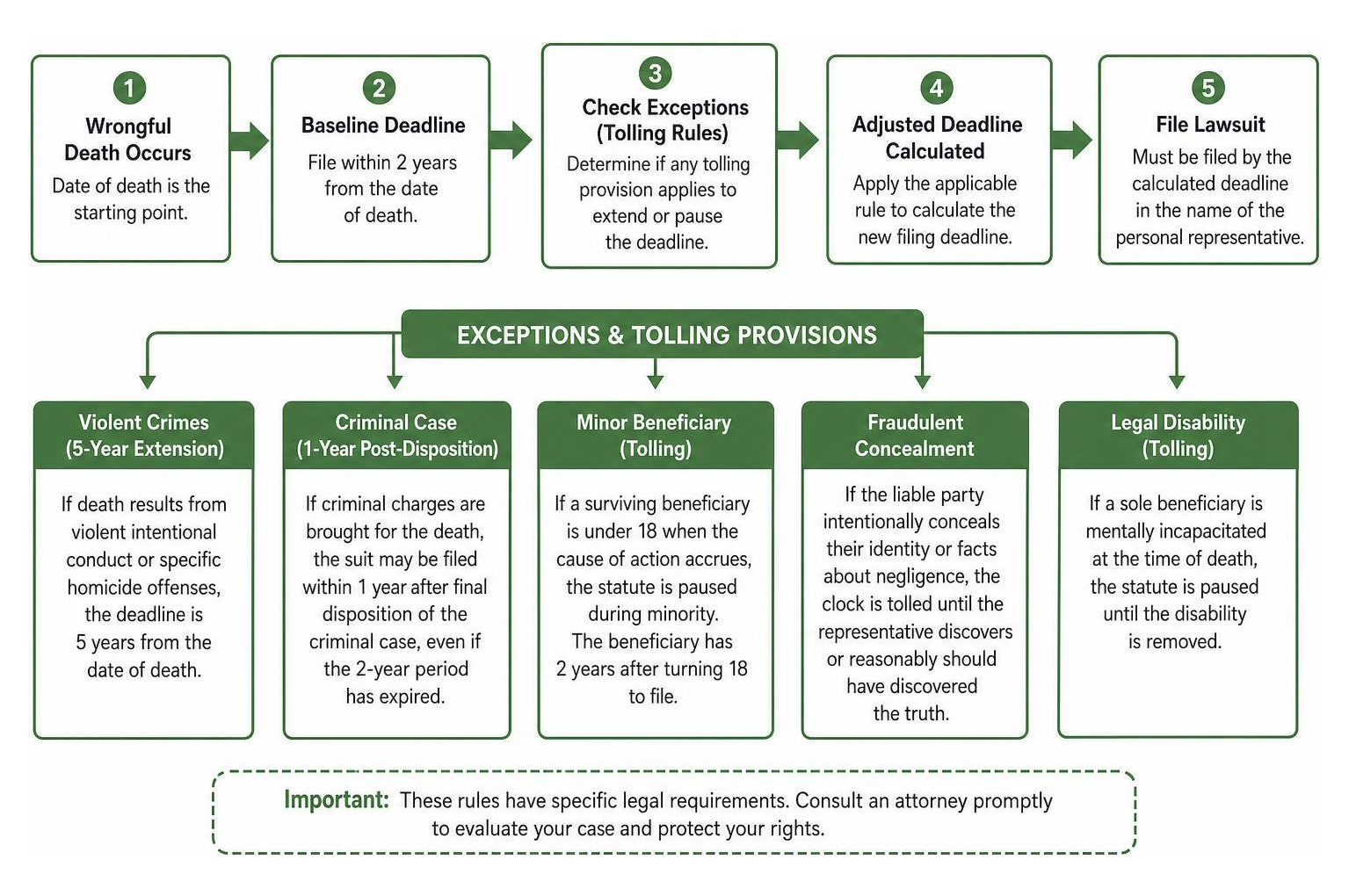
In the vast majority of cases, the standard statute of limitations for an Illinois wrongful death claim is two years from the exact date of the decedent’s death. Whether the fatal incident involved a wrongful death car accident, a truck crash, or workplace negligence, the accrual date typically starts on the day the person passed away—not necessarily the day the original injury occurred.
If a suit is not filed within this two-year window, the defendant can move to dismiss the lawsuit. Except under specific statutory tolling circumstances, Illinois circuit courts will grant the dismissal, permanently barring the estate from seeking financial recovery. You can read more about overall accident timelines in our guide on statutes of limitation on accidents in illinois.
Role of the Personal Representative and Beneficiaries
Under Illinois law, individual family members do not file a wrongful death lawsuit directly in their own names. Instead, 740 ILCS 180/2 dictates that the action must be brought in the name of the personal representative (the court-appointed executor or administrator) of the deceased person’s estate.
The lawsuit is brought for the exclusive benefit of the surviving spouse and next of kin (such as children or lineal heirs). If no formal probate estate has been opened, the court can appoint a special administrator upon proper motion to handle the litigation. For a broader overview of state-specific recovery rules, consult this resource on Illinois Wrongful Death Law: Statute, Damages & Settlement Guide.
Key Exceptions and Statutory Tolling Rules
While two years is the baseline, the Illinois legislature has carved out specific exceptions that either extend or toll (pause) the clock. These rules account for criminal conduct, minor beneficiaries, and unusual circumstances. For direct statutory phrasing, review Illinois Statutes Chapter 740. Civil Liabilities § 180/2 | FindLaw.
Violent Crimes and Criminal Case Exceptions
When a death results from violent intentional conduct or specific homicide offenses (such as first-degree murder, involuntary manslaughter, or reckless homicide), Illinois extends the filing deadline:
- 5-Year Extension: The statute of limitations expands to 5 years from the date of death.
- 1-Year Post-Disposition Rule: If criminal charges are brought against the defendant for the death, the personal representative may bring the civil wrongful death suit within 1 year after the final disposition of the criminal case, even if the general two-year window has expired.
Minor Beneficiaries and Tolling Provisions
When a surviving beneficiary entitled to recover under the Wrongful Death Act is under 18 years of age when the cause of action accrues, the law protects their legal rights. Under minor tolling provisions:
- The statute of limitations is paused during the child’s minority.
- The minor beneficiary has 2 years after reaching the age of majority (turning 18) to commence an action.
Exceptions to the Illinois Wrongful Death Statute of Limitations
Beyond violent crime and minor tolling, other legal doctrines can toll the statute of limitations:
- Fraudulent Concealment: If the liable party intentionally hides their identity or conceals facts regarding their negligence, the clock may be tolled until the representative discovers the truth.
- Legal Disability: If a sole beneficiary is mentally incapacitated at the time of the decedent’s death, the limitation period may be paused until the disability is removed.
Because these exceptions carry subtle legal requirements, you must act fast to evaluate whether a tolling provision applies to your case.
Discovery Rule, Medical Malpractice, and Government Claims
Certain types of wrongful death claims involve unique rules that alter standard deadline calculations.

Medical Malpractice and the Illinois Wrongful Death Statute of Limitations
When fatal injuries stem from medical negligence, the illinois wrongful death statute of limitations intersects with medical malpractice statutes.
- The Discovery Rule: A claimant generally has 2 years to file from the date they knew, or reasonably should have known, of the fatal medical injury and its wrongful cause.
- Statute of Repose: Illinois imposes an absolute 4-year cap (statute of repose) on medical malpractice claims, calculated from the date the negligent medical act occurred—regardless of when the injury or death was discovered.
For a deep dive into these interplay rules, see our article on illinois medical malpractice statute of limitations dont let the clock run out on your case.
Claims Against Government Entities and Municipalities
Suing a municipal body, local government agency, or public employee in Illinois involves much shorter windows under the Local Governmental and Governmental Employees Tort Immunity Act:
- 1-Year Deadline: Claims against local public entities or their employees must generally be filed within 1 year from the date of death.
- Formal Notice Requirements: Specific administrative notices must often be served within tight timelines prior to filing the suit.
Wrongful Death Act vs. Survival Act Claims
When a person dies from a tortious act, two distinct causes of action may arise in Illinois: a Wrongful Death Act claim and a Survival Act claim (755 ILCS 5/27-6).
| Feature | Illinois Wrongful Death Act (740 ILCS 180/) | Illinois Survival Act (755 ILCS 5/27-6) |
|---|---|---|
| Primary Purpose | Compensates surviving family for their losses | Allows estate to recover for decedent’s pre-death damages |
| Who Receives Damages | Surviving spouse and next of kin | Deceased person’s probate estate |
| Recoverable Losses | Grief, sorrow, mental suffering, loss of society, lost financial support | Pre-death pain and suffering, lost wages before death, medical expenses |
| General Deadline | 2 years from date of death | 2 years from injury (or extended via Survival Act provisions) |
Key Differences in Deadlines and Recoverable Damages
While wrongful death actions compensate survivors for non-economic grief, loss of companionship, and future economic loss, survival actions protect the decedent’s own personal injury claim. For instance, if an accident victim survived for several weeks in an ICU before passing away, the Survival Act allows the estate to collect for those weeks of pre-death pain and suffering and hospital bills.
To ensure all heads of damages are pursued, families should understand both sets of limits. Learn more about civil timelines in our guide on how long do you have to file a personal injury claim in illinois.
What Happens If You Miss the Filing Deadline?
Filing a claim after the illinois wrongful death statute of limitations has expired carries severe statutory consequences:

- Mandatory Dismissal: The defendant’s legal counsel will file a Motion to Dismiss under 735 ILCS 5/2-619. Courts lack authority to extend deadlines purely out of sympathy.
- Loss of Recovery Rights: The estate permanently loses the right to collect compensation for medical bills, funeral expenses, loss of income, and grief.
- Barred Settlement Negotiations: Insurance carriers will refuse to negotiate once the limitation period lapses, as they no longer face legal exposure.
To avoid catastrophic procedural forfeitures, review dont let the clock run out on your illinois injury claim.
Frequently Asked Questions
What is the standard time limit for filing a wrongful death lawsuit in Illinois?
Under 740 ILCS 180/2, the standard filing deadline is two years from the date of the person’s death.
How does the discovery rule apply if the cause of death is not immediately known?
The discovery rule pauses the clock until the representative knows or reasonably should know that the death was caused by wrongful conduct. However, in medical malpractice scenarios, the claim is still bounded by a strict 4-year statute of repose.
Can a minor file a wrongful death claim after turning 18 in Illinois?
Yes. Beneficiaries who were under 18 at the time of accrual have up to two years after their 18th birthday to file an action under Illinois minor tolling provisions.
Conclusion
Navigating the illinois wrongful death statute of limitations requires swift, decisive action during an emotionally challenging time. From identifying the proper personal representative to calculating complex tolling rules across medical malpractice, government, or criminal exceptions, timing is critical.
At Cullotta Bravo Law Group, we represent families across Aurora, Chicago, Naperville, Joliet, and surrounding Illinois communities. With over 35 years of trial experience, our team provides aggressive, compassionate representation to ensure your family’s rights are protected before the clock runs out.
If you have questions about filing deadlines or need help pursuing a claim, explore our resource on statutes of limitation on accidents in illinois or contact us today for a consultation. We also represent families requiring assistance from a wrongful death lawyer aurora, a wrongful death attorney aurora il, or representation for wrongful death joliet claims.