

Maximum car accident settlement: Unlocking 2026 Potential
Understanding the True Potential of Your Car Accident Claim
Maximum car accident settlement amounts depend on factors like injury severity, medical costs, lost wages, policy limits, and fault. While minor injuries may settle for $10,000-$25,000, moderate injuries can range from $25,000-$100,000, and severe injuries can reach $250,000-$1,000,000 or more. Catastrophic injuries may exceed $2,000,000, but there is no universal “maximum”—each case is unique.
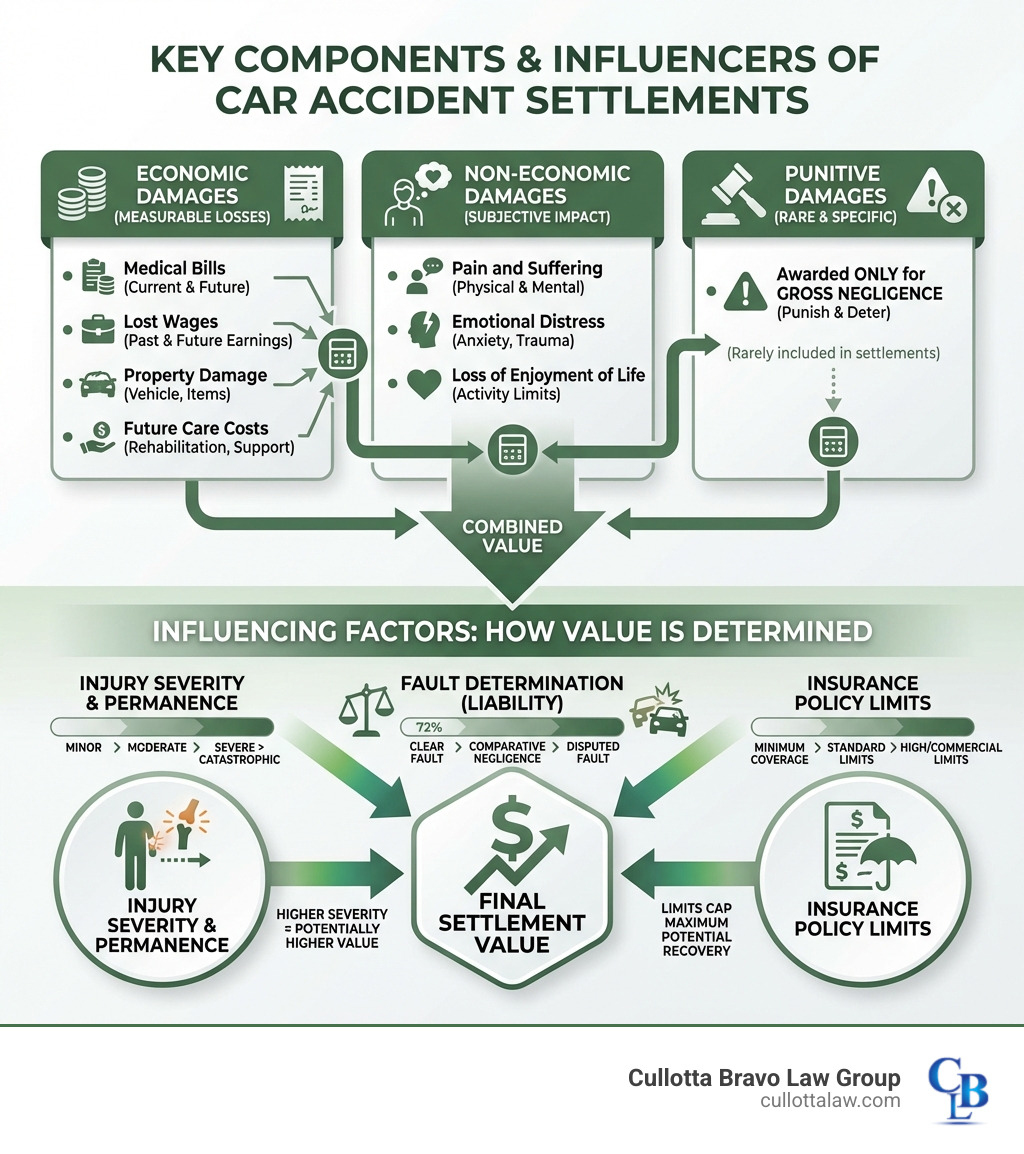
Key Settlement Components:
- Economic Damages: Medical bills, lost wages, future care costs, property damage
- Non-Economic Damages: Pain and suffering, emotional distress, loss of enjoyment
- Punitive Damages: Rarely awarded, only in cases of gross negligence
Primary Factors Affecting Settlement Value:
- Severity and permanence of injuries
- Clarity of fault (Illinois uses modified comparative negligence)
- Available insurance and policy limits
- Quality of documentation and legal representation
Car accident settlements are not lottery wins; they are complex calculations designed to compensate you for real losses. While the phrase “million-dollar settlement” gets attention, most cases settle for less. Understanding what drives settlement value is critical to securing fair compensation.
Insurance companies have adjusters and lawyers whose goal is to pay you as little as possible. You need an advocate who understands how these cases are valued and won’t accept a lowball offer. This guide breaks down how settlements are determined, what factors increase compensation, and the steps to protect your claim.
I’m Peter Cullotta, founding partner at Cullotta Bravo Law Group. With over 35 years of experience, I’ve secured millions for injured clients across Chicagoland. My firm has handled countless car accident cases, and we know what it takes to maximize settlement values and hold insurance companies accountable.
Simple guide to Maximum car accident settlement terms:
Deconstructing a Settlement: The Building Blocks of Compensation
When we talk about a maximum car accident settlement, we’re discussing the total financial recovery for all losses from a crash. It’s not just about medical bills; it covers a broad spectrum of damages designed to make you whole. These damages fall into three categories: Economic, Non-Economic, and, in rare cases, Punitive Damages.
Economic Damages: The Tangible Costs
Economic damages, or “special damages,” are the measurable financial losses from your accident. These are costs with a clear dollar figure.

This category includes:
- Past Medical Expenses: All treatment costs from the accident to the settlement date, including ER visits, surgery, and physical therapy.
- Future Medical Care: Anticipated costs for ongoing treatment or future surgeries. For instance, a spinal fusion can cost $50,000 to $150,000, and a knee replacement can range from $35,000 to $60,000.
- Lost Income: Wages, bonuses, and benefits you’ve lost because you couldn’t work.
- Diminished Earning Capacity: If your injuries reduce your long-term earning potential, this future loss is compensable. You can learn more about lost wages and earning capacity.
- Vehicle Repair Costs: The cost to repair or replace your vehicle and rental car expenses.
- Out-of-Pocket Expenses: Other accident-related costs like transportation to medical appointments or home modifications.
We track every penny you’ve spent and will need to spend. For a deeper dive, explore The Real Cost of a Personal Injury.
Non-Economic Damages: The Intangible Human Cost
Non-economic damages, or “general damages,” compensate for intangible losses without a direct bill. These are a significant part of any claim, especially when aiming for a maximum car accident settlement.
This category covers:
- Physical Pain and Suffering: Compensation for the physical pain you endure.
- Emotional Trauma/Distress: Includes anxiety, depression, and fear resulting from the accident. You can read more about emotional distress.
- Permanent Disability or Disfigurement: Compensation for lifelong physical impairment or scarring.
- Loss of Enjoyment of Life: For when injuries prevent you from enjoying hobbies, sports, or daily routines.
- Loss of Consortium: Compensates a spouse for the loss of companionship and affection.
- Chronic Pain: We understand how to quantify the suffering from persistent pain. Learn more about Navigating Chronic Pain After a Car Accident.
- Post-Traumatic Stress Disorder (PTSD): Compensation for the psychological aftermath of a traumatic accident.
While these damages lack an invoice, their impact is real. We work with experts to assign a fair value to these losses.
Punitive Damages: In rare cases of exceptionally reckless or intentional conduct (gross negligence), punitive damages may be awarded. They are meant to punish the wrongdoer, not compensate the victim. They are exceedingly rare in typical car accident cases but can sometimes be awarded for Catastrophic Injuries caused by egregious conduct.
Key Factors That Influence the Maximum Car Accident Settlement
Determining the maximum car accident settlement is a complex evaluation of many interwoven factors, not a simple calculation.
Insurance adjusters are skilled negotiators aiming to minimize payouts, scrutinizing every detail. The quality of your evidence and legal representation is paramount. For a comprehensive look, check out What Determines My Car Accident Settlement Amount?.
The Severity and Permanence of Your Injuries
This is the number one factor. More severe and lasting injuries lead to higher compensation.
- Catastrophic Injuries: Life-altering injuries like Traumatic Brain Injuries, spinal cord damage, or amputations often result in permanent disability and extensive medical care. Settlements can exceed $2 million. Cases requiring surgery, on average, lead to settlements 3.5 times higher than those without.
- Major Accidents: Injuries like fractures or concussions requiring surgery can result in settlements from $50,000 to $1 million or more.
- Minor Injuries: While cuts, sprains, and whiplash are less severe, they still require treatment. Settlements typically range from $3,000 to $15,000. However, even minor collisions can cause serious injuries with delayed pain.
The length and complexity of your recovery are also crucial. We have extensive experience with Back and Neck Injury Cases and understand their long-term implications.
Proving Fault: Illinois’s Modified Comparative Negligence Rule
In Illinois, who is at fault directly impacts your settlement. Our state follows a “modified comparative negligence” rule.
This means you can only recover damages if you are 50% or less at fault. If you are 51% or more at fault, you recover nothing. If you are partially at fault (e.g., 20%), your compensation is reduced by that percentage. A $100,000 award would be reduced to $80,000.
Proving the other driver’s negligence is paramount and involves gathering evidence like police reports, witness statements, and photos. Insurance companies will try to shift blame to reduce their payout. We know how to counter these tactics. Learn more about Understanding Comparative Fault in Illinois Car Accident Cases.
The Role of Insurance Policy Limits
The maximum car accident settlement is often constrained by available insurance coverage.
- At-Fault Driver’s Liability Coverage: This is the primary source of compensation. Illinois minimums ($25,000 per person) are often insufficient for serious accidents.
- Underinsured/Uninsured Motorist (UIM/UM) Coverage: This is crucial when the at-fault driver has little or no insurance. We strongly advise all clients in Aurora, Chicago, Naperville, and Joliet to carry robust UIM/UM coverage.
- Other Factors: In some cases, it’s possible to “stack” multiple policies. If multiple people were injured, the policy limits must be divided among all claimants.
When damages exceed the at-fault driver’s limits, we explore all avenues, including your own UIM coverage. Explore Uninsured Accidents: What Can I Do? for more details.
The Calculation Conundrum: How Settlement Value Is Estimated
There’s no magic calculator for car accident settlements. While insurance companies use formulas, each claim is unique, influenced by specific facts and injuries. In Illinois, we focus on proving the full extent of your losses. For a deeper understanding of how we approach valuation, visit our page on Calculating Settlement of a Personal Injury Claim.
Understanding the “Multiplier Method”
One widely used method to start negotiations is the “multiplier method.” This estimates non-economic damages based on economic damages.
Here’s how it generally works:
- Special Damages as a Base: We first add up all your economic damages (medical bills, lost wages, etc.).
- Multiplier Application: This sum is then multiplied by a factor, or “multiplier,” (typically 1.5 to 5, or higher) to estimate your non-economic damages like pain and suffering.
- Adding Lost Wages: Finally, lost wages are added to the combined total to arrive at a preliminary settlement value.
The choice of multiplier is crucial and depends on factors like injury severity, length of recovery, impact on daily life, and clarity of fault. For minor injuries, a multiplier of 1-2x is common. For serious injury claims, multipliers of 3-5x or higher can be justified.
Why Average Settlement Numbers Can Be Misleading
You might see statistics online about “average car accident settlements,” but these can be incredibly misleading for your specific case.
- Statistics vs. Individual Cases: An “average” includes everything from minor fender-benders to catastrophic collisions. Lumping these together doesn’t reflect your unique claim’s worth.
- Broad Ranges: Even when broken down by injury type, the ranges are vast. For example, minor injury settlements might range from $3,000 to $15,000, while severe injuries can range from $250,000 to $3,000,000+.
- Illinois Specifics: The average cost of a nonfatal disabling injury requiring hospitalization is approximately $47,000. In Illinois, the average settlement for a car accident case without surgery is between $10,000 and $25,000, while cases requiring surgery often exceed $100,000. These figures demonstrate how widely settlement values can vary.
Focusing on averages can lead to unrealistic expectations or cause you to accept a lowball offer. Your claim’s value should be determined by its specific facts, not by misleading statistics.
The Road to Resolution: Your Guide to the Settlement Process
Navigating a car accident claim is a marathon, not a sprint. Understanding the process helps set realistic expectations for achieving the maximum car accident settlement.
Here’s a general overview of the journey:
- Initial Consultation: We discuss your accident, injuries, and legal options.
- Investigation: We gather evidence, including police reports, medical records, and expert opinions.
- Demand Letter: We send a comprehensive demand to the insurance company outlining your damages.
- Negotiation: We engage with the adjuster to reach a fair settlement. Most personal injury cases (approximately 98%) settle out of court.
- Mediation: A neutral third party may help facilitate a resolution if negotiations stall.
- Litigation: If a fair settlement isn’t reached, we file a lawsuit and prepare for court.
Steps to Take to Achieve the Maximum Car Accident Settlement
To maximize your settlement, take these critical steps after an accident:
- Seek Immediate Medical Attention: This ensures your well-being and creates an official record linking your injuries to the accident.
- Report the Accident: Notify the police and your insurance company promptly.
- Document Everything: Take photos of the scene, vehicle damage, and injuries. Keep records of all related expenses.
- Do Not Admit Fault: Even a casual “I’m sorry” can be used against you.
- Avoid Recorded Statements: Do not speak to the other driver’s insurer without your attorney.
- Follow All Medical Advice: Adhere to your doctor’s treatment plan. Gaps in treatment can weaken your claim.
- Hire an Experienced Lawyer: This is crucial. The Insurance Research Council (IRC) found that claimants with legal representation receive, on average, 3.5 times more compensation than unrepresented individuals.
For a more detailed guide, refer to Steps to Take to Maximize a Car Accident Settlement Amount.
How Long Will My Car Accident Settlement Take?
Achieving a maximum car accident settlement often requires patience.
- Simple Cases: Minor injuries with clear liability might settle in 3-6 months.
- Moderate Cases: More significant injuries could take 6-12 months.
- Complex Cases: Severe injuries, disputed liability, or cases that go to trial can take 1-3+ years.
Delays can be caused by disputed fault or the need to wait until you’ve reached “maximum medical improvement” to account for all future costs. We work diligently to move your case forward while ensuring full compensation. You can find more information about the process on How Long Will You Wait for Your Car Accident Settlement?.
Frequently Asked Questions about Car Accident Settlements
Are personal injury settlements taxable in the U.S.?
Generally, compensation for physical injuries or sickness is not taxable under federal law. This includes damages for medical expenses and pain and suffering related to those physical injuries.
However, certain parts of a settlement can be taxable:
- Lost Wages: The IRS typically considers this taxable income.
- Punitive Damages: These are always taxable.
- Emotional Distress (Not Linked to Physical Injury): Compensation for emotional distress not caused by a physical injury may be taxable.
Consult a tax professional about your specific settlement.
What is the difference between a claim as a driver versus a passenger?
As a passenger, your claim has distinct advantages when aiming for a maximum car accident settlement.
- Passengers are Rarely at Fault: You typically bear no fault, which simplifies the liability aspect of your claim.
- Claim Against Multiple Drivers: You can often pursue a claim against the insurance of the driver of your car, the other at-fault driver, or both.
- Access to Multiple Policies: If both drivers were at fault, you could claim against both liability policies. Your own auto insurance (MedPay or UM/UIM) might also apply.
The severity of your injuries and available insurance limits remain crucial factors.
When should I hire a personal injury lawyer?
The answer is almost always: immediately after the accident. Early legal intervention is key to achieving a maximum car accident settlement:
- Before Talking to Insurers: An attorney can handle all communication with the other driver’s insurance company, who will try to get you to say things that hurt your claim.
- If Injuries are Serious: For anything beyond minor bruises, a lawyer is essential to account for long-term costs.
- If Liability is Disputed: An attorney can immediately begin gathering evidence to prove negligence.
- To Level the Playing Field: You need an experienced advocate to counter the insurance company’s legal team.
- Statute of Limitations: We ensure all legal deadlines in Illinois are met, so you don’t lose your right to compensation.
Even if you’re unsure if you have a case, a free consultation provides clarity. For a complete guide on finding the right legal representation, visit Find Car Accident Lawyer: Complete Guide.
Conclusion
Achieving a maximum car accident settlement is a nuanced process, not about winning a lottery, but about securing fair compensation for your physical, emotional, and financial losses. The value of your claim hinges on injury severity, the clarity of fault under Illinois’s comparative negligence rule, and available insurance limits.
While million-dollar settlements are possible in catastrophic cases, they are not the norm. Most claims settle for amounts that cover medical bills, lost wages, and pain and suffering. Regardless of the scale, the goal is to ensure you are fully compensated.
This complex journey underscores the importance of expert legal guidance. At Cullotta Bravo Law Group, we have over 35 years of experience and a history of securing multi-million dollar settlements for clients across Aurora, Chicago, Naperville, and Joliet. We provide personalized attention and unwavering advocacy.
Don’t steer the aftermath of a car accident alone. Contact an experienced Aurora car accident lawyer to discuss your case today. Let us fight to secure the maximum car accident settlement you deserve.