

Pain and suffering claim: Essential Guide 2026
Why Pain and Suffering Claims Matter for Your Recovery
A pain and suffering claim is a legal request for compensation for the physical pain and emotional distress you experience after an injury caused by someone else’s negligence. These are non-economic damages—meaning they don’t come with a receipt, but they’re just as real as your medical bills.
Key Facts About Pain and Suffering Claims:
- What it covers: Physical pain, emotional distress, anxiety, depression, loss of enjoyment of life, and reduced quality of life
- How it’s calculated: Through the multiplier method (1.5-5x your economic damages) or per diem method (daily rate x days of suffering)
- Who can claim: Anyone injured due to negligence in car accidents, slip and falls, medical malpractice, or other incidents
- Time limits: Typically 3 years in Illinois, but varies by state and case type
- No caps in Illinois: Most personal injury cases have no limit on pain and suffering damages
When you’re hurt in an accident, your losses extend far beyond medical bills and lost wages. The physical pain that keeps you awake at night, the anxiety you feel getting back behind the wheel, the depression from missing out on activities you love—these are all compensable damages. Yet insurance companies routinely downplay or dismiss these claims, offering settlements that don’t reflect the true impact on your life.
The challenge lies in proving something that doesn’t show up on a medical bill. How do you put a dollar value on the fear you now feel in situations that never bothered you before? How do you quantify the frustration of not being able to play with your children or enjoy your hobbies? These questions make pain and suffering claims the most contested—and often most valuable—part of personal injury cases.
As Peter Cullotta, I’ve spent over 35 years helping injured individuals throughout the Chicagoland area pursue fair compensation, including substantial pain and suffering claim awards. My experience includes securing millions in verdicts and settlements by building compelling evidence that tells the full story of how an injury has changed someone’s life.
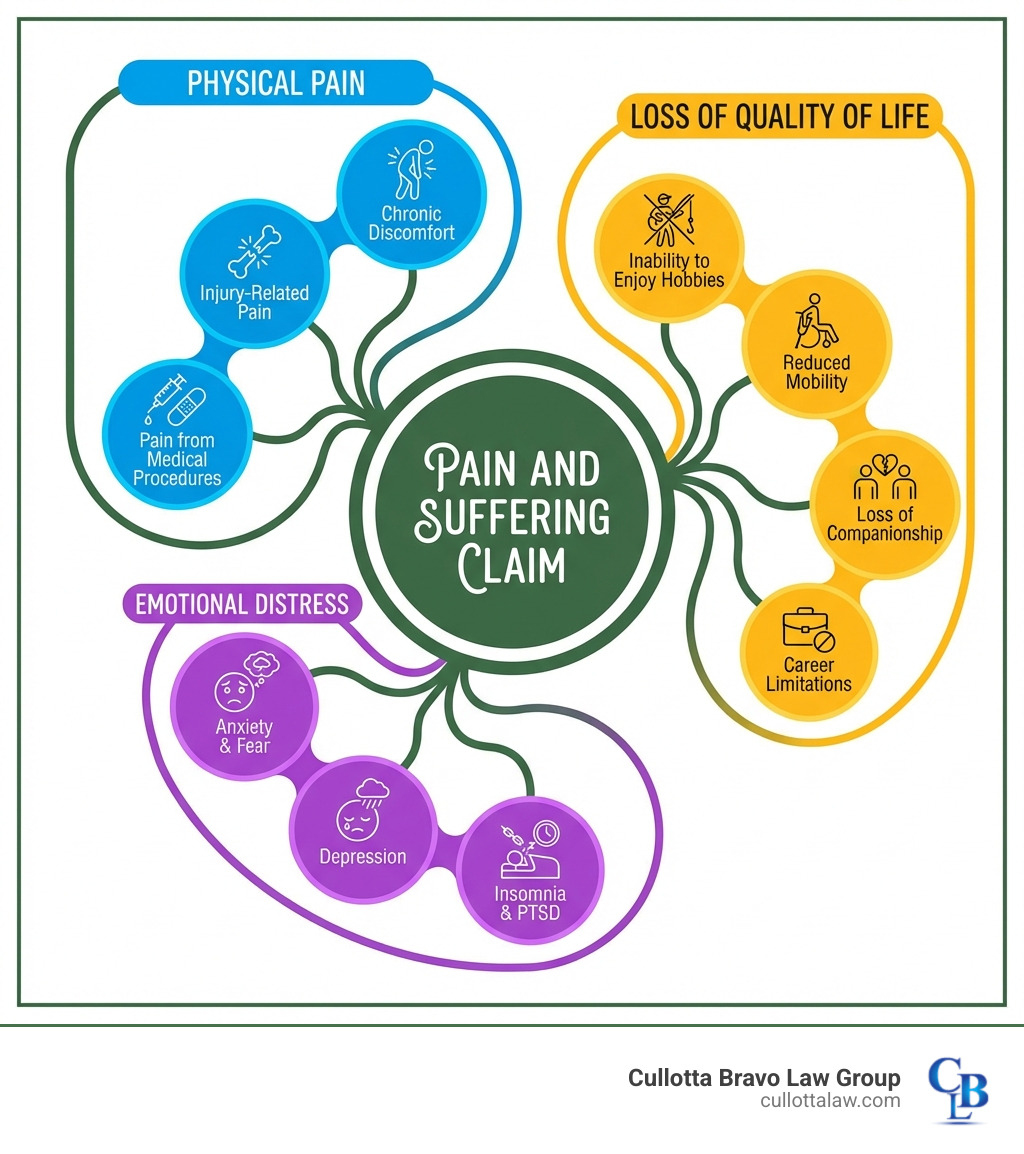
Simple guide to Pain and suffering claim terms:
Understanding “Pain and Suffering” in a Personal Injury Case
In the legal world, “pain and suffering” is a term we use to describe the non-economic damages an injured person experiences after an accident caused by someone else’s negligence. Unlike economic damages, which are tangible financial losses like medical bills or lost wages, pain and suffering covers the less quantifiable, yet very real, personal effects of an accident. It encompasses both the physical discomfort and the mental anguish that result from your injuries. Essentially, it’s about compensating you for the impact the injury has had on your overall quality of life.
What Constitutes Pain and Suffering?
When we talk about what makes up a pain and suffering claim, we’re looking at a broad spectrum of impacts an injury can have on an individual. These can be categorized into physical and emotional components.
Physical Pain and Suffering Examples:
This includes the immediate pain from your injuries, the discomfort from medical treatments and procedures, and any ongoing or chronic pain. Common examples we see include:
- Back pain and neck pain
- Traumatic brain injuries
- Broken bones and dislocated joints
- Internal organ damage
- Nerve damage
- Headaches
- Pulled or sprained muscles
- Paralysis
- Chronic discomfort that lasts for weeks, months, or even years, potentially becoming permanent. The National Institute of Neurological Disorders and Stroke highlights how chronic pain can last for extended periods, significantly diminishing quality of life.
Emotional Distress and Mental Anguish Examples:
Beyond the physical, an accident can leave deep emotional and psychological scars. These intangible damages are a crucial part of your pain and suffering claim and can include:
- Psychological trauma
- Fear (e.g., fear of driving again after a car accident)
- Insomnia or other sleep disturbances
- Worry and anxiety about the future, finances, or legal proceedings
- Anger and frustration over your limitations
- Grief, especially in cases of wrongful death
- Cognitive changes
- Loss of quality of life or enjoyment of life when injuries prevent you from participating in activities you once loved
- Irritability and mood swings
- Depression
- Post-traumatic stress disorder (PTSD), which can manifest with severe symptoms long after the event. The Mayo Clinic provides detailed information on post-traumatic stress disorder.
- Inconvenience caused by the injury and its recovery process.
These emotional and mental impacts are very real, even if they don’t show up on an X-ray. Our job is to make sure these hidden injuries are recognized and compensated.
How Pain and Suffering Differs from Economic Damages
To truly understand a pain and suffering claim, it’s important to differentiate it from economic damages.
Economic Damages: These are the tangible, measurable financial losses you incur due to an injury. They come with receipts, bills, or clear documentation. Examples include:
- Medical bills (doctor visits, hospital stays, surgeries, medications, physical therapy)
- Lost wages and income (past and future)
- Property damage
- Rehabilitation costs
- Other out-of-pocket expenses directly related to the accident.
Non-Economic Damages (Pain and Suffering): These are the intangible losses that are subjective and not easily quantifiable with a specific dollar amount. They represent the personal impact of your injury on your life.
| Economic Damages (Tangible Losses) | Non-Economic Damages (Intangible Losses – Pain and Suffering) |
|---|---|
| Medical bills | Physical pain and discomfort |
| Lost wages | Emotional distress, anxiety, fear |
| Future medical treatment costs | Mental anguish, depression, insomnia |
| Property damage | Loss of enjoyment of life |
| Rehabilitation expenses | Inconvenience, frustration |
| Reduced earning capacity | Disfigurement or scarring |
| Loss of companionship (Loss of Consortium) |
The core difference lies in their nature: economic damages are objective and easily proven with documentation, while pain and suffering damages are subjective and require a more nuanced approach to valuation and proof. We need to tell your story, demonstrating how your life has been altered beyond the numbers on a bill.
How Compensation for Pain and Suffering is Calculated

Calculating compensation for a pain and suffering claim is often the most challenging aspect of a personal injury case because these damages are inherently subjective. There’s no fixed formula, and the value can range significantly from case to case. While judges, juries, and insurance companies all consider various factors, insurance companies often use their own internal computer programs to evaluate claims, sometimes differing from the methods attorneys use. These programs may consider the type of injury, the kind of medical treatment sought (e.g., physician vs. chiropractor), and the duration of treatment.
However, as your legal advocates, we use established methods to determine a fair settlement amount, taking into account the specifics of your injury and its long-term impact.
Common Calculation Methods: Multiplier vs. Per Diem
Two primary methods are commonly used to estimate the value of a pain and suffering claim:
-
The Multiplier Method: This is perhaps the most widely recognized method. It involves adding up all your economic damages (medical bills, lost wages, etc.) and then multiplying that total by a factor, or “multiplier,” typically ranging from 1.5 to 5.
- How it works: If your economic damages total $10,000, and the multiplier is 3, your pain and suffering compensation would be $30,000.
- The multiplier chosen depends on: The severity of your injury, the duration of your recovery, the impact on your daily life, and the permanence of your injury. A minor injury with a quick recovery might warrant a 1.5 multiplier, while a severe, life-altering injury could justify a 5.
- Example: If you had $50,000 in medical bills and lost wages, and your injuries were severe and long-lasting, a multiplier of 4 could result in $200,000 for pain and suffering.
-
The Per Diem Method: “Per diem” means “per day.” This method assigns a specific dollar amount for each day you experienced pain and suffering, from the date of the accident until you reach Maximum Medical Improvement (MMI).
- How it works: A daily rate (e.g., $150) is assigned for each day of suffering. If you suffered for 75 days, your pain and suffering compensation would be $11,250 ($150 x 75 days).
- The daily rate often correlates with: Your daily earning capacity or the severity of your daily pain.
- When it’s used: This method is often applied to injuries with a clear, defined recovery period.
While these methods provide a framework, they are starting points for negotiation. The final settlement or verdict will depend heavily on the unique circumstances of your case and our ability to persuasively present your story.
Factors That Influence Your Settlement Amount
Several key factors will significantly influence the amount of compensation you may receive for your pain and suffering claim:
- Severity and Permanence of Injury: This is arguably the most critical factor. A severe injury, especially one that leads to permanent disability or long-term complications, will generally result in higher compensation than a minor injury. We consider the type of injury, its impact on your body, and any lasting effects.
- Duration of Pain and Recovery: The longer you experience pain and the longer your recovery period, the greater your pain and suffering is generally considered to be by insurance companies and courts.
- Impact on Daily Life: How has the injury affected your ability to perform daily activities, engage in hobbies, work, or maintain relationships? We carefully document how your life has changed. For example, a piano teacher who loses fingers in an accident would likely have a significantly higher claim than someone in a call center with a similar injury, due to the impact on their profession and quality of life.
- Psychological Effects: Significant emotional trauma, such as anxiety, depression, or PTSD, can substantially increase the value of your claim. Proving these often requires expert testimony and thorough documentation.
- Required Medical Treatment: The nature and extent of your medical treatment (e.g., surgeries, extensive physical therapy, pain management) serve as objective indicators of your pain and suffering.
- Age of the Victim: Younger victims with permanent injuries may receive higher awards because they will live with the effects of their injuries for a longer period.
- Credibility of the Victim: Your honesty, consistency, and ability to articulate your experience of pain and suffering to doctors, therapists, and ultimately, a jury, can greatly influence the outcome.
Building a Strong Pain and Suffering Claim: Evidence is Key

A pain and suffering claim relies heavily on compelling evidence. Since these damages are intangible, proving their existence and quantifying their impact requires meticulous documentation and a strategic approach. Without solid evidence, it can become your word against the insurance company’s, and they are quick to minimize or deny claims that lack proper documentation. Our experience shows that strong evidence is everything.
Crucial Evidence for Proving Your Pain and Suffering Claim
To build a robust case for your pain and suffering claim, we carefully gather and present various forms of evidence:
- Medical Records from All Providers: This includes emergency room visits, diagnostic tests (X-rays, MRIs), physician notes, physical therapy records, and prescription history. These documents are vital for establishing the nature, extent, and ongoing treatment of your injuries. The National Institutes of Health found that over 70% of personal injury verdicts are influenced most strongly by medical documentation.
- Prescription Receipts: Documentation of pain medication, antidepressants, or anti-anxiety medications supports your claim of physical and emotional suffering.
- Photos and Videos of Injuries Over Time: Visual evidence of your injuries, their progression, and any visible scarring or disfigurement can be incredibly powerful. Claims supported with photographic evidence are 40% more likely to result in favorable settlements.
- A Detailed Personal Pain Journal: We encourage our clients to keep a day-to-day journal documenting their symptoms, pain levels, emotional state, difficulties with daily activities, missed work or social events, and any other ways the injury impacts their life. This provides a consistent, contemporaneous record of your suffering.
- Testimony from Family and Friends: Statements from those close to you can corroborate the changes in your personality, mood, physical abilities, and overall quality of life since the accident.
- Psychological Evaluation Reports: If you are experiencing significant emotional distress, anxiety, depression, or PTSD, evaluations from a mental health professional can provide expert testimony to substantiate these claims. Proving emotional distress can be challenging, but expert testimony is crucial.
- Proof of Missed Work or Activities: Employment and wage records, as well as evidence of cancelled memberships, event tickets, or inability to participate in hobbies, demonstrate the loss of enjoyment of life and functional limitations.
We also ensure consistency in all statements made throughout the claims process, as any discrepancies can be used by insurance companies to undermine your credibility.
The Role of Psychological Distress in Your Claim
Psychological distress plays a significant role in a pain and suffering claim, often representing the “invisible price tag” of an accident. While physical pain is evident, mental anguish can be just as debilitating, if not more so. We frequently see clients experiencing:
- Anxiety: Constant worry about recovery, finances, or future accidents.
- Depression: Feelings of hopelessness, sadness, and loss of interest in activities.
- Insomnia: Difficulty sleeping due to pain, anxiety, or traumatic memories.
- Mood Swings: Irritability, anger, or sudden changes in emotional state.
- Post-traumatic stress disorder (PTSD): A severe anxiety disorder that can develop after experiencing a traumatic event, leading to flashbacks, nightmares, and avoidance behaviors.
Proving mental anguish requires careful documentation. This includes notes from therapists, psychiatrists, or counselors, records of medication for mental health conditions, and your personal journal detailing your emotional struggles. Expert testimony from a mental health specialist is often crucial for explaining the depth and impact of your psychological distress to a jury or insurance adjuster. We understand that pain isn’t always visible, and emotional scars don’t show up on an X-ray, which is why we fight to ensure these profound impacts are fully recognized.
Navigating the Legal Process for Your Pain and Suffering Claim
Navigating the legal process for a pain and suffering claim can be complex, but with the right legal guidance, it becomes manageable. From understanding critical deadlines to dealing with insurance companies and, if necessary, going to trial, we are here to guide you every step of the way.
Are There Time Limits for Filing a Claim?
Yes, there are strict time limits, known as statutes of limitations, for filing personal injury claims, including those for pain and suffering. In Illinois, you typically have three years from the date of the injury to start legal action for most personal injury claims, such as those arising from car accidents or slip and falls.
It’s crucial to act quickly because missing this deadline can mean forfeiting your right to compensation entirely. While some states like Louisiana have a one-year limit, and Alabama has a two-year limit, our focus is on ensuring you meet the specific deadlines applicable here in Illinois. There are rare exceptions, such as cases where the injury or its cause was not immediately findable, but these are complex and require immediate legal consultation.
For specific types of claims, like those against local government entities, the deadlines can be much shorter. This is why contacting an experienced personal injury lawyer as soon as possible after an injury is one of the most important steps you can take. We can ensure all deadlines are met and your rights are protected.
Understanding Damage Caps and Related Claims
One of the most common questions we hear is about damage caps. In Illinois, we have good news: there are generally no caps on pain and suffering damages for most personal injury cases. The Illinois Supreme Court has previously found such caps unconstitutional. This means that if you’re injured due to someone else’s negligence in a car accident, slip and fall, or nursing home abuse case, your compensation for pain and suffering is not limited by a statutory maximum. However, it’s worth noting that certain federal claims or claims against specific government entities might still have limitations.
Beyond direct pain and suffering, another important related claim is loss of consortium. This is a type of pain and suffering experienced by family members, typically a spouse, due to the injury or death of their loved one. It encompasses the loss of companionship, affection, guidance, intimacy, and household services that the injured or deceased person provided. For example, if a spouse is severely injured in a car accident in Aurora and can no longer participate in family activities or provide emotional support, their partner may have a claim for loss of consortium.
Wrongful death claims also allow close family members to recover for the pain and suffering of the deceased prior to death, as well as their own grief and loss of companionship. In Illinois, this is covered under the Illinois Wrongful Death Act (740 ILCS 180/). This means that if a loved one tragically passes away due to negligence, we can help their family seek justice for both their own profound loss and the suffering the deceased endured.
Frequently Asked Questions About Pain and Suffering
We understand that you likely have many questions about pain and suffering claims. Here are some of the most common inquiries we receive:
How much is a typical pain and suffering claim worth?
This is perhaps the most difficult question to answer definitively because there is no “typical” amount. The value of a pain and suffering claim depends entirely on the unique details of each case. As we’ve discussed, factors like the severity and permanence of your injury, the duration of your pain, the impact on your daily life, and any psychological effects all play a huge role. While the average personal injury settlement in the U.S. is around $52,900, outcomes vary greatly. We don’t have a crystal ball, but with our experience, we can provide an estimate based on similar cases and the evidence we gather. Our goal is always to maximize your compensation, ensuring you receive a fair settlement that reflects the true impact of your injuries.
Can I claim pain and suffering if I was partially at fault for the accident?
In Illinois, you can still recover damages even if you were partially at fault for the accident, thanks to our state’s “modified comparative negligence” rule. This means that if you are found to be 50% or less at fault, you can still recover compensation for your injuries, including pain and suffering. However, your total award will be reduced by your percentage of fault. For example, if you were awarded $100,000 but found to be 20% at fault, your compensation would be reduced by 20% to $80,000. If you are found to be more than 50% at fault, you generally cannot recover any damages. This is a complex area of law, and we can help assess your situation to determine your eligibility.
Are pain and suffering settlements taxable?
Generally, no. Under federal tax law, compensation received for physical injuries or physical sickness, including amounts for pain and suffering, is typically not considered taxable income. This applies whether the compensation is received through a settlement or a court award. However, there can be exceptions, particularly if punitive damages are awarded (which are meant to punish the at-fault party rather than compensate you) or if your claim includes compensation for emotional distress not tied to a physical injury. It’s always wise to consult with a tax professional regarding your specific settlement, but for most personal injury claims, the pain and suffering portion is tax-free.
Get the Fair Settlement You Deserve
Navigating a pain and suffering claim is undoubtedly one of the most challenging aspects of a personal injury case. It requires meticulous documentation, a deep understanding of legal principles, and strong advocacy to ensure your intangible losses are recognized and fairly compensated. From the physical pain to the emotional distress, the impact of an injury extends far beyond medical bills and lost wages.
We’ve seen how insurance companies try to minimize these critical damages. That’s why having an experienced personal injury lawyer by your side is not just helpful—it’s essential. At Cullotta Bravo Law Group, we pride ourselves on providing aggressive legal representation, treating each client with the dignity and respect they deserve, and fighting tirelessly for multi-million dollar settlements and verdicts.
If you or a loved one has suffered an injury due to someone else’s negligence in Aurora, Chicago, Naperville, or Joliet, don’t let the complexities of a pain and suffering claim deter you from seeking the justice you deserve. We are here to help you understand your rights, build a compelling case, and maximize your compensation.
Contact an Aurora car accident lawyer for a free consultation today. Let us put our 35+ years of experience to work for you, ensuring your story is heard and your pain is acknowledged.