

Real Estate Documents 101: Crafting Your Property Sale Agreement
Why Property Deed Preparation Can Make or Break Your Real Estate Transfer
Property deed preparation is the process of drafting, executing, and recording the legal document that transfers real estate ownership from one party to another. Done correctly, it protects everyone involved. Done wrong, it can create title problems that surface years later — often at the worst possible moment, like when you try to sell or refinance.
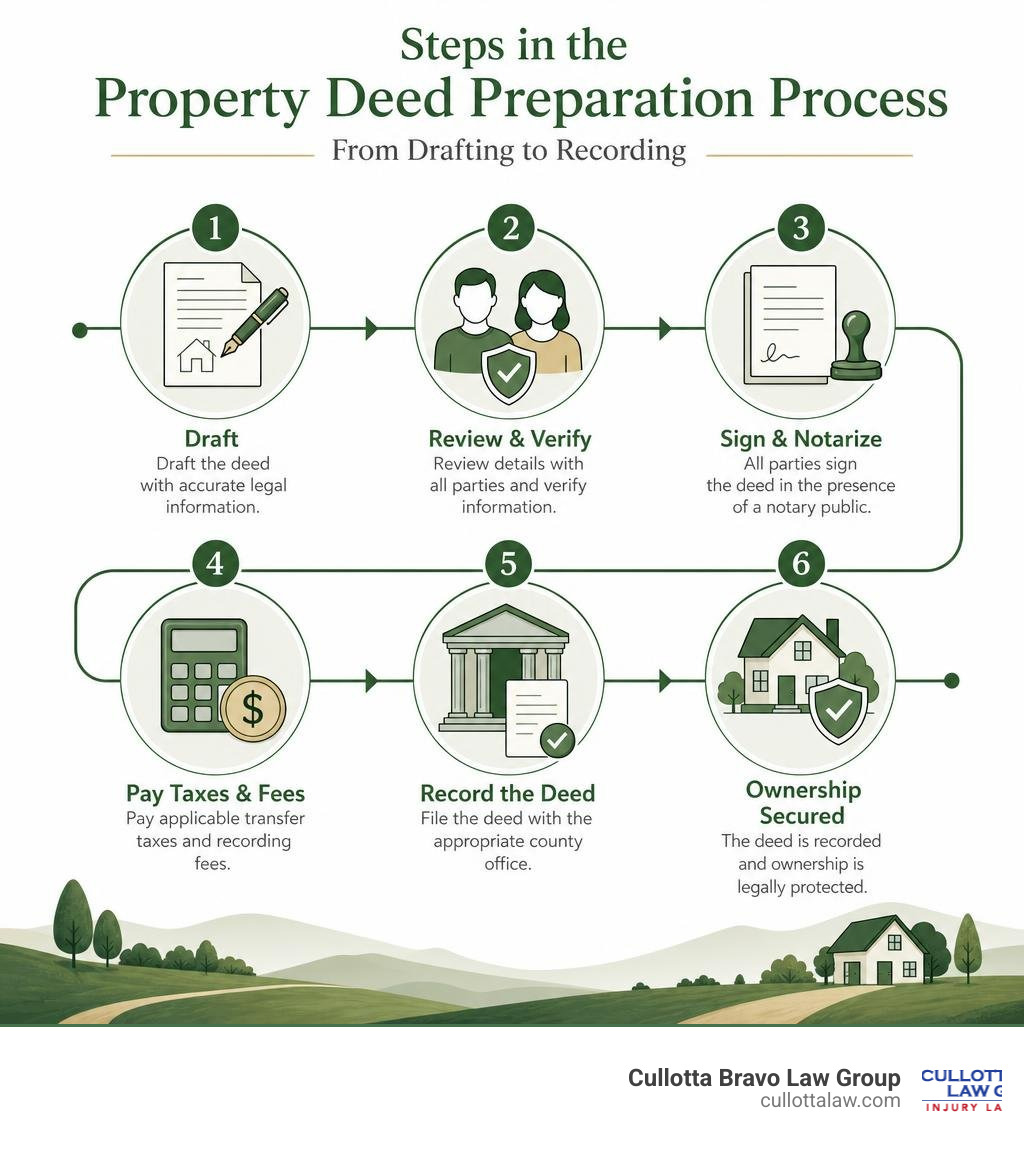
Here’s what proper property deed preparation involves:
- Choose the right deed type — general warranty, special warranty, quitclaim, transfer-on-death, life estate, or lady bird deed
- Gather required information — legal description, prior deed reference, grantor and grantee names, and form of ownership
- Draft the deed correctly — using precise legal language that matches your state’s requirements
- Sign before a notary — the deed must be acknowledged by a licensed notary public to be valid
- Pay applicable taxes — recordation and transfer taxes apply in most states, though many family transfers qualify for exemptions
- Record the deed — file with the correct county office (circuit court clerk in Virginia, Division of Land Records in Maryland) to make the transfer legally effective
A deed that is never recorded, or recorded with errors, gives the new owner little legal protection against future buyers or creditors.
Approximately 60% of title defects discovered during real estate transactions stem from errors or omissions in previously recorded deeds. And title insurance claims related to deed preparation errors cost the industry an estimated $400 million annually. These are not rare edge cases — they happen to ordinary homeowners, families, and investors every day.
I’m Peter Cullotta, founding partner at Cullotta Bravo Law Group, and with over 35 years of experience navigating complex legal documents and protecting clients’ rights across Illinois, Arizona, and Wisconsin, I understand how a seemingly routine property deed preparation mistake can escalate into a costly legal dispute. In the sections below, we’ll walk you through everything you need to know to get it right the first time.
Quick look at Property deed preparation:
Understanding Deeds and Their Levels of Protection
To master property deed preparation, we must first clarify a common point of confusion: the difference between a “deed” and a “title.”
Think of a title as an abstract concept. It represents your legal bundle of rights to own, use, and transfer a piece of land. A deed, on the other hand, is the physical, written document that actually moves those rights from one person to another. The process of legally transferring these rights is known as conveyance.
Before you ever draft a deed, there is usually an underlying agreement governing the transaction. To understand how these pieces fit together, it helps to review What is a Real Estate Contract?, which establishes the terms of sale before the deed is executed.
Different deeds offer different levels of protection to the buyer (grantee) and impose varying levels of liability on the seller (grantor). Choosing the wrong one can leave a buyer exposed or a seller unexpectedly sued.
| Deed Type | Grantor Liability | Title Protection for Grantee | Primary Use Case |
|---|---|---|---|
| General Warranty Deed | Highest (covers all history) | Complete protection against all past defects | Standard home sales |
| Special Warranty Deed | Limited (only covers grantor’s ownership) | Protection only against defects caused by current seller | Commercial sales, builder transfers |
| Quitclaim Deed | None | No warranties or title protection | Family transfers, divorce, clearing title |
| Transfer on Death Instrument (TODI) | None during life | Passes title automatically at death, bypassing probate | Estate planning |
The Crucial Step of Property Deed Preparation
The actual drafting of the deed is where the legal magic—or legal misery—happens. The document must clearly identify the “grantor” (the person giving up the property) and the “grantee” (the person receiving it). It must also explicitly state the intention to convey the legal rights associated with the land.
In Illinois, counties like Cook, DuPage, Kane, and Will have strict formatting and administrative guidelines. If your deed is off by even a fraction of an inch in its margins, or if it lacks the proper legal language, the county recorder will reject it. To avoid these headaches, we recommend reviewing our Ultimate Checklist for Real Estate to ensure your entire transaction remains on track.
Selecting the Right Deed for Your Property Deed Preparation
Selecting the right deed depends entirely on your situation, your relationship with the other party, and your long-term goals.
- General Warranty Deeds: This is the gold standard for traditional real estate transactions. The seller promises that they own the property, have the right to sell it, and will defend the buyer against any title claims stretching all the way back to the original land grant.
- Special Warranty Deeds: Here, the seller only guarantees that they didn’t cause any title problems during their period of ownership. If a long-lost heir from three owners ago suddenly claims they own the land, the seller isn’t on the hook.
- Quitclaim Deeds: This deed transfers whatever interest the grantor currently has—even if that interest is absolutely nothing. Because they offer zero warranties, they are highly risky for arm’s-length purchases. However, they are incredibly common for moving property between spouses, adding a family member, or transferring real estate into an LLC.
- Transfer-on-Death Instrument (TODI): In Illinois, we use a TODI instead of the “Lady Bird deeds” popular in states like Florida or Michigan. A TODI allows you to designate a beneficiary who will automatically inherit the property when you pass away, entirely bypassing the slow and expensive probate process. You retain full control to sell, mortgage, or revoke the transfer during your lifetime.
- Life Estate Deeds: This deed transfers ownership to a “remainderman” while reserving the right for the original owner (the life tenant) to live in the home for the rest of their days.
If your primary goal is passing real estate down to the next generation without leaving them a legal mess, consulting a professional who understands these structures is vital. You can learn more about this by reading our guide on Passing It On: Finding the Right Property Inheritance Lawyer.
Essential Steps and Requirements for Property Deed Preparation
For a deed to be legally binding and recordable in Illinois, it must contain several precise components:
- An Accurate Legal Description: Do not copy the street address or the parcel index number (PIN) and call it a day. The deed must contain the full, formal legal description (such as the lot, block, and subdivision details or metes-and-bounds measurements). Copying this incorrectly is one of the leading causes of title defects.
- Prior Deed Reference (The BEING Clause): It is highly recommended to include a “being” clause, which explains exactly how the current grantor originally acquired the property (referencing the previous deed’s book, page, and recording date).
- Statement of Consideration: The deed must state what is being exchanged for the property (e.g., “Ten Dollars and other good and valuable consideration” or a statement of “no consideration” if it is a true gift).
- Transfer Tax Declarations and Exemptions: Illinois imposes state and county transfer taxes. Furthermore, municipalities like Chicago, Joliet, and Aurora have their own local municipal transfer stamp requirements. If your transfer is exempt (such as a gift to a child or a transfer into a revocable trust), the correct exemption code must be typed directly onto the deed, and a PTAX-203 tax declaration form must be filed alongside it.

Determining Forms of Joint Ownership and Vesting
How co-owners hold title (known as vesting) has massive legal and financial consequences. If you are preparing a deed for multiple people, you must explicitly state the ownership type:
- Tenants in Common: This is the default form of ownership for unmarried co-owners in Illinois. Each person owns a specific percentage of the property. When one owner dies, their share does not go to the surviving co-owners; instead, it passes to their heirs through probate.
- Joint Tenancy with Right of Survivorship (JTWROS): Owners hold equal shares. When one joint tenant dies, their share automatically transfers to the surviving owners outside of probate. This must be explicitly written in the deed (e.g., “as joint tenants and not as tenants in common”).
- Tenancy by the Entirety: This is a special form of joint ownership reserved strictly for married couples for their primary residence. It offers robust protection: creditors of only one spouse cannot place a lien on or force the sale of the home. Like joint tenancy, it includes an automatic right of survivorship.
To ensure your property lines and title are entirely clear before committing to these ownership structures, check out Know Your Lines: A Guide to Property Title Searches and Boundary Surveys.
Common Pitfalls, Risks, and the Importance of Professional Recording
Many homeowners believe that once a deed is signed and notarized, the transfer is complete. However, a deed is generally not effective against subsequent buyers or creditors until it is officially recorded with the County Recorder of Deeds (such as the Kane County, Cook County, DuPage County, or Will County recorder offices).
If you leave a deed in a desk drawer unrecorded, the previous owner could theoretically sell the property to someone else, or a creditor could attach a massive lien to the home.
Furthermore, minor errors can completely invalidate a deed. In the notable Illinois case In re Estate of Ann L. Cuneo, two quitclaim deeds executed just days before a woman’s death were ruled invalid. Why? Forensic analysis proved that the notary stamp used on the document did not even exist on the date the parties claimed the deed was signed. Witness testimony was impeached, and the entire transfer was thrown out.

Mistakes on deeds can lead to years of litigation. If you are currently dealing with a dispute over property ownership, boundaries, or an incorrectly drafted deed, consult The Complete Legal Guide to Resolving Residential and Commercial Property Disputes to understand your legal recourses.
Frequently Asked Questions about Property Deeds
What is the difference between a deed and a title?
A title is the abstract concept of legal ownership and the rights that come with it. A deed is the physical, written legal document used to transfer those rights from a seller to a buyer. You cannot hold a “title” in your hands, but you can hold a “deed.”
How do I transfer property to a trust or LLC?
To transfer property to a trust or an LLC, you must prepare, sign, and record a new deed (usually a quitclaim or special warranty deed) conveying the property from your individual name to the name of the trust or business entity. In Illinois, transfers to your own revocable living trust are typically exempt from transfer taxes, but you must still file the appropriate local and state exemption forms.
What happens if a property deed is lost or contains errors?
If a deed is lost after being recorded, you can easily obtain a certified copy from the county recorder’s office for a small fee. If a recorded deed contains errors (such as a misspelled name or a minor typo in the legal description), you can file a “corrective deed” or “deed of confirmation” to fix the mistake without triggering new transfer taxes.
Conclusion
Property deed preparation may seem like a simple administrative task, but a single missing word, an incorrect legal description, or a faulty notary acknowledgment can result in title defects that take thousands of dollars and years of court battles to resolve.
At Cullotta Bravo Law Group, we have spent over 35 years providing aggressive, high-quality legal representation to clients in Aurora, Chicago, Naperville, Joliet, and throughout Illinois. Whether you are transferring a home to a family member, funding a trust, or navigating a complex real estate sale, our team is here to ensure your documents are drafted flawlessly and your property rights are fully protected.
Don’t leave your most valuable asset to chance. Visit our Real Estate page to learn more about how we can support your property transfer needs.