

The Complete Legal Guide to Resolving Residential and Commercial Property Disputes
When a Lease Becomes a Legal Battle: What You Need to Know About Commercial Property Disputes
Commercial property disputes are legal conflicts involving the ownership, use, or leasing of business real estate — and they can derail your operations fast.
Here is a quick overview of what you need to know:
- What they are: Disagreements between landlords, tenants, investors, or developers over commercial real estate — offices, retail spaces, warehouses, and more
- Most common causes: Unpaid rent, lease term disagreements, property condition (dilapidations), boundary conflicts, and title defects
- How they are resolved: Negotiation, mediation, arbitration, or litigation — in that order of preference
- How long they take: Typically 3 to 18 months depending on complexity
- Key stat: Over 80% of commercial property disputes are resolved without ever going to court
- Cost: Complex cases that reach litigation can exceed $50,000 in legal fees
These disputes are not just legal headaches. They cost businesses money, time, and critical relationships — often at the worst possible moment.
Lease conflicts alone account for roughly 60% of all commercial property legal disputes, with non-payment of rent being the single most common trigger. And even disputes that seem minor at first — a vague repair clause, an unclear boundary line — can snowball into months of costly litigation if left unaddressed.
The good news? Most conflicts can be resolved efficiently — but only if you understand your rights, your options, and when to act.
I’m Peter Cullotta, founding partner at Cullotta Bravo Law Group, with over 35 years of trial experience navigating complex legal conflicts — including commercial property disputes — across Illinois. My team and I are here to help you protect your business interests and find the fastest, most effective path to resolution.
Commercial property disputes glossary:
Understanding the Landscape of Commercial Property Disputes

When we talk about commercial property disputes in Illinois—whether you are in the heart of Chicago or growing a business in Aurora—we are talking about high stakes. Unlike residential real estate, which often has built-in consumer protections, commercial deals are viewed by the law as “arm’s length” transactions between sophisticated parties. This means the court assumes you knew exactly what you were signing.
In our 35 years of experience, we’ve seen that these conflicts rarely stem from one single event. Instead, they are the result of “crossed wires” regarding Real Estate fundamentals. Here are the primary battlegrounds we navigate:
Rent Arrears and Financial Defaults
Money is the most frequent cause of friction. Lease disputes account for approximately 60% of all commercial property legal disputes, with non-payment of rent leading the pack. In May 2026, as the Illinois market continues to evolve, we see many disputes arising from “CAM” (Common Area Maintenance) charges. A tenant might expect a $2,000 monthly bill but receive a $4,500 invoice because of unexpected parking lot repairs or snow removal costs in Naperville.
Lease Terms and Ambiguities
If a lease says the tenant is responsible for “maintenance,” does that include replacing a $50,000 HVAC system or just changing the filters? Ambiguity is the enemy of a peaceful landlord-tenant relationship. When terms aren’t defined with surgical precision, both parties end up in our office arguing over who pays for what.
Boundary Lines and Encroachments
Aurora is the second largest city in Illinois, and as it grows, every square inch of land becomes more valuable. We often handle cases where a business owner realizes a neighbor’s new fence or parking expansion is creeping onto their lot. These boundary disputes often require land surveys and a deep dive into historical deeds to resolve.
Title Defects and Dilapidation Claims
Title defects—such as undisclosed liens or “clouds” on the title—can derail up to 25% of commercial sales transactions. On the back end of a lease, we see “dilapidation claims.” This is when a landlord claims the tenant failed to return the property to its original condition, often leading to arguments over what constitutes “normal wear and tear” in a warehouse versus a retail boutique.
Common Triggers and Proactive Prevention Strategies

The best way to win a legal battle is to ensure it never starts. In commercial property disputes, prevention is built on a foundation of clarity. Most “overnight” lawsuits were actually months or years in the making, fueled by poor communication and “handshake deals” that were never put in writing.
The Danger of Ambiguous Language
Many business owners make the mistake of signing a contract when they only understand “most” of it. In Illinois litigation, an ambiguous contract is executed at your own peril. If a clause can be interpreted in two different ways, you are essentially inviting a judge to decide the fate of your business. This is why understanding what is a real estate contract—and every single rider attached to it—is vital.
Due Diligence: More Than a Checklist
Before you buy or lease a property in Joliet or Naperville, you must look under the hood. This includes:
- Environmental Assessments: Phase I and Phase II reports to ensure you aren’t inheriting a toxic cleanup bill.
- Zoning Verification: Ensuring your intended use (like adding live music to a restaurant) is actually permitted.
- Title Searches: Securing Title Insurance is a standard requirement for a reason—it protects you from “undisclosed heirs” or ancient liens that could freeze your property value.
Documentation and Communication Logs
We always tell our clients: if it isn’t in writing, it didn’t happen. In a dispute, your “communication log” is your best friend. Save every email, keep notes of every phone call, and document property conditions with photos and videos. If a roof leaks in January, don’t just call the landlord; send an email with a timestamped photo. That digital paper trail is often the difference between a quick settlement and a $50,000 court case.
Proactive Measures to Avoid Commercial Property Disputes
To keep your business running smoothly, we recommend these four proactive steps:
- Seek Early Legal Advice: Engaging an Aurora real estate attorney during the negotiation phase is significantly cheaper than hiring a litigator after a breach has occurred.
- Professional Surveys: Establish a baseline property condition before the keys change hands. Detailed “Schedules of Condition” prevent arguments over dilapidations later.
- Clear Repair Schedules: Explicitly define “repair” vs. “replace” vs. “improvement.” Don’t leave it to chance.
- Tenant Estoppel Certificates: If you are buying a building with existing tenants, these certificates prevent tenants from later claiming the previous owner promised them free rent or secret upgrades.
Navigating the Ladder of Dispute Resolution
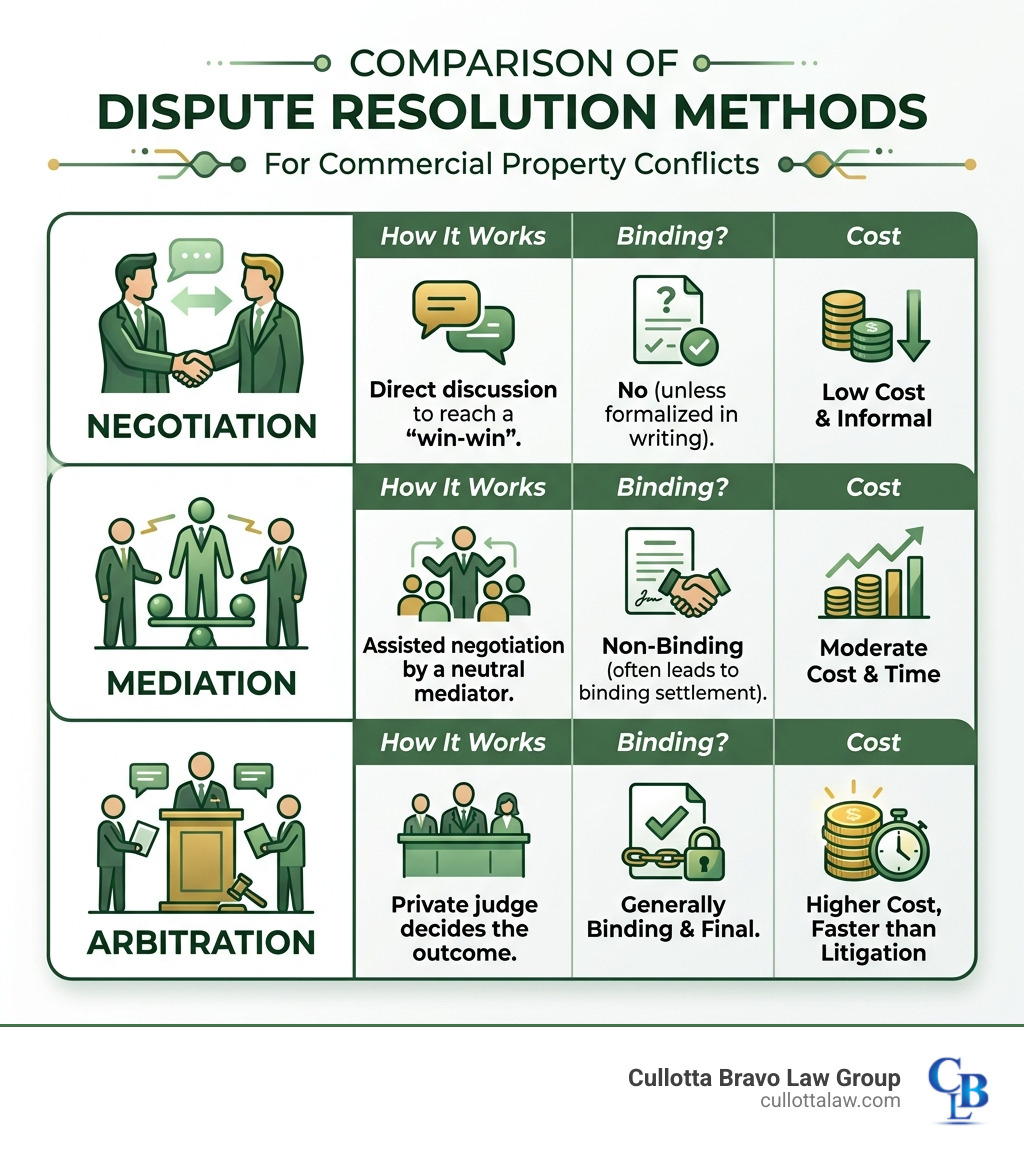
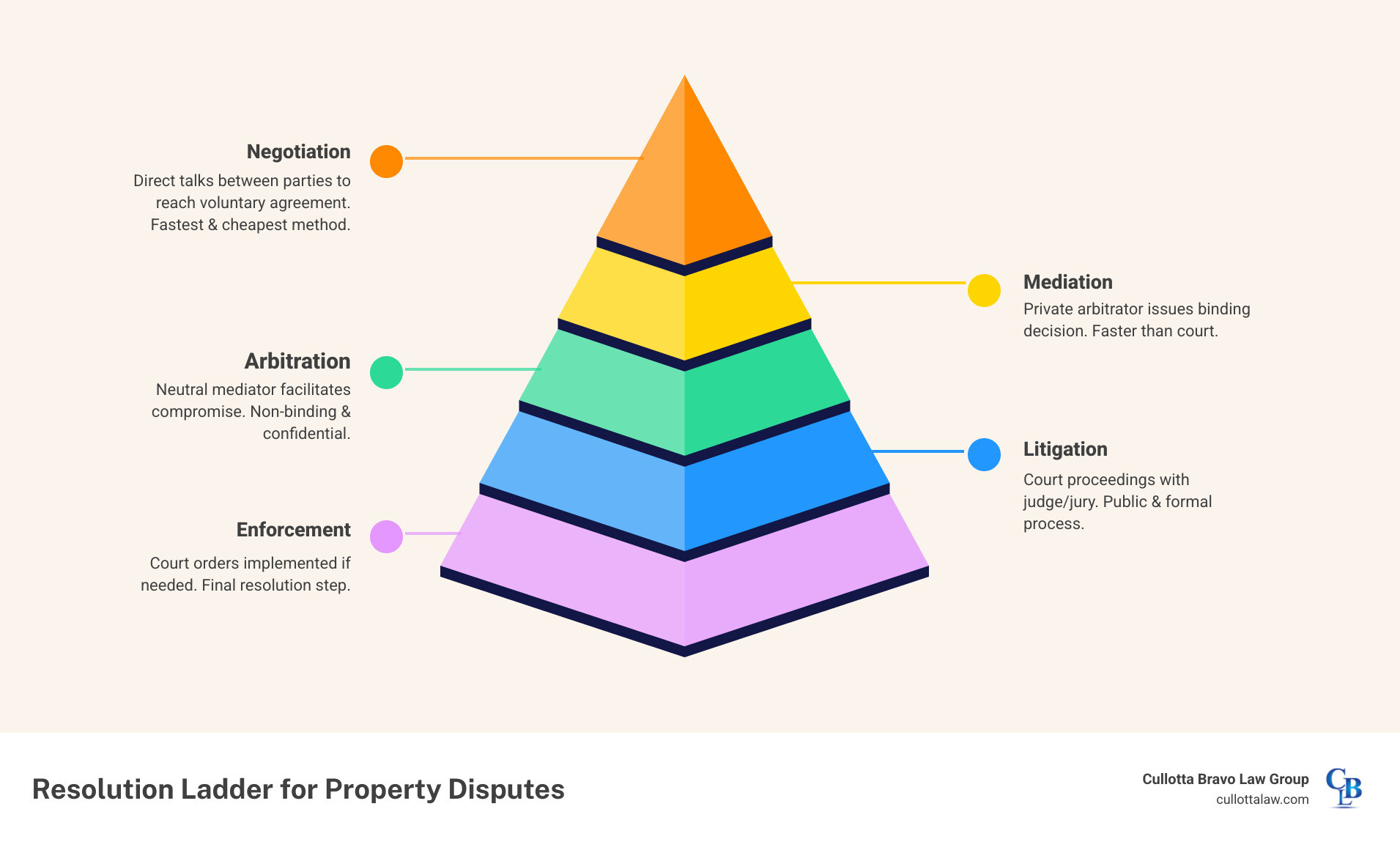
When a conflict arises, you don’t have to jump straight to a jury trial. Think of dispute resolution as a ladder. Each rung you climb increases the cost, the time commitment, and the formality.
| Method | How it Works | Binding? | Cost |
|---|---|---|---|
| Negotiation | Direct talk between parties to find a “win-win.” | No (unless signed) | Low |
| Mediation | A neutral third party facilitates a compromise. | No (unless signed) | Moderate |
| Arbitration | A private “judge” makes a final decision. | Yes | High |
| Litigation | A public court battle ending in a judgment. | Yes | Very High |
Interest-Based Negotiation
This is the first rung. We often find that commercial property disputes are fueled by emotion or temporary cash flow issues. Maybe a tenant is late on rent because of a one-time equipment failure. By sitting down and using “interest-based negotiation,” we can often find a solution—like a temporary rent deferral—that preserves the business relationship and keeps the revenue flowing.
Mediation and Arbitration
Over 80% of commercial property disputes are resolved through these Alternative Dispute Resolution (ADR) methods.
- Mediation is excellent for preserving relationships. It is confidential and allows for creative solutions a judge can’t offer (like a lease extension in exchange for a repair credit).
- Arbitration is faster than court but more formal than mediation. It is a popular choice for technical disputes because you can choose an arbitrator with specific real estate expertise. However, be warned: arbitration decisions are usually final with very limited avenues for appeal.
When to Litigate Commercial Property Disputes
While we prefer to settle, there are times when you must climb to the top of the ladder. Litigation becomes a “last resort” but a necessary one in specific scenarios:
- Complex Fraud: If a seller intentionally hid structural defects or lied about property income.
- Injunctions: When you need a court order to immediately stop someone from tearing down a wall or blocking an easement.
- Setting Precedent: When the other party is being completely unreasonable and you need a legally enforceable judgment to protect your assets.
If you find yourself at this stage, you need an aggressive Commercial Real Estate Attorney who knows how to navigate the Illinois court system. At Cullotta Bravo Law Group, we don’t just “handle” cases; we prepare every case as if it’s going to trial to ensure we have the strongest possible leverage.
Legal Rights and Frameworks in Illinois Real Estate
Navigating commercial property disputes requires a firm grasp of Illinois-specific law. While other states may have different rules, Illinois has its own set of “playbooks” for property rights.
The Right to “Quiet Enjoyment”
Even in a commercial setting, a tenant has the right to use the property without “unlawful entry” or constant interference from the landlord. If a landlord is constantly showing up unannounced or starting construction that blocks the entrance to your shop, they may be violating this right.
Eviction Procedures (Forcible Entry and Detainer)
In Illinois, landlords cannot just “change the locks” (peaceable re-entry) as easily as they might in other jurisdictions. We must follow the Illinois Forcible Entry and Detainer Act. This requires specific notice periods and a court order. Attempting a “self-help” eviction can lead to massive lawsuits against the landlord.
Adverse Possession and Easements
Did you know someone could potentially claim ownership of your land if they use it openly and exclusively for 20 years in Illinois? While rare in the commercial sector, it happens—especially with shared alleys or parking strips. If you are facing this, consulting an Adverse Possession Attorney is critical. Similarly, “easements” (the right to use someone else’s land for a specific purpose) are a frequent source of litigation when one party tries to expand their building into a utility or access path.
Building Codes and Zoning
Local ordinances in Aurora and Naperville are strict. If you are cited for a violation, a Building Code Violation Lawyer can help you navigate the administrative hearings. Additionally, property tax appeals are a vital tool for commercial owners in Illinois to ensure their overhead remains manageable as property values fluctuate.
Frequently Asked Questions about Commercial Property Disputes
How long does it typically take to resolve a commercial property dispute?
The timeline varies wildly based on the path you take.
- Negotiation/Mediation: Can be resolved in weeks or 3 months.
- Standard Litigation: Typically takes 6 to 18 months.
- Complex Cases: If there are multiple parties or environmental issues, it can stretch to 2 years or more. The goal is always to resolve the issue as quickly as possible to minimize business disruption.
What are the potential costs involved in resolving these conflicts?
Resolving commercial property disputes isn’t cheap, but the cost of doing nothing is usually higher.
- Simple Mediation: May cost a few thousand dollars.
- Complex Litigation: Legal fees can easily exceed $50,000. This is why we focus on cost-benefit analysis. We want to make sure you aren’t spending $20,000 in legal fees to chase a $10,000 debt.
Can commercial property disputes be settled without going to court?
Absolutely. In fact, over 80% of these cases are settled via ADR. Courts in Illinois actually encourage (and sometimes mandate) mediation before they will grant a trial date. Settling out of court keeps your business private, saves money, and allows you to get back to work faster.
Conclusion
At Cullotta Bravo Law Group, we understand that your commercial property is more than just brick and mortar—it’s the engine of your livelihood. Whether you are dealing with a tenant who stopped paying rent in Naperville or a boundary dispute in Aurora, you deserve aggressive, dignified representation.
With over 35 years of experience and a track record of multi-million dollar settlements, we have the local expertise to protect your assets. We serve clients throughout Aurora, Chicago, Naperville, and Joliet, ensuring that “business as usual” stays that way.
Don’t let a dispute drain your resources. If you’re facing a conflict, reach out to us for Real Estate legal support that puts your business first.
Contact Cullotta Bravo Law Group today for a consultation on your commercial property concerns.