

The Essential Guide to Navigating Workers Comp for Brain Injuries
What You Need to Know About a Workers Comp Brain Injury Claim
If you’ve suffered a workers comp brain injury, here’s what you’re entitled to at a glance:
| Benefit | What It Covers |
|---|---|
| Medical treatment | All reasonable and necessary care, including imaging, rehab, and specialist visits |
| Temporary disability | Lost wages while you recover and cannot work |
| Permanent disability | Compensation if your injury causes lasting impairment |
| Vocational rehabilitation | Job retraining or modified duties if you can’t return to your old role |
| Ongoing care | Long-term treatment for persistent symptoms like headaches, cognitive issues, or seizures |
A traumatic brain injury on the job can change everything — your ability to work, think clearly, and care for your family — often in an instant.
TBI ranges from a mild concussion that clears up in weeks to a severe injury with permanent, life-altering effects. And yet, many workers don’t realize how complex these claims can be. Insurance companies frequently undervalue brain injury claims, pushing quick settlements before the full picture is clear. Settling too soon can mean walking away with far less than you’ll actually need for future medical care and lost earning capacity.
This guide walks you through exactly what to expect: how your injury is classified, what medical care you’re owed, how treatment is authorized, and how to protect your right to full benefits.
I’m Peter Cullotta, founding partner at Cullotta Bravo Law Group, with over 35 years of experience fighting for injured workers — including those navigating the unique challenges of a workers comp brain injury claim in Illinois. I’ve helped clients secure millions in verdicts and settlements, and I want to make sure you understand your rights before making any decisions that could affect your future.
Workers comp brain injury word roundup:
Understanding Your Workers Comp Brain Injury Claim
Navigating workers’ compensation after a head injury can feel like trying to solve a Rubik’s Cube while wearing mittens. It’s complicated, frustrating, and the stakes are incredibly high. When we talk about a workers comp brain injury, we are usually referring to a Traumatic Brain Injury (TBI). This happens when an external force—like a fall from a ladder or a blow from falling debris—disrupts the normal function of the brain.
In Illinois, the law is designed to ensure that if you are hurt while performing your job duties, your medical bills and a portion of your lost wages are covered. However, brain injuries are “invisible” injuries. Unlike a broken arm, you can’t always see a TBI on a standard X-ray. This is why understanding the medical classifications and the legal requirements for your claim is the first step toward a successful recovery.
For more detailed insights, you can explore more info about traumatic brain injuries to see how these cases are handled legally.
Classifying TBI Severity: Mild, Moderate, and Severe
To manage these claims, medical professionals and insurance adjusters use specific scales to “rank” the injury. The most common tool is the Glasgow Coma Scale (GCS), which measures responsiveness.
- Mild TBI (Concussion): This is the most common type. It involves a GCS score of 13-15. You might lose consciousness for less than 30 minutes, or not at all. While “mild” sounds harmless, it can still lead to months of cognitive struggles.
- Moderate TBI: This involves a GCS score of 9-12. Loss of consciousness (LOC) usually lasts between 30 minutes and 24 hours. Post-traumatic amnesia (PTA) can last up to a week.
- Severe TBI: This is a critical medical emergency with a GCS score of 8 or less. LOC lasts more than 24 hours, and the road to recovery is often long and requires intensive permanent total disability support.
Understanding these tiers is vital because they dictate the “standard of care” the insurance company is required to pay for. Even if your injury is classified as “mild,” you may still face significant hurdles, similar to those seen in nursing home concussions, where specialized care is necessary.

Common Symptoms and Red Flags
A workers comp brain injury doesn’t always announce itself with a giant bump on the head. Sometimes, the symptoms creep up days or weeks later. We categorize these into four “buckets”:
- Physical: Headaches (the most common), nausea, fatigue, and dizziness.
- Cognitive: Feeling “foggy,” difficulty concentrating, and memory lapses.
- Behavioral: Increased irritability, impulsivity, or “not feeling like yourself.”
- Emotional: Depression, anxiety, and mood swings.
Red Flags (Seek Emergency Care Immediately): If you or a coworker experience any of the following, it could indicate increasing intracranial pressure or a brain bleed:
- A headache that gets worse and does not go away.
- Weakness, numbness, or decreased coordination.
- Repeated vomiting or nausea.
- Slurred speech or extreme drowsiness.
While we often focus on the brain, don’t forget that many head injuries occur alongside orthopedic injuries, such as neck strain or spinal issues, which also need to be documented in your claim.
Diagnostic Standards and Medical Testing for Workplace TBIs
In the early stages of a workers comp brain injury claim, the insurance company will look for “objective evidence.” They want proof that something is actually wrong. This is where diagnostic testing becomes the backbone of your case.
Medical guidelines emphasize that while a physical exam is the first step, advanced imaging is often required to rule out life-threatening complications like hematomas (blood clots) or “midline shifts” (where the brain is pushed to one side).
One startling statistic to keep in mind: approximately one-third of TBI patients suffer from persistent anterior pituitary disorders. This means the injury affected the part of the brain that controls hormones, leading to issues with thyroid function or glucose metabolism. If your doctor isn’t looking for these neuroendocrine issues, you might be missing a huge piece of your recovery puzzle.
Imaging and Neuropsychological Assessments for Workers Comp Brain Injury
Not all scans are created equal. Research shows that MRI sensitivity is significantly higher than CT scans for detecting certain types of damage.
- CT Scans: These are great for the ER. They are fast and excellent at finding bone fractures or large bleeds.
- MRI Scans: These are superior for detecting “shearing” white matter injuries and smaller contusions. In one study of 107 trauma patients, MRI had a sensitivity of 96.4% compared to just 63.4% for CT scans.
If you were involved in a vehicle accident on the job, you likely received an initial CT scan, but follow-up MRIs may be necessary if symptoms persist.
Neuropsychological Assessments: If your symptoms last longer than a month, you may need a neuropsychological evaluation. This isn’t just a “talk therapy” session; it’s a rigorous, often 3-hour assessment of your memory, attention, and executive function. It helps distinguish between the physical effects of the TBI and any pre-existing conditions. To understand why these tests are so critical, read more on why to head to the doctor right away for common tests.
Authorized Treatments and Rehabilitation for Workers Comp Brain Injury
The goal of workers’ comp is to get you back to “Maximum Medical Improvement” (MMI). For a brain injury, this doesn’t just mean resting in a dark room. Modern guidelines suggest a shift toward active therapeutic exercise.
We believe in a “functional gains” approach. This means the insurance company should pay for treatments that show a measurable improvement in your ability to perform daily tasks or work duties. If a therapy isn’t working after 2-3 weeks, it should be re-evaluated or changed.
Physical, Occupational, and Vestibular Therapies
Recovery is often a team effort involving several types of specialists:
- Physical Therapy (PT): Focuses on balance, strength, and endurance.
- Occupational Therapy (OT): Helps you relearn how to manage daily activities, from using a computer to organizing your schedule.
- Vestibular Rehabilitation: This is crucial if you suffer from vertigo or dizziness. It trains your brain to process signals from your inner ear and eyes more effectively.
- Aquatic Therapy: Sometimes, exercising in water is easier on the body while the brain is recovering its sense of balance.
Whether your injury happened on a construction site or in an office, these therapies are often authorized under workers’ compensation guidelines. In some cases, a head injury might be accompanied by other physical trauma, such as torn rotator cuff injuries, requiring a coordinated rehab plan.
Medication Management and Surgical Interventions
Managing a workers comp brain injury often involves a complex cocktail of medications. Guidelines recommend:
- Headache Management: Using NSAIDs or triptans for migraines.
- Neurostimulants: To help with “brain fog” and cognitive speed.
- Antidepressants: To manage the emotional toll and sometimes to help with nerve pain.
- Anti-spasticity Agents: If the injury has caused muscle stiffness or spasms.
Surgical and Injection Therapies: In some cases, conservative treatment isn’t enough. Occipital nerve blocks or radiofrequency neurotomy may be used for chronic, injury-related headaches. If there is a “surgical mass” or significant midline shift found on a CT scan, emergency surgery (like a craniotomy) may be required. These procedures are high-stakes, especially in cases involving workplace violence or severe falls.
Maximizing Recovery and Returning to Work
The road back to work isn’t a straight line. It’s more like a winding path through the woods. The “Positive Patient Response” is the North Star here—we look for objective improvements in your ability to function.
| Recovery Phase | Timeframe | Focus |
|---|---|---|
| Acute | < 1 Month | Stabilization, rest, and initial diagnostics |
| Subacute | 1 – 3 Months | Active rehab, vestibular training, and light duty |
| Chronic | > 3 Months | Managing persistent symptoms and long-term adjustments |
Managing Persistent Post-Concussion Symptoms (PCS)
For some, symptoms don’t go away. This is known as Post-Concussion Syndrome (PCS). Factors that can delay recovery include your age, the severity of the initial impact, and even your stress levels regarding the claim itself.
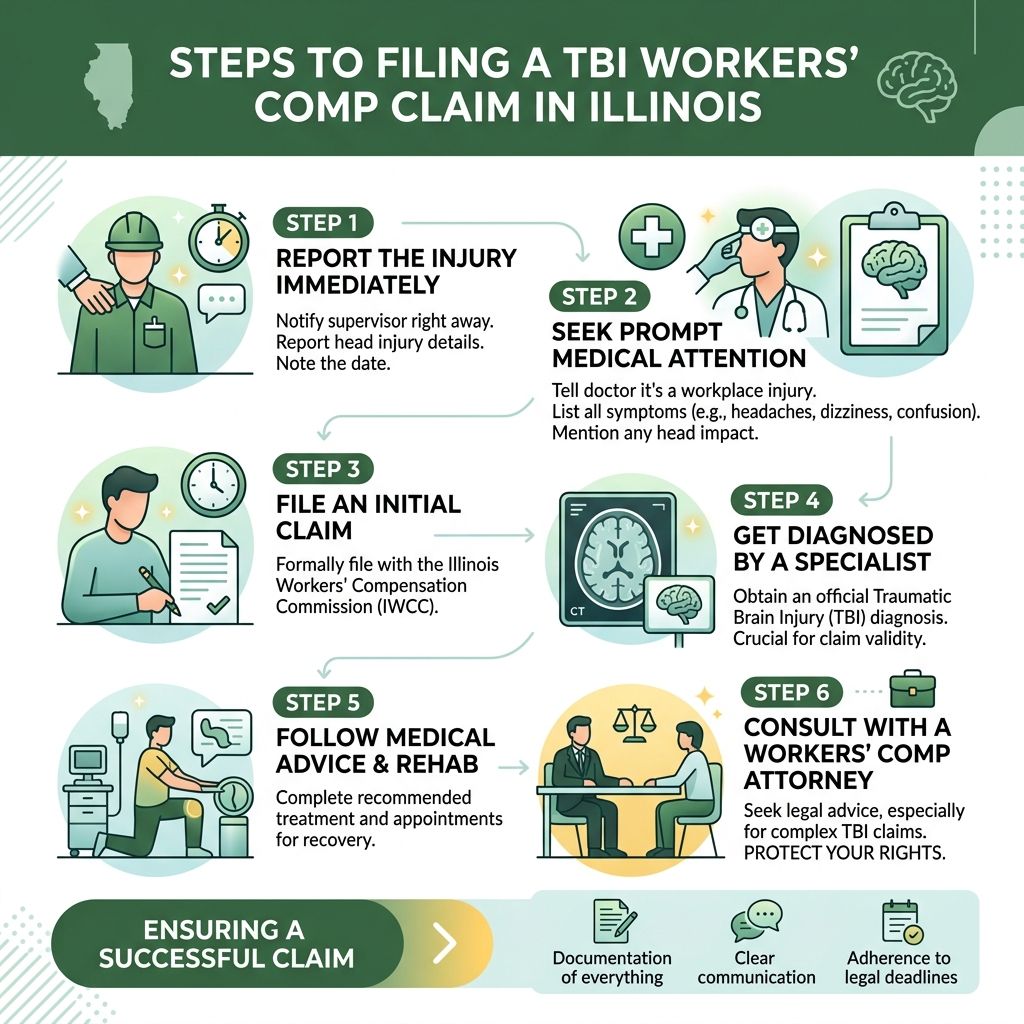
If you find your recovery is stalling, it might be time to look at 7 mistakes that can hurt your workers’ compensation claim. One of the biggest mistakes is failing to report new or worsening psychological symptoms, which are a valid part of a workers comp brain injury claim.
Functional Capacity and Job Site Evaluations
Before you return to your full duties, a Functional Capacity Evaluation (FCE) is often performed. This is a series of tests to see what you can physically and cognitively handle.
A job site evaluation may also be necessary. This is where a professional looks at your actual workplace in Chicago or Aurora to see if modifications—like noise-canceling headphones, reduced screen time, or flexible hours—can help you succeed. If you can only return to work in a limited capacity, you may be eligible for partial disability claims in Illinois.
If you are just starting this process, make sure you know the specifics of filing for workers’ comp in Aurora or your specific local jurisdiction.
Frequently Asked Questions about Workplace Brain Injuries
How is TBI severity determined in a workers’ comp case?
Severity is classified as mild, moderate, or severe based on the Glasgow Coma Scale (GCS), the duration of loss of consciousness (LOC), and the length of post-traumatic amnesia (PTA). A “mild” TBI usually has a GCS of 13-15 and LOC of less than 30 minutes.
What medical tests are required for a brain injury claim?
Standard protocols recommend a CT scan for acute stabilization to rule out immediate threats like bleeding. However, an MRI is often required for detecting detailed intracranial injuries that a CT might miss. Neuropsychological assessments are also standard for symptoms lasting more than a month.
Can I receive workers’ comp for a concussion?
Yes, a concussion is medically classified as a mild TBI. You are entitled to full benefits, including medical care and wage replacement, provided the injury occurred during the course of your employment.
Conclusion
A workers comp brain injury is a heavy burden to carry, but you don’t have to carry it alone. From the initial diagnosis to the final settlement, every step requires precision and a deep understanding of both medical guidelines and Illinois law.
At Cullotta Bravo Law Group, we provide aggressive legal representation for workers in Aurora, Chicago, Naperville, and Joliet. We believe in treating our clients with the dignity they deserve while fighting for the multi-million dollar settlements that reflect the true cost of a life-altering brain injury. We know the tactics insurance companies use to minimize these “invisible” injuries, and we know how to counter them with hard evidence and expert testimony.
If you or a loved one are struggling with the aftermath of a workplace head injury, don’t wait for the insurance company to make the first move. Contact a personal injury lawyer in Naperville today for a free consultation. Let us handle the legal battle so you can focus on your recovery.