
The High Cost of Hitting the No-Zone: Semi Truck Blind Spot Crashes
When a Semi Truck Blind Spot Crash Changes Everything
A semi truck blind spot crash is one of the most devastating — and preventable — types of accidents on American roads today. Here’s what you need to know right away:
Quick Facts: Semi Truck Blind Spot Crashes
| Topic | Key Facts |
|---|---|
| Annual blind-spot crashes (all vehicles) | Over 800,000 in the U.S. |
| Annual fatalities linked to truck blind spots | Approximately 300 per year |
| Occupants most often killed | 70% are passengers in other vehicles, not the truck |
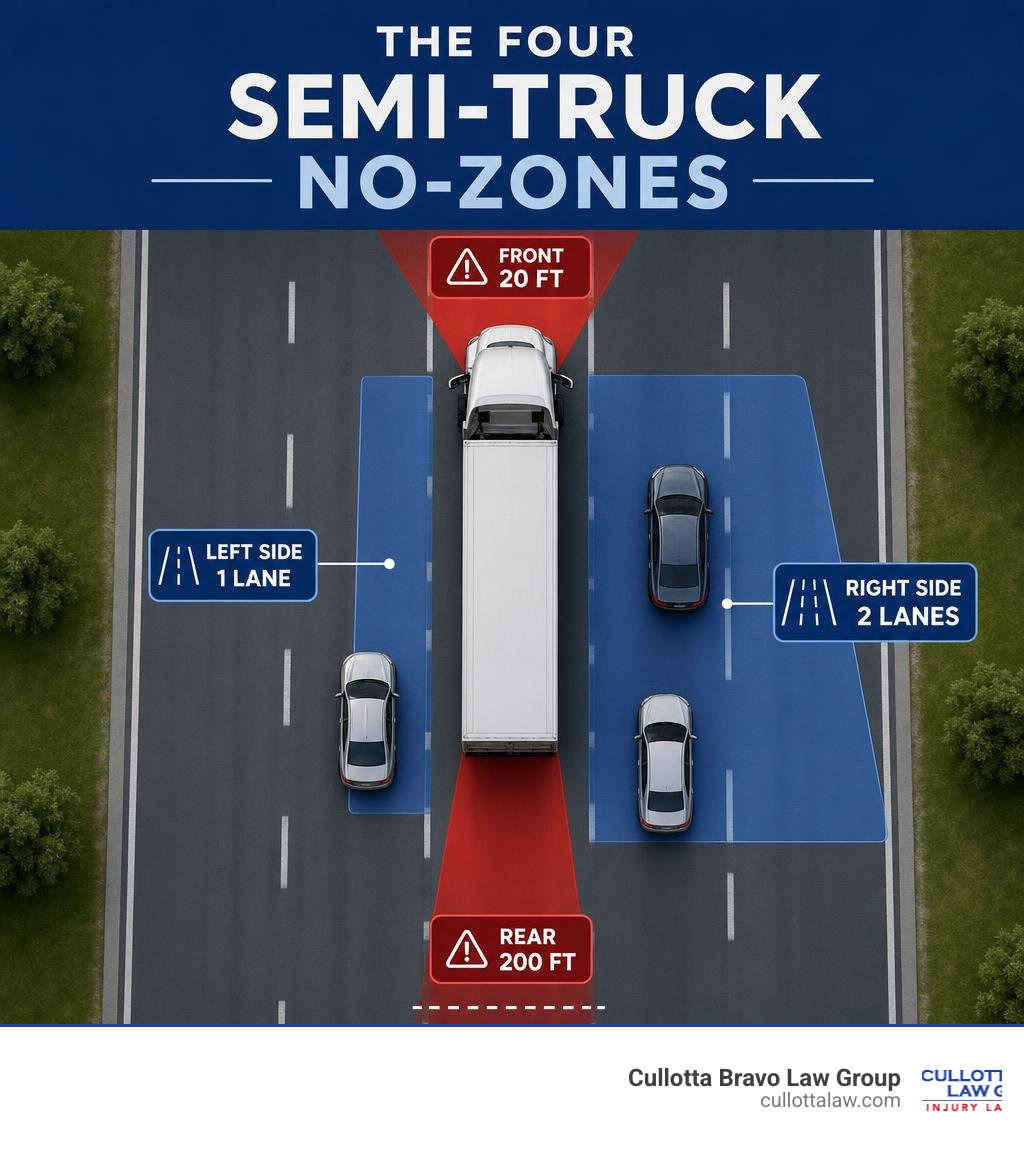
| Four main blind spots (“no-zones”) | Front (20 ft), Rear (up to 200 ft), Right side (2+ lanes wide), Left side (1 lane wide) |
| Biggest danger zone | Right side of the truck — the most common location for serious crashes |
| Key rule | If you can’t see the driver’s face in their mirror, they cannot see you |
Every day, passenger vehicles share highways with 80,000-pound commercial trucks. Those trucks have enormous blind spots — far larger than most drivers realize. According to the Federal Motor Carrier Safety Administration (FMCSA), these no-zones are a leading cause of collisions between large trucks and smaller vehicles.
The physics are unforgiving. When a fully loaded tractor-trailer — weighing up to 20 times more than a typical car — strikes a vehicle it never saw, the results are often catastrophic: crushed metal, life-altering injuries, and families left without answers.
In one out of every three big rig crashes, the truck driver never saw the other vehicle. That’s not bad luck. That’s a system failure — one that involves driver training, company safety policies, federal regulations, and in many cases, outright negligence.
If you or someone you love has been hurt in this type of crash, understanding how these accidents happen — and who is responsible — is the first step toward protecting your rights.
I’m Peter Cullotta, founding partner of Cullotta Bravo Law Group, with over 35 years of experience representing injured individuals throughout the Chicagoland area, including victims of semi truck blind spot crash cases involving negligent drivers and trucking companies. In the sections below, I’ll walk you through everything you need to know — from where no-zones are located to how fault is proven and what your claim may be worth.
Basic semi truck blind spot crash vocab:
What is a Semi-Truck No-Zone and Where Are Blind Spots Located?
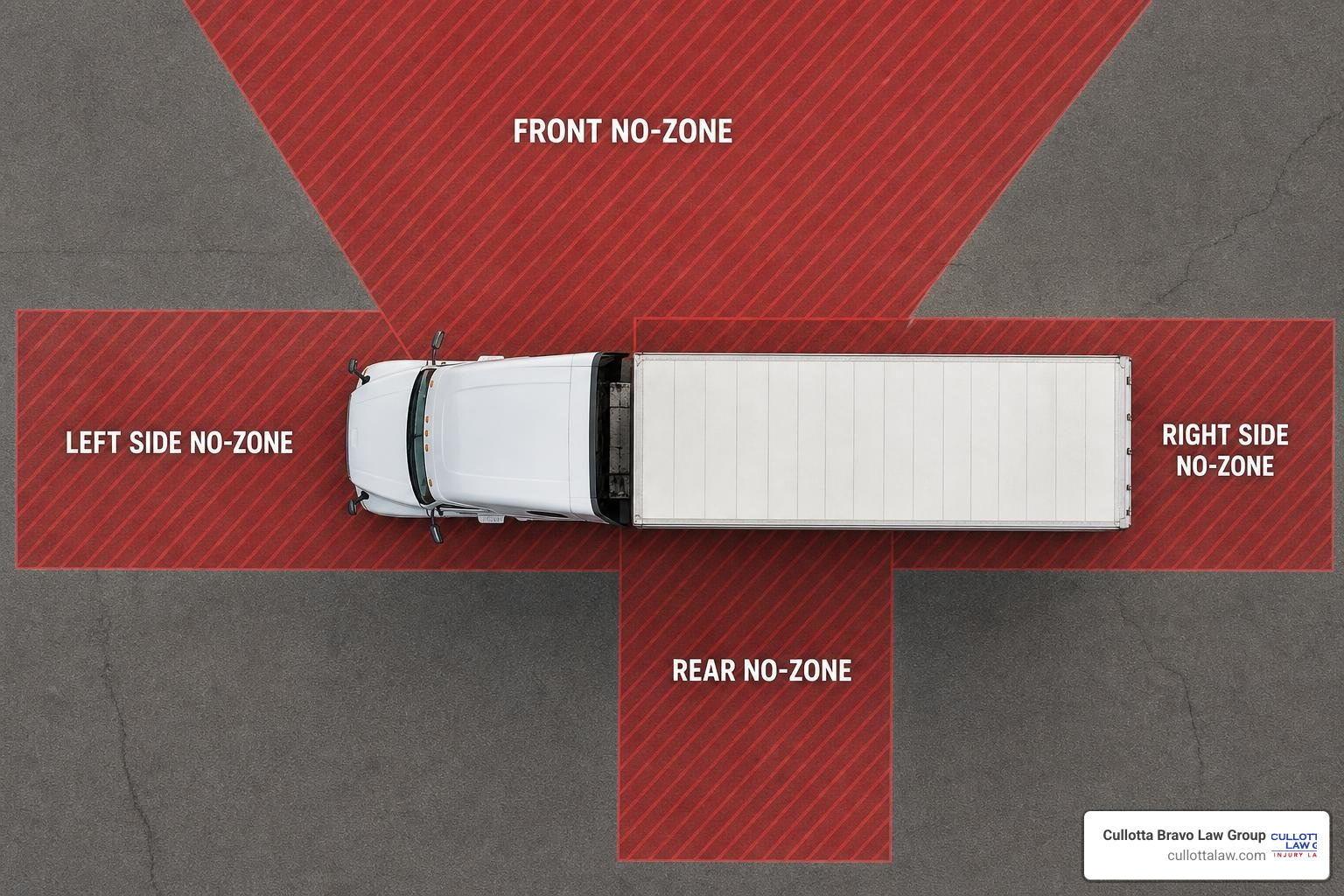
When we talk about commercial trucks, we aren’t just talking about larger cars. Semi-trucks operate on a completely different scale. Because of their length, height, and lack of a rear-view mirror, they have massive areas of zero visibility surrounding them. In the trucking industry, these dangerous blind spots are commonly referred to as “no-zones.”
These are not areas where visibility is simply “poor” — they are zones where a passenger vehicle can completely disappear from the truck driver’s view. If you are driving in a no-zone, you are essentially invisible to the trucker.
Despite massive technological leaps in modern automotive safety, these zones remain incredibly dangerous. To understand why, you can learn why trucks still have massive blind spots even in an era of advanced driver assistance systems.
To put this in perspective, let’s compare the blind spots of a standard passenger vehicle with those of a commercial tractor-trailer:
| Blind Spot Location | Passenger Car | Semi-Truck (Tractor-Trailer) |
|---|---|---|
| Front | Approx. 3 to 5 feet | Approx. 20 feet (completely hides a small car or SUV) |
| Rear | Approx. 10 to 15 feet | Up to 200 feet (the length of several cars) |
| Left Side | Behind the B-pillar (approx. 1 lane wide) | Extends from the cab back along the trailer (1 lane wide) |
| Right Side | Behind the C-pillar (approx. 1 lane wide) | Extends diagonally back and outward (2+ lanes wide) |
The Right-Side No-Zone: The Most Dangerous Blind Spot
The right side of an 18-wheeler is, without a doubt, the most dangerous place a passenger vehicle can linger. Because the truck driver sits on the left side of the cab, their visibility to the right is severely compromised.
This blind spot doesn’t just cover the lane directly next to the truck; it can stretch across two or more lanes of traffic and run the entire length of the trailer. This is why passing a truck on the right is extremely hazardous.
Furthermore, because of their massive length (often exceeding 50 feet), trucks must swing wide to the left to execute a tight right turn. If a passenger vehicle slips into the right-side blind spot during this maneuver, it can easily lead to a “right-turn squeeze” accident, crushing the smaller vehicle against the curb or utility poles. To avoid this hazard, you must learn how to navigate the semi-trailer blind zone like a pro and never linger on a truck’s right side.
Front and Rear No-Zones: Tailgating and Cutting Off Big Rigs
The front and rear blind spots of a semi-truck are equally unforgiving:
- The Front No-Zone (Approx. 20 Feet): Because truck cabs sit high off the ground and have long hoods, there is a blind spot directly in front of the truck bumper. If you merge too quickly after passing a semi, your car can disappear entirely from the driver’s view. If the truck driver cannot see you, they cannot adjust their speed to maintain a safe following distance.
- The Rear No-Zone (Up to 200 Feet): Unlike passenger cars, commercial trailers do not have rear-view mirrors. If you follow a truck too closely (within 150 to 200 feet of the trailer), the driver has absolutely no way of knowing you are there. If the truck has to brake suddenly, you will have zero reaction time, which often leads to devastating rear-end or underride collisions.
Common Causes and Types of No-Zone Collisions

A semi truck blind spot crash rarely happens without some form of underlying negligence. While the physical existence of no-zones is a design reality, crashes occur when drivers fail to manage these visibility limitations safely.
According to the Large Truck Crash Causation Study (LTCCS), inadequate surveillance — meaning a driver failed to look properly before executing a maneuver — is a factor in roughly 14% of large-truck crashes. The most common human errors and systemic failures that trigger these accidents include:
- Driver Fatigue: Long hours behind the wheel lead to cognitive decline and slow reaction times. A tired driver is much less likely to check their mirrors thoroughly or maintain active situational awareness.
- Distracted Driving: Texting, adjusting navigation systems, eating, or using dispatch radios can cause a truck driver to drift or change lanes without checking their blind spots.
- Inadequate Training: Operating a commercial vehicle requires specialized skills. Trucking companies that rush drivers through training programs produce operators who do not know how to monitor their blind spots properly.
- Improper Mirror Alignment: Commercial drivers are legally required to conduct pre-trip inspections, which include adjusting all side-view and convex mirrors to minimize blind spots. Failing to do so is direct evidence of negligence.
The catastrophic impact of these human factors is well-documented. For instance, the NTSB investigation of fatigue-related truck crashes highlights how acute sleep loss, circadian disruption, and untreated sleep disorders can cause commercial operators to completely fail to react to traffic patterns, leading to high-speed collisions.
Sideswipe and Lane-Change Incidents
Sideswipe collisions are the classic blind-spot crash. These typically occur on multi-lane highways like I-88, I-55, or I-294 in northeastern Illinois when a truck driver attempts to change lanes without verifying that the adjacent lane is clear.
Because the truck driver’s side mirrors provide a limited angle of view, a passenger car traveling parallel to the trailer can easily be struck. The sheer mass of the truck often pushes the smaller vehicle into other lanes, off the roadway, or into concrete highway barriers, causing secondary chain-reaction pileups.
Underride and Override Crashes
When a passenger vehicle collides with the front, side, or rear of a semi-truck, the structural incompatibility between the two vehicles creates an extreme safety hazard:
- Underride Crashes: These occur when a smaller passenger vehicle slides underneath the side or rear of a truck trailer. Because the bed of the trailer sits at windshield level for most passenger cars, an underride crash often bypasses the car’s crumple zones and airbags, crushing the passenger cabin and leading to catastrophic or fatal head injuries.
- Override Crashes: These happen when a semi-truck fails to stop in time and literally drives over the top of a smaller vehicle in front of it. This often occurs when a truck driver fails to notice a vehicle stopped in their front blind spot during heavy traffic or at intersections.
Federal Regulations and Safety Technologies Addressing Blind Spots
To protect public safety, the Federal Motor Carrier Safety Administration (FMCSA) enforces strict regulations regarding commercial vehicle equipment and driver conduct.
Under 49 CFR Part 393, all commercial motor vehicles must be equipped with mirrors that provide a clear view of the highway to the rear and along both sides of the vehicle. If a trucking company allows a vehicle on the road with cracked, missing, or improperly positioned mirrors, they are in direct violation of federal law.
Additionally, 49 CFR Part 392 requires commercial drivers to exercise extreme caution and maintain an active lookout, stating that drivers must not change lanes or move laterally until they have verified that it is safe to do so.
Despite these clear mandates, regulators have been slow to keep pace with modern safety solutions. As outlined in the news report Unseen: Why regulations lag behind safety solutions, the U.S. Department of Transportation still does not require commercial trucks to be equipped with side-view cameras or advanced sensor systems, leaving it up to individual fleets to adopt these life-saving technologies voluntarily.
In the meantime, many safety-conscious owner-operators choose to take matters into their own hands. If you are a commercial operator looking to improve your visibility, you can upgrade your truck with blind spot mirrors to help eliminate these dangerous zones.
Advanced Safety Tech: Cameras, Sensors, and EDRs
While federal law does not yet mandate them, several advanced safety technologies can significantly reduce the risk of a semi truck blind spot crash:
- Blind-Spot Detection (BSD) and Side-Object Sensors: These radar-based systems alert the truck driver via visual or audible warnings when a vehicle is traveling in an adjacent lane.
- Forward Collision Warning (FCW) and Automatic Emergency Braking (AEB): These systems monitor the front no-zone and can automatically apply the brakes if a collision is imminent.
- Event Data Recorders (EDRs): Similar to flight data recorders, these “black boxes” capture critical pre-crash data, including vehicle speed, brake application, steering angles, and whether driver assistance systems were active or ignored.
The critical importance of capturing this data is emphasized in official crash analyses, such as the NTSB 2026 centerline crossover crash investigation, which relies heavily on electronic data to reconstruct complex collision sequences and determine exactly why a commercial vehicle drifted out of its lane.
Trucking Company Responsibilities and CDL Standards
Trucking companies have a non-delegable duty to ensure their drivers are fully qualified, trained, and licensed. This includes verifying that all drivers hold a valid Commercial Driver’s License (CDL) and comply with federal Hours-of-Service (HOS) regulations to prevent fatigue.
Unfortunately, systemic gaps in driver licensing and safety monitoring continue to put motorists at risk. High-profile legal battles, such as the CDL licensing standards and lawsuits, highlight the ongoing national struggle to enforce strict licensing standards, verify English language proficiency, and keep unqualified or unsafe commercial drivers off the road.
Who is Liable for a Semi Truck Blind Spot Crash?
Determining liability in a semi truck blind spot crash is highly complex. Trucking companies and their insurance adjusters will almost always try to shift the blame to you, claiming that you were “negligently lingering” in the truck’s no-zone.
However, under Illinois law, commercial drivers are held to a high standard of care. A truck’s blind spots do not give the driver a license to collide with other vehicles.
Depending on the facts of your case, multiple parties can be held legally responsible for your injuries:
- The Truck Driver: If the driver changed lanes without signaling, was speeding, distracted, fatigued, or failed to adjust their mirrors properly, they can be held directly liable for negligence.
- The Trucking Company: Under the legal doctrine of respondeat superior, employers are responsible for the negligent actions of their employees. Furthermore, a trucking company can be held independently liable for negligent hiring, failure to train, poor maintenance practices, or forcing drivers to violate HOS rules.
- Third-Party Maintenance Contractors: If a contracted mechanic failed to repair a broken mirror, faulty blind-spot sensor, or defective braking system, they may share liability.
- Cargo Loading Companies: If improperly loaded or unsecured cargo shifted during transit, causing the trailer to sway or making it impossible for the driver to control the vehicle, the loading company may be at fault.
Proving Negligence in a Semi Truck Blind Spot Crash
To build a successful injury claim, you must gather objective, undeniable evidence. Because trucking companies often control the most critical pieces of evidence, it is vital to act quickly before this data is overwritten or destroyed. Key evidence includes:
- Black Box (EDR) Data: Proves the truck’s speed, braking patterns, and throttle position in the seconds leading up to the crash.
- Electronic Logging Device (ELD) Logs: Reveals whether the driver exceeded their federally mandated driving hours, which points directly to fatigue.
- Dashcam Footage: Provides an objective visual record of the pre-crash sequence, lane positions, and signaling.
- Preservation Demands: A formal legal letter sent by your attorney demanding that the trucking company preserve all physical and digital evidence, including driver qualification files and telematics data.
- Accident Reconstruction: Working with forensic engineering experts to analyze skid marks, vehicle damage angles, and debris fields to prove exactly how the collision occurred.
How to Protect Your Rights After a Semi Truck Blind Spot Crash
If you are involved in a collision with a semi-truck in Illinois, taking the right steps immediately after the crash can protect your health and preserve your legal rights:
- Call 911 Immediately: Request police and emergency medical services to the scene. Ensure the responding officer files an official police report.
- Seek Immediate Medical Attention: Even if you feel fine, adrenaline can mask serious injuries like internal bleeding, concussions, or soft-tissue damage. Medical records created immediately after the crash are vital evidence.
- Document the Scene: If it is safe to do so, take photos and videos of both vehicles, the lane markings, skid marks, road conditions, and any nearby traffic signs.
- Gather Witness Information: Collect names, phone numbers, and statements from anyone who saw the accident occur.
- Avoid Giving Recorded Statements: Do not speak to the trucking company’s insurance adjusters or sign any settlement offers without consulting a lawyer.
- Contact a Qualified Attorney: To navigate the complex legal landscape of commercial vehicle accidents, consult an experienced Illinois truck accident attorney guide to understand your options.
Practical Tips for Passenger Vehicle Drivers to Avoid No-Zones
While commercial drivers bear the primary responsibility for operating their vehicles safely, practicing defensive driving around big rigs can drastically reduce your risk of a collision.
The single most important rule to remember is: If you cannot see the truck driver’s face in their side-view mirror, they cannot see you.
When sharing the road with semis, keep these safety practices in mind:
- Pass Quickly on the Left: Always pass a semi-truck on the left side, where the blind spot is significantly smaller. Never linger alongside the trailer; complete your pass promptly and move back into a safe position. To ensure you are doing this correctly, review our guide on how to safely pass a truck on the highway.
- Never Tailgate: Maintain a following distance of at least 4 seconds behind a large truck. If you cannot see both of the truck’s side mirrors, you are driving in the rear no-zone.
- Avoid Cutting Off Trucks: When merging in front of a semi, ensure you can see the entire front cab of the truck in your rear-view mirror before changing lanes. This ensures you have cleared the front no-zone and left the truck adequate stopping distance.
- Give Turning Trucks Extra Space: Never attempt to squeeze past a truck on the right side when it is approaching an intersection or preparing to turn. Assume the truck will need to swing wide to execute its turn.
Frequently Asked Questions about No-Zone Accidents
Is a truck driver always at fault for a blind-spot accident?
While truck drivers have a strict duty of care to ensure a lane is clear before moving laterally, they are not automatically at fault in every scenario.
If a passenger vehicle driver cut off the truck abruptly, tailgated, or attempted an illegal passing maneuver on the right, liability may be shared. Illinois operates under a modified comparative negligence system, meaning you can still recover damages as long as you are found to be 50% or less at fault for the crash.
To understand how fault is evaluated in these complex scenarios, investigators will look at physical evidence, witness statements, and electronic data to determine each driver’s level of responsibility.
What are the most common injuries in a blind-spot truck crash?
Due to the massive weight disparity between commercial trucks and passenger cars, injuries resulting from these collisions are often severe or life-threatening. Common injuries include:
- Traumatic Brain Injuries (TBIs): Caused by violent head impacts or penetration injuries.
- Spinal Cord Damage: Often resulting in permanent paralysis or chronic nerve pain.
- Crush Injuries and Amputations: Resulting from the cabin of the passenger car collapsing.
- Severe Fractures and Internal Organ Damage: Caused by high-impact forces.
These catastrophic injuries often require extensive medical treatment, long-term rehabilitation, and can have a devastating impact on victims and their families in Chicagoland.
How long do I have to file a truck accident claim in Illinois?
In Illinois, the statute of limitations for personal injury claims is generally two years from the date of the accident. If you fail to file a lawsuit within this two-year window, you will permanently lose your right to seek compensation.
However, because trucking companies often destroy dispatch logs, maintenance records, and ELD data after six months, you should contact an attorney immediately to send a formal evidence preservation demand.
Conclusion
A semi truck blind spot crash can shatter your life in an instant, leaving you facing mounting medical bills, lost wages, chronic pain, and an uncertain future. When you are up against a massive trucking corporation and their aggressive insurance defense lawyers, you should not have to fight for justice alone.
At Cullotta Bravo Law Group, we have spent over 35 years providing aggressive, compassionate representation to injury victims in Aurora, Chicago, Naperville, Joliet, and throughout Illinois. We know the tactics trucking companies use to avoid liability, and we have a proven track record of securing multi-million dollar settlements for our clients. We treat every client with the dignity they deserve while fighting relentlessly to secure the maximum compensation possible.
Do not let a negligent trucking company dictate your recovery. Contact an Illinois truck accident attorney today to schedule your free, no-obligation case consultation.