

When Should You Say “I Need an Accident Lawyer” After a Crash?
A collision rattles your nerves, damages your vehicle, and leaves you facing a wave of paperwork. In minor fender benders where nobody is hurt and vehicle damage is negligible, resolving the claim directly through insurer property damage channels might be straightforward. However, the moment physical pain emerges, medical bills arrive, or drivers disagree on what happened, the situation shifts dramatically.
Knowing when to seek professional legal guidance is critical. When injuries interfere with your daily routine or insurance adjusters start questioning your version of events, saying “I need an accident lawyer” is often the first step toward protecting your rights. Deciding if you need a car accident lawyer early on shields you from costly mistakes.
How to Know When I Need an Accident Lawyer Immediately
Certain accident scenarios require urgent legal intervention to protect critical evidence and ensure your rights remain intact:
- Severe or Permanent Injuries: Broken bones, spinal injuries, severe concussions, or injuries requiring surgery involve high-dollar future care costs that insurers fight hard to minimize.
- Commercial Truck Collisions: Crashes involving commercial trucks bring complex federal safety regulations, corporate defense teams, and multiple layers of commercial insurance into play.
- Disputed Liability: If the other driver denies responsibility or claims you caused the crash, you need a prompt investigation to preserve traffic camera footage, black box data, and witness accounts.
- Multi-Vehicle Pileups: Crashes involving three or more vehicles create finger-pointing chaos between multiple insurance carriers trying to shift liability onto each other.
- Wrongful Death: When a tragic collision claims the life of a loved one, surviving family members need dedicated legal advocacy to pursue accountability and long-term financial security.
Why Calling an Attorney Beats Handling Claims Alone
Insurance companies are for-profit corporations with teams of adjusters and defense lawyers trained to minimize payouts. Adjusters often sound friendly on the phone, but their goal is to close your file for as little money as possible.
Managing a claim on your own while recovering from injuries leaves you vulnerable to aggressive settlement tactics, delayed claims, and unexpected denials. Understanding why calling an attorney beats handling claims alone boils down to leveling the playing field. An experienced legal team calculates the full scope of your past and future losses, gathers hard evidence, and forces the insurer to negotiate in good faith.
Immediate Steps to Take After an Accident to Protect Your Rights
The actions you take in the minutes and hours following a crash establish the foundation of your injury claim. Staying calm and following a structured approach prevents critical evidence from disappearing.
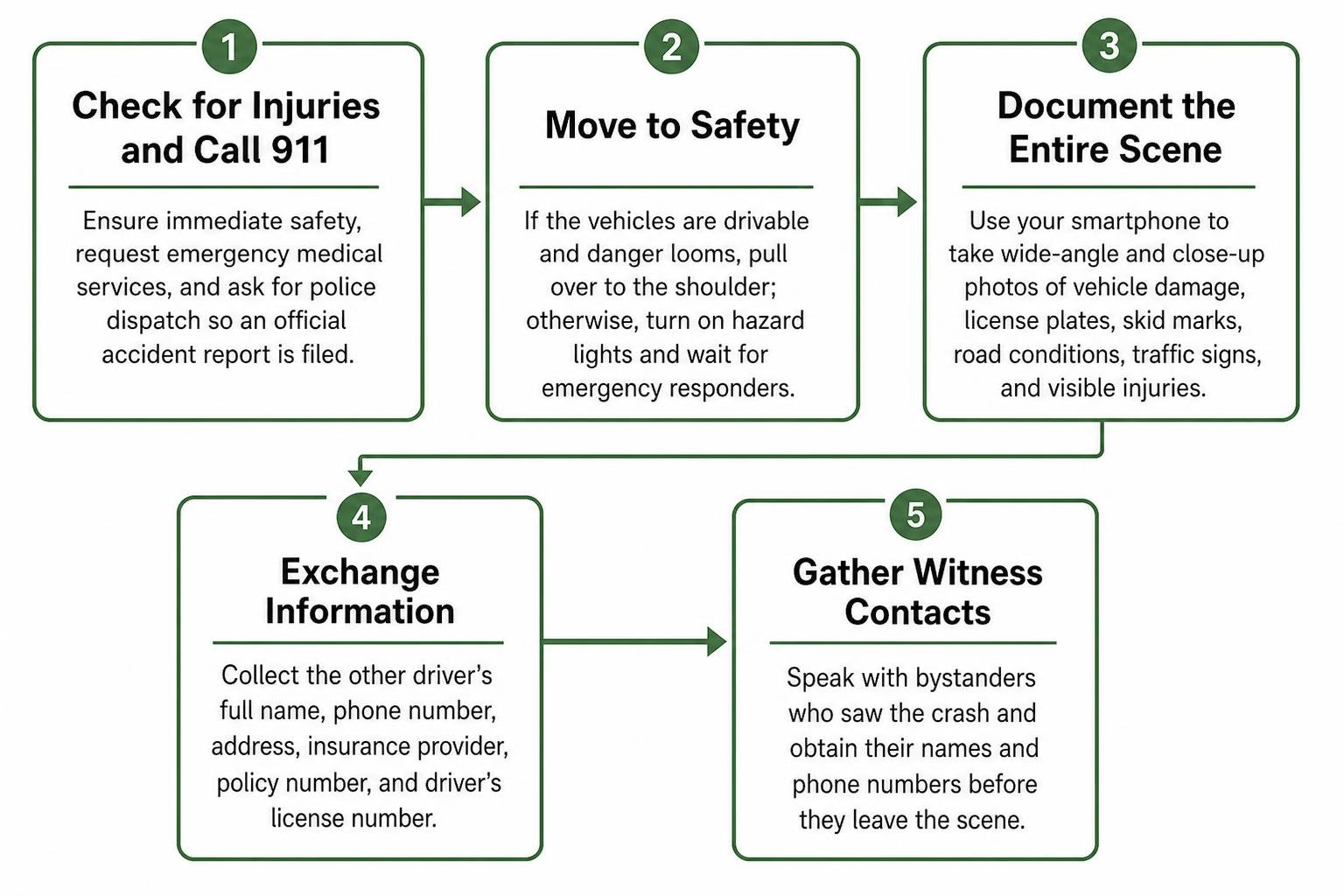
- Check for Injuries and Call 911: Ensure immediate safety, request emergency medical services, and ask for police dispatch so an official accident report is filed.
- Move to Safety: If the vehicles are drivable and danger looms, pull over to the shoulder; otherwise, turn on hazard lights and wait for emergency responders.
- Document the Entire Scene: Use your smartphone to take wide-angle and close-up photos of vehicle damage, license plates, skid marks, road conditions, traffic signs, and visible injuries.
- Exchange Information: Collect the other driver’s full name, phone number, address, insurance provider, policy number, and driver’s license number.
- Gather Witness Contacts: Speak with bystanders who saw the crash and obtain their names and phone numbers before they leave the scene.
- Seek Medical Care Promptly: Visit an emergency room, urgent care clinic, or your physician right away, even if you believe your injuries are minor.
- Organize Records and Seek Guidance: Keep all discharge summaries, bills, and receipts in a safe place, and reach out for personal injury claim help before giving statements to insurance representatives.
Identifying Overlooked Injuries After a Collision
During a car wreck, the sudden rush of adrenaline can easily mask pain. Many serious crash injuries do not exhibit immediate, obvious symptoms:
- Traumatic Brain Injuries (TBI): Concussions and brain bruising can manifest hours or days later as mild confusion, headaches, light sensitivity, or sudden mood changes.
- Whiplash and Soft Tissue Damage: Severe neck and back strains frequently worsen 24 to 48 hours after impact as inflammation sets in.
- Internal Bleeding and Organ Damage: Deep chest or abdominal pain, dizziness, or deep bruising from seatbelts require urgent medical imaging to rule out life-threatening internal harm.
- Spinal Disc Herniations: Numbness, tingling, or radiating pain in your arms or legs often point to nerve impingement that demands specialist evaluation.
Why You Should Avoid Speaking to the Other Driver’s Insurer
Shortly after a crash, you will likely receive a call from the at-fault driver’s insurance adjuster asking for a recorded statement. You are under no legal obligation to give a recorded interview to the other party’s insurer.
Adjusters are skilled at asking leading questions designed to get you to downplay your physical pain or inadvertently accept partial blame. Additionally, insurers often offer quick, lowball settlement checks before you know the full medical extent of your injuries. Accepting that check releases the insurer from all future financial responsibility. Direct all insurance calls to your attorney instead.
Understanding Fault, Compensation, and Legal Deadlines
Pursuing a personal injury claim requires proving that another party acted negligently and that their negligence directly caused your injuries and financial losses. As outlined in the Accidents and Injuries Legal Guide, personal injury law aims to make injured victims whole by awarding financial compensation for both objective economic losses and subjective personal hardships.
| Damage Category | Examples of Recoverable Losses | Purpose of Compensation |
|---|---|---|
| Economic Damages | Emergency room bills, future surgeries, physical therapy, prescription medication, lost wages, reduced future earning capacity, vehicle repair costs | Reimburses direct, out-of-pocket financial losses backed by bills and paystubs |
| Non-Economic Damages | Physical pain and suffering, emotional distress, loss of normal life, physical disfigurement, disability, loss of consortium | Compensates for the intangible human toll and physical agony caused by the crash |
How Comparative Fault Affects Your Financial Recovery
Car accidents are rarely simple, and insurance companies often argue that the injured victim shares responsibility for the collision. Under comparative negligence laws, your financial recovery is adjusted based on your assigned percentage of fault:
- If your total damages equal $100,000 and you are found to be 10% responsible for the accident, your final payout is reduced by 10%, resulting in a $90,000 recovery.
- In modified comparative fault jurisdictions, you can recover damages as long as your fault does not exceed 50%. If you are found 51% or more at fault, you are barred from recovering any compensation.
This dynamic makes strong evidence collection vital. Your lawyer works to disprove false allegations of fault to protect your final financial recovery.
Handling Uninsured and Underinsured Motorist Claims
What happens when the driver who hit you carries no auto insurance, or carries state minimum liability limits that fail to cover your hospital stay?
In these situations, your own policy’s Uninsured Motorist (UM) and Underinsured Motorist (SUM/UIM) coverage becomes essential. UM coverage applies during hit-and-run crashes or collisions with uninsured drivers, while UIM coverage bridges the financial gap between the at-fault driver’s low policy limits and your total damages. Navigating these first-party claims can be surprisingly adversarial, as your own insurer steps into the shoes of the defense to limit their payout.
Strict Filing Deadlines and Statutes of Limitations
You do not have unlimited time to take legal action after an auto accident. Every state enforces strict statutes of limitations governing personal injury lawsuits:
- Personal Injury Lawsuits: Most standard auto accident lawsuits must be officially filed in civil court within a specific timeframe (frequently two to three years from the exact date of the accident).
- No-Fault / PIP Windows: If your claim involves mandatory no-fault or personal injury protection benefits, formal claims must often be submitted within 30 days of the crash.
- Claims Involving Government Entities: If your crash involved a city bus, municipal maintenance vehicle, or dangerous roadway conditions maintained by a local government entity, formal notices of claim often carry deadlines as short as 6 months to one year.
Failing to file your lawsuit before the statute of limitations expires permanently bars you from seeking financial recovery in court, regardless of how severe your injuries are.
How to Choose the Best Legal Representation for Your Case

Selecting legal representation is one of the most important decisions you will make after an accident. You need a dedicated advocate with substantial courtroom experience, resources to fund expert investigations, and a clear history of achieving significant settlements.
You can research qualified representation through legal resources such as a reputable Personal Injury Lawyer Directory or by reviewing the ultimate guide to finding the best car accident attorneys. Look for a firm with decades of dedicated personal injury focus rather than a general practice firm that handles traffic tickets or real estate closings on the side.
Understanding Contingency Fees: Can You Afford an Attorney?
Many accident victims worry about how they will afford legal counsel while out of work with mounting medical bills. Fortunately, reputable personal injury attorneys represent clients on a contingency fee agreement.
Under a contingency model:
- You pay zero upfront retainers or out-of-pocket hourly fees.
- Your attorney advances all case costs, including filing fees, expert witness consultations, medical record retrievals, and accident reconstruction.
- The legal fee is a set percentage deducted directly from the final settlement or court verdict.
- If your lawyer does not win your case, you do not owe legal fees.
Reviewing the accident lawyer contingency fee structure ensures complete transparency before signing any representation agreement.
Key Questions to Ask When Thinking “I Need an Accident Lawyer”
During your initial consultation, interview the attorney to confirm they are the right fit for your case:
- How many years of trial experience do you have handling auto accident cases?
- Do you personally handle my case, or will it be passed off to a junior associate or case manager?
- What is your track record with multi-million dollar injury settlements and jury verdicts?
- How frequently will your office update me on the progress of my claim?
- Are you fully prepared to take my case to trial if the insurance company refuses to offer a fair settlement?
Frequently Asked Questions About Hiring an Accident Attorney
How much does it cost upfront to hire an auto accident lawyer?
It costs nothing out of pocket. Personal injury lawyers operate on a contingency fee basis, providing free initial consultations and advancing all litigation expenses. Legal fees are collected only as an agreed-upon percentage of your final settlement or verdict.
What is the deadline to file a car accident lawsuit?
Filing deadlines depend on state statutes of limitations, which typically range between two and three years from the date of the crash. Claims involving municipal entities or government vehicles often carry much shorter notice deadlines, making early consultation essential.
Can I still recover damages if I was partially at fault for the crash?
Yes. Under comparative negligence laws, you can recover financial compensation even if you contributed to the collision, provided your share of fault does not exceed the legal threshold. Your total compensation is reduced proportionally by your percentage of fault.
Conclusion
Car accidents disrupt your health, your family life, and your financial stability. You do not have to battle aggressive insurance carriers alone while trying to heal.
At Cullotta Bravo Law Group, our team brings over 35 years of aggressive legal representation, client-centered care, and a proven history of securing multi-million dollar settlements for injury victims across Aurora, Chicago, Naperville, Joliet, and throughout Illinois. We handle the investigations, adjusters, and courtroom battles so you can focus entirely on your physical recovery.
If you are ready to protect your legal rights and demand the full compensation you deserve, explore our complete car accident attorney guide or contact our team today for a free, confidential case evaluation.