

What to Do When Nursing Home Care Goes Wrong
When a Nursing Home Fails Your Family: What You Need to Know
A wrongful death nursing home case happens when a resident dies because a facility or its staff failed to provide safe, adequate care. If you’ve just lost a loved one and suspect neglect or abuse played a role, here’s what matters most:
Quick answers:
- What is it? A legal claim filed when nursing home negligence or abuse causes a resident’s death.
- Who can file? Surviving spouses, children, siblings, or the estate’s personal representative.
- What can you recover? Medical bills, funeral costs, loss of companionship, and sometimes punitive damages.
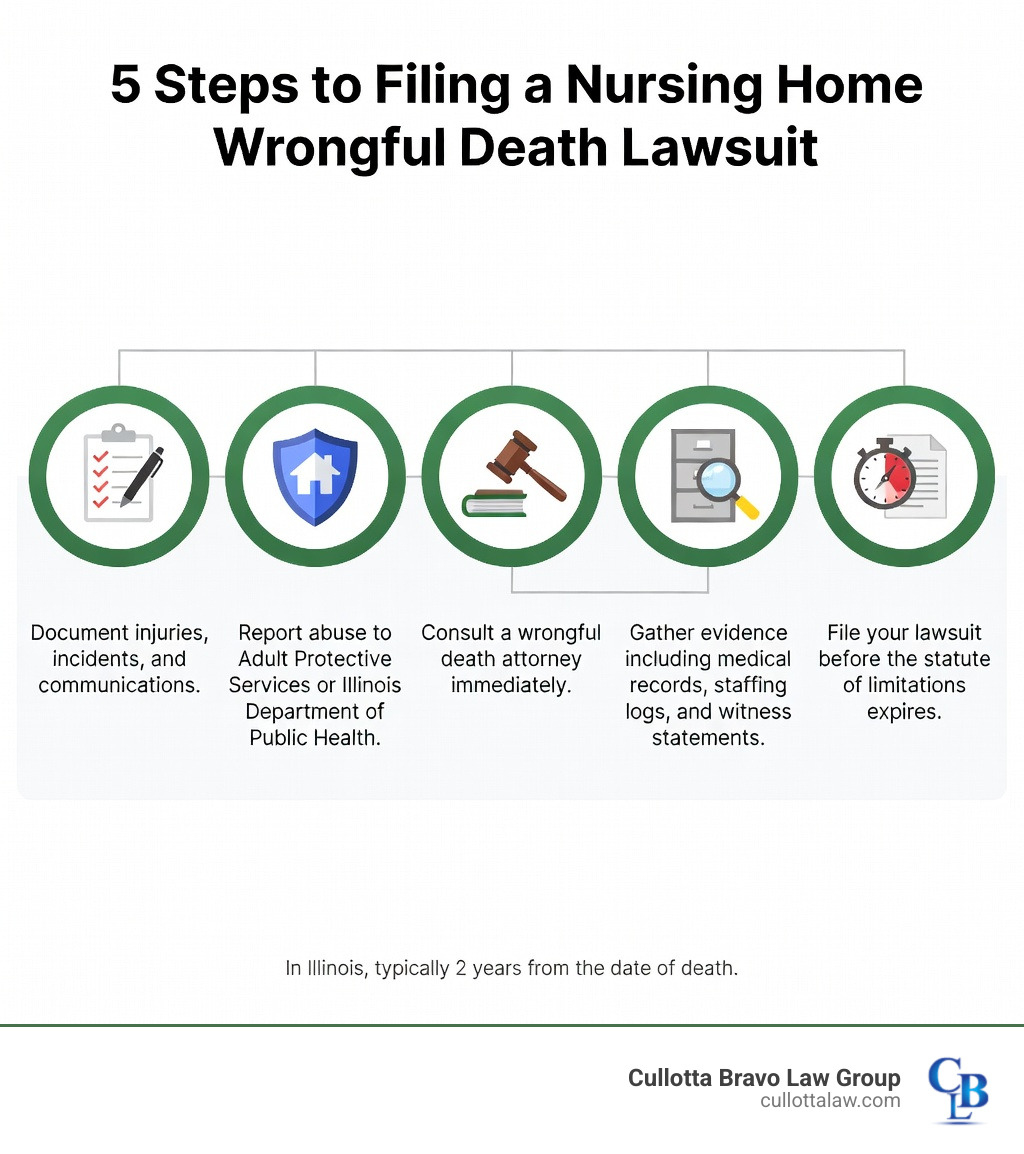
- How long do you have? In Illinois, typically 2 years from the date of death.
- First step? Document everything and consult a wrongful death attorney immediately.
Nursing homes are supposed to be safe. But the reality is troubling. According to available data, elders who experience abuse face a 300% higher risk of death than those who don’t — and two in three care staff members have admitted to committing some form of abuse in the past year. These aren’t isolated incidents. They reflect a system under serious strain, one where understaffing, inadequate training, and lack of oversight can turn a trusted facility into a place of preventable tragedy.
When families place a parent or grandparent in a nursing home, they’re extending enormous trust. When that trust is broken — and a loved one dies as a result — families deserve answers, accountability, and justice.
I’m Peter Cullotta, founding partner of Cullotta Bravo Law Group, a trial lawyer with over 35 years of experience fighting for families harmed by nursing home negligence and abuse throughout the Chicagoland area. I’ve seen how wrongful death nursing home cases devastate families, and I’ve spent my career making sure negligent facilities are held accountable.
Understanding Wrongful Death Nursing Home Claims

When we talk about a wrongful death nursing home claim, we are looking at a specific area of civil law. At its core, it is about accountability. Every nursing home in Illinois—whether in Aurora, Joliet, or Chicago—owes its residents a “duty of care.” This means they are legally required to provide a safe environment and the medical attention necessary to keep residents healthy.
A wrongful death in nursing homes occurs when that duty is breached. To win a case, we must prove three things:
- The nursing home had a duty to protect your loved one.
- The home breached that duty (through action or inaction).
- That breach was the “proximate cause” of the death.
It is important to understand that a civil wrongful death claim is different from criminal charges. While the state might bring criminal charges for extreme abuse, a civil lawsuit is the only way for a family to receive financial compensation for their loss. Furthermore, nursing homes can be held vicariously liable for the actions of their employees. This means if a nurse or CNA is negligent, the facility itself is often the one that must pay the price. For more context, you can read more info about nursing home neglect to see how these failures often start long before a death occurs.
Identifying a Wrongful Death Nursing Home Incident
Not every death in a nursing home is “wrongful.” We all know that our elders are often in frail health. However, a nursing home lawsuit complete guide helps distinguish between natural causes and preventable tragedies.
Negligent conduct often looks like a “failure to act.” It might be a staff member failing to turn a bedridden patient, leading to a fatal infection, or failing to monitor a resident with dementia who then wanders out into the cold. Intentional abuse is rarer but even more horrific, involving physical strikes or the deliberate withholding of medication. In both cases, the facility is responsible for the tragedy that follows.
Who is Eligible to File a Claim?
According to Cornell Law School on wrongful death, most states allow the immediate family to seek justice. However, the rules can vary slightly depending on where you are.
In Illinois, the claim is typically filed by the “personal representative” or executor of the deceased person’s estate. The money recovered is then distributed to the surviving spouse and “next of kin” (usually children or parents).
While our firm focuses on Illinois, it is interesting to see how other states handle this. For example, Arizona 12-612 specifies that a surviving husband, wife, child, or parent can file. Similarly, California 377.60 allows domestic partners to file as well. Regardless of the specific language, the goal remains the same: ensuring the people most affected by the loss have a path to justice.
Common Causes of Fatal Negligence and Abuse
Many families are shocked to learn how “minor” issues can quickly become fatal for an elderly person. In a wrongful death nursing home case, we often see a snowball effect where one small oversight leads to a catastrophic health failure.
| Common Injury | Fatal Complication | Negligence Factor |
|---|---|---|
| Bedsores | Sepsis / Septic Shock | Failure to turn or clean the resident |
| Minor Fall | Traumatic Brain Injury (TBI) | Failure to use bed rails or supervise |
| UTI | Kidney Failure | Dehydration or poor hygiene |
| Choking | Asphyxiation | Improper diet or lack of supervision |
Pressure sores and nursing home negligence are particularly heartbreaking because they are almost 100% preventable. When a resident isn’t moved, the skin breaks down, and nursing home infections can set in. If not treated, this leads to nursing home sepsis, a full-body inflammatory response that is often the final cause of death.
Other common causes include nursing home injury falls, which account for a massive portion of nursing home ER visits. When a resident falls and hits their head, it can lead to a nursing home concussion or internal bleeding that staff might miss if they aren’t monitoring the resident closely. We also see tragic cases of nursing home choking when residents with swallowing difficulties are given the wrong type of food.
How Understaffing Leads to a Wrongful Death Nursing Home Case
Why do these things happen? In many cases, it’s not because the staff is “evil,” but because the facility is chronically understaffed. When one nurse is responsible for 30 residents, things get missed.
Understaffing leads to:
- Inadequate training: New hires are thrown onto the floor without knowing how to handle emergencies.
- Nursing home inadequate supervision: Residents wander off (elopement) or fall because no one was there to help them to the bathroom.
- Failure to monitor: Vital signs aren’t checked, and a brewing infection goes unnoticed until it’s too late.
The World Health Organization notes that high rates of abuse are often a direct result of caregiver burnout and systemic facility failures. When profits are prioritized over people, residents pay the ultimate price.
Warning Signs Families Should Never Ignore
If you have a loved one in a facility, you must be their eyes and ears. Warning signs of nursing home abuse aren’t always obvious. Sometimes the first subtle signs of nursing home abuse or neglect are just a change in personality.
Look for:
- Unexplained bruising: Especially on the arms or neck.
- Sudden weight loss: This could indicate malnutrition or nursing home feeding tube failures.
- Poor hygiene: Dirty clothes, unwashed hair, or the smell of urine.
- Behavioral changes: If your usually cheerful mom suddenly becomes withdrawn or fearful of certain staff members, pay attention.
- Unsanitary conditions: If the room is dirty, it’s a sign the facility is cutting corners everywhere.
Legal Process and Proving Liability
Starting a lawsuit can feel overwhelming, but it is a structured process. You start a lawsuit by filing a “complaint” in court. From there, we enter the “discovery” phase. This is where we depose witnesses—which means taking their sworn testimony—and demand documents from the facility.
As your wrongful death attorney in Aurora, IL, our job is to dig deep. We look at who inspects nursing home and long-term care facilities and pull the state’s own reports. The Illinois Department of Public Health (IDPH) and the Office of Inspector General (OIG) maintain records of every citation a home has received. If a home has a history of “serious deficiencies,” it makes our case much stronger.
Proving Negligence in a Wrongful Death Nursing Home Lawsuit
Evidence is the heartbeat of your case. We use a variety of sources to build a “preponderance of evidence” (the legal standard in civil cases):
- Medical records: These show the timeline of your loved one’s decline.
- Staffing logs: We can prove the facility was understaffed on the night of the incident.
- Photos of injuries: Pictures of bedsores or bruises are powerful evidence.
- Expert testimony: We often hire doctors to explain how the facility’s failure directly caused the death.
- Inspection reports: Data from the Centers for Medicare & Medicaid Services (CMS) and the Agency for Healthcare Research and Quality (AHRQ) help us establish what the “standard of care” should have been.
Compensation and Recoverable Damages
No amount of money can bring back a parent or spouse, but compensatory damages are designed to cover the losses your family has suffered.
These include:
- Medical expenses: The cost of the hospital stay before the passing.
- Funeral and burial costs.
- Loss of companionship: The emotional value of the relationship that was stolen from you.
- Grief and sorrow: Illinois law allows for damages based on the mental suffering of the survivors.
In some egregious cases, we may also seek punitive damages. These aren’t meant to compensate the family, but to punish the nursing home for particularly shocking behavior and to deter them from doing it again. While some states have caps on these awards, a skilled wrongful death lawyer in Aurora knows how to maximize the recovery for your family.
Statutes of Limitations and Jurisdictional Differences
Time is not on your side in these cases. In Illinois, the Wrongful Death Act generally gives you two years from the date of death to file a claim. If you miss this window, you lose your right to sue forever.
There are some complexities, however. If the death involved medical malpractice, there might be a shorter deadline. Conversely, the “discovery rule” might extend the deadline if the cause of death wasn’t immediately apparent. Furthermore, there are often laws to try and shield nursing homes from negligence lawsuits, such as arbitration agreements buried in the initial move-in paperwork. We know how to navigate these hurdles.
Reporting Abuse in Illinois and Ontario
If you suspect abuse but it isn’t an emergency, you should still report it to the authorities. In the U.S., you can contact Adult Protective Services or the National Long-Term Care Ombudsman Resource Center.
For our friends in Ontario, Canada, the process involves the Long-Term Care ACTION Line and the Patient Ombudsman. Regardless of where you are, protecting family members in Illinois nursing homes starts with making a formal record of your concerns. This was especially critical during the height of the pandemic, as seen in the Illinois nursing home negligence and coronavirus reports, where isolation often hid the signs of neglect.
Frequently Asked Questions about Nursing Home Negligence
What is the statute of limitations for a nursing home wrongful death claim?
In Illinois, you generally have two years from the date of the death. However, if the negligence was hidden, the “discovery rule” might give you more time. Because of the shorter deadline for certain medical claims, you should always seek a legal consultation as soon as possible to ensure your rights are protected.
Can I sue for wrongful death if my loved one had pre-existing conditions?
Yes! This is a common tactic nursing homes use to avoid responsibility. They will claim, “They were 90 and sick anyway.” But the law is clear: the facility still has a duty of care. If their negligence hastened the death or caused accident or abuse injuries in nursing home patients that wouldn’t have otherwise occurred, they are liable. We focus on the “standard of care”—did they do what a reasonable facility would have done?
What are examples of recent nursing home settlements?
While every case is different, recent years have seen significant verdicts. In Kentucky, a family was awarded $5.2 million for a death caused by an infected bedsore. In California, a facility was ordered to pay $42.5 million for the unauthorized use of sedatives. These biggest nursing home abuse stories of 2022 show that juries are increasingly tired of facility negligence and are willing to hold them financially accountable.
Conclusion
At Cullotta Bravo Law Group, we believe that our elders deserve to live their final years with dignity and respect. With over 35 years of experience, we provide aggressive legal representation for families in Aurora, Chicago, Naperville, and Joliet. We have a history of securing multi-million dollar settlements because we don’t back down from big insurance companies or powerful nursing home chains.
If you believe your loved one’s death was preventable, don’t wait. The evidence can disappear, and the clock is ticking. Contact us for a nursing home abuse consultation today. We will treat your family with the dignity you deserve while fighting for the justice your loved one is owed.