

Why Fast Action Matters After an 18-Wheeler Crash
18 wheeler accident lawyers help injured people act quickly to preserve evidence, identify every responsible party, and pursue fair payment for medical bills, lost income, and pain. After a crash, get medical care, call police, photograph what you safely can, save all paperwork, and avoid giving a recorded statement to the trucking insurer before you understand your rights.
A collision with a commercial tractor-trailer is not a typical car accident. A fully loaded truck can weigh up to 80,000 pounds, and the crash may involve the driver, trucking company, cargo loader, maintenance provider, or parts manufacturer. Important proof can disappear fast, including electronic logging device records, black-box data, GPS information, inspection reports, and maintenance files.
The trucking company and its insurer may begin their own investigation right away. A lawyer can send preservation notices, investigate possible federal safety-rule violations, and build a claim based on the full impact of the crash – not just today’s bills. Federal data shows that large truck crashes remain a serious public safety issue, with thousands of fatal collisions reported each year.
I am Peter Cullotta, a trial lawyer with more than 35 years of experience representing injured people in complex personal injury cases throughout Chicagoland. At Cullotta Bravo Law Group, I bring a practical litigation background to cases involving 18 wheeler accident lawyers and the serious legal issues commercial crashes create.
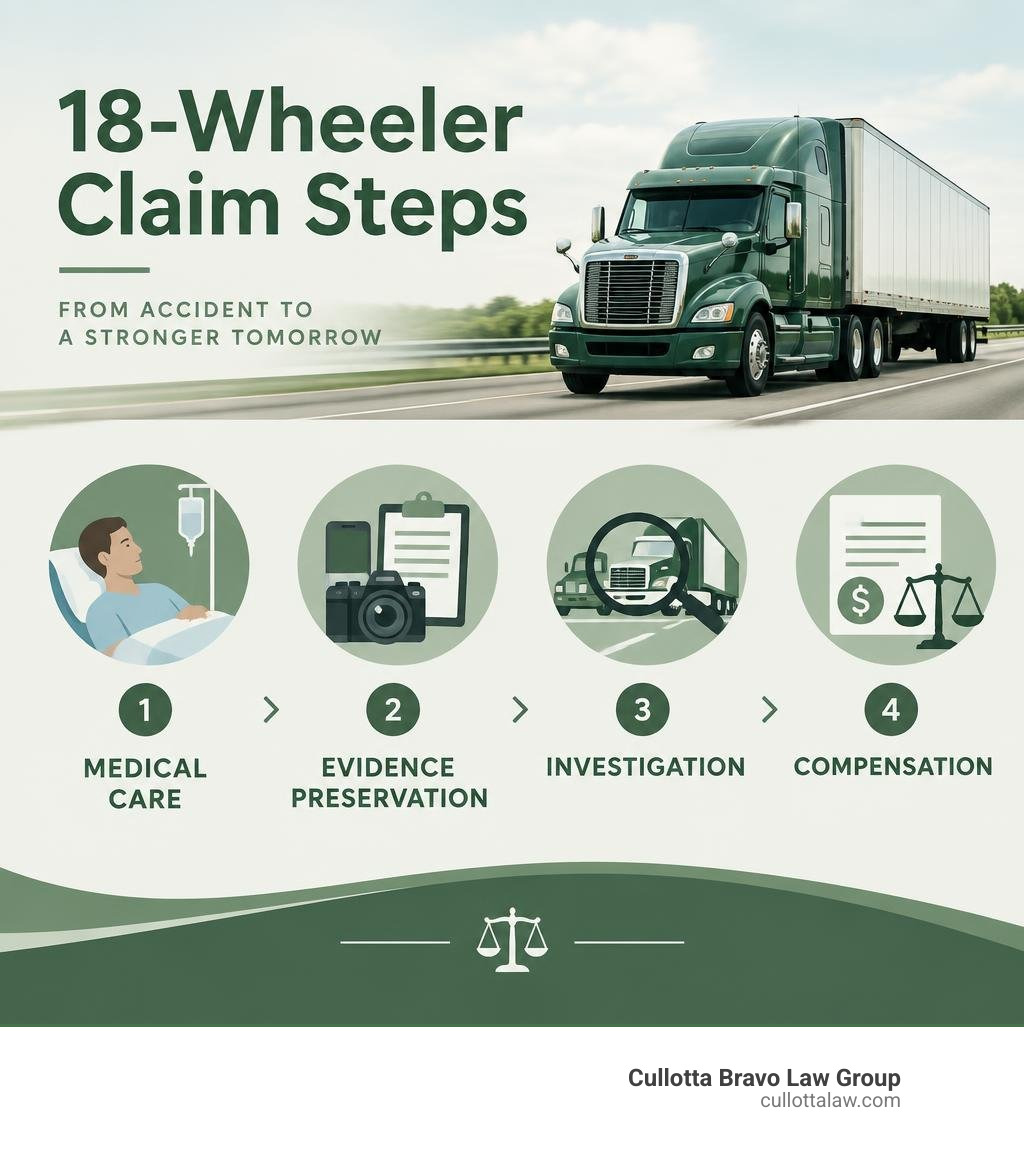
18 wheeler accident lawyers glossary:
Unique Complexities: Commercial Semi-Truck Crashes vs. Standard Passenger Vehicle Accidents
When an 80,000-pound semi-truck collides with a standard four-door sedan weighing barely 4,000 pounds, basic physics dictates the outcome. The sheer disparity in mass creates an immense force multiplier that frequently leads to catastrophic injuries or fatalities for passenger car occupants. Navigating these claims requires understanding that commercial litigation operates on an entirely different level than typical auto collision claims.
| Feature | Passenger Car Accident Claim | 18-Wheeler Commercial Truck Lawsuit |
|---|---|---|
| Gross Vehicle Weight | 3,000 to 5,000 lbs | Up to 80,000 lbs (40 tons) |
| Stopping Distance (65 mph) | ~300 feet | ~525 feet or more |
| Governing Regulations | State traffic codes | Federal Motor Carrier Safety Regulations (FMCSR) & state laws |
| Typical Insurance Coverage | $25,000 to $100,000 | $750,000 to $5,000,000+ per commercial policy |
| Liable Parties | Usually just the individual driver | Driver, motor carrier, broker, cargo loader, manufacturer, mechanics |
| Digital Evidence | Cell phone records, dashcams | Black boxes (ECM/EDR), ELD logs, GPS telematics, fleet data |
| Corporate Defense | Single insurance adjuster | Dedicated rapid-response defense teams, corporate attorneys |
Because of the massive stopping distance required for commercial tractor-trailers, rear-end collisions and high-speed impacts are particularly devastating. Recovering fair compensation involves navigating the aftermath of an 18-wheeler collision with aggressive legal strategies designed to take on deep-pocketed corporate insurers.
Federal Safety Regulations and Hours of Service Violations
Commercial drivers and freight carriers must comply with strict safety rules enforced by the Federal Motor Carrier Safety Administration (FMCSA). One of the most critical safety frameworks is the Hours of Service (HOS) regulations. These rules are designed to prevent driver fatigue, which remains one of the primary catalysts for commercial vehicle disasters.
Key FMCSA Hours-of-Service rules include:
- 11-Hour Driving Limit: Drivers may drive a maximum of 11 hours after 10 consecutive hours off duty.
- 14-Hour Driving Window: Driving cannot occur past the 14th consecutive hour after coming on duty.
- Mandatory 30-Minute Break: Drivers must take a 30-minute rest after 8 cumulative hours of driving without an interruption.
- 60/70-Hour Duty Limit: Commercial drivers cannot exceed 60 hours on duty over 7 consecutive days, or 70 hours over 8 consecutive days.
Motor carriers are legally required to log these hours using Electronic Logging Devices (ELDs). When companies pressure drivers to ignore these safety standards to hit tight delivery windows, catastrophic crashes occur. For more details on these regulatory standards, check our comprehensive 2026 truck accident legal guide.
Multi-Party Liability Across Commercial Freight Chains
In standard car crashes, liability usually rests entirely with one negligent motorist. In commercial trucking, however, the supply chain involves many layers. Proving negligence often means holding multiple corporate entities accountable.
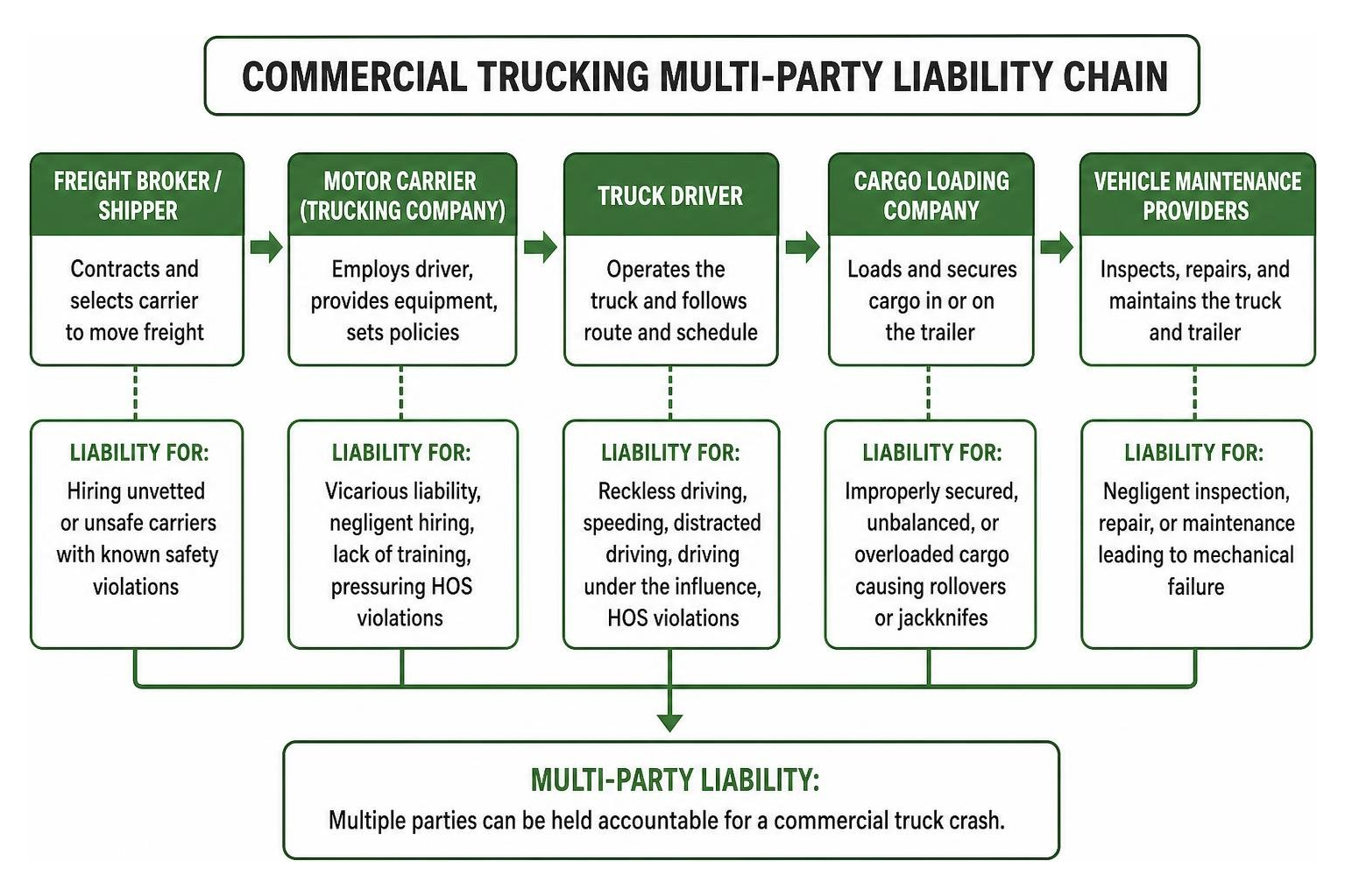
Entities that can be held liable include:
- The Truck Driver: For reckless driving, speeding, distracted driving, or driving under the influence.
- The Motor Carrier (Trucking Company): For vicarious liability, negligent hiring, lack of adequate training, or forcing drivers to violate HOS rules.
- Freight Brokers and Shippers: For contracting with unvetted, unsafe carriers with known safety violations.
- Cargo Loading Companies: For improperly secured, unbalanced, or overloaded trailers that cause rollovers or jackknifes.
- Maintenance and Repair Contractors: For failing to identify worn brake pads, defective tires, or steering issues during mandatory inspections.
- Parts and Truck Manufacturers: For defective components such as faulty air brakes, tire tread separations, or defective hitch mechanisms.
Unraveling this complex chain is crucial when pursuing a trucking company liability claim to ensure all available insurance coverage is identified.
Critical Evidence and How 18 Wheeler Accident Lawyers Build an Unbeatable Case
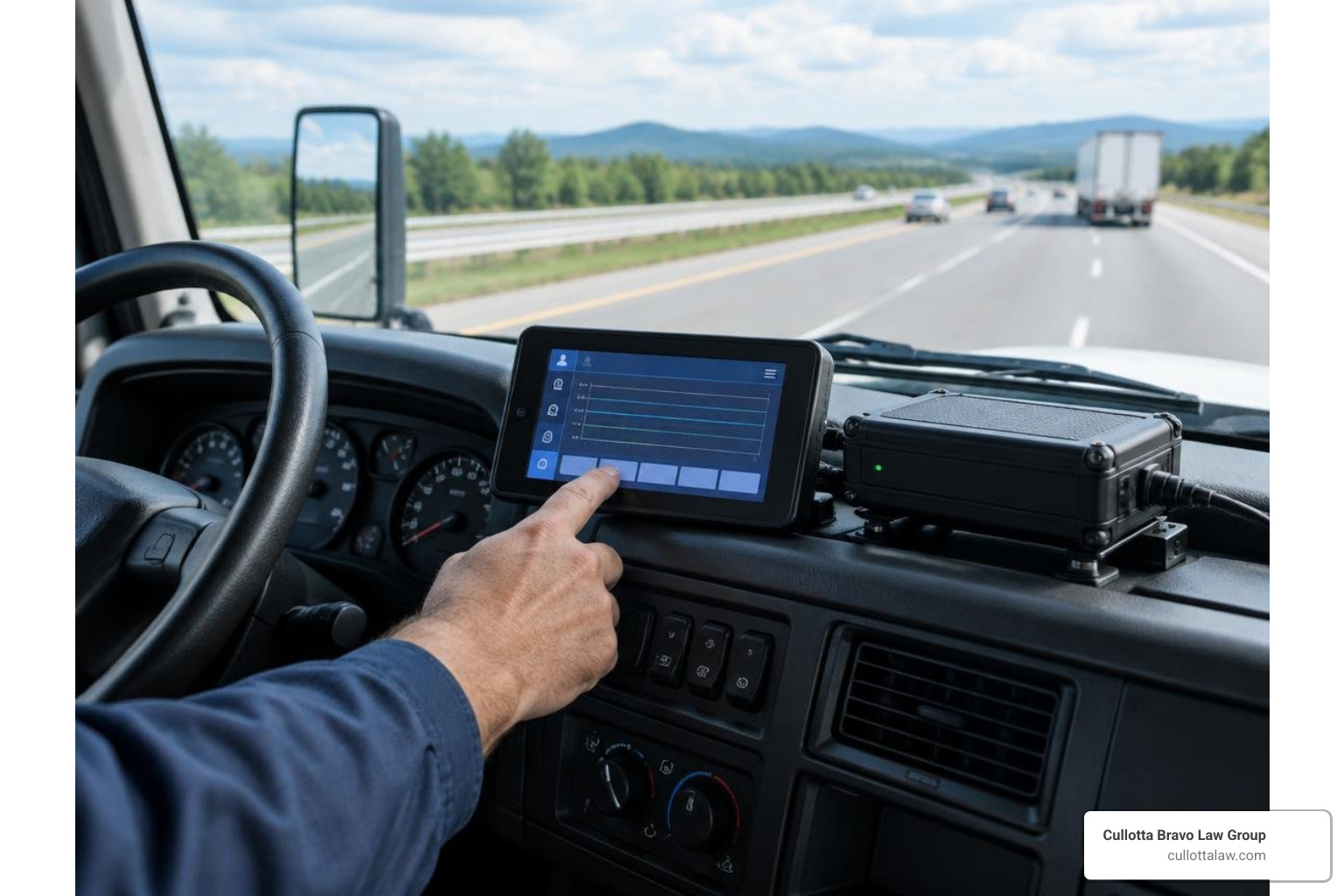
In the hours immediately following a major commercial collision, the motor carrier’s rapid-response team is often already on-scene gathering data to minimize company liability. Victims must move just as quickly. Crucial digital evidence can easily be lost or overwritten within weeks if formal legal steps are not taken right away.
To protect this evidence, we immediately draft and dispatch formal spoliation letters. A spoliation letter is a legally binding demand requiring the trucking company, insurance carriers, and third-party contractors to preserve all physical and digital records connected to the collision, the vehicle, and the driver.
What 18 Wheeler Accident Lawyers Do to Secure Electronic Logging Devices and EDR Data
Modern commercial rigs are packed with onboard computers that record essential crash metrics. Securing this digital evidence before it is overwritten is a top priority for our litigation team when clients are choosing a big rig accident attorney.
Key electronic evidence includes:
- Event Data Recorders (EDR / Black Box): Records precise operational parameters in the seconds before, during, and after impact, such as vehicle speed, brake pedal application, engine RPM, seatbelt usage, and steering inputs.
- Electronic Logging Devices (ELD): Digital records that track hours spent on-duty, off-duty, and actively driving to establish whether the trucker exceeded federal fatigue limits.
- Fleet Telematics and GPS Tracking: Real-time routing data showing route deviations, sudden deceleration events, and excessive speeding leading up to the impact.
- Driver Qualification Files (DQF): Background checks, medical certifications, prior traffic violations, and mandatory drug/alcohol screening results.
Accident Reconstruction and Maintenance Record Audits
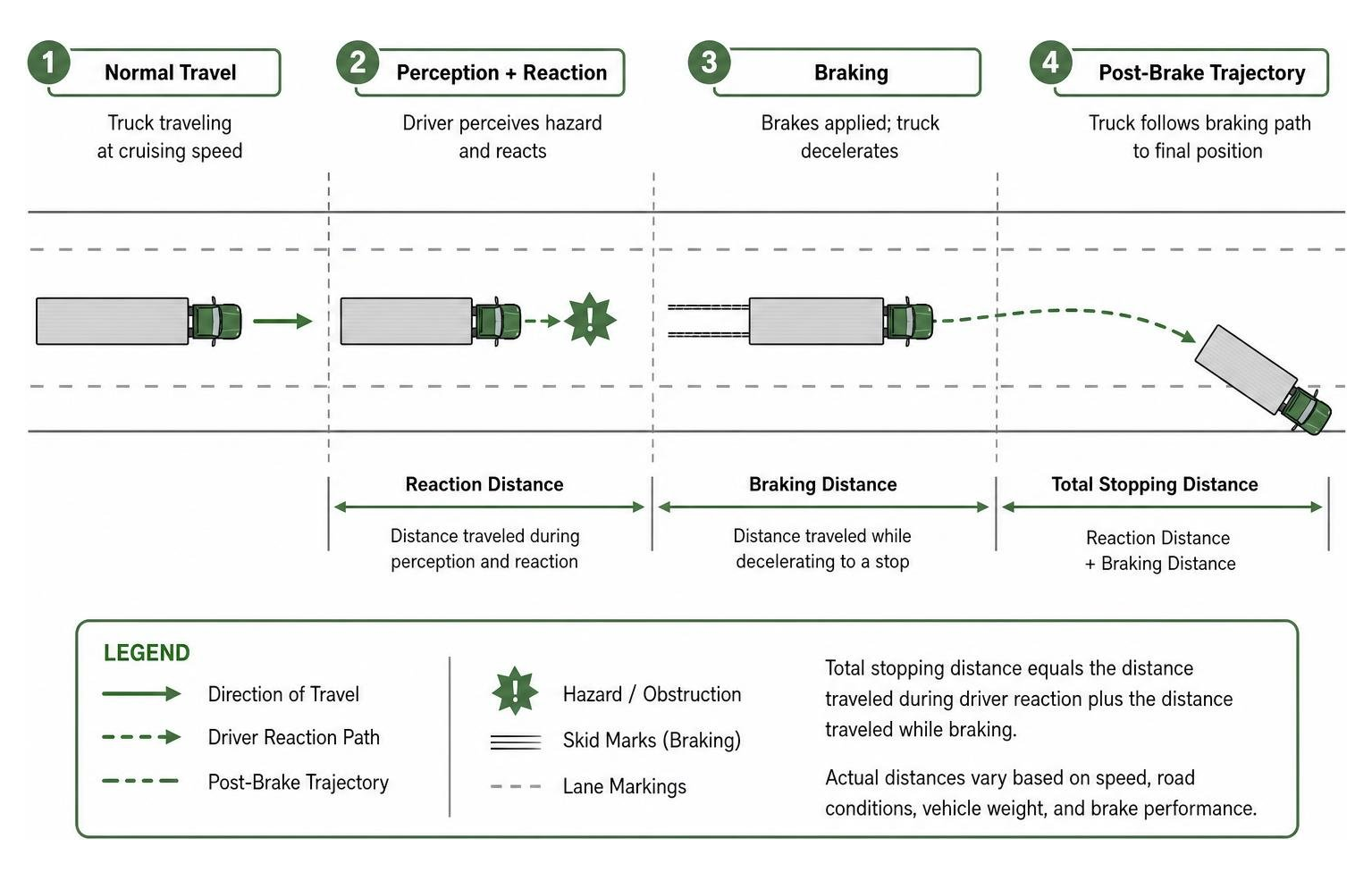
Proving liability in high-stakes commercial cases often requires top forensic specialists. We collaborate closely with board-certified accident reconstruction engineers who analyze physical evidence from the scene, including:
- Yaw marks, gouge marks, and skid patterns on the pavement to measure initial braking speeds.
- Crush damage analysis on all vehicles involved to calculate exact impact angles and transfer of energy.
- Full mechanical audits of the tractor-trailer, including pre-trip inspection logs, air brake pushrod travel, and tire tread depth.
This rigorous technical analysis helps demonstrate safety rule violations and defeats common defense tactics that attempt to shift blame onto passenger vehicle drivers.
Common Causes, Catastrophic Injuries, and Recoverable Damages
Truck crashes often stem from a combination of driver error and systematic corporate neglect. When an 18-wheeler collides with a passenger car, the physical consequences are usually severe.
Common causes of commercial truck collisions include:
- Driver Drowsiness & Sleep Apnea: Falling asleep behind the wheel or suffering from micro-sleeps due to excessive driving schedules.
- Distracted Driving: Texting, adjusting fleet dispatch computers, or using cell phones while navigating heavy highway traffic.
- Improper Maintenance: Neglected brake systems, worn-out tires susceptible to blowouts, and missing safety lights.
- Unsafe Driving Behavior: Tailgating, aggressive lane changes, speeding through construction zones, and taking curves too quickly.
These collisions often cause severe, life-altering injuries, including traumatic brain injuries (TBI), severe spinal cord damage and paralysis, crushed limbs requiring amputation, internal organ damage, and extensive bone fractures. In the worst cases, these crashes result in tragic losses of life, leading to fatal truck accident wrongful death claims.
Severe Crash Dynamics: Jackknifes, Rollovers, and Blind Spots
Commercial tractor-trailers behave very differently from standard automobiles due to their length, articulated joints, and high center of gravity.
- Jackknife Accidents: When a truck’s drive wheels lock up on wet or icy roads, the trailer can swing outward perpendicular to the cab, sweeping across multiple lanes of traffic. To understand these dynamic wrecks better, review our guide on understanding dangerous jackknife crashes.
- Rollover and Tip-Over Crashes: Shifting freight or improper weight distribution creates extreme instability. Learn more about overloaded truck accident risks and liability to see how improper cargo loading causes massive tip-overs.
- Blind Spot (“No-Zone”) Collisions: Tractor-trailers have massive blind spots along their right side, rear, front, and left quarter panels. For more on navigating near large rigs, read our breakdown on semi-truck blind spot and No-Zone collisions.
- Underride Collisions: These occur when a passenger vehicle slides underneath the trailer’s side or rear, often shearing off the passenger cabin.
How 18 Wheeler Accident Lawyers Calculate Economic and Non-Economic Compensation
Because commercial truck crashes cause extensive trauma, calculating the true value of your claim requires a comprehensive assessment of both current and long-term financial impacts.
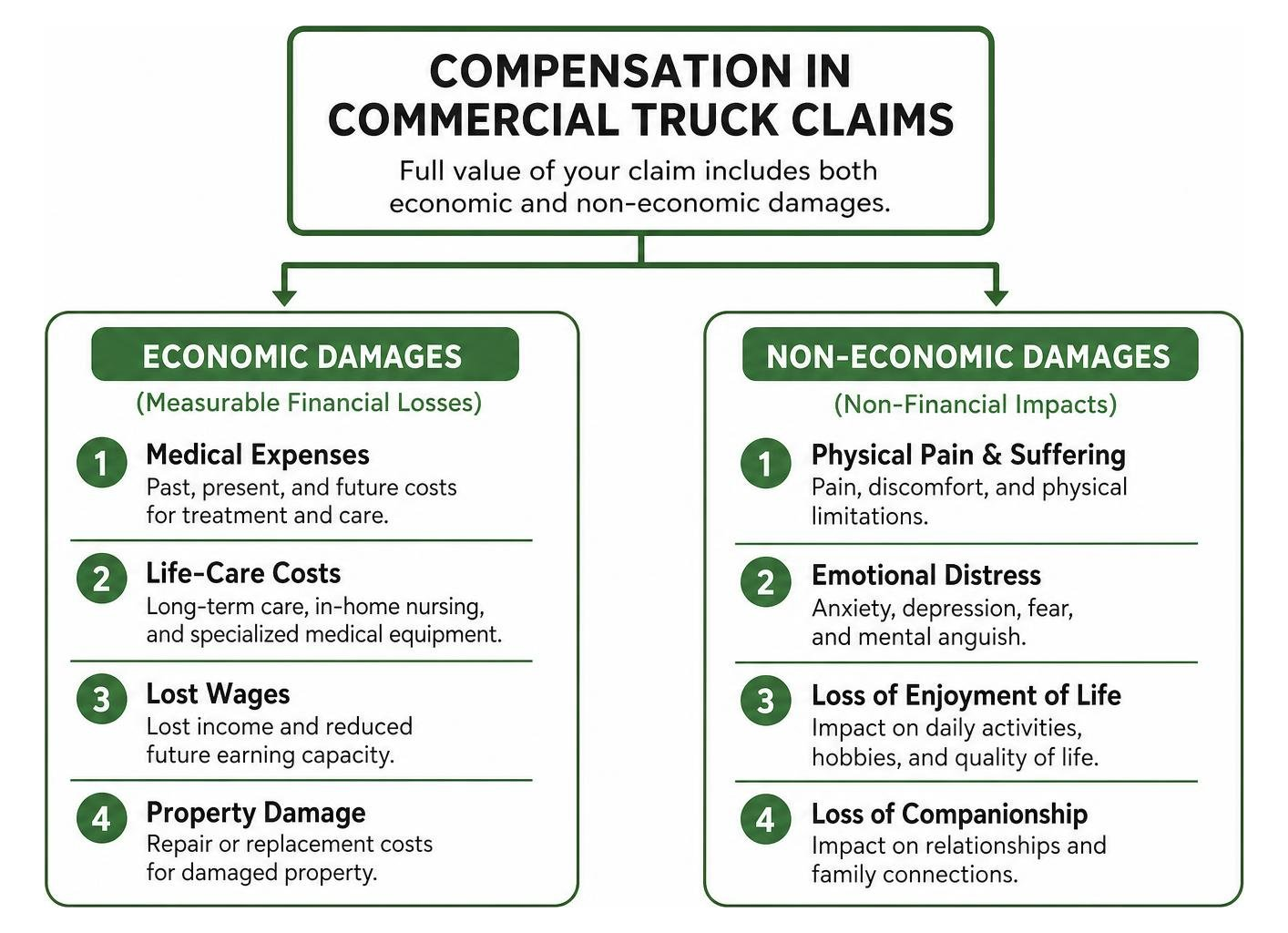
Economic Damages (Measurable Financial Losses):
- Past, present, and future medical expenses (surgeries, hospital stays, physical therapy).
- Long-term life-care plans for in-home nursing or specialized medical equipment.
- Lost wages and compensation for reduced future earning capacity.
- Property damage repair or replacement costs.
Non-Economic Damages (Intangible Human Losses):
- Physical pain, suffering, and physical impairment.
- Emotional distress, PTSD, and anxiety.
- Loss of consortium and diminished quality of life.
- Permanent disfigurement and scarring.
Punitive Damages: In cases involving gross negligence—such as a motor carrier intentionally falsifying logbooks or hiring an unlicensed driver with repeated DUI offenses—courts may award punitive damages to punish the wrongdoer and deter similar corporate misconduct.
Frequently Asked Questions About 18-Wheeler Collisions
What should I do immediately after an 18-wheeler accident?
Your priority after a crash is physical safety and medical care. If you are able, follow these steps to protect your health and legal rights:
- Call 911 Immediately: Ensure emergency medical services and police arrive at the scene so an official police accident report is filed.
- Seek Immediate Medical Evaluation: Even if you feel fine, adrenaline can mask severe internal bleeding, concussions, or spinal injuries. Always see a doctor right away.
- Document the Scene Safely: Take photographs and video of all vehicle damage, skid marks, road conditions, and the trucking company name and DOT numbers on the truck cab.
- Gather Driver and Witness Information: Collect names, phone numbers, commercial driver’s license (CDL) numbers, and insurance carrier details.
- Do Not Give Recorded Statements: Commercial insurance adjusters will reach out quickly to lock you into statements that minimize your claim. Do not sign anything or give recorded answers before consulting a lawyer.
What is the statute of limitations for filing an 18-wheeler accident lawsuit?
Under state personal injury laws, accident victims generally have two years from the date of the crash to file a personal injury lawsuit against negligent parties. If the accident resulted in a fatality, the family has two years from the date of death to file a wrongful death claim.
However, certain exceptions apply:
- Government Entities: If the truck was owned or operated by a municipal or state government body, formal notice of claim must often be filed within a much shorter window (sometimes as short as six months to one year).
- Minors: If the injured party was a minor at the time of the crash, the statutory clock is generally tolled until their 18th birthday.
Because evidence disappears quickly, you should never wait until the statutory deadline approaches to begin building your case.
How do contingency fees work when hiring legal representation?
At Cullotta Bravo Law Group, we represent truck accident victims on a contingency fee basis. This means:
- You pay zero upfront legal fees or out-of-pocket costs to retain our services.
- We cover all upfront case expenses, including hiring accident reconstruction engineers, gathering black box data, retaining medical specialists, and filing court documents.
- We only collect attorney fees if we successfully secure a financial settlement or jury verdict on your behalf.
- If we do not recover compensation for your case, you owe us nothing in legal fees.
This approach gives you access to experienced, aggressive legal representation regardless of your current financial situation, leveling the playing field against well-funded insurance corporations.
Conclusion
A collision with an 80,000-pound commercial semi-truck can change your life in seconds. Trucking corporations and their insurers move quickly to protect their bottom line, deploying adjusters and legal teams to minimize their payouts. You deserve an aggressive advocate on your side who moves just as quickly to preserve critical black box data, investigate safety rule violations, and demand fair compensation.
With more than 35 years of trial experience, Cullotta Bravo Law Group has recovered multi-million dollar settlements for injured clients across Chicagoland. We treat every client with dignity while fighting relentlessly against corporate trucking carriers.
If you or a loved one was injured in a commercial vehicle crash in Aurora, Chicago, Naperville, Joliet, or anywhere throughout Illinois, reach out to our dedicated team today. Consult an experienced Illinois truck accident attorney for a free, no-obligation case evaluation and let us help you get your life back on track.