

Workers Comp Lawyer Terms Demystified: Find a Qualified Attorney
What a Workers’ Comp Lawyer Does — and When You Need One
A workers comp lawyer is a licensed attorney who helps injured employees get the medical benefits, wage replacement, and disability compensation they are legally entitled to after a workplace injury.
Quick answer — here’s what you need to know:
- Workers’ comp covers medical bills, lost wages, and disability benefits regardless of fault
- You do not need to pay a workers’ comp lawyer upfront — they work on contingency (no win, no fee)
- Attorney fees are capped and must be approved by the governing board, then deducted from your award
- You should contact a lawyer immediately if your claim is denied, disputed, or involves a serious injury
- You may be able to file both a workers’ comp claim and a separate personal injury lawsuit if a third party caused your injury
- Illinois law strictly limits how long you have to file — missing deadlines can cost you everything
Getting hurt at work turns your life upside down fast. Medical appointments pile up. Paychecks stop coming. And the insurance company — which is not on your side — starts making calls.
The system is complex by design. Since 2003, lawmakers in 33 states have passed laws that reduce benefits or make it harder for injured workers to qualify. The odds are not always in your favor without experienced help.
I’m Peter Cullotta, founding partner at Cullotta Bravo Law Group, and I’ve spent over 35 years representing injured workers throughout the Chicagoland area as a workers comp lawyer — recovering millions in verdicts and settlements for people facing exactly what you’re going through. In the sections below, I’ll walk you through everything you need to know, in plain language, so you can protect your rights and make informed decisions.
Immediate Steps to Take After a Workplace Injury
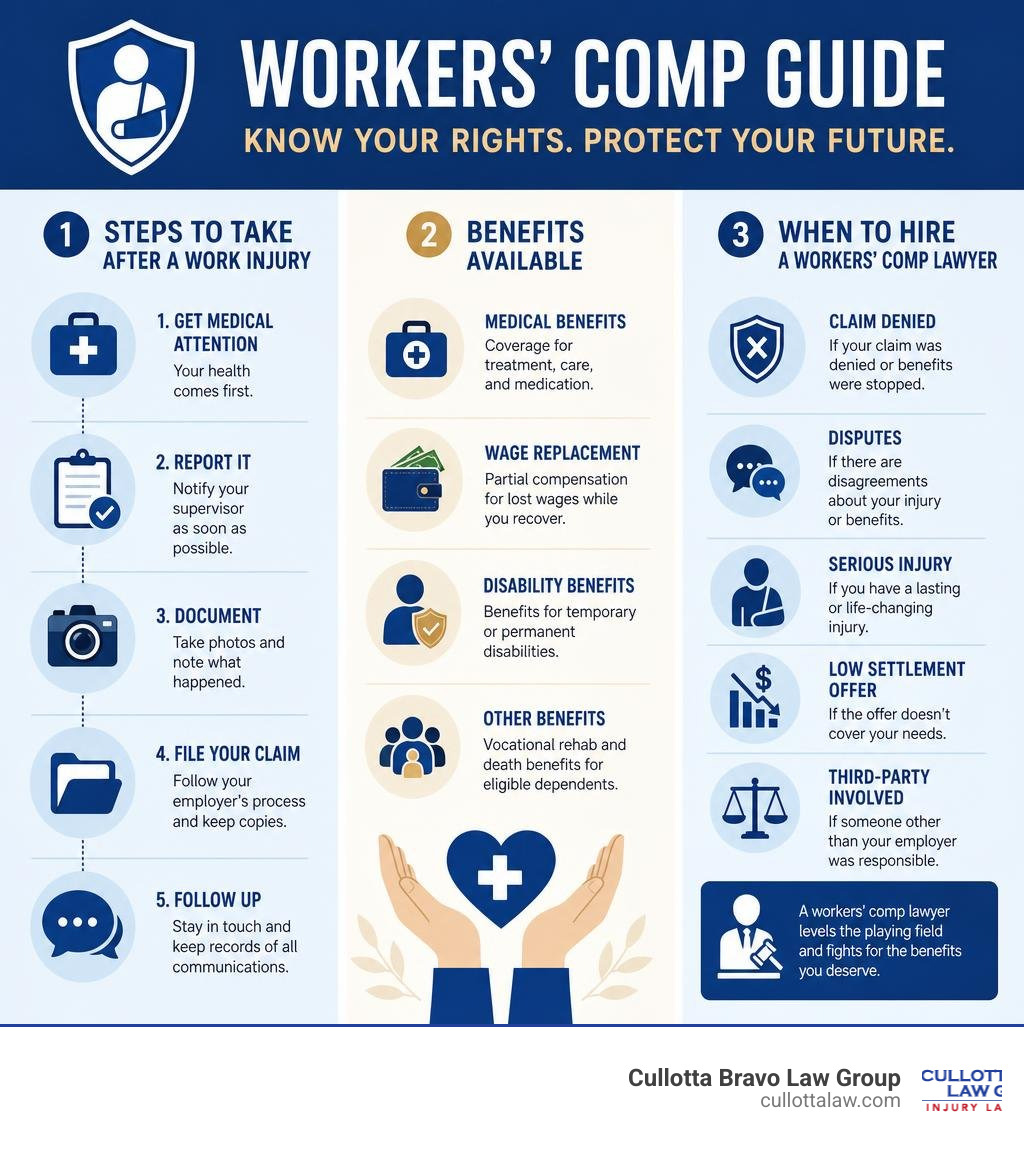
When you are injured on the job, your very first moves can make or break your entire claim. The insurance carrier is already looking for reasons to minimize your payout, so you must act quickly and systematically to protect yourself.
The absolute first priority is your physical safety. If you are experiencing an emergency, go to the nearest emergency room immediately. Do not worry about paperwork, employer networks, or who is paying the bill in those first critical minutes. Your health is irreplaceable.
Once your condition is stabilized, you need to begin navigating the formal claims process. If you are in Kane County or surrounding areas, reviewing our guide on Filing for Workers Comp in Aurora IL will give you a localized step-by-step roadmap. To avoid early missteps that insurance adjusters love to exploit, we highly recommend studying these 7 Mistakes That Can Hurt Your Workers Compensation Claim before you speak with any insurance representatives.
Reporting the Injury and Documenting the Scene
In Illinois, you must notify your employer of your injury. Under state rules, you have a strict limit of 45 days to report the accident. If you miss this window, you could lose your right to benefits entirely.
While verbal notice is technically permitted, we always advise providing written notice. Send an email, a text message, or fill out an official incident report, and keep a copy for your own records. Be clear about the date, time, location, and exactly how the injury occurred.
In addition to reporting, gather as much evidence as possible right away:
- Take Photographs: Document the exact scene of the accident, any faulty equipment, unsafe conditions, and your visible injuries.
- Collect Witness Information: Get the names, phone numbers, and written statements of any coworkers or bystanders who saw what happened.
- Request the Official Report: Ask your supervisor for a copy of the workplace’s internal injury report.
- Keep All Correspondence: Retain every email, text, and letter between you and your employer regarding the injury.
Demystifying Benefits and the Claims Process

Understanding what you are entitled to under Illinois law is the first step toward reclaiming your financial stability. Many injured workers do not realize that the workers’ compensation system is designed to provide comprehensive support, not just cover a couple of doctor visits.
The baseline for most financial benefits is your Average Weekly Wage (AWW). This calculation determines how much you receive in weekly disability checks. It is calculated by taking your gross earnings from the 52 weeks prior to your injury and dividing them by 52. If you missed significant time during those weeks, those periods should be excluded to prevent your average from being artificially lowered. Be careful: insurance adjusters frequently miscalculate this number, quietly shortchanging workers for months or even years.
Types of Benefits a Workers Comp Lawyer Can Secure
An experienced workers comp lawyer can help you secure several distinct categories of benefits depending on the nature and severity of your injuries:
- Medical Benefits: Your employer’s insurance must cover 100% of all reasonable and necessary medical care related to your work injury. This includes surgeries, physical therapy, medications, and medical devices. There are no copays or deductibles for you to pay.
- Temporary Total Disability (TTD): If your doctor states you cannot work while recovering, or if your employer cannot accommodate your temporary light-duty restrictions, you are entitled to TTD benefits. In Illinois, TTD pays two-thirds (66.7%) of your Average Weekly Wage tax-free.
- Permanent Partial Disability (PPD): If you recover but are left with permanent physical limitations, you may qualify for PPD. This compensates you for the permanent loss of use of a body part or a general loss of earning capacity. To understand how to maximize this, read our guide on Partial Disability Claims in Illinois How to Improve Your Chance of Success.
- Permanent Total Disability (PTD): If your injuries are so severe that you can never return to gainful employment, you may be eligible for weekly lifetime payments. Learn more about these critical benefits in our breakdown of Permanent Total Disability.
- Vocational Rehabilitation: If you can no longer perform your old job, you may be entitled to professional retraining, resume help, and job search assistance paid for by the insurer.
- Death Benefits: If a workplace tragedy results in a loss of life, surviving spouses and dependents can recover significant financial support. We explain this sensitive process in our guide on Death Benefits.
Navigating the Claims Process and Timeline
Once you report your injury, your employer should notify their insurance carrier. The insurer then has 14 days to either begin paying TTD benefits or issue a formal letter explaining why your claim is delayed or denied.
If your claim is accepted, you will receive medical treatment and weekly checks while you recover. However, if the insurance adjuster disputes your medical treatment, cuts off your benefits prematurely, or offers a lowball settlement, your case will need to be filed formally with the Illinois Workers’ Compensation Commission (IWCC).
Resolving a disputed claim can take anywhere from a few months to several years, especially if it requires formal hearings, depositions from medical experts, and appeals. Having a dedicated legal team ensures your case moves through the IWCC system as efficiently as possible.
When to Hire a Workers Comp Lawyer and How They Are Paid

Many workers wonder if they truly need an attorney. If your injury was minor, required only one doctor visit, and you missed no work, you can likely handle it on your own. However, if your injuries are serious or your employer is uncooperative, trying to navigate the system alone is a major risk.
Signs You Need a Workers Comp Lawyer
You should absolutely contact an attorney if you experience any of the following warning signs:
- Your claim is denied: The insurance company sends a letter stating your injury didn’t happen at work or is a pre-existing condition.
- Your medical treatment is delayed or denied: The adjuster refuses to authorize a surgery, MRI, or physical therapy recommended by your doctor.
- You are pressured to return to work: Your employer or the insurance company tries to force you back to work before your doctor has cleared you.
- You have a pre-existing condition: The insurer is trying to blame your current workplace pain on an old injury.
- Your injury is catastrophic: You have suffered a traumatic brain injury, spinal damage, or severe joint damage. If you are researching local representation, you can read our Detailed Reviews of the Top 10 Workers Compensation Attorneys to understand what sets elite firms apart.
Understanding Contingency Fees and Board Approval
One of the biggest hurdles keeping injured workers from seeking legal help is the fear of high attorney fees. Fortunately, the workers’ compensation system is designed to be completely accessible to everyone, regardless of their financial situation.
Workers’ compensation lawyers work on a contingency fee basis. This means:
- No Upfront Costs: You do not pay anything out-of-pocket to hire us. We cover all the upfront costs of gathering medical records, hiring experts, and filing paperwork.
- No Win, No Fee: If we do not secure a financial recovery or settlement for you, you owe us absolutely nothing for our legal services.
- Strictly Regulated Fees: In Illinois, workers’ comp attorney fees are capped by law at 20% of your recovered settlement or award. Furthermore, all legal fees must be formally approved by an arbitrator at the Illinois Workers’ Compensation Commission before they can be paid. The insurance carrier deducts this approved fee directly from your final financial award, so you never have to write a check.
Workers’ Comp vs. Third-Party Personal Injury Lawsuits
One of the most critical legal distinctions to understand after a workplace accident is the difference between a standard workers’ compensation claim and a third-party personal injury lawsuit.
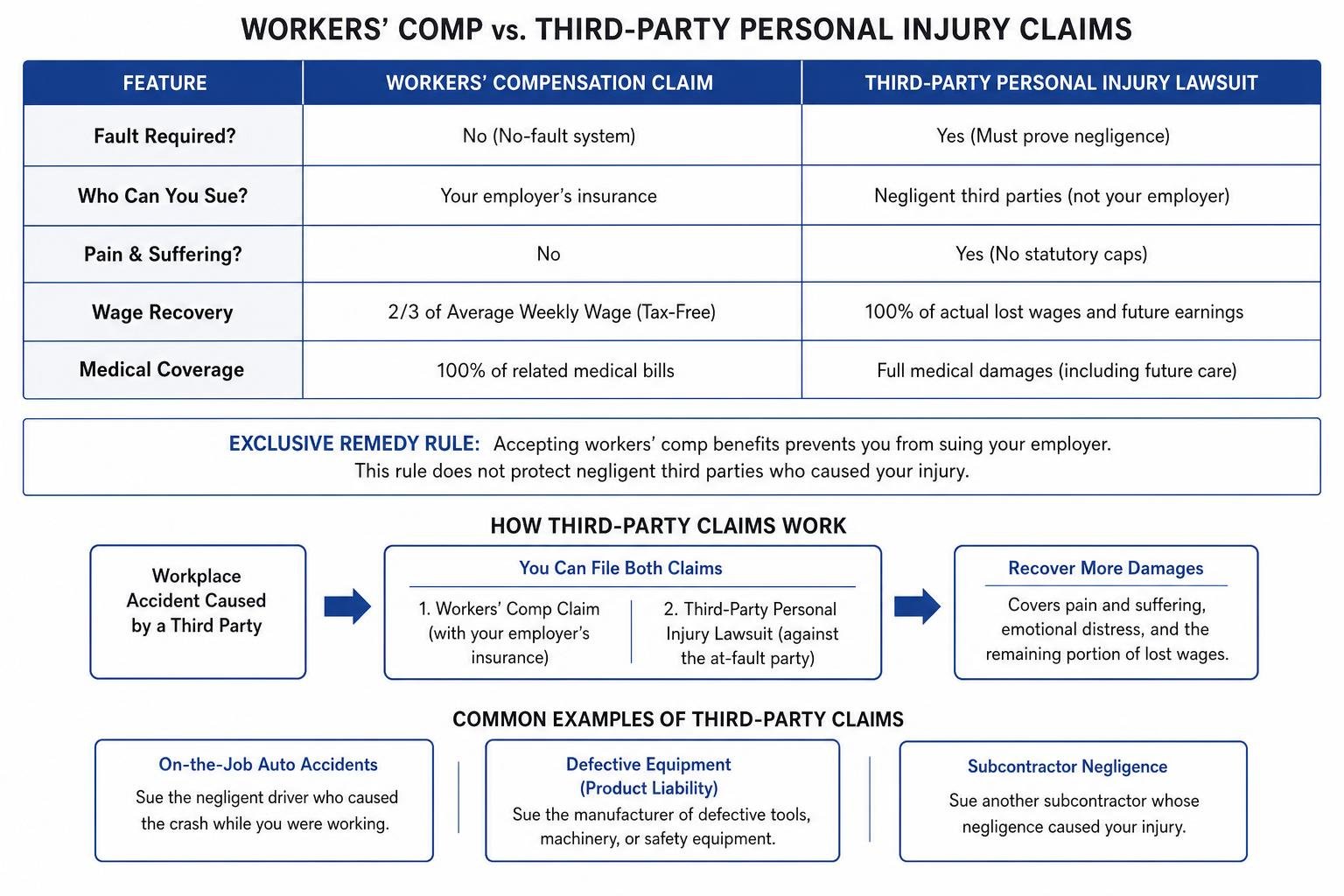
| Feature | Workers’ Compensation Claim | Third-Party Personal Injury Lawsuit |
|---|---|---|
| Fault Required? | No (No-fault system) | Yes (Must prove negligence) |
| Who Can You Sue? | Your employer’s insurance | Negligent third parties (not your employer) |
| Pain & Suffering? | No | Yes (No statutory caps) |
| Wage Recovery | 2/3 of Average Weekly Wage (Tax-Free) | 100% of actual lost wages and future earnings |
| Medical Coverage | 100% of related medical bills | Full medical damages (including future care) |
Accepting workers’ compensation benefits generally prevents you from suing your employer directly in civil court. This is known as the exclusive remedy rule. However, this rule does not protect negligent third parties who contributed to your injuries.
The Exclusive Remedy Rule and Third-Party Liability
If a third party — someone other than your employer or a direct coworker — caused your injury, you can pursue both a workers’ comp claim and a personal injury lawsuit simultaneously.
Common examples of third-party claims include:
- On-the-Job Auto Accidents: If you are a delivery driver or traveling for work and are struck by a negligent driver, you can file a workers’ comp claim with your employer and a personal injury claim against the at-fault driver. Read more about this in our guide on Workers Compensation on the Job Vehicle Accidents.
- Defective Equipment (Product Liability): If you are injured because a heavy machine, power tool, or safety device malfunctioned due to a manufacturing defect, you can sue the equipment manufacturer.
- Subcontractor Negligence: On busy construction sites, if an employee of a completely different subcontractor drops materials on you or leaves a dangerous hazard, they can be held liable.
By filing a third-party lawsuit, you can recover damages that workers’ comp doesn’t cover, such as physical pain and suffering, emotional distress, and the remaining portion of your lost wages.
Handling Denials, Appeals, and Employer Retaliation
It is incredibly common for insurance companies to issue initial denials. They do this hoping you will simply give up and go away. If you receive a denial letter, do not panic — it is simply the beginning of the legal fight.
To understand the full appeals process and how we systematically dismantle insurance company excuses, consult our comprehensive Denied Workers Comp Guide 2026.
Common Reasons for Claim Denials
Insurance adjusters use a predictable playbook when denying claims. Some of the most common excuses include:
- Delayed Reporting: Claiming you didn’t notify your supervisor within the 45-day window.
- Lack of Medical Evidence: Arguing that your medical records do not clearly link your pain to a specific workplace incident.
- Pre-Existing Conditions: Claiming your injury is just natural degeneration or the result of an old sports injury.
- No Witness Verification: Asserting that because no one saw you fall, it didn’t happen.
We combat these denials by gathering comprehensive medical testimony, securing independent medical evaluations, and presenting clear, undeniable timelines of your accident.
Can You Be Fired for Filing a Claim?
Many injured workers suffer in silence because they are terrified of losing their jobs. We want to make this as clear as possible: It is strictly illegal under Illinois law for an employer to fire, demote, harass, or retaliate against you for filing a workers’ compensation claim.
If your employer fires you because you filed a claim, you may have grounds for a highly lucrative retaliatory discharge (wrongful termination) lawsuit. The law protects your right to seek medical care and financial support after an on-the-job injury.
Frequently Asked Questions About Workers’ Compensation
Navigating the workers’ compensation system naturally brings up many questions. Here are clear, direct answers to the questions we hear most frequently at our firm.
How long do I have to file a workers’ comp claim in Illinois?
In Illinois, there are two critical deadlines you must meet:
- Notice to Employer: You must notify your employer of the injury within 45 days of the accident.
- Statute of Limitations: You must file a formal Application for Adjustment of Claim with the Illinois Workers’ Compensation Commission (IWCC) within three years from the date of the injury, or within two years from the date you last received a workers’ comp benefit payment (whichever is later).
What is Maximum Medical Improvement (MMI)?
Maximum Medical Improvement (MMI) is a formal designation made by your treating physician. It means your condition has stabilized and is unlikely to improve any further with additional medical treatment.
Reaching MMI is a major pivot point in your case:
- It means your temporary benefits (TTD) will likely stop.
- It is the moment we assess whether you have permanent restrictions or a permanent disability.
- It allows us to calculate the true value of your case and begin negotiating a final lump-sum settlement.
Can I choose my own doctor for a work injury?
Yes, in Illinois, you generally have the right to choose your own treating doctor. Under the state’s “two-doctor rule,” you can select up to two primary medical providers of your own choosing, and the insurer must cover them and any specialists they refer you to.
However, if your employer has an approved Preferred Provider Program (PPP) network, you must choose a doctor within that network, or use one of your two “choices” to opt out of the PPP in writing. Always consult an attorney before making major medical transitions to ensure your bills remain covered.
Conclusion
Sustaining a workplace injury is a stressful, overwhelming experience, but you do not have to carry the burden alone. The insurance companies have teams of lawyers and adjusters working every day to protect their bottom lines — you deserve to have an aggressive, experienced legal team protecting yours.
At Cullotta Bravo Law Group, we have spent over 35 years fighting for injured workers in Aurora, Chicago, Naperville, Joliet, and across Illinois. We pride ourselves on providing aggressive legal representation while treating every single client with the dignity, respect, and compassion they deserve. Our track record of multi-million dollar settlements speaks for itself.
If you or a loved one has been injured on the job, do not wait until the insurance company denies your claim. Contact us today for a free, no-obligation consultation, or visit our main Workers Compensation page to learn more about how we can help you secure the maximum benefits you are legally owed.