

Detailed Reviews of the Top 10 Workers’ Compensation Attorneys
When You’re Hurt at Work, a Workers’ Compensation Attorney Can Make All the Difference
A workers’ compensation attorney is a lawyer who helps injured employees get the medical care and wage replacement benefits they’re legally owed after a workplace injury.
Quick answer — here’s what you need to know:
- Workers’ comp is a no-fault insurance system that covers most employees injured on the job
- Benefits include medical treatment, wage replacement, disability payments, and death benefits
- You do not need to prove your employer was negligent to qualify
- Injured workers represented by attorneys receive settlements averaging 20–40% higher than those without legal help
- Most workers’ comp attorneys work on contingency — you pay nothing unless you win
Every year, millions of American workers get hurt on the job. The U.S. Bureau of Labor Statistics reported 2.6 million nonfatal workplace injuries and illnesses in 2023 alone. Many of those workers face the same situation: they’re dealing with pain and recovery while also fighting an insurance company that wants to pay as little as possible.
The system is supposed to protect you. But in practice, claims get denied, benefits get delayed, and insurance adjusters use tactics most injured workers don’t see coming.
That’s where having the right attorney changes everything.
I’m Peter Cullotta, founding partner of Cullotta Bravo Law Group, and over my 35 years as a trial lawyer in the Chicagoland area I’ve represented hundreds of injured workers as a workers’ compensation attorney, helping them secure the full benefits they deserve against powerful insurance carriers. If you’ve been hurt at work and aren’t sure what to do next, this guide will walk you through everything — from understanding your rights to finding the right legal representation.
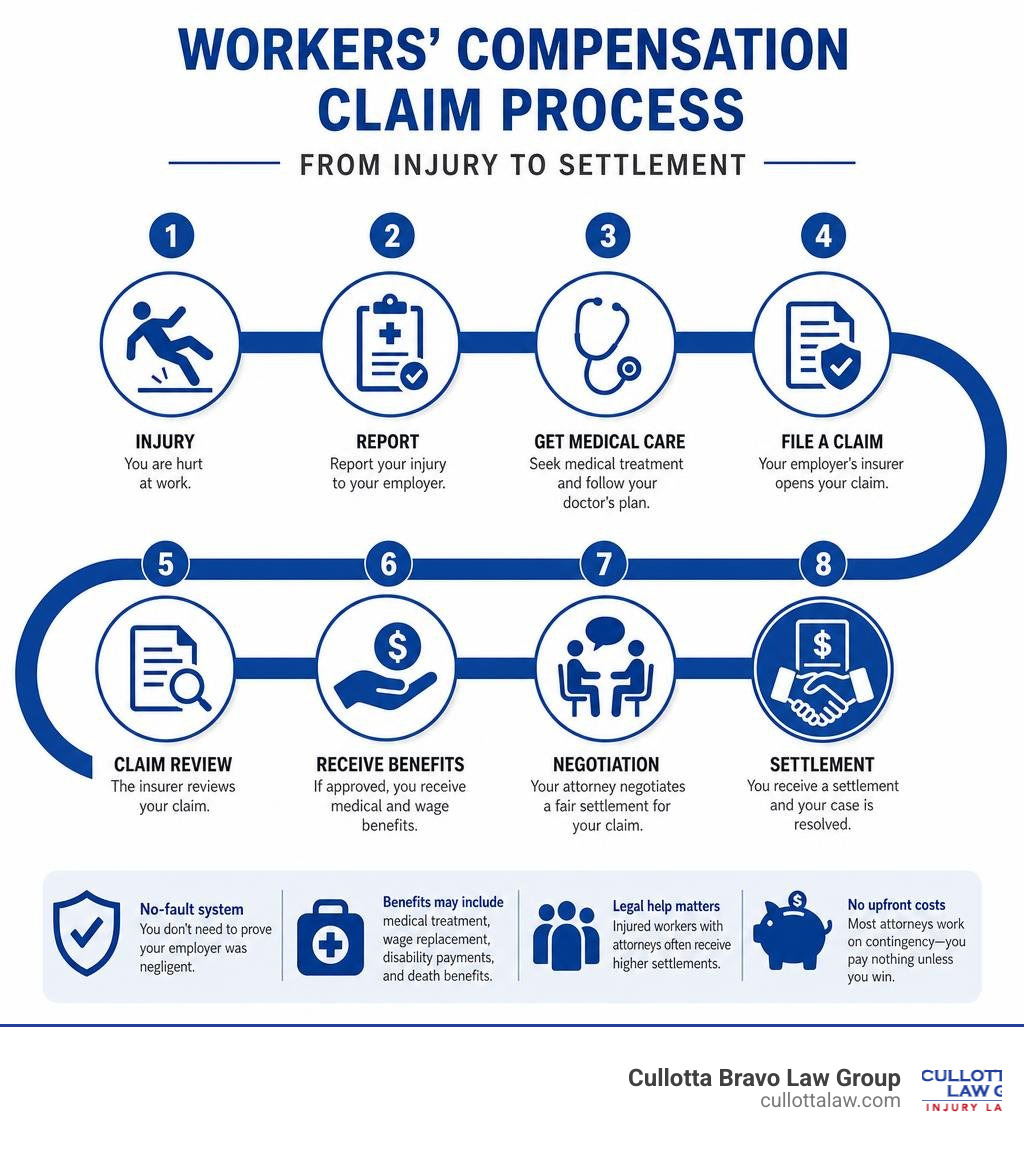
Understanding Workers’ Compensation and Your Rights as an Employee

At its core, the workers’ compensation system is a historic compromise between employers and employees. Workers give up their right to sue their employers in civil court for negligence, and in exchange, employers provide a streamlined, no-fault insurance system that covers medical treatment and lost wages.
Under the Illinois Workers’ Compensation Act, this system is designed to provide quick relief. If you are injured in the course of your employment, you are entitled to comprehensive benefits. These include:
- Complete Medical Care: Coverage for all “reasonably necessary” medical treatment to cure or relieve the effects of your injury.
- Temporary Total Disability (TTD): Weekly cash benefits to replace lost wages while you are unable to work. In Illinois, this is typically two-thirds (66.67%) of your average weekly wage.
- Permanent Disability Benefits: Compensation if your injury leaves you with permanent physical limitations, whether partial (PPD) or total (PTD).
- Vocational Rehabilitation: Training or physical therapy to help you transition into a new role if you can no longer perform your old job.
Navigating these benefits can quickly become overwhelming, especially when insurance companies attempt to limit your medical options or cut off your weekly checks early. To understand how the law protects you throughout this process, read our comprehensive guide on Workers Compensation.
Who Qualifies for Benefits and What Injuries Are Covered?
Almost every W-2 employee in Illinois is covered by workers’ compensation from their very first day on the job. This includes full-time, part-time, seasonal, and even some temporary workers.
The primary requirement is that the injury must “arise out of and in the course of employment.” This means the injury must be directly connected to your work duties. Covered injuries generally fall into several categories:
- Acute Traumatic Injuries: Sudden accidents such as slips, trips, falls, machinery accidents, and heavy lifting incidents. These frequently cause severe orthopedic damage. To learn more about how we handle these cases, check out Workers Compensation Orthopedic Injuries.
- Repetitive Strain Injuries: Damage caused by performing the same motion thousands of times over months or years. A classic example is carpal tunnel syndrome from typing or assembly line work, or shoulder issues like those covered in our guide on Workers Compensation Torn Rotator Cuff Injuries.
- Occupational Diseases: Illnesses contracted due to prolonged exposure to hazardous materials, toxic chemicals, or extreme environments at work.
- Mental Health and Stress: Psychological conditions caused by severe, abnormal workplace stress or sudden traumatic events on the job. You can read more about this in our article on Stress at Work: How to Navigate Mental Health Workers Compensation Claims.
How State Laws Differ Across the United States
While the fundamental concept of workers’ compensation is similar nationwide, the specific laws, benefit calculations, and procedural rules vary significantly by state.
- Illinois: Governed by the Illinois Workers’ Compensation Commission (IWCC). Illinois features strong protections for injured workers, including the right to choose your own treating doctors (within certain limits) and robust permanent partial disability benefits.
- California: Features a massive system with 23 district offices. California relies heavily on evidence-based medical treatment guidelines (MTUS) and strict, complex permanent disability rating schedules.
- Massachusetts: Governed by Chapter 152 and administered by the Department of Industrial Accidents (DIA). Weekly benefits start after five days of missed work unless the disability lasts 21 days or more.
- New York: Allows both licensed non-attorney representatives and attorneys to represent claimants. All legal fees must be approved by the Workers’ Compensation Board and are deducted directly from the worker’s award.
- North Carolina: Offers robust benefits but has a highly formalized board-certification process for legal specialists, regulated by the state bar.
- Washington: Features a unique state-run monopoly system where the Department of Labor & Industries (L&I) acts as the sole insurer for most employers.
Because these state laws are so distinct, it is critical to work with a local workers’ compensation attorney who understands the specific statutes, administrative codes, and local court systems of your state.
How to Choose the Best Workers Compensation Attorney for Your Case

Selecting the right legal advocate is the single most important decision you will make after a workplace injury. The insurance company employs experienced adjusters and defense lawyers whose primary goal is to minimize your payout. You deserve an equally skilled representative to level the playing field.
When evaluating potential law firms, you should look for several key indicators of quality:
- Exclusive or Heavy Focus on Workers’ Comp: Laws change rapidly. An attorney who handles divorce, traffic tickets, and occasionally workers’ comp will not have the deep procedural knowledge required for complex cases.
- Trial Experience: While most cases settle, your attorney must be prepared and willing to take your claim to trial before an arbitrator if the insurance company refuses to offer a fair settlement.
- Reputation and Client Reviews: Look for genuine testimonials from former clients that highlight communication, empathy, and successful outcomes.
What to Look For in a Workers Compensation Attorney
When you meet with an attorney for an initial consultation, ask specific questions about their experience and fee structure.
First, confirm that they operate on a contingency fee basis. In Illinois, workers’ comp attorney fees are capped by law at 20% of your recovered benefits, and you should never have to pay any upfront or out-of-pocket costs. If a firm asks for a retainer fee to start your workers’ comp case, walk away.
Second, ask about their history of securing settlements and awards. While past results do not guarantee future outcomes, a proven track record demonstrates that the firm knows how to maximize the value of a claim. For detailed insights on how settlements are negotiated and calculated, consult our guide on working with a Workers Comp Settlement Attorney.
Finding a Qualified Illinois Workers Compensation Attorney
If you live or work in Illinois, you need a firm that understands the local landscape. The Illinois Workers’ Compensation Commission (IWCC) handles all disputes, and hearings are held at specific regional venues depending on where your injury occurred.
For those in the Chicago metropolitan area, finding representation with deep local roots is essential. If you are looking for vetted specialists in Cook County, you can browse the Best Chicago, IL Workers’ Compensation Attorneys to see peer-nominated professionals.
If your injury occurred in Will County or DuPage County, local representation is equally critical. Navigating the specific procedures in Naperville, Joliet, and surrounding areas requires an attorney who regularly practices in these local venues and understands how local arbitrators handle cases.
At Cullotta Bravo Law Group, we regularly represent clients across these jurisdictions. If you are specifically seeking representation in Joliet, we invite you to review our dedicated resources on finding Top Rated Joliet Workers Compensation Lawyers for Your Injury Claim and our guide on Finding the Best Workers Compensation Lawyers Joliet Can Provide.
Step-by-Step Guide to Filing a Claim and Avoiding Common Mistakes
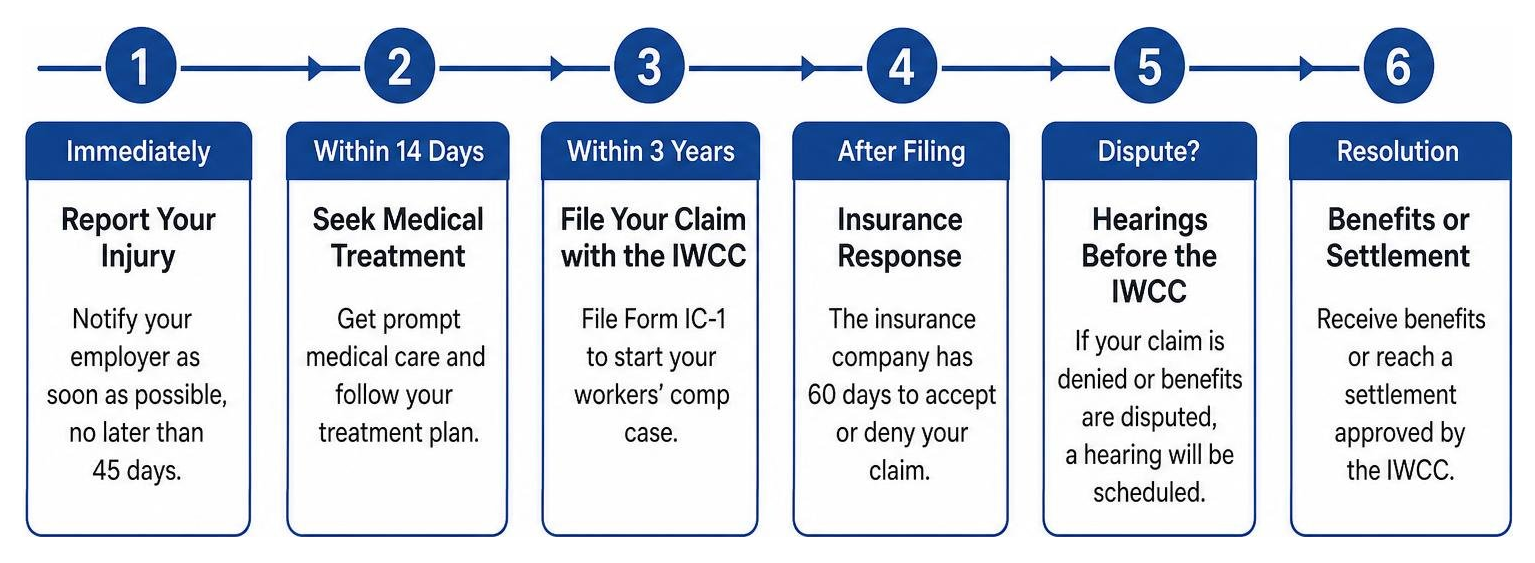
The workers’ compensation process is governed by strict timelines and procedural hurdles. A single misstep can give the insurance company the ammunition they need to deny your claim entirely. To protect yourself from these pitfalls, read our detailed article on 7 Mistakes That Can Hurt Your Workers Compensation Claim.
Immediate Steps to Take After a Workplace Injury
If you are injured on the job, take the following steps immediately:
- Seek Medical Attention: Your health is the top priority. Go to an emergency room, urgent care, or your primary care physician right away. Be completely honest with the medical staff and explicitly state that your injury occurred at work.
- Notify Your Employer: In Illinois, you must notify your employer of your injury within 45 days of the accident. It is highly recommended to do this in writing (via email or text) so you have a paper trail. If you fail to notify your employer within this timeframe, you may lose your right to benefits.
- Document Everything: Write down exactly what happened before, during, and after the accident. Take photos of the accident scene, your injuries, and any equipment involved. Keep copies of all medical records, work restriction notes, and receipts for out-of-pocket medical expenses.
- File a Formal Claim: Reporting the injury to your boss is not the same as filing a legal claim. To protect your rights, your attorney must file an Application for Adjustment of Claim with the IWCC. The statute of limitations in Illinois generally requires this to be filed within three years of the date of injury, or within two years of the last compensation payment, whichever is later.
For residents of Kane County, we have put together localized guides to help you navigate this process, including Filing for Workers Comp in Aurora IL. We also specialize in representing specific high-risk professions; if you drive for a living, check out our guide on Workers Compensation for Truck Drivers Aurora.
Navigating Complex Claims and Pre-Existing Conditions
One of the most common tactics insurance companies use to deny claims is pointing to a “pre-existing condition.” They will argue that your back pain, knee pain, or shoulder issue is simply a result of aging or an old sports injury, rather than your work duties.
However, under Illinois law, a pre-existing condition does not disqualify you from receiving benefits. If a workplace accident aggravated, accelerated, or worsened an existing condition, the employer is still fully responsible for your medical care and lost wages.
These cases require sophisticated medical evidence, expert opinions, and careful legal strategy. Our firm specializes in handling these highly complex claims, including:
- Partial Disability Claims in Illinois: How to Improve Your Chance of Success
- The Essential Guide to Navigating Workers Comp for Brain Injuries
Furthermore, we stay on top of evolving regulatory updates. For example, during the pandemic, rules shifted rapidly. You can review how these changes impacted the legal landscape in our articles on the Omicron and Workers Compensation Update and the Illinois Workers Comp Coronavirus Rule Repealed.
What to Do If Your Claim Is Denied or Your Employer Lacks Insurance
Receiving a denial letter from an insurance company can be incredibly stressful, but it is not the final word. Many initial denials are simply a strategic hurdle designed to see if you will give up.
| Feature | Workers’ Compensation Claim | Third-Party Personal Injury Lawsuit |
|---|---|---|
| Fault Required? | No (No-fault system) | Yes (Must prove negligence) |
| Who is Sued? | Employer’s Insurance Carrier | Negligent third party (not your employer) |
| Pain & Suffering? | Not covered | Covered (fully compensable) |
| Wage Benefits | Typically 66.67% of average weekly wage | 100% of past and future lost earning capacity |
| Medical Choice | Restricted to employer’s network/approved doctors | Complete freedom to choose any doctor |
If your claim is denied, or if you discover your employer has acted unlawfully, an experienced workers’ compensation attorney can help you fight back. For a comprehensive breakdown of your options, read our Denied Workers Comp Guide 2026.
Appealing a Denied Claim with Legal Help
To appeal a denial, your attorney will file a petition for an expedited hearing under Section 19(b) of the Illinois Workers’ Compensation Act. This process allows us to present evidence before an IWCC arbitrator to force the insurance company to pay for immediate medical treatment and retroactive TTD benefits.
Insurance companies deny claims for many reasons, but some of the most common include:
- Lack of Witness Corroboration: Claiming no one saw the accident happen.
- Delayed Reporting: Arguing that because you didn’t report it on day one, it didn’t happen at work.
- Discrepancies in Medical Records: Pointing to minor inconsistencies in how you described the accident to different doctors.
- Employee Misclassification: Claiming you are an “independent contractor” rather than an employee to avoid paying benefits. If you believe you have been mislabeled, check out our guide on Workers Compensation for Misclassified Workers.
Third-Party Lawsuits and Employer Liability
While the “exclusive remedy” rule generally prevents you from suing your employer in civil court, there are important exceptions. If a third party (someone other than your employer or a co-worker) caused your injury, you can file a separate personal injury lawsuit in addition to your workers’ comp claim.
Common third-party scenarios include:
- On-the-Job Vehicle Accidents: If you are hit by a negligent driver while running work errands or driving a delivery truck. Learn more about your rights in this scenario by reading On the Job Vehicle Accidents.
- Defective Equipment: If a machine, tool, or safety device malfunctions due to a manufacturing or design defect.
- Premises Liability / Third-Party Crimes: If you are injured due to dangerous conditions or lack of security on a property owned by someone else. To understand employer and third-party liability in dangerous environments, read Is Your Employer Liable If Youre Injured During a Crime at Work.
Frequently Asked Questions about Workers’ Compensation
How long does a workers’ compensation case typically take to resolve?
The timeline of a workers’ comp case depends entirely on your medical recovery. We generally advise against settling a claim until you have reached Maximum Medical Improvement (MMI). MMI is the point at which your doctor determines your condition has stabilized and is unlikely to improve further.
If you settle before reaching MMI, you may forfeit your right to have future medical treatments paid for by the insurance company. Once you reach MMI:
- Simple cases with clear liability can resolve in 6 to 12 months.
- Complex cases involving surgeries, disputed permanent disability, or appeals can take 18 to 24 months or longer.
Can I still sue my employer in addition to filing a workers’ comp claim?
Generally, no. Under the exclusive remedy provision of the Illinois Workers’ Compensation Act, you cannot sue your employer for negligence in exchange for receiving no-fault workers’ comp benefits. However, as discussed above, you can pursue civil damages through a third-party lawsuit if an outside party’s negligence contributed to your injury.
What happens if my employer does not carry workers’ compensation insurance?
In Illinois, carrying workers’ compensation insurance is mandatory for almost all employers. Operating without it is a serious criminal offense. If your employer does not have insurance, you can file a claim against the Illinois Workers’ Compensation Commission Injured Workers’ Benefit Fund, which is specifically designed to provide benefits to employees of uninsured businesses. You may also have the right to sue your uninsured employer directly in civil court.
Conclusion
A workplace injury can throw your entire life into chaos. You shouldn’t have to fight a multi-billion dollar insurance company alone while trying to heal.
At Cullotta Bravo Law Group, we have over 35 years of experience providing aggressive legal representation to injured workers in Aurora, Chicago, Naperville, and Joliet. We treat every client with the dignity they deserve, and we have a proven history of securing multi-million dollar settlements.
If you have been injured on the job, don’t wait for the insurance company to make the first move. Contact us today for a free, confidential consultation. We operate on a contingency fee basis, meaning you pay absolutely nothing unless we win your case. Let us fight for the benefits you deserve.
For more information or to speak with our legal team, visit our Cullotta Bravo Law Group Workers’ Compensation Portal.