

Stress at Work: How to Navigate Mental Health Workers Compensation Claims
When Work Breaks You Down: What Mental Health Workers Compensation Really Covers
Mental health workers compensation is a legal system that allows employees to claim benefits for psychological injuries caused by their job — just like a broken arm or a back injury.
Here’s a quick answer if you need it now:
Can you get workers’ comp for a mental health condition?
- Yes, in most states — but the rules are stricter than for physical injuries
- You generally need a formal diagnosis (such as PTSD, anxiety, or depression) from a licensed psychiatrist or psychologist
- The condition must be directly caused or significantly worsened by your job
- Some states cover stress-only claims; others require a physical injury first
- First responders often have stronger protections through PTSD presumption laws
- Filing deadlines are strict — often 30 days to notify your employer and 2 years to file
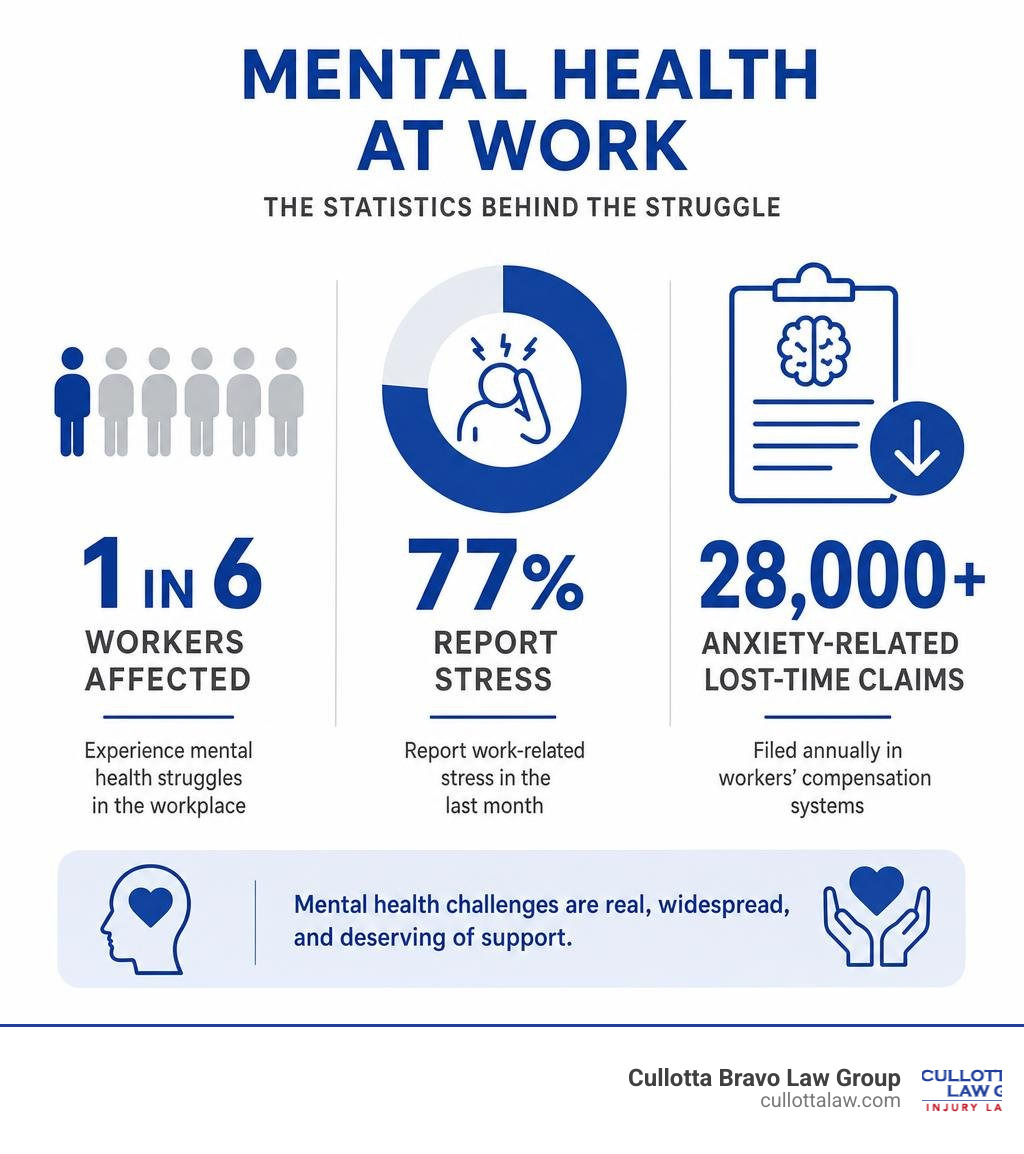
The numbers tell a stark story. Around one in six people experience mental health struggles in the workplace. As many as 77% of employees report work-related stress in the last month. Yet when workers try to file a claim, they often hit a wall — insurers dispute causation, employers raise defenses, and the process itself can make things worse.
Mental health claims are real, valid, and legally recognized. But they are also among the most contested claims in the workers’ compensation system. Knowing your rights before you file can make all the difference.
I’m Peter Cullotta, founding partner of Cullotta Bravo Law Group, with over 35 years of experience handling workers’ compensation cases throughout the Chicagoland area — including mental health workers compensation claims where injured workers deserve the same fair treatment as those with visible physical injuries. In the sections below, I’ll walk you through exactly what’s covered, how to prove your claim, and what to do if you’ve been denied.
Understanding Mental Health Workers Compensation: What Conditions Are Covered?
When your mind bears the brunt of a toxic, dangerous, or traumatic work environment, the damage is just as real as any physical wound. Over the years, our understanding of occupational health has evolved. Today, mental health workers compensation systems increasingly recognize that psychological harm is a major driver of work-related disability. According to key industry reports, psychiatric claims are among the fastest-growing cost categories in workers’ compensation, as highlighted in Scientific research on mental health outcomes.
But what conditions actually cross the threshold from “a bad day at the office” to a legally compensable injury?
Covered Psychological Conditions: Stress, Anxiety, Depression, and PTSD
To qualify for workers’ compensation benefits, you cannot simply feel “stressed out” by normal workplace challenges. You must have a diagnosed mental health condition. The most common conditions successfully claimed under workers’ compensation include:
- Post-Traumatic Stress Disorder (PTSD): Often triggered by a single, shocking event — such as witnessing a fatal accident, being the victim of a workplace assault, or experiencing a bank robbery.
- Major Depressive Disorder: Severe depression that develops due to prolonged exposure to hostile work environments, extreme overwork, or as a secondary result of a debilitating physical injury.
- Generalized Anxiety Disorder: Chronic, debilitating anxiety caused by extraordinary workplace pressures that prevent you from performing your daily job duties.
Physical-Mental vs. Mental-Mental Claims
Workers’ compensation systems generally categorize psychological claims into three distinct legal frameworks. Understanding which category your injury falls into is crucial for determining your chances of success:
- Physical-Mental Claims: This occurs when a physical work injury directly causes a psychological condition. For example, a construction worker who loses a hand in a machinery accident and subsequently develops severe PTSD or depression. These claims are widely accepted in almost every jurisdiction.
- Mental-Physical Claims: This is when psychological stress at work manifests as a physical ailment. An example is an employee experiencing such extreme, extraordinary stress that they suffer a heart attack or develop severe ulcers.
- Mental-Mental Claims: These are the most heavily contested. They involve a mental stimulus (like workplace trauma or extreme verbal abuse) resulting in a purely psychological injury (like PTSD or anxiety) without any physical impact. Many jurisdictions place incredibly high hurdles on these claims, requiring proof of “extraordinary” or “unusual” stress.
| Claim Type | Triggering Event | Resulting Condition | Legal Hurdles |
|---|---|---|---|
| Physical-Mental | Physical injury (e.g., severe fall, amputation) | Depression, PTSD, chronic pain syndrome | Relatively low; widely accepted |
| Mental-Physical | Extreme psychological stress, long hours | Heart attack, stroke, physical ulcers | Moderate; requires strong medical causation |
| Mental-Mental | Traumatic event, severe ongoing harassment | PTSD, severe anxiety, panic disorders | High; requires proof of extraordinary stress |
Proving Causation and the Role of Medical Evidence
Unlike a broken leg, which is immediately visible on an X-ray, a psychological injury is invisible. Insurance adjusters cannot “see” your depression or anxiety, which makes them highly skeptical. To win your claim, you must prove both legal causation (that the injury arose out of your employment) and medical causation (that the workplace stress directly caused the psychological condition).

If your psychological injury stems from a traumatic head injury, you should also read our guide on More info about brain injuries to understand how neurological and psychological claims intersect.
Proving Your Mental Health Workers Compensation Claim: The Burden of Proof
The burden of proof in a mental health workers compensation claim rests entirely on you, the employee. You must establish that your employment was the primary or substantial contributing factor to your psychiatric condition. This means distinguishing work-related stress from external life stressors, such as marital problems, financial difficulties, or personal family losses.
Insurers will actively search your personal history to argue that your anxiety or depression is a pre-existing condition or caused by personal life events. To counter this, you need contemporaneous records — such as emails documenting workplace harassment, formal complaints filed with HR, and immediate reports of traumatic incidents.
The Critical Role of DSM-5 Diagnosis and Medical Documentation
The cornerstone of any successful mental health claim is a formal diagnosis based on the Diagnostic and Statistical Manual of Mental Disorders (DSM-5). This diagnosis must come from a qualified medical practitioner.
According to guidelines found in Scientific research on provider resources, a primary care physician’s note saying you are “stressed” is rarely enough. Insurance carriers and state boards typically require evaluations from licensed psychiatrists or clinical psychologists. Your medical documentation must include:
- A clear DSM-5 diagnosis.
- A detailed causation statement explicitly linking the diagnosis to specific workplace events.
- A goal-directed, time-limited treatment plan focused on functional restoration and helping you return to work.
- Consistent, ongoing treatment records demonstrating that your symptoms interfere with your ability to perform daily job tasks.
State-by-State Legal Frameworks and Hurdles
The legal framework for psychological injuries varies wildly depending on where you work. Some jurisdictions have modernized their laws to reflect modern mental health science, while others maintain highly restrictive rules designed to limit claims.
For instance, international frameworks like the Scientific research on mental injury eligibility highlight how some regions have completely overhauled their systems to exclude general burnout while preserving pathways for severe, trauma-induced mental injuries.
California’s Predominant Cause Standard and Personnel Action Defenses
Under California Labor Code Section 3208.3, the state enforces some of the strictest standards in the country for psychiatric injuries. To successfully claim a psychiatric injury in California:
- Predominant Cause: You must prove that actual events of employment were the “predominant cause” (meaning at least 51%) of your psychiatric condition.
- 6-Month Rule: You must have been employed by the employer for at least six months, unless the injury was caused by a sudden, extraordinary workplace event.
- Good-Faith Personnel Actions: Employers are legally protected from claims resulting from “good-faith personnel actions.” If your stress or anxiety was caused by a performance review, a disciplinary action, a transfer, or a layoff notice, it is generally non-compensable.
New York’s Expanded Coverage and Behavioral Health Fee Schedules
Conversely, other states have taken major steps to expand mental health protections. In New York, recent legislative changes extended PTSD coverage to all workers who experience extraordinary work-related stress, moving past old frameworks that only protected first responders.
To manage this influx of claims, the state utilizes structured fee schedules, such as the Scientific research on NY behavioral health fee schedules, which establish uniform billing rules for psychologists and licensed clinical social workers treating injured workers.
Navigating State-Specific Rules for Mental Health Workers Compensation
If you live and work in Illinois — specifically in the Chicagoland area, including Aurora, Joliet, Naperville, and Chicago — you fall under the jurisdiction of the Illinois Workers’ Compensation Commission (IWCC).
In Illinois, purely mental-mental claims are compensable, but they face a strict legal standard. You must prove that you were subjected to extraordinary stress that is far greater than the ordinary, day-to-day stress experienced by other employees in similar positions. A hostile work environment, general job dissatisfaction, or standard pressure to meet sales quotas will not suffice.
However, if you experience a sudden, shocking event — such as witnessing a horrific machinery accident or being held up at gunpoint — Illinois law is much more supportive of your recovery. For a complete breakdown of how local laws protect you, read our More info about Aurora workers’ comp and see how we represent injured workers in neighboring communities with our More info about Joliet workers’ comp.
Benefits, Calculations, and Compensable Consequence Injuries
If your mental health claim is approved, you are entitled to the same basic categories of benefits as any physically injured worker.

These benefits are designed to keep you financially afloat while you receive the professional care you need to heal. If you work in a high-stress, high-risk industry, you can learn more about specific industry dynamics in our guide providing More info about truck driver workers’ comp.
How Mental Health Workers’ Comp Benefits Are Calculated
Approved claims generally yield several types of benefits:
- Medical Treatment: Full coverage for all reasonable and necessary medical care, including psychiatric evaluations, therapy sessions, and prescribed medications.
- Temporary Total Disability (TTD): If your mental health condition prevents you from working, you can receive wage replacement benefits. In Illinois, this is typically calculated as two-thirds (66.67%) of your average weekly wage based on the 52 weeks prior to your injury, subject to state maximum and minimum limits.
- Permanent Partial Disability (PPD): If your psychological injury results in permanent impairment that limits your future earning capacity, you may be eligible for a permanent disability settlement.
Compensable Consequence: When Physical Injuries Lead to Mental Health Issues
A “compensable consequence” injury occurs when a primary work-related injury leads to a secondary medical condition. In the context of mental health, this is incredibly common.
Consider a restaurant worker who suffers a severe, disfiguring burn in a kitchen fire. The physical injury is painful, but the resulting trauma, isolation during recovery, and fear of returning to the kitchen can lead to severe clinical depression and anxiety. Under the law, this secondary mental injury is a compensable consequence of the primary physical injury. You are entitled to have your therapy and psychiatric care fully covered under the original workers’ comp claim. To see how we protect service and hospitality workers in these situations, check out our guide with More info about restaurant workers.
Deadlines, Employer Defenses, and Disputed Claims
Insurance carriers do not like paying out mental health claims. Because psychological injuries lack objective physical markers, insurers routinely dispute them. To protect your rights, you must act quickly and prepare for a fight. If your claim has already been turned down, don’t panic — read our comprehensive guide with More info about denied claims.
Strict Deadlines and Time Limits for Filing
Time is your enemy in any workers’ compensation case. In Illinois, you must adhere to strict deadlines:
- 30-Day Notice: You must notify your employer (preferably in writing) of your injury within 45 days of the accident or the onset of the condition. For gradual-onset mental injuries caused by repetitive trauma or stress, the “date of injury” is typically established as the day you became aware that your psychological condition was work-related.
- Statute of Limitations: You generally have three years from the date of the injury, or two years from the date you last received compensation (whichever is later), to file a formal Application for Adjustment of Claim with the IWCC.
Common Insurer Defenses and How to Respond to a Denial
When you file a psychiatric claim, the insurance company will likely deploy one or more of the following defenses:
- Pre-existing Conditions: They will demand your historical medical records to argue that your depression or anxiety existed long before the workplace incident.
- The Independent Medical Examination (IME): The insurer will send you to a doctor of their choosing. This doctor is paid by the insurance company and is highly motivated to find that you are exaggerating your symptoms or that your stress is caused by personal issues.
- The Credibility Defense: If you failed to disclose a prior mental health treatment or an old injury during your hiring process, insurers will use this to destroy your credibility, as seen in the legal precedent Scientific research on psychological injury claims.
Frequently Asked Questions about Workplace Mental Health Claims
Can I get workers’ comp for stress and anxiety alone?
Yes, but it is highly dependent on your state’s laws and the severity of your situation. In Illinois, you can receive compensation for a purely mental-mental claim (stress and anxiety without a physical injury), but you must prove that the stress was extraordinary and unusual compared to the normal pressures of your employment. General stress from a demanding boss or long hours usually does not qualify.
What should I do if my employer denies my mental health claim?
If your employer or their insurance carrier denies your claim, you should immediately consult with an experienced attorney. Do not agree to recorded statements with the insurance adjuster without legal counsel. You have the right to appeal the denial before the Illinois Workers’ Compensation Commission. To learn how a dedicated attorney can help negotiate a fair payout, read More info about workers’ comp settlement attorneys.
How does a pre-existing mental health condition affect my claim?
Having a history of anxiety or depression does not automatically disqualify you from receiving benefits. Under Illinois law, if workplace conditions or a specific traumatic event aggravated, accelerated, or worsened your pre-existing condition, you are still entitled to compensation. However, complete transparency with your treating doctors is vital. Failing to disclose prior mental health treatment can severely damage your credibility and lead to a swift denial, a concept thoroughly documented in Scientific research on mental injury entitlements.
Conclusion
Navigating a mental health workers compensation claim can feel like an uphill battle against an invisible enemy. While you are trying to heal from severe psychological trauma, depression, or anxiety, insurance adjusters are actively working to undermine your credibility and deny your benefits.
You do not have to fight this battle alone. At Cullotta Bravo Law Group, we believe that psychological wounds deserve the same respect, medical care, and financial compensation as physical ones. With over 35 years of legal experience in Aurora, Chicago, Joliet, and Naperville, we provide aggressive, compassionate legal representation. We treat our clients with the dignity they deserve while fighting relentlessly for the multi-million dollar settlements they need to rebuild their lives.
If you are struggling with a work-related mental health condition or have had your claim unfairly denied, reach out to us today. Contact Cullotta Bravo Law Group for a consultation to schedule a free, confidential evaluation of your case. Let us handle the legal burden so you can focus on your recovery.