

From Fault to Fortune: Navigating Car Accident Settlements and Pain and Suffering
What Car Accident Pain Suffering Really Means for Your Settlement
Car accident pain and suffering is one of the most valuable — and most misunderstood — parts of any injury claim. If you want a quick answer, here it is:
What is pain and suffering in a car accident claim?
| Type | What It Covers | How It’s Calculated |
|---|---|---|
| Physical pain | Injury pain, medical treatment discomfort, lasting physical limitations | Multiplier method (1.5x–5x medical bills) or per diem (daily rate) |
| Mental suffering | Anxiety, PTSD, depression, loss of enjoyment of life | Same methods; supported by mental health records |
| Combined value | Both types together = your non-economic damages | Depends on injury severity, evidence, and fault |
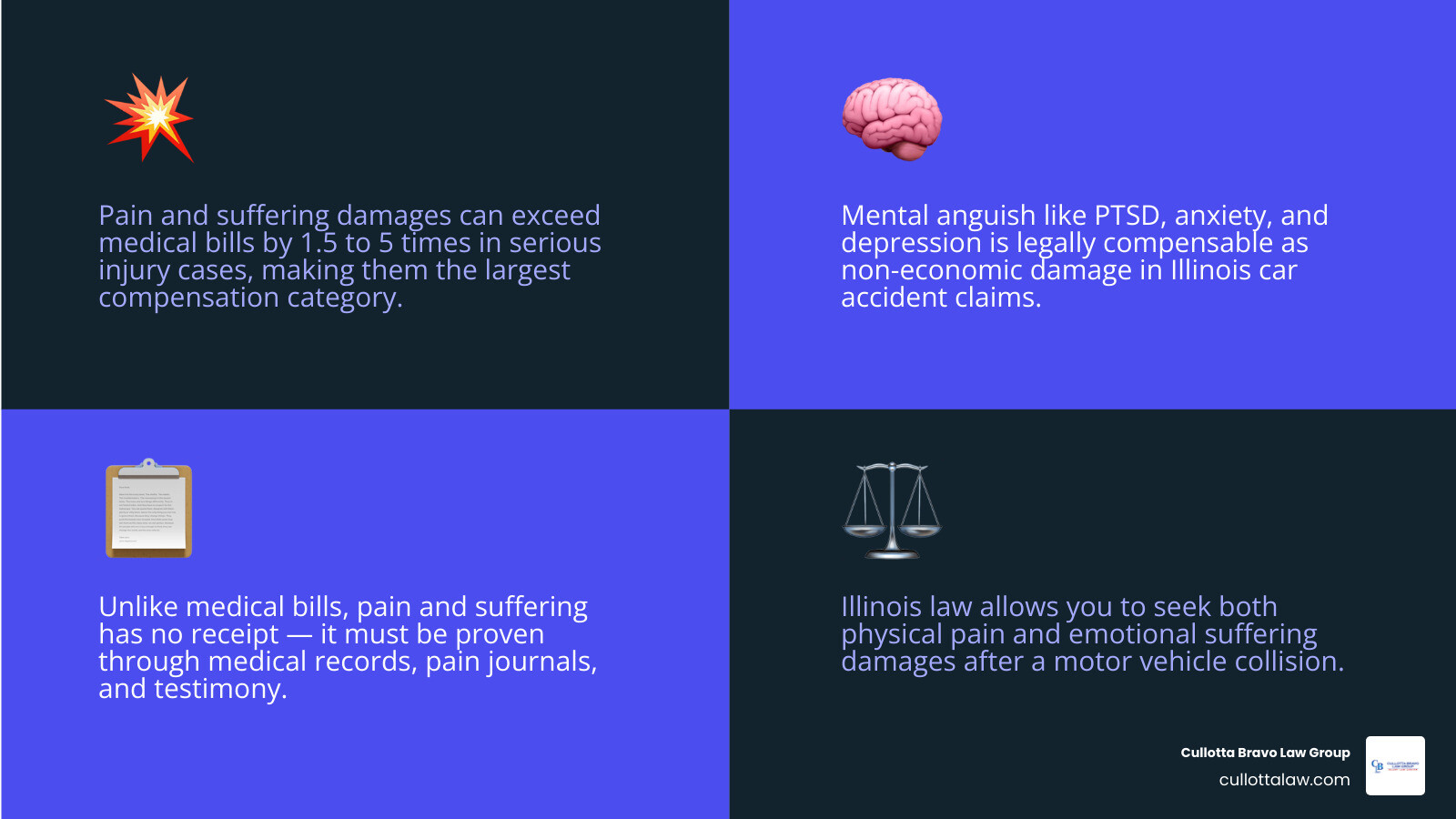
Unlike medical bills or lost wages, pain and suffering doesn’t come with a receipt. Yet in serious injury cases, it’s often the largest category of compensation. Insurance adjusters work hard to minimize it — and most accident victims don’t know how to push back.
That’s exactly why this guide exists.
I’m Peter Cullotta, founding partner of Cullotta Bravo Law Group, and over my 35+ years as a trial lawyer in the Chicagoland area I’ve helped injured clients recover millions in verdicts and settlements — including car accident pain and suffering damages that insurers initially tried to dismiss or undervalue. In the sections below, I’ll walk you through how these damages are defined, calculated, and proven so you know exactly where you stand.
Understanding Car Accident Pain Suffering and Damages
When you are involved in a motor vehicle collision, your life can be turned upside down in a fraction of a second. The physical and emotional fallout can linger long after the wreckage is cleared from the roads of Aurora, Chicago, Naperville, or Joliet. Under Illinois law, you have a right to seek compensation for these hardships. These compensable losses are legally classified as damages.

Broadly speaking, damages are split into two main groups: economic and non-economic. Car accident pain suffering falls squarely into the non-economic category. Understanding the real cost of a personal injury medical bills lost wages and non-economic damages is essential because non-economic damages aim to compensate you for the intangible, subjective harm that cannot be easily measured by a cash register or billing statement.
Economic vs. Non-Economic Damages in a Personal Injury Claim
To understand how non-economic damages are valued, it helps to contrast them with economic damages.
- Economic Damages: These are your objective, out-of-pocket financial losses. They have a clear dollar amount attached to them. Examples include your medical expenses (like emergency room bills, surgery costs, physical therapy, and prescriptions) and lost income. If your injuries prevent you from returning to work, we can refer to our car accident lost wages a step by step guide to getting your due to calculate exact lost earnings down to the penny.
- Non-Economic Damages: These represent the subjective, human cost of your injuries. There is no invoice for a sleepless night, no receipt for the persistent fear of driving after a crash, and no bill for the inability to pick up your toddler. This is where car accident pain suffering resides. It is the legal mechanism that attempts to restore your quality of life and peace of mind.
What Qualifies as Car Accident Pain Suffering?
Pain and suffering is not a single concept; it is a broad umbrella that covers both physical and mental hardships. In our decades of legal practice in Illinois, we have seen how these damages manifest in several distinct ways:
- Physical Pain: This is the actual discomfort caused by your physical injuries. It includes the acute pain immediately following a crash, the agony of undergoing medical procedures, and the dull, persistent ache of recovery.
- Mental Anguish and Emotional Distress: A serious collision is a traumatic event. Victims often suffer from sleep disruption, severe anxiety, depression, and post-traumatic stress disorder (PTSD).
- Physical Impairment: If your injuries prevent you from walking, bending, lifting, or performing daily activities, you are experiencing physical impairment. This is especially true for those navigating chronic pain after a car accident who face a lifetime of restricted mobility.
- Disfigurement and Scarring: Severe burns, lacerations, or surgical scars can cause profound emotional distress and self-consciousness, altering how a person interacts with the world.
How Insurance Companies Calculate Non-Economic Damages
Because pain and suffering does not come with a pre-determined price tag, insurance adjusters do not simply guess a number. Instead, they rely on structured methods and, increasingly, complex software programs (such as Colossus) to establish a baseline settlement value.
When calculating settlement of a personal injury claim, insurance companies look closely at the duration and consistency of your medical treatment. They assume that a person who requires six months of physical therapy has experienced more pain and suffering than someone who only visited a chiropractor twice. That is why clear documentation, consistent treatment, and a complete picture of how the crash changed your daily life are so important.
The Multiplier Method vs. The Per Diem Method
In negotiations, attorneys and insurance adjusters typically use one of two primary mathematical frameworks to estimate the value of car accident pain suffering.
| Method | How It Works | Best Used For |
|---|---|---|
| The Multiplier Method | Adds up all economic damages (special damages) and multiplies that total by a number between 1.5 and 5, depending on severity. | Cases with clear medical bills, long recovery timelines, or permanent injuries. |
| The Per Diem Method | Assigns a specific daily dollar rate (often equivalent to a day’s wages) for every day the victim suffers from their injuries. | Injuries with a predictable, finite recovery period (e.g., a broken bone that fully heals in six months). |
The Multiplier Method in Action
The multiplier method is the most common approach. The multiplier used depends heavily on the severity of the injury:
- Low Range (1.5x to 2.5x): Typically applied to minor, soft-tissue injuries like whiplash or muscle strains that resolve within a few weeks.
- Mid Range (2.5x to 3.5x): Applied to moderate injuries requiring injections, extensive physical therapy, or minor surgeries (such as a herniated disc).
- High Range (4x to 5x or more): Reserved for catastrophic, permanent, or life-altering injuries such as brain trauma, amputation, or severe disfigurement.
These calculations are only starting points. A higher multiplier is usually supported by strong medical evidence, visible injuries, permanent limitations, surgery, extensive rehabilitation, or credible testimony about how the injury affected your work, family life, sleep, mobility, and emotional health.
Estimating Your Car Accident Pain Suffering Settlement
To estimate what your claim might be worth, you must look at the specific facts of your case. For example, a minor rear-end collision in Naperville resulting in whiplash and $4,000 in medical bills might warrant a 2.0 multiplier, yielding $8,000 in pain and suffering (for a total settlement estimate of $12,000).
Conversely, a high-speed T-bone collision in Joliet resulting in a broken wrist requiring surgery and $40,000 in medical expenses could easily justify a 3.5x multiplier, resulting in $140,000 in pain and suffering damages.
Every case is fact-specific, and settlement value can change based on liability disputes, insurance policy limits, prior injuries, future medical needs, and how well your pain and limitations are documented. To protect your rights locally, read our guide on pain and suffering claims what you need to know for a fair settlement.
Key Factors and Evidence That Shape Your Claim Value
You cannot simply tell an insurance adjuster that you are hurting and expect them to pay a high settlement. In the legal world, if you cannot prove it, it did not happen.

To maximize the value of your car accident pain suffering claim, you must build an airtight wall of evidence. This starts at the crash scene itself. Taking cell phone pictures what photos to take if youre in an accident provides immediate, objective proof of the force of the impact, which directly correlates to the physical trauma your body endured.
Crucial Evidence Needed to Prove Subjective Harm
To transform subjective pain into objective proof, we gather and present several layers of evidence:
- Consistent Medical Records: Your medical charts are the foundation of your claim. Do not skip doctor appointments or physical therapy sessions. Insurance adjusters look for gaps in treatment to argue that your pain has subsided.
- A Detailed Pain Journal: Keep a daily log. Instead of writing “I feel bad,” write specific limitations: “Today, my lower back pain was an 8/10. I could not bend down to tie my shoes, and I had to ask my spouse to help me get out of bed.”
- Witness Statements: Statements from family, friends, neighbors, or coworkers describing how the injury has changed your daily life, mood, and relationships are incredibly powerful.
- Delayed Injury Documentation: Many serious injuries, particularly chest, back, or neck injuries, are masked by adrenaline immediately after a crash. If symptoms appear hours or days later, seek medical care promptly and make sure the new symptoms are clearly documented in your records.
How Shared Fault and State Laws Impact Recovery
Your final recovery is also dictated by state law. Illinois operates under a modified comparative fault system with a 51% bar rule, which is addressed in Illinois law under 735 ILCS 5/2-1116.
Under this rule:
- If you are found to be 50% or less at fault for the accident, you can still recover damages, but your total payout (including pain and suffering) will be reduced by your percentage of fault. For example, if your total damages are $100,000 but you are found 20% at fault, you will receive $80,000.
- If you are found to be 51% or more at fault, you recover nothing.
This is why establishing clear liability is just as important as proving your injuries. For a deeper breakdown of how this works in local courts, read our article on understanding comparative fault in illinois car accident cases.
Frequently Asked Questions about Non-Economic Damages
Can I claim pain and suffering in a no-fault state?
In true no-fault states (like Florida or New York), injured drivers must first turn to their own Personal Injury Protection (PIP) insurance, which only covers medical bills and lost wages—not pain and suffering. To sue the at-fault driver for pain and suffering in those states, your injuries must meet a strict statutory “serious injury threshold” (such as bone fractures, permanent loss of a bodily function, or significant disfigurement).
However, Illinois is a tort (at-fault) state. This means you do not have to meet a high “serious injury threshold” to pursue pain and suffering damages from the negligent driver who caused your crash.
What is the statute of limitations for filing a pain and suffering lawsuit in Illinois?
In Illinois, you generally have two years from the date of the car accident to file a lawsuit for personal injuries. If you fail to file within this timeframe, you lose your legal right to seek compensation forever.
Because building a strong case takes time, you should never wait until the last minute. To protect your claim, read statutes of limitation on accidents in illinois and dont let the clock run out on your illinois injury claim.
Do I need a lawyer to pursue pain and suffering damages?
While you are legally allowed to represent yourself, negotiating a pain and suffering claim on your own is highly risky. Insurance companies are notorious for offering lowball settlements to unrepresented victims, knowing they lack the resources to take the case to trial.
At Cullotta Bravo Law Group, we work on a contingency fee basis. This means there are no upfront costs, and we only get paid if we win your case. You can learn more about how this works in our accident lawyer contingency fee guide and our car accident attorney complete guide.
Conclusion
Recovering from a car accident is hard enough without having to battle insurance companies for the compensation you rightfully deserve. Car accident pain suffering is a very real, deeply personal consequence of a crash, and it should never be treated as an afterthought by an insurance adjuster.
At Cullotta Bravo Law Group, we have spent over 35 years providing aggressive, compassionate legal representation to injury victims in Aurora, Chicago, Naperville, Joliet, and throughout Illinois. We know how to calculate the true value of your claim, gather the necessary evidence, and force the insurance companies to treat you with the dignity you deserve.
If you or a loved one is struggling with physical pain or emotional trauma after a collision, do not carry the burden alone. Contact us today for a Free Consultation on Illinois Injury Claims. We will review your case, explain your options, and help you navigate the path from fault to fortune.