

Real Estate Attorney vs Realtor: Core Roles and Key Differences
Understanding the divide between a real estate attorney and a real estate agent comes down to understanding the difference between marketing a property and legally transferring its ownership. While both professionals work to bring a deal across the finish line, their toolkits, legal responsibilities, and primary goals are fundamentally distinct.
A Realtor or real estate agent is focused on market dynamics. They study local neighborhood trends, stage homes, run marketing campaigns, coordinate open houses, and negotiate offers to get the highest possible price for a seller or the most favorable purchase terms for a buyer.
In contrast, a real estate attorney focuses on legal validity, contract obligations, and risk mitigation. They ensure clear title ownership, identify hidden liens or encumbrances, draft enforceable contingencies, and ensure compliance with municipal and state real property statutes.
| Feature / Responsibility | Real Estate Attorney | Realtor / Real Estate Agent |
|---|---|---|
| Primary Focus | Legal protection, risk mitigation, and title validity | Marketing, property valuation, showings, and sales negotiation |
| Contract Authority | Can draft custom legal clauses, addenda, and legal agreements | Uses standardized, state-approved template forms |
| Compensation Model | Flat fee ($500–$2,000) or hourly rate ($150–$500/hr) | Commission percentage of final sales price |
| MLS Access | No access to the Multiple Listing Service | Direct access to list and search properties on the MLS |
| Legal Advice | Fully licensed to provide formal legal counsel | Legally prohibited from providing legal advice |
| Title Examination | Reviews chain of title, resolves boundary issues and liens | Coordinates with title companies for standard title insurance |
| Dispute Resolution | Represents clients in contract disputes and litigation | Mediates interpersonal deal negotiations only |
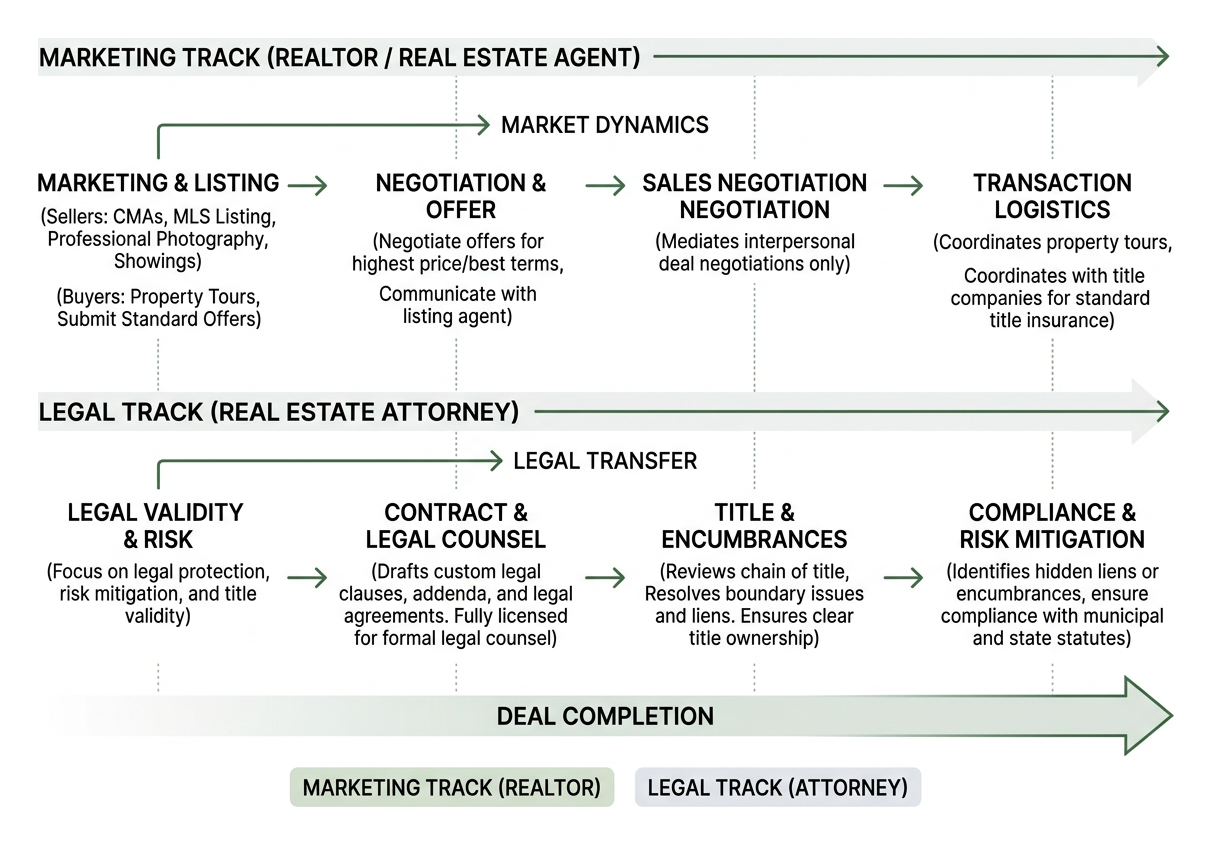
Primary Duties in a Real Estate Attorney vs Realtor Transaction
During a typical transaction, the day-to-day duties of these two professionals run parallel to one another.
A real estate agent handles the public-facing and logistical aspects of the sale. For sellers, this involves conducting comparative market analyses (CMAs), listing the home on the local MLS, organizing professional photography, and managing showings. For buyers, the agent sets up property tours, communicates with the listing agent, and submits standard offer paperwork.
A real estate attorney steps in to handle the critical legal mechanics. When drafting or modifying purchase agreements, an attorney goes beyond basic fill-in-the-blank forms. Legal counsel is essential when crafting your property sale agreement to incorporate custom contingencies, financing conditions, or post-closing possession terms that protect your personal assets.
Furthermore, attorneys perform detailed title examinations. While title insurance companies issue policies, an attorney actively reviews municipal records, easements, and prior deeds. Discovering a recorded easement or a missing heir from three transfers ago requires legal resolution, making property title searches and boundary surveys a key part of protecting your long-term equity.
Licensing, Legal Authority, and Fiduciary Duties
The difference in licensing and professional oversight between agents and attorneys is substantial.
To become a licensed real estate agent, an individual completes state-mandated coursework and passes a licensing exam. To hold the title of “REALTOR®,” they must also join the National Association of Realtors (NAR) and subscribe to its Code of Ethics. Agents owe fiduciary duties to their clients, including loyalty, confidentiality, and disclosure. However, agents are legally barred from practicing law. They cannot interpret ambiguous contract language, advise on legal remedies if a buyer defaults, or draft non-standard legal documents.
A real estate attorney must complete a four-year undergraduate degree, graduate from an accredited law school (earning a Juris Doctor), pass a state bar examination, and maintain strict continuing legal education requirements. As detailed in this review of Differences Between a Real Estate Attorney vs. a Realtor: Expert Insights and Career Guide, an attorney possesses the legal authority to give binding counsel, interpret property statutes, and represent clients in court should a transaction collapse into litigation.
This distinction becomes especially critical regarding representation conflicts. In some real estate transactions, an agent may act as a “dual agent,” attempting to represent both the buyer and the seller in the same transaction. While legal in many jurisdictions with written consent, dual agency creates inherent conflicts of interest because an agent cannot aggressively negotiate price for both opposing parties at once. An attorney, bound by strict professional conduct rules, represents your individual legal interests without split loyalties.
Cost Breakdown: Flat Legal Fees vs. Commission Percentages
Cost is one of the most visible differences when evaluating legal versus brokerage representation. Real estate agents and real estate attorneys operate on completely different payment models, each carrying distinct financial implications for your bottom line.
Comparing Upfront Costs and Hidden Expenses in Real Estate Attorney vs Realtor Services
Real estate attorneys typically charge transparent, predictable rates. For a standard residential transaction, most attorneys bill a flat fee ranging between $500 and $2,000. For complex matters—such as resolving municipal code violations, drafting custom seller-financing instruments, or handling transactions with uncooperative co-owners—attorneys may charge an hourly rate, generally between $150 and $500 per hour, with total fees for complex disputes landing between $2,000 and $5,000.
Real estate agents, on the other hand, work on a commission model tied to the final sale price of the property. Historically, total agent commissions have run between 5% and 6% of the transaction value, typically split between the listing brokerage and the buyer’s brokerage. Following industry-wide antitrust settlements regarding broker compensation rules, buyer-agent commission terms are negotiated directly via written agreements, giving consumers greater clarity on fee structures.
For buyers, consulting a lawyer before entering a purchase agreement ensures that deposit monies are protected under clear contingency timelines. When entering the market, following a structured buyers guide to legal support ensures that every inspection response, mortgage contingency, and closing cost credit is legally enforceable.
How Agent Commissions Impact Net Sale Proceeds
On high-value properties, commission percentages quickly add up to tens of thousands of dollars.
Consider a property selling for $800,000:
- A 5% total real estate commission equals $40,000.
- A standard flat-fee real estate attorney closing package might cost $1,200.
In a direct private sale—such as selling a home to an existing tenant, a family member, or a direct buyer—hiring an attorney rather than an agent can save a seller upwards of $30,000 to $50,000 in brokerage fees while ensuring all legal transfer documents are properly executed.
However, the raw math of commission savings must be weighed against marketing exposure. Industry data from 2025 shows that For Sale By Owner (FSBO) transactions accounted for only 5% of all home sales—an all-time low. Furthermore, FSBO properties recorded a median sale price of $360,000, compared to $425,000 for agent-assisted sales—an 18% gap.
Because roughly 87% of buyers find their prospective homes through the MLS (to which attorneys do not have listing access), selling entirely without marketing support can lead to lower purchase offers. Additionally, 43% of FSBO sellers report making legal or paperwork mistakes, and 64% fail to secure their initial target price. While an attorney provides essential legal oversight, an agent provides the market reach necessary to drive competitive bidding.
When to Hire an Attorney, an Agent, or Both Professionals

Deciding whether to hire an attorney, an agent, or both depends on the nature of the property, the presence of existing buyers, and the legal complexity of the title. To keep your closing on schedule, following an ultimate checklist for real estate helps align your marketing efforts with legal requirements.
Complex Transactions Requiring Legal Counsel
While an agent is well-equipped to market a standard suburban single-family home, several scenarios require formal legal representation:
- Title Defects and Liens: If a title search uncovers mechanics’ liens, unpaid property tax judgements, or unreleased prior mortgages, an attorney must step in to clear title before a warranty deed can be issued.
- Inherited Property and Estate Transfers: Selling a home tied up in probate requires specialized legal procedures. Working with legal counsel experienced in passing down property inheritance ensures that estate representatives have full legal authority to convey title without triggering future heirship disputes.
- Boundary Disputes and Encroachments: If a neighbor’s fence, driveway, or garage crosses property lines, a real estate agent cannot legally negotiate boundary adjustments or draft lot line agreements; this requires an attorney.
- Divorce and Multi-Party Sales: When co-owners are in conflict, attorneys provide neutral legal execution or individual client advocacy to protect equity distributions.
- Private or FSBO Transactions: When a buyer and seller have already found each other, paying a 5% to 6% commission is often unnecessary. An attorney can handle contract drafting, earnest money escrow, and closing documentation at a fraction of the cost.
State Requirements and Mandatory Attorney Closing Laws
The legal necessity of a real estate lawyer also depends on state law. About half of U.S. states require an attorney’s involvement in some portion of a real estate closing, with 11 states mandating that a licensed attorney conduct or oversee the entire closing process.
In mandatory attorney states—such as Connecticut, Delaware, Georgia, Massachusetts, New York, North Carolina, and South Carolina—only a licensed attorney may prepare closing instruments, certify title, or disburse escrow funds.
In non-mandatory states, title companies and closing settlement agents frequently conduct the closing paperwork. However, even in jurisdictions where attorneys are not strictly required by statute, retaining counsel remains common practice. Title insurance agents represent the insurance underwriter’s liability—they do not provide legal advice or advocate for the buyer or seller. Having your own attorney ensures that your personal financial and legal rights are protected at the closing table.
Frequently Asked Questions About Real Estate Professionals
Can a real estate attorney completely replace a realtor during a property sale?
Legally, yes. A homeowner is under no statutory obligation to hire a real estate broker to sell their property. An attorney can draft the purchase contract, review home inspection addenda, hold earnest money in an escrow account, examine the title commitments, and prepare the closing deed.
However, an attorney does not replace an agent’s marketing engine. Attorneys do not stage homes, run open houses, take professional interior photos, or list properties on the MLS. If you already have a vetted buyer, an attorney can completely handle the transaction. If you need broad market exposure to attract competitive offers from the general public, using an agent alongside an attorney is the most effective approach.
Which states require an attorney to be present at closing?
States with strict attorney closing mandates include:
- Connecticut
- Delaware
- Georgia
- Massachusetts
- New Hampshire
- New Jersey (by custom and contract practice)
- New York
- North Carolina
- South Carolina
- Vermont
- West Virginia
In these jurisdictions, state statutes or supreme court rulings dictate that specific closing actions constitute the practice of law, requiring a licensed bar member to oversee document execution and fund disbursement.
What questions should I ask before hiring an attorney or agent?
Before retaining either professional, ask targeted questions to verify their experience:
Questions for a Real Estate Attorney:
- Do you charge a flat closing fee or an hourly rate, and what specific services are covered?
- How many residential or commercial real estate closings do you handle each month?
- Will you directly review my contract and title commitment, or will a paralegal handle the file?
- How do you resolve unreleased liens or unexpected inspection disputes before closing?
Questions for a Real Estate Agent:
- What is your track record and average days-on-market for properties in my specific neighborhood?
- How do your listing agreements handle broker compensation and buyer-agent commissions?
- What specific marketing channels do you use beyond standard MLS syndication?
- Are you comfortable collaborating directly with my real estate attorney during contract review?
Conclusion: Making the Right Choice for Your Property Transaction
Choosing between a real estate attorney and a real estate agent is not about picking one profession over the other—it is about matching the right skills to the right stages of your transaction. Real estate agents are invaluable for positioning your property, pricing it competitively, and navigating the open market. Real estate attorneys provide the legal protection necessary to safeguard your hard-earned equity, resolve complex title challenges, and ensure you never sign an agreement that exposes you to future liability.
Whether you are buying your first home, selling a family estate, or executing a private sale, having dedicated legal counsel gives you peace of mind from contract to closing. For dedicated guidance on property agreements, title reviews, and transaction oversight, consult an experienced real estate legal team to protect your interests at every step.