

What to Do After a Commercial Truck Wreck
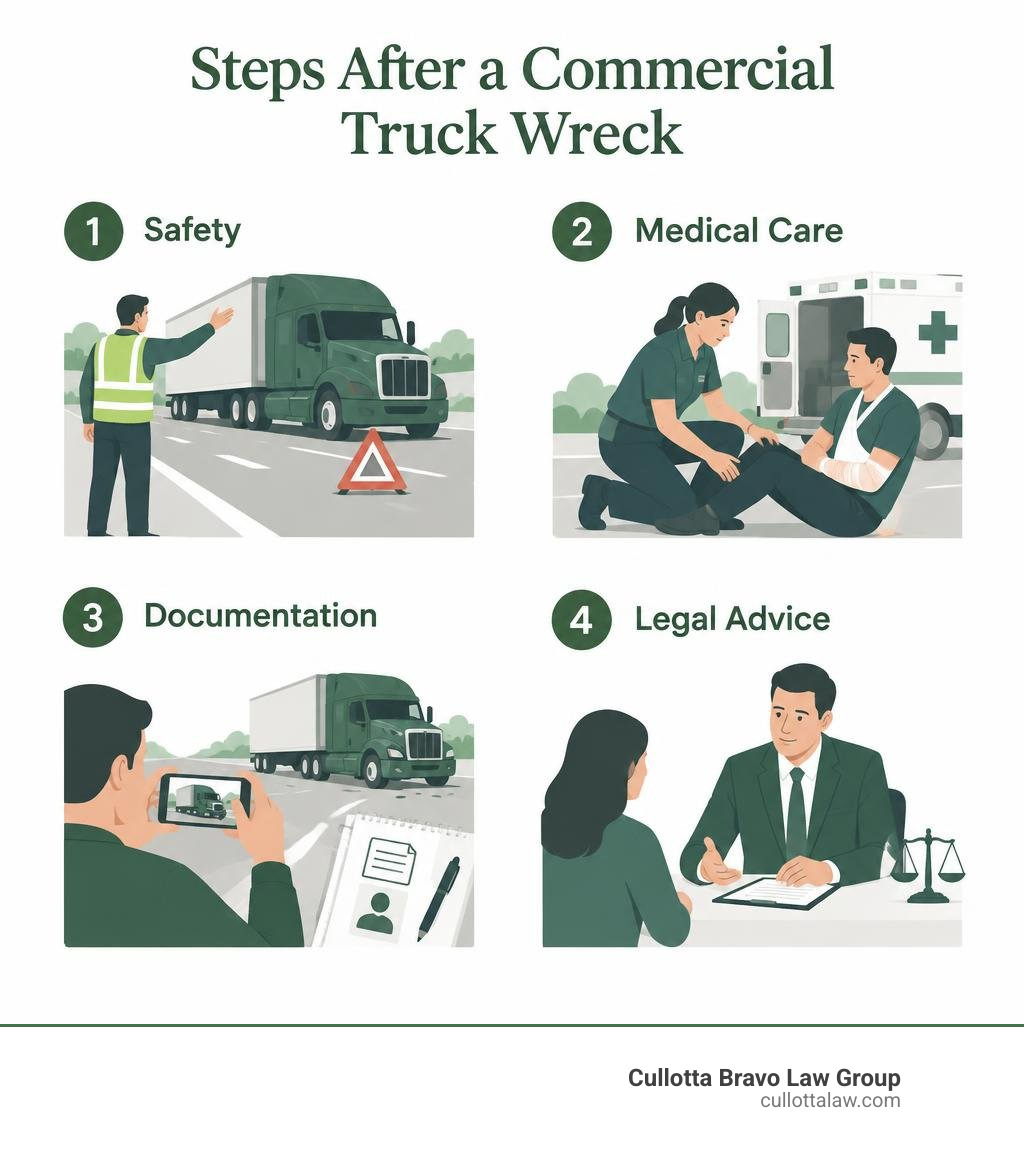
Get to safety, call 911, and seek medical care. If you can do so safely, take photos, get witness contact details, and keep the police report number. Avoid guessing who caused the crash or accepting a quick insurance settlement before you understand your injuries and losses. Truck claims may depend on records that can be lost, including driver logs, vehicle data, and maintenance files.
The stakes are high: in 2024, 70% of people who died in large-truck crashes were occupants of other vehicles. Finding out what happened can help identify who may be responsible and what compensation you can seek.
I’m Peter Cullotta, founding partner of Cullotta Bravo Law Group. For more than 35 years, I’ve represented injured people; this guide explains the steps that matter after a commercial truck wreck.
Relevant articles related to commercial truck wreck:
Understanding the Root Causes of a Commercial Truck Wreck
When an 80,000-pound semi-truck collides with a 4,000-pound passenger car, basic physics dictates the outcome. Large commercial vehicles weigh 20 to 30 times more than standard cars. That massive weight difference creates devastating force during an impact. Nationally, 5,218 large trucks were involved in fatal crashes in 2024, resulting in 5,340 lost lives. Across the country, 120,724 trucks were involved in collisions that caused 161,201 injuries that same year—a steady rise in injury-producing crashes over recent years.
Driver fatigue remains one of the primary catalysts behind these collisions. Federal regulations strictly govern commercial driving limits through Hours-of-Service (HOS) rules, capping daily driving time at 11 hours within a 14-hour workday after 10 consecutive hours off duty. Research confirms that when a commercial operator drives beyond eight continuous hours, the risk of a crash doubles. The pressure to meet tight delivery schedules often leads drivers and motor carriers to cut corners, resulting in micro-sleeps, slowed perception-reaction times, and catastrophic lapses in judgment.
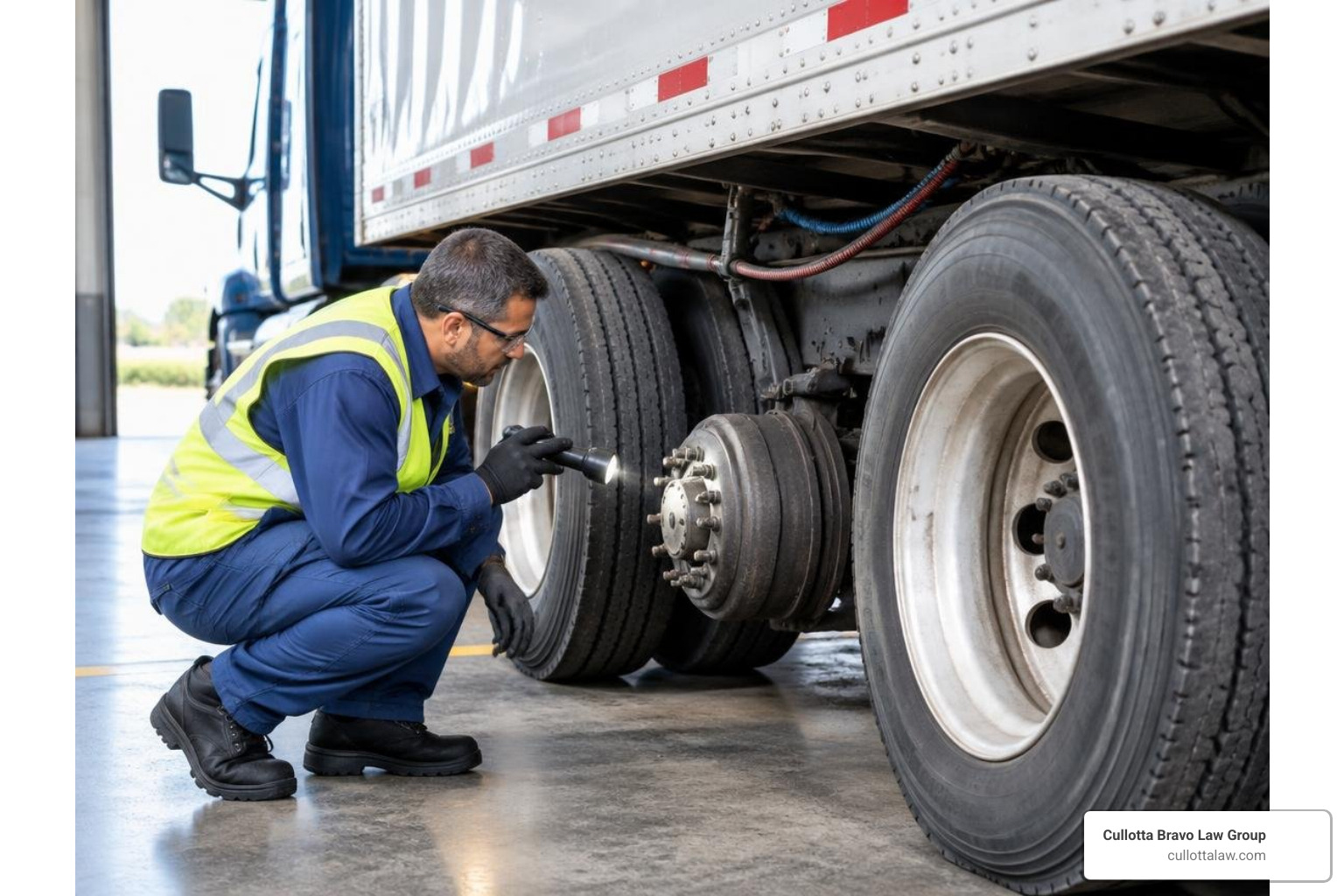
Mechanical neglect is another leading contributor. Large commercial trucks require immense braking power, yet mechanical failures frequently undermine stopping capability. Brake defects are cited in over a third of commercial vehicle equipment violations, and commercial rigs operating with out-of-adjustment brakes face a significantly higher crash rate. Beyond brake fade, steering failures, worn tires, and overloaded truck risks severely extend braking distances, turning a manageable traffic slowdown into a multi-vehicle catastrophe.
Critical Factors Leading to a Commercial Truck Wreck in Work Zones
Highway construction corridors represent some of the most hazardous environments on modern roadways. High-speed approaches combined with sudden lane closures demand immediate driver awareness and rapid deceleration. Approximately 70% of fatal heavy-truck rear-end collisions occur on roadways with speed limits of 60 mph or greater, and roughly 13% of all fatal heavy-truck rear-end crashes happen inside highway work zones.
When a fully loaded tractor-trailer travels at 70 mph into a construction queue moving at under 10 mph, the speed differential eliminates any margin for error. As detailed in the federal safety findings of the NTSB Kenly work zone crash investigation, commercial drivers who fail to register advance warning signs—such as Portable Changeable Message Signs (PCMS)—can strike stopped queues at full highway speed without braking. Missing early warnings, coupled with driver distraction or false duty-status logs, transforms routine construction delays into deadly chain-reaction collisions.
Equipment Failures and Underride Guard Deficiencies
Even when drivers react, inadequate physical safeguards can drastically worsen crash outcomes. Underride collisions occur when a smaller passenger vehicle slides beneath the rear or side of a commercial trailer, bypassing the passenger car’s crumple zones and air bags.
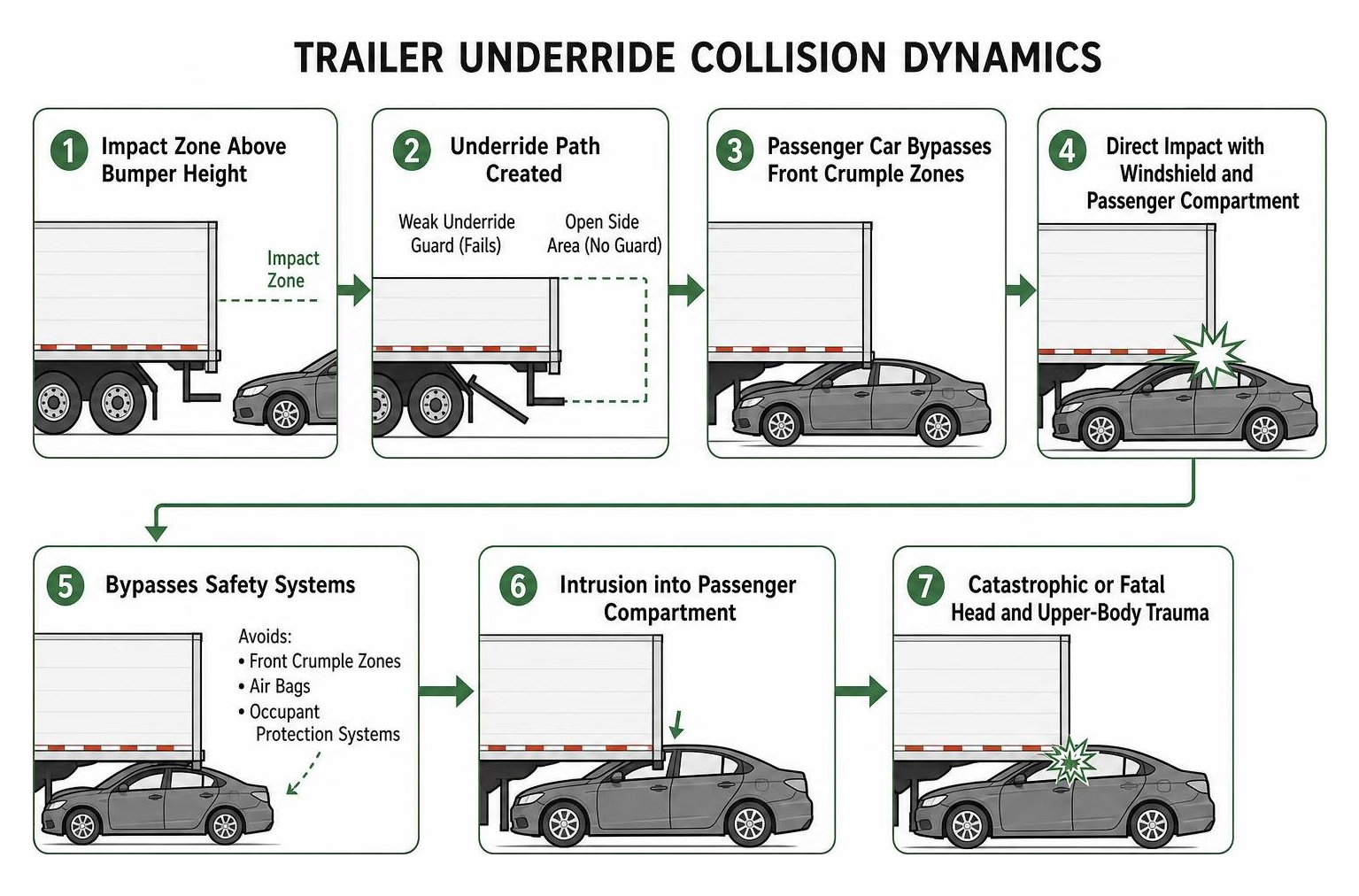
Standard rear guards frequently fail at offset angles. Upgraded standards, like the Insurance Institute for Highway Safety (IIHS) TOUGH GUARD criteria, evaluate whether rear guards prevent underride across full, partial, and narrow overlaps. However, regulatory gaps remain substantial regarding side underride protection. Side guards could prevent hundreds of passenger vehicle occupant fatalities annually, yet they are not universally mandated.
When equipment failures like tire blowouts or brake lockups trigger sudden instability, the tractor and trailer can fold in on themselves, leading to devastating jackknife accident mechanics that sweep across adjacent lanes and trap surrounding motorists.
Crash Dynamics and Post-Accident Hazard Patterns
The sheer kinetic energy generated in heavy freight collisions produces unique secondary hazards. Large commercial vehicles carry high centers of gravity, making them susceptible to rollover events when maneuvering suddenly, drifting onto soft highway shoulders, or navigating tight interchanges. Rollovers represent roughly one in ten fatal commercial crashes, carrying serious injury rates nearly five times higher than typical crashes.
When a heavy tractor-trailer rolls over, the saddle-mounted external diesel fuel tanks are directly exposed to structural crush and pavement friction. Commercial trucks account for 17% of fatal vehicle fires nationwide despite representing just 8% of all fatal crashes.
A stark illustration of this hazard occurred in a documented rollover incident detailed in the Texas I-10 truck rollover report, where a tractor drifted into a barrier at highway speed, immediately ruptured its fuel tanks, and ignited a post-crash fire. The following table summarizes key operational and fatality patterns across vehicle types and road configurations:
| Metric / Scenario | Commercial Large Trucks | Passenger Vehicles |
|---|---|---|
| Fatal Crashes per 100M Miles | 1.6 | 1.4 |
| Primary Fatality Demographic | 70% Other Vehicle Occupants | Predominantly Own-Vehicle Occupants |
| Rural vs. Interstate Fatalities | Over 50% Rural / ~25% Interstate | Higher concentration in urban/suburban zones |
| Post-Crash Fire Fatality Share | 17% of all fatal vehicle fires | 83% across all remaining vehicle classes |
| Weekday Fatal Crash Percentage | 76% (Concentrated on freight cycles) | Distributed more evenly across weekends |
Preserving Crucial Evidence After a Severe Collision
Securing accountability following a catastrophic crash requires immediate, meticulous evidence gathering. Commercial motor carriers and their corporate insurers deploy rapid-response investigation teams to the scene within hours. Their goal is to limit liability and control the narrative. Victims and their families must counter this effort by securing critical electronic data before it is erased, overwritten, or destroyed.
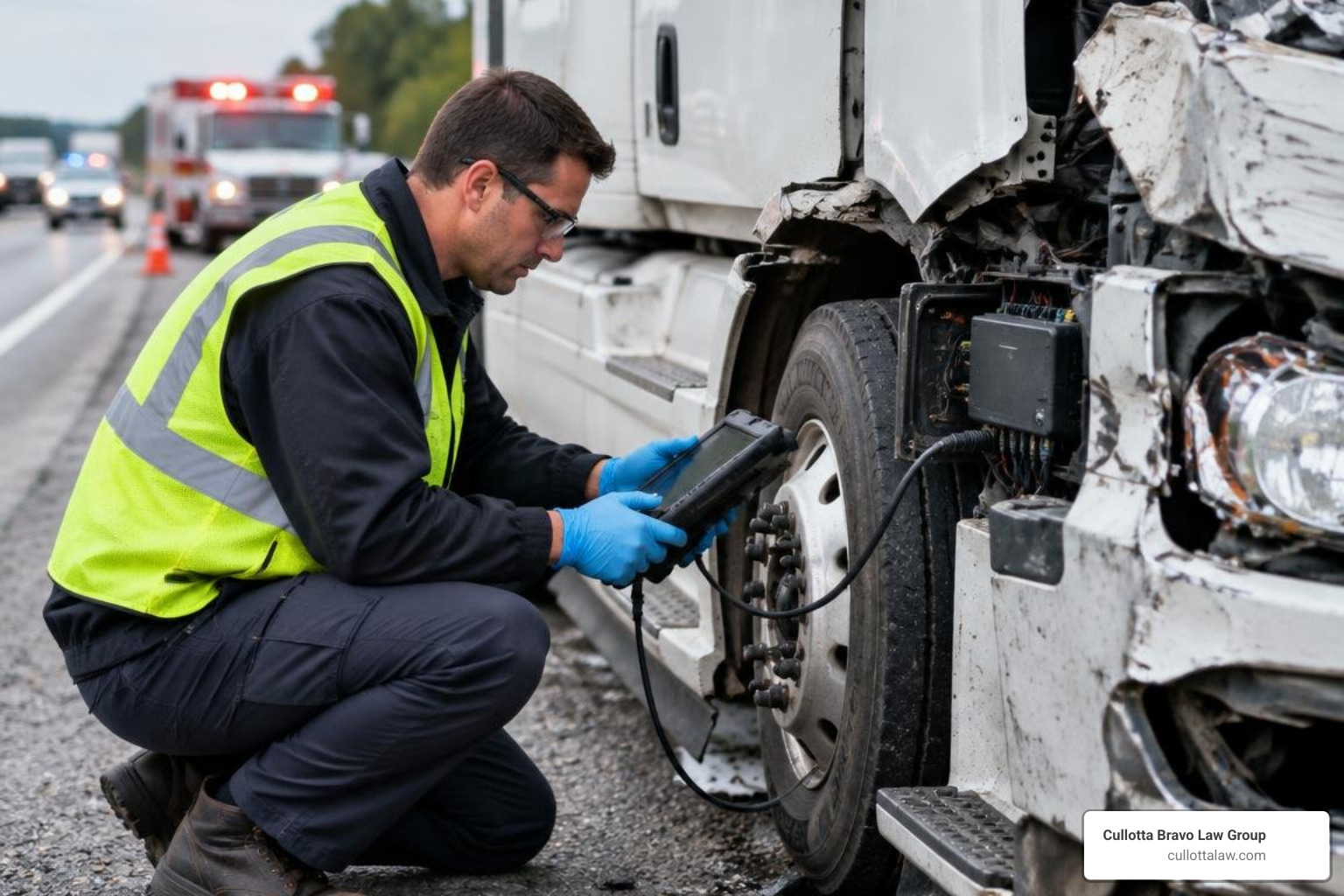
Modern commercial trucks are equipped with Electronic Control Modules (ECMs) and Event Data Recorders (EDRs), commonly known as black boxes. These onboard computers log crucial crash metrics, including vehicle speed prior to impact, throttle position, brake application, engine RPM, steering inputs, and whether collision-avoidance systems intervened. Federal rules also require Electronic Logging Devices (ELDs) that track hours behind the wheel and duty status changes.
To prevent the trucking company from altering or discarding this vital data, retaining experienced 18-wheeler accident attorney guidance is essential. A formal spoliation letter must be served immediately on the motor carrier, freight broker, maintenance vendor, and insurer. This legal notice demands the immediate preservation of ECM downloads, ELD records, dispatch messages, vehicle inspection reports, and driver qualification files.

Overcoming Evidentiary Challenges After a Commercial Truck Wreck
Severe truck crashes often involve evidentiary challenges that complicate reconstruction. High-intensity post-crash diesel fires can consume the tractor’s cab and melt ECM hardware, making direct chip downloads impossible.
When hardware is damaged, investigators must reconstruct events using corroborating external sources. Cloud-based fleet telematics, dispatch communications, satellite GPS waypoints, toll transponder timestamps, and mobile phone billing records help establish pre-crash speed, braking patterns, and driver distraction. Subpoenaing third-party maintenance shop records and historical state inspection records uncovers systemic neglect, even if physical components were damaged in the collision.
Establishing Liability and Pursuing Maximum Compensation
Unlike a standard two-car accident, commercial freight collisions involve complex corporate structures and overlapping lines of legal responsibility. Under the doctrine of respondeat superior (vicarious liability), motor carriers are legally liable for the negligent actions of their employee drivers performed within the scope of employment.
In addition to vicarious liability, trucking companies face direct liability for independent corporate negligence, such as:
- Negligent Hiring: Employing drivers with past DUIs, suspended commercial licenses, or severe moving violations.
- Negligent Training and Supervision: Failing to instruct operators on hazardous-condition driving, mountain braking, or securement.
- HOS Compliance Failures: Pressuring drivers through unrealistic delivery bonuses that incentivize falsifying duty-status logs.
- Deferred Maintenance: Skipping mandatory 90-day and annual vehicle safety inspections to keep tractors moving.
Holding these entities accountable requires in-depth trucking company liability claims that dissect the carrier’s Federal Motor Carrier Safety Administration (FMCSA) safety measurement records.
Injured victims frequently worry about the costs of taking on well-funded transportation corporations. Understanding standard legal fee structures provides peace of mind: truck accident litigation is handled on a contingency-fee basis, meaning you pay no out-of-pocket legal fees unless your legal team successfully secures a recovery on your behalf.
Wrongful Death and Catastrophic Injury Damages
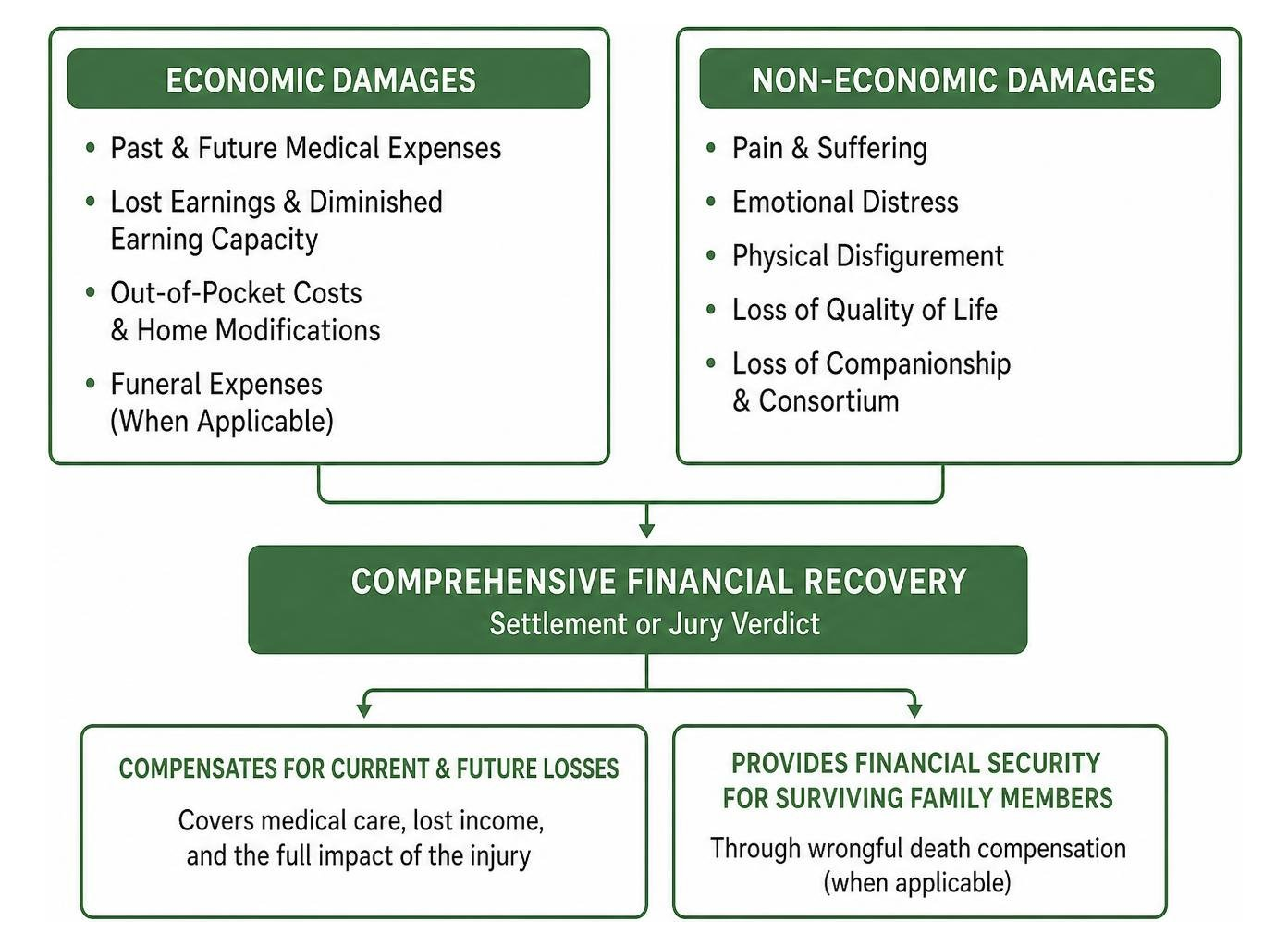
The trauma inflicted by an 80,000-pound commercial vehicle routinely results in life-altering harm, including traumatic brain injuries (TBI), spinal cord paralysis, complex fractures, severe burns, and amputations. Securing total financial recovery requires capturing both current and long-term damages:
- Past and Future Medical Expenses: Emergency surgeries, intensive care hospitalization, ongoing physical therapy, home modifications, and lifelong medical equipment.
- Lost Earnings and Diminished Earning Capacity: Replacing lost income and compensating for the future earnings a victim can no longer achieve.
- Non-Economic Damages: Pain and suffering, emotional distress, physical disfigurement, and loss of quality of life.
- Wrongful Death Compensation: Providing surviving spouses, children, and dependent family members with financial security, loss of companionship, and coverage for funeral costs through dedicated fatal truck accident representation.
Frequently Asked Questions About Truck Accident Claims
What should I do immediately following a collision with a semi-truck?
First, check for injuries and move to a safe location away from traffic if you can do so safely. Call 911 immediately to dispatch police and emergency medical teams. Seek a thorough medical evaluation at the scene or an emergency room, as internal bleeding and head trauma may not show symptoms right away. Document the scene by photographing vehicle positions, skid marks, debris, truck company logos, and USDOT numbers. Obtain witness contact details, and avoid discussing fault with the trucking company’s insurance adjusters before seeking guidance on navigating the aftermath of a semi-truck collision.
How do electronic logging devices prove hours-of-service violations?
Electronic Logging Devices (ELDs) automatically synchronize with a commercial truck’s engine control module to record driving time, engine operation hours, vehicle motion, and geographic location. These tamper-resistant digital records provide an objective timeline of when the driver was driving, on duty, or in the sleeper berth. By cross-referencing ELD log files with GPS coordinates, fuel purchase receipts, toll transponder data, and shipping bills of lading, attorneys can identify when a driver exceeded federal driving hours or falsified duty status to hide fatigue.
Who can be held liable in a multi-vehicle freight collision?
Multiple corporate entities may share legal responsibility in a commercial freight collision, depending on the factors involved:
- The Truck Driver: For speeding, distracted driving, fatigue, or reckless operation.
- The Motor Carrier: For vicarious liability, negligent hiring, poor safety oversight, or forced HOS violations.
- The Freight Broker / Shipper: For negligently hiring a carrier with known safety violations.
- Cargo Loading Companies: For improperly distributing, overloading, or securing freight, leading to shifts or rollovers.
- Maintenance and Repair Contractors: For improper brake adjustments, failing to repair known mechanical defects, or mounting substandard tires.
- Vehicle and Parts Manufacturers: For design or manufacturing defects in steering components, tires, or underride guards.
Conclusion
The window to protect your rights after a commercial truck wreck is limited. Critical electronic control module data, electronic logging records, and physical evidence can be overwritten or cleared in the weeks following a crash. Furthermore, state statutes of limitations set firm deadlines on when personal injury and wrongful death lawsuits must be filed.
At Cullotta Bravo Law Group, we have spent over 35 years aggressively holding negligent motor carriers and their corporate insurers accountable. With offices serving Aurora, Chicago, Naperville, and Joliet, our team provides the dedicated guidance you need to secure justice. Contact our experienced Illinois truck accident attorney team today to schedule your consultation and take the first step toward reclaiming your future.