

Tick-Tock on Toxic Toys: Illinois Product Liability Deadlines
Illinois Product Liability Statute of Limitations: The Quick Answer
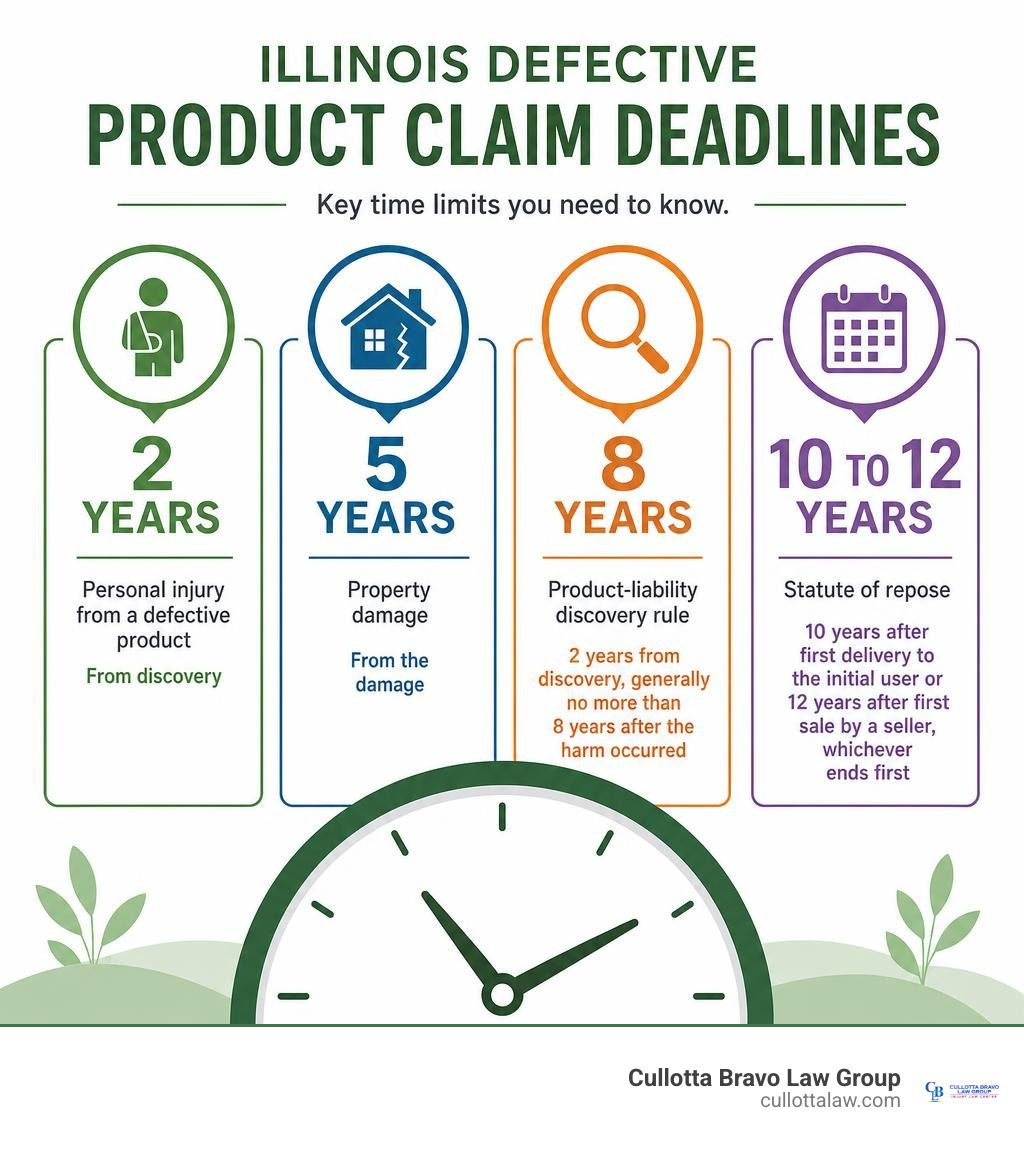
The illinois product liability statute of limitations can set more than one deadline for a defective-product claim. In most cases, an injured person has 2 years from when they knew, or reasonably should have known, about the injury and its possible link to a product. Property-damage claims may have a 5-year deadline, but Illinois also has a separate statute of repose that can end a claim sooner.
| Claim or rule | Key Illinois deadline |
|---|---|
| Personal injury from a defective product | Usually 2 years from discovery |
| Property damage | Usually 5 years from the damage |
| Product-liability discovery rule | 2 years from discovery, generally no more than 8 years after the harm occurred |
| Statute of repose | 10 years after first delivery to the initial user or 12 years after first sale by a seller, whichever ends first |
These dates matter because a claim can be lost even when the defect is real and the medical bills are serious. The right deadline may depend on when the injury happened, when you connected it to the product, when the product first entered use, and whether special rules apply.
I am Peter Cullotta, founding partner of Cullotta Bravo Law Group. With more than 35 years of personal-injury litigation experience, I help injured people understand time-sensitive issues such as the illinois product liability statute of limitations before a missed deadline limits their options.
Illinois product liability statute of limitations terms at a glance:
- Illinois personal injury statute of limitations
- Illinois car accident statute of limitations
- Illinois wrongful death statute of limitations
Core Deadlines for an Illinois Product Liability Statute of Limitations Claim
When an everyday item turns hazardous—whether it is a child’s toy painted with toxic chemicals, a faulty lawnmower, or a malfunctioning vehicle part—the legal system provides a path to compensation. However, that path is gated by strict time frames. In Illinois, understanding the Illinois Statute of Limitations for Defective Products is just as vital as gathering medical records or preserving the broken product itself.
Think of statutory deadlines as a ticking countdown timer. Once the timer runs out, Illinois courts generally lose the legal authority to hear your lawsuit, regardless of how clear the manufacturer’s blunder might be. Because product liability cases frequently involve complex manufacturing supply chains, technical design flaws, and hidden corporate records, starting the process as early as possible gives your legal counsel the runway required to build a rock-solid case.
Personal Injury vs. Property Damage Timelines
Not all product defects cause bodily harm; some shatter your living room floor or burn down a garage. Under Illinois law, the statutory clock ticks at different speeds depending on whether you suffered physical harm or economic harm through property destruction.
- Personal Injury Claims (2-Year Limit): If a dangerous product causes physical harm, medical expenses, lost wages, or pain and suffering, the standard statute of limitations is two years. As a general rule, this two-year period begins on the date the injury occurred or the date you discovered (or reasonably should have discovered) both the injury and its cause.
- Property Damage Claims (5-Year Limit): If a defective appliance catches fire and ruins your kitchen—but mercifully nobody suffers bodily harm—Illinois grants a longer five-year statute of limitations from the date the damage occurred.
To help illustrate these differences, review our breakdown below:
| Type of Claim | Primary Statutory Deadline | When the Clock Starts | Primary Law/Reference |
|---|---|---|---|
| Personal Injury | 2 Years | Date of injury or discovery of harm/cause | 735 ILCS 5/13-213 / 735 ILCS 5/13-202 |
| Property Damage | 5 Years | Date the property harm occurred | 735 ILCS 5/13-205 |
| Discovery Rule Personal Injury Cap | Max 8 Years | Date the underlying injury actually occurred | 735 ILCS 5/13-213(d) |
| Repose (Consumer Delivery) | 10 Years | Date of initial sale/lease to end user | 735 ILCS 5/13-213(b) |
| Repose (Seller Placement) | 12 Years | Date of initial sale/lease by seller into commerce | 735 ILCS 5/13-213(b) |
Understanding how long do you have to file a personal injury claim in illinois ensures you do not mistake a property deadline for a personal injury timeline. For a broader look at physical injuries resulting from consumer goods, review our guide on product liability injuries in illinois.
Legal Theories: Strict Liability, Negligence, and Breach of Warranty
When we file a product defect lawsuit in Illinois courts, we typically ground the complaint in one or more of three distinct legal theories. Each legal theory comes with its own evidentiary burdens and statutory deadlines.
- Strict Product Liability: This is the most common theory in product liability litigation. Under strict liability, you do not have to prove that the manufacturer was careless or lazy. You only need to prove that the product left the defendant’s control in an “unreasonably dangerous” condition due to a design flaw, manufacturing defect, or inadequate warning, and that this dangerous condition directly caused your harm.
- Negligence: A negligence claim focuses on the manufacturer’s or seller’s conduct. You must demonstrate that the company failed to exercise reasonable care in designing, testing, assembling, or inspecting the product, or failed to issue adequate warnings.
- Breach of Warranty: Claims can be based on express written warranties (like a 5-year manufacturer guarantee) or implied warranties created by law (such as the implied warranty of merchantability, which promises an item is fit for its ordinary intended purpose). Warranty claims are often governed by Illinois commercial law (the Uniform Commercial Code), which typically carries a four-year statute of limitations from when delivery of the item was made, regardless of when you discovered the defect.
Modern technological advancements add new layers to these legal theories. For instance, glitches in advanced driver-assistance systems or automated vehicle subroutines involve complex coding defects, as detailed in our analysis of defective car software.
How the Statute of Repose Limits Product Defect Claims

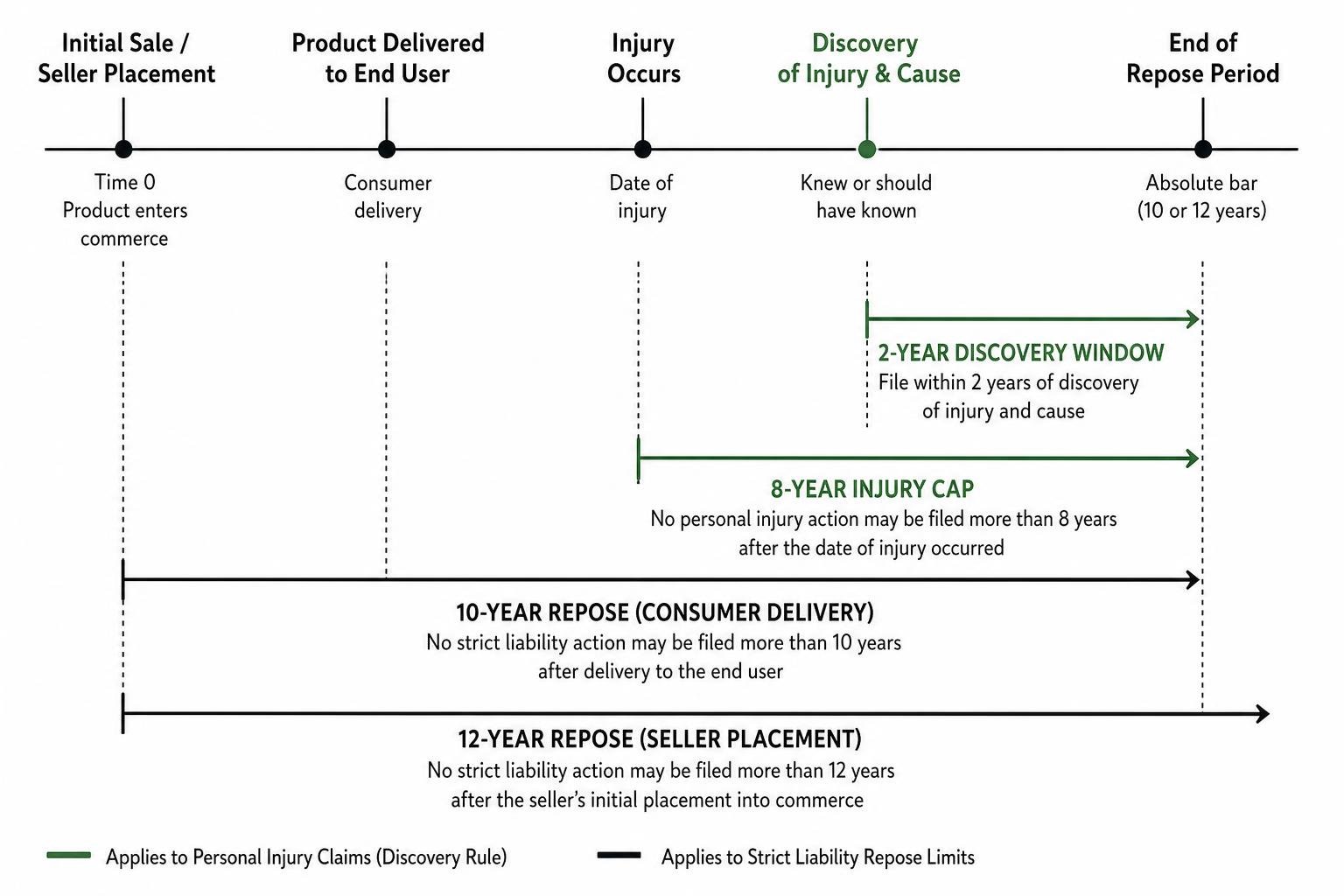
While the illinois product liability statute of limitations measures time starting from when an injury happens or is discovered, the statute of repose acts as a completely independent, hard deadline attached to the product’s age.
Think of the statute of repose as an expiration date on the manufacturer’s exposure to strict liability. Once a product passes its statutory repose limit, strict liability claims against manufacturers and commercial sellers are completely barred—even if you are injured today by an undeniably dangerous design defect.
Illinois Product Liability Statute of Limitations and the Discovery Rule
In many situations, an injury is not immediately obvious. For instance, exposure to toxic chemicals in a toy or dangerous industrial machinery might cause a latent illness or hidden internal damage that takes months or years to identify.
To prevent unfairness, Illinois applies the discovery rule under 735 ILCS 5/13-213. Under this rule, if your injury is delayed or latent, your 2-year statute of limitations window does not begin until the date you knew, or through reasonable diligence should have known, of the existence of your injury and that it was wrongfully caused.
However, the legislature created a firm safety valve for defendants:
- The 8-Year Injury Cap: Under 735 ILCS 5/13-213(d), if you rely on the discovery rule for an injury that occurred within the statute of repose period, you must bring your legal action within 2 years of discovering the injury, but in no event more than 8 years after the actual date the injury occurred.
Consider an auto defect like a safety belt failure. If a defective mechanism fails during a crash, as explored in our guide on seat belt failure, the injury is immediately known, so the 2-year clock starts clicking on the day of the collision. But if a defect causes a subtle, delayed medical condition, the discovery rule and its 8-year cap become central to calculating your exact filing deadline.
The 10-Year Consumer vs. 12-Year Seller Repose Rules
Under Illinois Code of Civil Procedure Section 13-213, the statute of repose imposes two main time thresholds for strict liability product actions:
- 10 Years from Consumer Delivery: The action must be commenced within 10 years from the date of first sale, lease, or delivery of possession to its initial user, consumer, or other non-seller.
- 12 Years from First Commercial Sale: The action must be commenced within 12 years from the date of first sale, lease, or delivery of possession by a seller (such as when the manufacturer first sells the product to a wholesale distributor).
Which rule applies? The statute explicitly states that whichever period expires earlier will bar the claim.
For example, imagine a toxic toy manufactured and shipped to a regional distributor in 2012 (starting the 12-year seller clock). It sat in a warehouse for 4 years before being sold to a family in 2016 (starting the 10-year consumer clock).
- The 12-year seller rule expires in 2024.
- The 10-year consumer rule would expire in 2026. Because the 12-year seller period ends earlier (2024), strict liability claims regarding that toy would be barred after 2024, even though the consumer only owned it for 8 years!
Tolling Rules and Special Exceptions Under Illinois Law

Fortunately, Illinois statutory law recognizes that rigid deadlines can produce unjust results in specific scenarios. When certain legal conditions are met, the statutory clock pauses—a legal process known as tolling.
Minors and Persons Under Legal Disability
Children and individuals who lack mental capacity cannot reasonably be expected to navigate complex court filings. Under 735 ILCS 5/13-213(e), Illinois law provides explicit protections:
- Minors Under Age 18: If the person entitled to bring a product liability action was under 18 years old when the personal injury, death, or property damage occurred, the statute of limitations clock does not begin running until they turn 18. Once they reach their 18th birthday, they generally have 2 years (until age 20) to initiate legal action.
- Persons Under Legal Disability: If an individual is under a legal disability (such as severe cognitive impairment or mental incapacity) at the time of the injury, the limitation period is tolled until the legal disability is formally removed.
These tolling protections safeguard vulnerable victims, ensuring that a child harmed by a defective product does not forfeit their constitutional right to justice simply because their parents failed to file a lawsuit before they reached adulthood.
Product Modifications and the Illinois Product Liability Statute of Limitations
What happens if a product was safe when originally sold, but later undergoes an alteration or modification that introduces a brand-new defect?
Under 735 ILCS 5/13-213(c), Illinois provides a specific statute of repose rule for modified products:
- If a product alteration, modification, or change creates a dangerous condition that causes injury, a product liability action may be brought against the party who made or authorized the alteration within 10 years from the date the modification was completed.
- Important Distinction: To qualify under this provision, the modification must have created a new dangerous condition or defect that was not present in the original product design. Merely replacing a worn component part with an identical, original-spec replacement part does not reset or extend the overall 10-year/12-year statute of repose timeline.
This rule frequently arises in commercial settings, such as heavy machinery altered on job sites or specialized landscaping gear. You can read more about equipment-related claims in our article on damages inflicted by defective yard equipment and your future.
Seller Certification and Tolling Under 735 ILCS 5/2-621
In product defect litigation, injured consumers often sue the local store or retail vendor where they purchased the item because the actual foreign manufacturer is unknown or difficult to contact. To protect innocent retailers who merely sold a boxed product without altering it, Illinois enacted the “seller certification” statute under 735 ILCS 5/2-621 (also found in the Illinois Code of Civil Procedure Section 2-621).
Here is how the seller certification process works and how it affects legal deadlines:
- Non-Manufacturer Dismissal: When a non-manufacturer seller (like a retail store or wholesaler) is sued in a strict product liability action, they can file an affidavit certifying the correct identity of the product manufacturer. Once the manufacturer is joined as a party to the lawsuit, the court must dismiss the non-manufacturer seller from the strict liability claims.
- Statute of Limitations Tolling: Commencing a strict product liability action against a non-manufacturer seller tolls the applicable statute of limitations and statute of repose relative to that seller while the action is pending.
- Reinstatement of Seller: The plaintiff can move to reinstate the dismissed seller at any time if:
- The statute of limitations or repose bars action against the manufacturer;
- The manufacturer provided an incorrect identity;
- The manufacturer is bankrupt, defunct, or no longer exists;
- The court lacks personal jurisdiction over the manufacturer; or
- The manufacturer cannot satisfy a judgment or settlement.
This legal mechanism ensures you do not lose your financial recovery options if the true manufacturer turns out to be insolvent or untraceable. To protect your claim from ticking clocks during complex multiparty litigation, refer to our legal guide on how to ensure dont let the clock run out on your illinois injury claim.
Frequently Asked Questions About Defective Product Deadlines
What is the statute of limitations for personal injury from a defective product in Illinois?
In Illinois, the standard statute of limitations for personal injury caused by a defective product is 2 years. The clock generally begins running on the date the injury occurred. However, if the injury or its connection to the product was not immediately apparent, the 2-year clock begins on the date you discovered, or reasonably should have discovered, the injury and its cause—subject to an absolute maximum cap of 8 years from the injury date.
Can a statute of repose bar a claim before an injury even happens?
Yes. The statute of repose is an absolute cutoff tied to when the product was manufactured, sold, or delivered to its first end-user. Under 735 ILCS 5/13-213, strict liability product claims are barred 10 years after delivery to the initial consumer or 12 years after initial sale by a seller (whichever comes first). If a 15-year-old defective ladder breaks and injures you today, the statute of repose will likely bar a strict liability claim against the original manufacturer, even though your injury happened today.
How does seller certification affect filing deadlines?
Under 735 ILCS 5/2-621, filing a timely strict product liability action against a non-manufacturer seller (such as a retail store) tolls the statute of limitations and statute of repose regarding that seller. If the actual manufacturer cannot be brought into court or goes bankrupt, the plaintiff can reinstate the non-manufacturer seller back into the lawsuit, preserving the plaintiff’s right to pursue compensation.
Conclusion
Navigating the illinois product liability statute of limitations requires moving fast while handling complex, overlapping rules. Between two-year discovery windows, five-year property limits, and rigid 10-to-12-year repose deadlines, a single misstep or delay can permanently block an otherwise valid case.
At Cullotta Bravo Law Group, our legal team brings over 35 years of aggressive litigation experience across Aurora, Chicago, Naperville, and Joliet. We treat every client with dignity while fighting tirelessly to secure full financial recovery from powerful product manufacturers and insurance carriers.
If you or a loved one suffered harm from an unsafe consumer item, toxic toy, or defective piece of machinery, do not wait until time runs out. Contact our experienced trial attorneys today to evaluate your statutory deadlines and protect your constitutional rights. For a detailed breakdown of statutory timeframes across all accident types, explore our ultimate pillar resource on statutes of limitation on accidents in illinois.